Extended Essay 2027: What Changed and What Stayed the Same
By Michael Thompson · Education Specialist; 10 years teaching the IB at Bromsgrove School · Published 4 October 2026 · Updated 6 October 2026
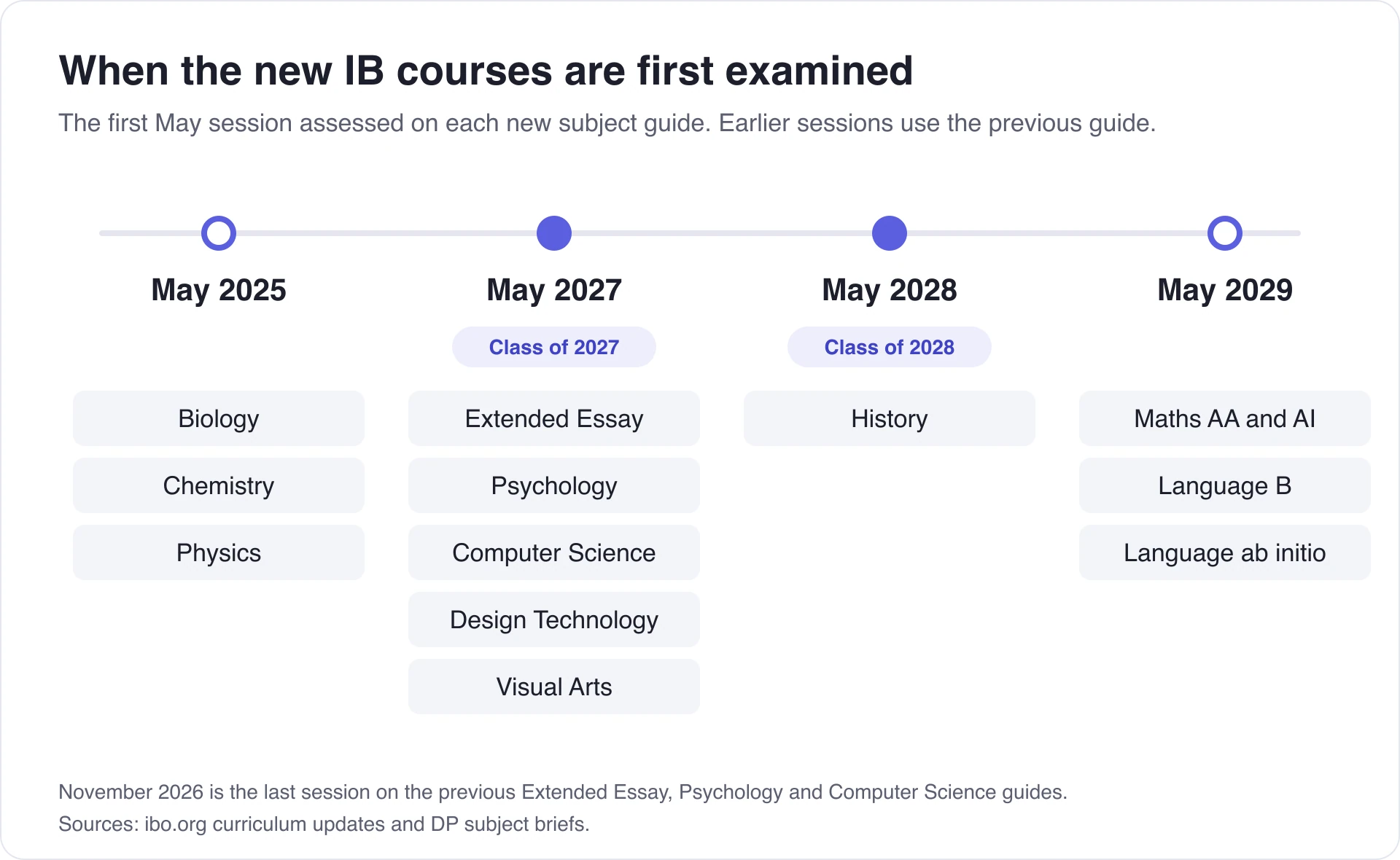
The extended essay 2027 guide applies to every IB Diploma student sitting May 2027 or later - and it replaces the previous model in full. Published in February 2025, the new guide shifts the assessment from 34 marks across five criteria to 30 marks across a redefined set of five criteria, with Discussion and evaluation now carrying the most weight. November 2026 is the last session marked on the old model, so if you started your DP in August or September 2025, the new rules are yours. This article sets out what has genuinely changed, what has stayed the same, and what the absence of grade boundaries means for your predicted grade.
Key Takeaways
- First assessment is May 2027: The new extended essay guide, published February 2025, applies to all students from the May 2027 session onwards; November 2026 is the last session under the previous 34-mark model.
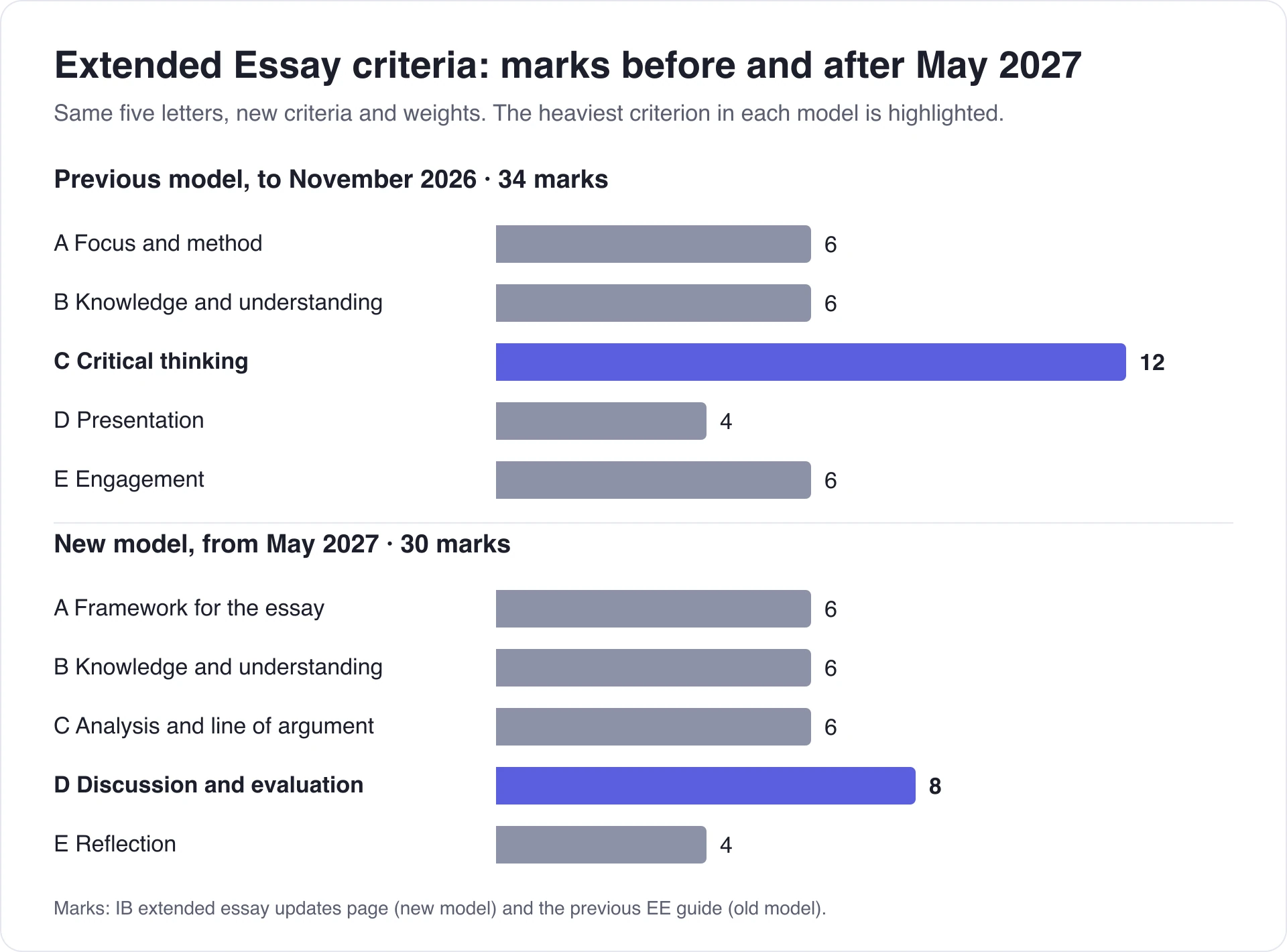
- Total marks drop to 30: The revised model has five criteria - Framework for the essay (6), Knowledge and understanding (6), Analysis and line of argument (6), Discussion and evaluation (8), and Reflection (4).
- Discussion and evaluation is the highest-weighted criterion: At 8 marks, Criterion D carries more weight than any other single criterion, so a strong, evaluative line of argument matters more than ever.
- Two formal pathways now exist: Students choose between a subject-focused essay (one DP subject) or an interdisciplinary essay integrating two DP subjects; the former World Studies EE has been absorbed into the interdisciplinary pathway.
- The RPF replaces the old RPPF: The new Reflection and Progress Form (RPF) holds a single 500-word reflective statement written at the end of the process, replacing the previous form's three separate written reflections.
- No grade boundaries exist yet for the 30-mark scale: The IB will set grade boundaries after the May 2027 session; any predicted EE grade assigned before results day (6 July 2027) is therefore based on professional judgement, not a confirmed scale.
In This Article
- Who the Extended Essay 2027 Applies To
- The New Extended Essay Criteria and Rubric for 2027
- Two Research Pathways: Subject-Focused and Interdisciplinary
- Extended Essay Structure and Requirements: What Stayed the Same
- Reflection in 2027: The RPF and the Viva Voce
- Extended Essay Grade Boundaries for 2027: Why They Don't Exist Yet
- What to Do Next
1. Who the Extended Essay 2027 Applies To
The extended essay 2027 revision applies to every IB Diploma Programme student sitting the May 2027 session or later. If your school began DP Year 1 in August or September 2025, you are in the first cohort assessed under the new model. November 2026 is the final session marked on the previous guide, so students sitting their exams this autumn are working under different rules to you.
The new extended essay guide was published in February 2025, with first teaching from August 2025. One practical consequence worth noting: no essay will be examined under the new criteria until the May 2027 session, so there are no authentic marked examples yet. Until there are, treat any marked sample essay you find online with caution: most were written and marked under the old 34-mark criteria.
The extended essay remains a compulsory, externally assessed component of the DP core. It is not optional, and it cannot be substituted. Combined with Theory of Knowledge, it contributes a maximum of three additional points to your diploma score.
2. The New Extended Essay Criteria and Rubric for 2027
The 2027 EE is marked against five criteria, labelled A to E, with a total of 30 marks. The criterion names and guiding questions are set out in the publicly available subject brief, and the mark allocations are on the IB's EE updates page; the full mark-band descriptors sit in the EE subject guide on the IB Programme Resource Centre, which requires a school login to access.
The five criteria are (IB DP extended essay updates):
- Criterion A: Framework for the essay - 6 marks
- Criterion B: Knowledge and understanding - 6 marks
- Criterion C: Analysis and line of argument - 6 marks
- Criterion D: Discussion and evaluation - 8 marks
- Criterion E: Reflection - 4 marks
Criterion D carries the most marks of any single criterion. That is not a small design detail: it means examiners award more than a quarter of the total mark on the quality of the student's discussion and evaluative thinking alone.
How the criteria compare to the previous model
The table below shows the previous criteria (last examined November 2026, 34 marks total) alongside the 2027 criteria (30 marks total).
| Previous criterion | Previous marks | 2027 criterion | 2027 marks |
|---|---|---|---|
| Focus and method | 6 | Framework for the essay (A) | 6 |
| Knowledge and understanding | 6 | Knowledge and understanding (B) | 6 |
| Critical thinking | 12 | Analysis and line of argument (C) | 6 |
| (Critical thinking, split) | - | Discussion and evaluation (D) | 8 |
| Presentation | 4 | (absorbed into Criterion A) | - |
| Engagement | 6 | Reflection (E) | 4 |
| Total | 34 | Total | 30 |
Sources: IB DP extended essay updates; Hachette Learning; ManageBac.
Editorial interpretation (not IB wording)
Reading the two models side by side, three structural shifts stand out:
- Critical thinking has been split. The old 12-mark Critical thinking criterion is now divided into Analysis and line of argument (6 marks) and Discussion and evaluation (8 marks). The split rewards students who can demonstrate that analysis and evaluative discussion are distinct intellectual moves, not a single block of "critical" writing.
- Presentation has been folded in. The old 4-mark Presentation criterion, which covered structural conventions, now sits inside Framework for the essay. Students still need to get structure right; they just cannot recover marks for it separately from the essay's framing.
- Reflection has contracted. Engagement was worth 6 marks and drew on three written reflections recorded across the process. Reflection is now worth 4 marks and is based on a single 500-word reflective statement written after the viva voce. Less space on the mark scheme, but the focus has shifted to what the student learned and the transferable skills gained, not simply that they engaged with the process.
The net effect is a tighter, more differentiated rubric that makes evaluative quality the single biggest lever on the final mark.
3. Two Research Pathways: Subject-Focused and Interdisciplinary
Under the new model, every student follows one of two clearly defined research pathways, usually decided once a broad topic has been chosen and refined.
The subject-focused pathway works as the traditional EE always has: the research question sits within a single DP subject, and the essay works within that subject's methods and conventions.
The interdisciplinary pathway requires the student to integrate the perspectives of two DP subjects to investigate a question. This is not a loose thematic connection: both subject lenses must actively shape the analysis.
The practical consequence worth knowing: the former World Studies Extended Essay no longer exists as a separate option. The IB has absorbed it into the interdisciplinary pathway. Students who would previously have chosen World Studies now select the interdisciplinary pathway instead. The old World Studies requirement for a focus on contemporary global significance, with explicit local and global context, no longer applies to the interdisciplinary pathway.
A second structural change affects language students specifically. Categories have been removed from Language A and Language B essays, so students in those subjects no longer select a sub-category within their subject area before writing.
One counter-intuitive point on pathway choice: switching from subject-focused to interdisciplinary is not automatically the more ambitious option. The interdisciplinary pathway demands that two subject frameworks genuinely inform the argument, which makes the research design harder to execute well. Choosing it because a topic feels broad is a different thing from choosing it because two specific subject lenses are both necessary to answer the question.
4. Extended Essay Structure and Requirements: What Stayed the Same
Amid the 2027 revisions, the structural DNA of the extended essay is unchanged. If you know what the EE looked like before, most of the scaffolding will be familiar.
The 4,000-word upper limit remains. Per the IB subject brief, the word count covers the introduction, body, conclusion, and any quotations. The full 2027 Extended essay guide leaves out the contents page, headers, maps, charts, diagrams, tables, equations and calculations, citations and references, the bibliography and the RPF; a footnote or endnote that is not a reference does count.
The required submission elements are the same as before:
- Title page
- Contents page
- Introduction
- Body of the essay
- Conclusion
- References and bibliography
The subject brief confirms all six must be present in the final submission.
Three mandatory, formal reflection sessions with a supervisor are still required. The final session is the viva voce, a 20 to 30-minute interview between student and supervisor that checks academic integrity and invites the student to reflect on their learning experience. It is not a defence of the essay's argument; the focus is on the process, not the conclusions.
The EE still earns diploma points with TOK. The EE still combines with Theory of Knowledge for a maximum of 3 additional diploma points, so a strong EE grade still matters beyond the essay itself.
One thing worth noting: the supervisor must remain a qualified member of staff within the student's own school. External tutors cannot fulfil that role, whatever other support they provide.
Independent research and external assessment are also unchanged. The essay is marked by examiners outside your school, not by your supervisor.
5. Reflection in 2027: The RPF and the Viva Voce
The old Reflections on Planning and Progress Form (RPPF) asked students to write three separate reflections across the EE process. The 2027 guide replaces it with a single document: the Reflection and Progress Form (RPF).
Per the IB EE subject brief, the RPF does two things. It records attendance at each of the three mandatory formal reflection sessions, and it holds one 500-word reflective statement written at the end of the EE process, after the viva voce.
The viva voce is the final of those three sessions: a 20 to 30-minute interview between the student and their supervisor. Its purposes, as stated in the subject brief, are to check academic integrity, reflect on successes and difficulties, and consider what has been learned. Think of it as a short oral debrief rather than an examination - supervisors are not testing subject knowledge here; they are checking that the work is genuinely the student's own and helping the student reflect on what they took from the process.
The counter-intuitive point worth noting: you write your reflective statement after the viva voce, not before it. The conversation comes first; the written reflection follows. That sequence is deliberate - the interview is meant to prompt the thinking you then record.
Under the 2027 criteria, Reflection is Criterion E, worth 4 marks, down from 6 under the previous Engagement criterion. The refocus is explicit: Criterion E now centres on transferable skills and growth, not the breadth of engagement across the process. Fewer marks, tighter scope.
6. Extended Essay Grade Boundaries for 2027: Why They Don't Exist Yet
No grade boundaries exist for the new 30-mark extended essay scale. The IB sets boundaries after each session, not before it, which means the first confirmed boundaries for the 2027 criteria will only be set after the May 2027 session, ahead of results on 6 July 2027.
This matters practically. Any predicted EE grade a school issues before that date, whether for university applications or internal tracking, is based on professional judgement applied to the new criteria. It is not mapped to a confirmed boundary scale. Schools and students should treat predicted grades as exactly that: informed estimates, not verified conversions of raw marks to letter grades.
The gap in exemplar material compounds this. No essay will be examined under the new criteria until the May 2027 session, so there are no authentic examined essays to calibrate against yet: supervisors work from the full EE guide and its markband descriptors, and students can read the published subject brief.
The counter-intuitive implication: a student whose school predicts them an A under the new criteria is receiving a judgement calibrated without any boundary anchor. That is not a criticism of schools. It is simply the structural reality of the first year of any revised specification, and it is worth understanding before drawing conclusions from a predicted grade.
This section explains the gap. It does not fill it with estimates.
7. What to Do Next
Your most useful move this week is to read the IB Extended Essay subject brief for first assessment 2027 on ibo.org. It is publicly available, takes around 15 minutes to read, and sets out all five criteria with their guiding questions in one place.
Be clear which pathway you are on, subject-focused or interdisciplinary. The pathway shapes how your research question is framed and which subject guidance you and your supervisor work from, so confirm it at your next supervisor meeting rather than discovering a mismatch later.
Go into that meeting with the five criteria listed and one specific question about how your current research question maps to Criterion D, Discussion and evaluation, which carries 8 of the 30 available marks. It is the most heavily weighted criterion on the mark scheme.
FAQ
When is the extended essay due in 2027?
Internal school deadlines vary, but the first external assessment session under the new guide is May 2027 (examination window 23 April-18 May 2027); students should check their school's submission deadline, which will be earlier than the exam session.
What are the extended essay criteria for 2027?
The five criteria are Framework for the essay (6 marks), Knowledge and understanding (6), Analysis and line of argument (6), Discussion and evaluation (8), and Reflection (4), totalling 30 marks - labelled Criterion A to E.
What are the extended essay grade boundaries for 2027?
No grade boundaries have been published for the new 30-mark scale; the IB will set them after the May 2027 session, with results expected 6 July 2027.
What is the difference between the subject-focused and interdisciplinary extended essay pathways?
The subject-focused pathway is based on a single DP subject, while the interdisciplinary pathway integrates the lenses of two DP subjects; the former World Studies EE has been absorbed into the interdisciplinary pathway.
What replaced the RPPF in the new extended essay guide?
The RPPF is replaced by the Reflection and Progress Form (RPF), which records a single 500-word reflective statement written at the end of the EE process, along with attendance at the three formal reflection sessions.
Does the extended essay still combine with TOK for diploma points in 2027?
Yes - the EE continues to combine with Theory of Knowledge for a maximum of 3 additional diploma points under the new guide.
References
- DP extended essay updates - International Baccalaureate - https://www.ibo.org/university-admission/latest-curriculum-updates/dp-extended-essay-updates/
- Diploma Programme Subject Brief: Extended essay, first assessment 2027 (International Baccalaureate Organization, 2024) - https://www.ibo.org/globalassets/new-structure/university-admission/pdfs/ee_subjectbrief_en.pdf
- New guide for the IB Extended Essay - Hachette Learning - https://www.hachettelearning.com/blog/new-guide-for-the-ib-extended-essay
- The Extended Essay is Evolving: What We Know About the 2025 Changes | Subject Support - ManageBac+ - https://www.managebac.com/subject-support/the-extended-essay-is-evolving-what-we-know-about-the-2025-changes