IB Psychology Contexts: The Four Areas Every Student Studies
By Michael Thompson · Education Specialist; 10 years teaching the IB at Bromsgrove School · Published 4 October 2026
IB psychology contexts are one of the three organising pillars of the new DP Psychology course, first taught in August 2025 with first assessment in May 2027. Every student - SL and HL - studies all four contexts: health and well-being, human development, human relationships, and learning and cognition. This marks a significant shift from the previous course, where SL students chose one option and HL students chose two, meaning large parts of psychology were never studied. Each context has its own designated class practical method, and both Paper 1 and Paper 2 test how well you can apply your knowledge of contexts to unfamiliar situations and research.
Key Takeaways
- All four contexts are compulsory: Every SL and HL student studies health and well-being, human development, human relationships, and learning and cognition - no options, no choosing.
- Each context has a fixed class practical method: Interviews for health and well-being, observations for human development, surveys for human relationships, and experiments for learning and cognition, each with minimum sample sizes.
- 100 teaching hours go to contexts: The syllabus allocates 100 hours to integrating concepts and content through the four contexts, out of 150 hours total at SL and 240 at HL.
- Paper 1 Section B tests contexts directly: Two compulsory short-answer questions ask you to apply content knowledge to an unseen situation drawn from the contexts.
- Health and well-being replaces two old options: The previous abnormal psychology and health psychology options have been merged into a single health and well-being context.
- Learning and cognition is entirely new: This context has no direct predecessor in the previous guide and is the only one without a clear lineage from the old options.
In This Article
- What Are IB Psychology Contexts?
- How Contexts Replaced the Old Options
- Health and Well-Being: The Context and Its Class Practical
- Human Development: The Context and Its Class Practical
- Human Relationships: Sociocultural Influences on Behaviours in Context
- Learning and Cognition: The Cognitive Context in IBDP Psychology
- Class Practicals: Methods, Hours, and What They Assess
- How IB Psychology Contexts Appear in the Exams
- How to Revise Four Contexts Without Overload
- Where to Go from Here
1. What Are IB Psychology Contexts?
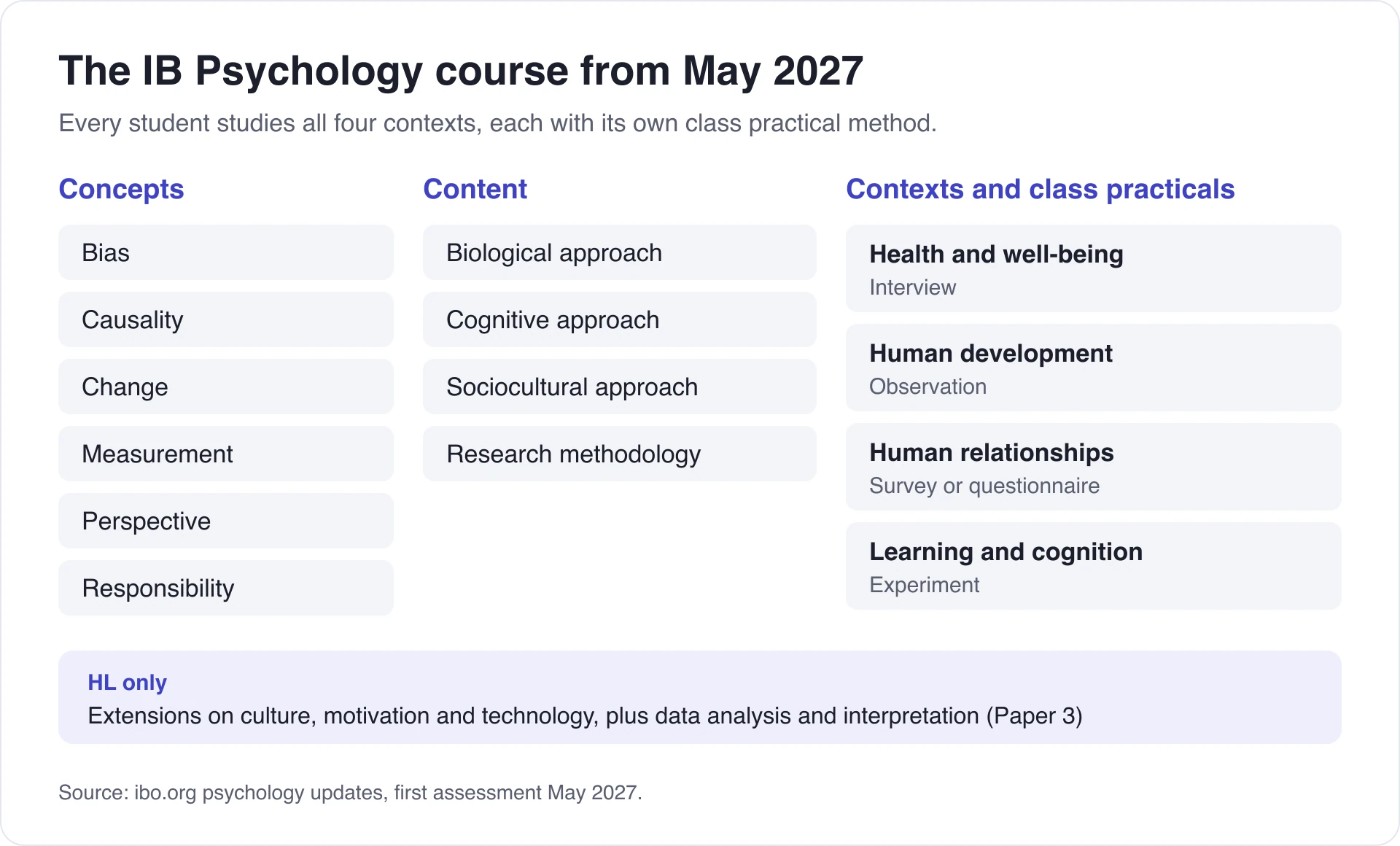
IB psychology contexts are the applied layer of the new DP Psychology course, first taught in August 2025 with first assessment in May 2027. The course is built around three organising elements: concepts, content, and contexts. Contexts are where the other two come together in real-world domains, asking students to apply psychological knowledge to specific areas of human experience rather than treating theory as an end in itself.
The content element covers three approaches (biological, cognitive, and sociocultural) plus research methodology. Running across all of it are six concepts: bias, causality, change, measurement, perspective, and responsibility. These concepts are not topics to memorise in isolation. They are the analytical lenses students bring to every context they study.
The four contexts are:
- Health and well-being
- Human development
- Human relationships
- Learning and cognition
One counter-intuitive point worth knowing early: under the previous course, students chose from optional topics. Now, as confirmed by the IBO and detailed by Pearson's curriculum analysis, every student, SL and HL, studies all four contexts. There is no choice. That changes how you plan revision and how Paper 1 Section B is set, as later sections explain.
2. How Contexts Replaced the Old Options
The most visible structural change in the new course is the removal of choice. Under the previous syllabus, SL students selected one option from a list that included abnormal psychology, developmental psychology, health psychology, and human relationships; HL students selected two. As a result, two students sitting the same exam could have studied entirely different options. The new course removes that asymmetry: all four contexts are compulsory for every student, SL and HL alike.
The four contexts are not simply the old options renamed. Two of them have clear predecessors, one is a merger, and one has no equivalent at all:
- Health and well-being absorbs what were previously two separate options: abnormal psychology and health psychology. They are now a single integrated context.
- Human development maps broadly onto the old developmental psychology option.
- Human relationships continues under the same name.
- Learning and cognition is entirely new, with no direct predecessor in the previous guide.
One concrete shift worth noting: topics that were previously restricted to HL extensions, including animal models and the diathesis-stress model, are now part of the course for all students. SL students now study material that used to be HL-only.
Note for students sitting November 2026 or earlier: you are assessed on the previous core-and-options course, with its separate options, experiment-replication IA, and different paper structure. The contexts described throughout this article apply only to the new course, with first assessment in May 2027.
The practical implication of the new structure is straightforward: there is no topic to skip. Every context can be examined, and every context has its own class practical method.
3. Health and Well-Being: The Context and Its Class Practical
This context is the broadest of the four. It covers the psychological aspects of health, well-being, and psychological disorder, asking how people understand, experience, and treat mental illness. As ManageBac's summary of the new course sets out, it replaces two separate option topics from the previous course, abnormal psychology and health psychology, merging them into a single required context that every student studies.
One specific requirement is worth noting. ManageBac's overview notes that within this context, students study one biological treatment for one disorder. Choosing a treatment with a strong evidence base gives you plenty to evaluate, and makes it easier to compare with other ways of treating the same disorder.
How the three content areas connect
- Biological: brain structure, neurochemistry, genetic vulnerability, and how biological treatments act on these.
- Cognitive: how thought patterns, schemas, and cognitive appraisal shape the experience of disorder and recovery.
- Sociocultural: stigma, cultural variation in diagnosis, and how social context affects both the onset and treatment of disorder.
Each content area offers a different angle on the same disorder, which is exactly what Paper 1 Section B questions are designed to test.
The class practical: interview
The designated method for this context is the interview, conducted as a structured interview, a semi-structured interview, or a focus group. Per the IBO, the minimum sample size is one participant interviewed individually, or three to eight participants in a single focus group.
The focus group lower bound of three matters in practice. Running a focus group with only two people is a paired conversation, not a group dynamic, and falls outside the requirements. If recruitment is difficult, an individual interview with one participant still meets the minimum, though you trade a range of voices for depth.
Use this context to practise connecting research methodology to real ethical decisions: interviewing participants about health and well-being raises distinct issues around informed consent, distress, and confidentiality that are well worth working through before the exam.
4. Human Development: The Context and Its Class Practical
Human development asks a deceptively simple question: what changes as we grow, and what stays the same? The context covers psychological change and continuity across the lifespan, from infancy through to old age, examining the processes that shape how people think, feel, and behave at different life stages.
All three content areas run through this context naturally:
- Biological approach: brain maturation, neuroplasticity, and the role of hormones in developmental transitions such as adolescence and ageing.
- Cognitive approach: how schemas form and shift over time, and how memory, reasoning, and decision-making develop or decline across the lifespan.
- Sociocultural approach: socialisation, cultural norms, and how the social environments a person moves through, family, school, peer group, shape psychological development.
This context is a good place to weigh individual against situational explanations: whether a developmental outcome (aggression in adolescence, cognitive decline in later life) is better explained by internal factors such as genetics or neurological change, or by external factors such as family structure or cultural context.
The class practical for this context is observation. The IB specifies that the observation can be naturalistic or controlled, overt or covert, and participant or non-participant, giving teachers real flexibility in design. The minimum sample size is one participant, the same as an individual interview and the lowest of the four.
That low minimum is worth noting. A single-participant observation can go deep, but it also makes claims about generalisability harder to defend, which is exactly the kind of methodological trade-off Paper 2 asks you to evaluate.
5. Human Relationships: Sociocultural Influences on Behaviours in Context
The Human Relationships context covers how people relate to one another, in pairs and in groups. Pearson's authors also note that the revised course reintroduces compliance techniques and conformity, both of which had been removed in the previous revision of the syllabus.
The sociocultural approach is more prominent here than in any other context, which makes sense: group norms, social roles, and cultural expectations are central to nearly every topic. That said, the biological approach contributes too, for example through research on attachment or aggression, and the cognitive approach connects via social perception and attribution processes. The context genuinely requires you to move across all three content areas rather than anchoring entirely to one.
The class practical for this context is a survey or questionnaire, with a minimum sample of 10 participants. That minimum is the highest across all four practicals, per the IBO's updated course information. The IB does not give a reason, but it makes sense: survey data are mostly about patterns across responses. An observation of one child's play behaviour can still yield useful qualitative insight; a questionnaire with three respondents produces almost nothing you can interpret with any confidence.
When designing your class practical for this context, focus on a tightly scoped research question, broad enough to recruit 10 participants within your school but narrow enough that your questionnaire items actually measure what you claim to be measuring.
6. Learning and Cognition: The Cognitive Context in IBDP Psychology
Learning and Cognition is the only one of the four contexts with no direct predecessor among the old options, although Pearson's authors note that most of its learning objectives were previously taught in the core approaches. It examines how people learn, remember, think, and process information, drawing directly on the cognitive approach at the heart of the course's content areas.
The cognitive approach is the natural home of this context. Research into memory encoding, attention, schema formation, and problem-solving all sit here. But the context is not purely cognitive. The biological approach contributes the neuroscience of learning, covering how synaptic plasticity, neurochemistry, and brain structures such as the hippocampus underpin memory consolidation. The sociocultural approach adds a different angle: situated learning theory, for instance, argues that cognition is shaped by the social and cultural environment in which it occurs, not just by internal mental processes. Students who can move between all three lenses when discussing a single learning phenomenon will be better placed in Paper 1 Section B, where unseen situations drawn from the four contexts require exactly that kind of applied thinking.
The class practical for this context is an experiment, either a true experiment or a quasi-experiment, with a minimum sample size of five participants. That small minimum creates a genuine methodological trade-off: five participants are manageable in a school setting, but you need to understand how a sample that size limits generalisability, a point directly relevant to concepts such as measurement and causality.
Per the IBO, first assessment for this revised course is May 2027, so Learning and Cognition will appear in external exams for the first time that session.
7. Class Practicals: Methods, Hours, and What They Assess
The four contexts are not purely theoretical. Each one comes with a class practical, a piece of hands-on research that feeds directly into the Paper 2 exam.
Hours and structure
Per the IB curriculum update, class practicals are allocated 30 teaching hours, covering a minimum of four practicals, one in each context. That allocation is identical at SL and HL.
Class practicals can be teacher-led or student-led, according to ManageBac, and you may collect and analyse data as a class. This is quite different from the internal assessment (IA), which is an individual research proposal, internally assessed and externally moderated. The IA's full assessment criteria, including the mark breakdown, are set out in the subject guide available on the IB Programme Resource Centre; schools have access through their coordinator.
Methods and minimum sample sizes
| Context | Method | Minimum sample size |
|---|---|---|
| Health and well-being | Interview (structured, semi-structured, or focus group) | 1 individual, or 3-8 participants in one focus group |
| Human development | Observation (naturalistic or controlled; overt or covert; participant or non-participant) | 1 participant |
| Human relationships | Survey or questionnaire | 10 participants |
| Learning and cognition | Experiment (true or quasi-) | 5 participants |
One counter-intuitive point: the human development practical requires only a single observed participant, tied with the individual interview as the smallest minimum, yet observation demands careful design decisions (covert vs overt, structured coding schemes) that make it no simpler in practice.
What gets assessed
Paper 2 Section A contains four questions that focus on the class practicals. This is distinct from Section B, which asks students to evaluate an unseen research study. Doing the practicals carefully matters because the exam questions draw on your understanding of method, procedure, and findings from work you actually conducted in class.
8. How IB Psychology Contexts Appear in the Exams
The four ib psychology contexts are not just a teaching framework. They are the direct source material for several of the exam sections you will sit at the end of the course. Knowing which section draws on which skill tells you how to prepare differently for each one.
Paper 1: The Sections That Test Contexts Directly
Section B contains two compulsory short-answer questions. Each presents an unseen situation, drawn from one of the four contexts, and asks you to apply your content knowledge to it. Per IBO updates, Paper 1 runs for 1 hour 30 minutes and carries 35 marks. Both questions are compulsory, so you cannot avoid a context you found difficult to study.
Pearson's authors say the IB is moving away from memorised template answers for the new course, and that a very concise answer of around 200 words can be enough for Paper 1 Section A. Expect the same in Section B: what counts is applying your knowledge to the situation in front of you, not reciting a prepared framework.
Section C is concept-based: two extended-response questions, each from a different context, and at SL you answer one of them. The six concepts (bias, causality, change, measurement, perspective, responsibility) are the lens for these responses, but the content you draw on comes directly from your contextual study. A Section C question on causality will likely require you to anchor your argument in specific research or theory from one of the four contexts.
Paper 2 Section B: Evaluate an Unseen Study
Paper 2 Section B presents an unseen research study and asks you to evaluate it with reference to two or more of the six concepts. The contexts give you the applied knowledge base to do this well: understanding how surveys work in human relationships, or what controls matter in a learning and cognition experiment, makes you a more credible evaluator of unfamiliar methodology.
HL Paper 3: Data Analysis and Interpretation
HL students sit a third paper (1 hour 45 minutes, 30 marks, 30% of the HL grade) focused on interpretation and analysis of quantitative and qualitative research data, per IBO updates. The class practicals you complete across the four contexts are the closest preparation you will get: each one requires you to collect, analyse, and reflect on real data using a context-specific method.
No Grade Boundaries Yet
One practical point worth knowing early: no grade boundaries exist for the new course. The first boundaries are set after the May 2027 examination session, once real student performance data is available. Treat any published boundary as belonging to the old course and discard it.
| Paper | Section | What contexts provide |
|---|---|---|
| Paper 1 | Section B | Unseen situational scenarios (one per question) |
| Paper 1 | Section C | Content base for concept-based extended responses |
| Paper 2 | Section B | Applied knowledge for evaluating an unseen study |
| HL Paper 3 | Whole paper | Research methods experience from class practicals |
9. How to Revise Four Contexts Without Overload
Four contexts, three content areas (biological, cognitive, sociocultural), six concepts, and one class practical per context sounds like a lot of material. The saving grace is that the same research studies tend to reappear across contexts. A study on stress responses fits health and well-being; it can also support human relationships content on social support. Build your notes around that overlap rather than fighting it.
Organise revision by context, not by content area. Take one context as your anchor, then pull in the relevant biological, cognitive, and sociocultural evidence underneath it. This mirrors how Paper 1 Section B works, where you apply content to an unseen situation drawn from one of the four contexts.
Prioritise the class practical for each context first. Paper 2 Section A asks four questions that focus on the class practicals, and there are no past papers yet to show exactly how they are framed. Because the method for each context is fixed (interview for health and well-being, observation for human development, survey or questionnaire for human relationships, experiment for learning and cognition), you can prepare each practical in depth: method, sample, procedure, ethical considerations, and what the data showed.
For Paper 1 Section B practice, ask your teacher or a classmate for unfamiliar scenarios and write short, timed responses to them.
Do not silo the contexts. The six concepts run across all four areas, and so do broad debates such as nature versus nurture. Revising these cross-cutting ideas once, then applying them to each context in turn, saves time and builds the synthesis skills that Section B and concept-based Section C questions reward.
HL students have an additional 45 hours covering the effects of culture, motivation, and technology, and these apply across all four contexts, not to one context in isolation. Factor that scope in early rather than treating it as an afterthought.
10. Where to Go from Here
The most useful thing you can do before your next psychology lesson is ask your teacher which class practical your school is running first. The order matters more than it might seem: each method has a different minimum sample size, and the survey for human relationships needs the most, at least ten participants. If your class is small, flag that before data collection begins, not after.
Ask your teacher this week. Confirm the method, note the minimum sample size, and check whether consent forms or ethical approval need to be arranged in advance. Getting that detail early removes the one logistical problem that is genuinely hard to fix once you are mid-practical.
FAQ
What is IB Psychology and how is it structured?
IB DP Psychology is a Group 3 subject organised around three pillars - concepts, content, and contexts - with six key concepts, three content approaches (biological, cognitive, sociocultural) plus research methodology, and four compulsory contexts studied by all students at SL and HL.
How do IB psychology contexts work in the course?
Contexts are the applied layer of the course; students use biological, cognitive, and sociocultural content to understand real-world domains (health and well-being, human development, human relationships, learning and cognition), completing one class practical per context and answering context-based questions in Paper 1 Section B.
Do all IB Psychology students study all four contexts?
Yes - under the new guide (first assessment May 2027), both SL and HL students study all four contexts; in the previous course, SL students chose one option and HL students chose two.
What are the class practical methods for each IB psychology context?
Health and well-being uses an interview (minimum one participant or three to eight in a focus group), human development uses an observation (minimum one participant), human relationships uses a survey or questionnaire (minimum ten participants), and learning and cognition uses an experiment (minimum five participants).
How are IB psychology contexts assessed in exams?
Paper 1 Section B contains two compulsory short-answer questions asking students to apply content to an unseen situation drawn from the contexts; Paper 2 Section A tests knowledge of the four class practicals directly.
When is the first assessment for the new IB Psychology course?
The new DP Psychology course began first teaching in August 2025 and has its first assessment in May 2027; students examined in November 2026 or earlier sat the previous core/options course.
References
- Psychology updates - International Baccalaureate - https://www.ibo.org/university-admission/latest-curriculum-updates/psychology-updates/
- The new IB Diploma Psychology Guide and its implications for teaching - https://www.pearson.com/international-schools/international-schools-blog/2025/02/the-new-ib-diploma-psychology-guide-and-its-implications-for-tea.html
- New DP Psychology Course: What to Expect | Subject Support - ManageBac+ - https://www.managebac.com/subject-support/new-dp-psychology-course-what-to-expect
- IB Diploma Psychology Resources - https://www.pearson.com/international-schools/international-baccalaureate-curriculum/ib-diploma/ib-diploma-group-3-overview/ib-diploma-group-3-psychology1.html.html