Business Management Extended Essay: The Complete IB Guide
By Michael Thompson · Education Specialist; 10 years teaching the IB at Bromsgrove School · Published 4 September 2026 · Updated 4 October 2026
A business management extended essay asks you to investigate a real organisation using business and management theory, and to do it in 4,000 words or fewer. That word limit sounds generous until you realise the examiners want analysis, not description - and most marks are lost precisely because students spend too long explaining what a company does rather than evaluating why. This guide is written for the new extended essay, first assessed in May 2027: how its five criteria (30 marks in total) work in a business management context, what a strong research question looks like, where primary and secondary research fits in, and the reflection requirements (three supervisor sessions and a reflective statement on the RPF) that students often treat as afterthoughts.
Key Takeaways
- Five criteria, 30 marks total: From May 2027 the EE is marked on A Framework for the essay (6), B Knowledge and understanding (6), C Analysis and line of argument (6), D Discussion and evaluation (8) and E Reflection (4) - discussion and evaluation carries the most marks, and there is no separate presentation criterion.
- Research question quality is everything: The question must be evaluative or analytical, not descriptive - 'To what extent...' or 'How effectively...' prompts an argument; 'What is...' or 'How did...' usually just invites a report.
- Choose a real, accessible organisation: Anchoring your essay in a specific, named company gives you concrete data to analyse and stops the essay drifting into generic textbook summaries.
- Primary research adds depth but must be relevant: Interviews and surveys can strengthen your research methods (criterion A) and your analysis (criterion C), but only if the data directly addresses the research question - padding with irrelevant figures costs marks.
- Three mandatory reflection sessions with your supervisor: Criterion E is marked only from one reflective statement of no more than 500 words on the Reflection and progress form (RPF), written at the end of the process; notes kept after each session are what make it specific.
- Description is the single biggest mark-killer: Essays that summarise a company's history or explain a marketing model without applying it to a specific question score poorly on criteria C and D regardless of word count.
In This Article
- What a Business Management Extended Essay Actually Is
- IB Business Management Extended Essay Criteria Explained
- Choosing a Topic and Forming a Strong Research Question
- Business Management EE Structure: How to Organise Your Essay
- Primary and Secondary Research in a Business Management EE
- Where Business Management Essays Lose Marks
- Reflection Sessions and the RPF: What You Need to Know
- What to Do Next
1. What a Business Management Extended Essay Actually Is
A business management extended essay is a 4,000-word independent research paper that every IB Diploma Programme student must complete, externally assessed by examiners appointed by the IB. It is not an optional enrichment project - it is a mandatory component of the DP core.
The critical distinction most students miss: a business management EE must use business and management theory as the investigative lens. Describing how a company operates is not enough. You are expected to apply frameworks - think market structures, stakeholder theory, or motivation models - to a focused research question, then evaluate what the evidence reveals. An essay that reads as a company profile rather than a theoretical investigation will lose marks regardless of how much research went into it.
The IB's new extended essay was launched in February 2025 and is first assessed in May 2027. It is marked out of 30 and the mark is converted to a grade from A to E. An E is a failing condition: you need at least a D to be awarded the diploma, and your EE grade combines with your TOK grade to add up to three core points. No grade boundaries have been published for the 30-mark scale; senior examiners set them after the May 2027 session.
The new guide sets out two research pathways: subject-focused and interdisciplinary. A pure business management EE follows the subject-focused pathway, meaning the entire investigation sits within the discipline of business and management. The interdisciplinary pathway, which replaces the former World Studies EE, requires integrating perspectives from two DP subjects - that is a different beast entirely. Both pathways are marked against the same five criteria.
2. IB Business Management Extended Essay Criteria Explained
From May 2027 every extended essay, in any subject, is marked against the same five criteria, totalling 30 marks. The IB's Extended essay guide (first assessment 2027) applies them to business management through its guidance for the individuals and societies subject group. Understanding what each criterion actually rewards, rather than what it sounds like it rewards, is where most students find they can recover marks before submission.
| Criterion | Name | Marks |
|---|---|---|
| A | Framework for the essay | 6 |
| B | Knowledge and understanding | 6 |
| C | Analysis and line of argument | 6 |
| D | Discussion and evaluation | 8 |
| E | Reflection | 4 |
| Total | 30 |
Criterion A (Framework for the essay) covers three strands: the research question, your research methods and the structure of the essay. It rewards a question that is relevant, clear and focused for the scope of the essay, methods that suit the question and are explained and applied, and structural conventions that help communicate the research. A question scoped to one company's decision in one market period is far easier to defend here than a broad industry-wide question. The guide also asks you to check there are enough sources of suitable quality for your chosen methods - if there are not, change the question.
Criterion B (Knowledge and understanding) is where examiners look for relevant research materials, accurate subject terminology and business management concepts used effectively, not definitions. Naming Ansoff's matrix is worth little; using it to evaluate why a particular market development strategy carried more risk than product development earns marks.
Criterion C (Analysis and line of argument) rewards analysis that consistently produces relevant findings, and a clear, sustained line of argument linking your research question, your findings and your conclusion. An essay that is descriptive rather than analytical sits in the bottom band. Students who write narratively rather than analytically tend to cluster in the lower bands here.
Criterion D (Discussion and evaluation) is the heaviest criterion at 8 marks. It rewards a balanced discussion of the significance of your findings, supported by evidence, and an evaluation of the effectiveness of your essay: the strengths and limitations of your sources, data and approach, explained rather than listed. The guide wants evaluation woven through the essay rather than parked in one section at the end.
Criterion E (Reflection) is marked only from your reflective statement on the Reflection and progress form (RPF), not from the essay body. It rewards reflection that is evaluative, uses specific examples, and shows your growth and how you would transfer what you learned. No amount of strong writing in the essay compensates for a thin statement.
There is no standalone presentation criterion any more. Layout, headings, labelled figures and referencing now count through the structure strand of criterion A.
November 2026 candidates only: the final session on the old model marks the essay out of 34 - A Focus and method (6), B Knowledge and understanding (6), C Critical thinking (12), D Presentation (4) and E Engagement (6) - with E taken from the three-entry Reflections on planning and progress form (RPPF, 500 words in total). Everyone sitting from May 2027 uses the 30-mark model above.
3. Choosing a Topic and Forming a Strong Research Question
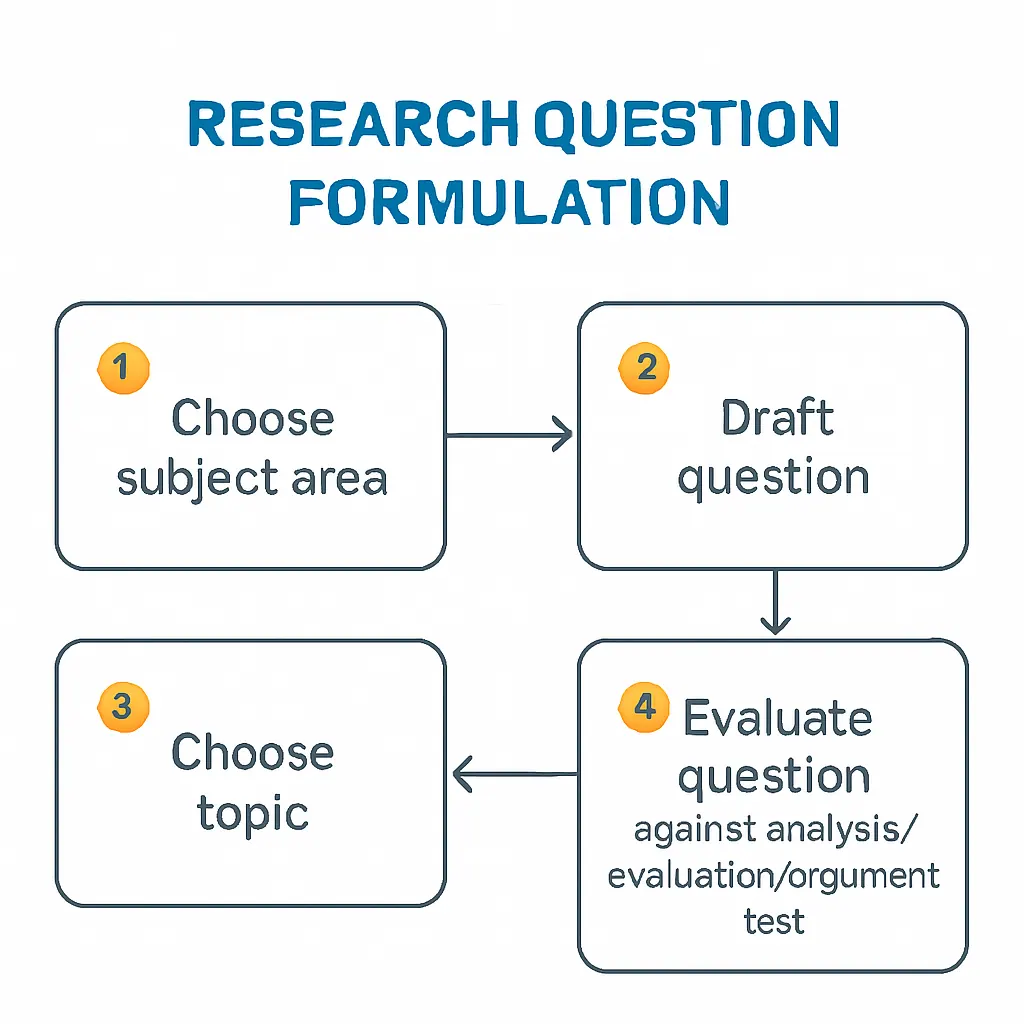
The IB's Extended essay guide (first assessment 2027) works through topic choice in stages: start from a broad topic area, decide which aspect really interests you and why business management is the right lens for it, then develop a research question. Its own business management walk-through starts from the broad area of corporate culture. The question should be clearly stated and focused, encourage analysis and evaluation rather than description, and be answerable within 4,000 words. Most students treat that final check as a formality. It is not. If your question cannot support a line of argument, the entire essay is built on a weak foundation, and no amount of good research will fix it.
The command-term test
A descriptive question fails that check. The guide warns against questions that lead to a descriptive essay or combine two questions in one, and suggests higher-order wording such as "how significant", "how successful" or "to what extent". Questions starting with "What is..." or "How did..." invite narration, not argument. Questions built around "to what extent," "evaluate," "analyse," or "how effectively" force you to weigh evidence and reach a reasoned position, which is exactly what criteria C and D reward.
Strong and weak question examples
| Question | Verdict | Why |
|---|---|---|
| To what extent has Patagonia's B Corp certification strengthened customer loyalty among UK consumers since 2022? | Strong | Named organisation, command term, bounded scope, arguable |
| How effectively did Oatly use market segmentation to enter the German dairy-alternative market between 2019 and 2022? | Strong | Specific company, country, timeframe, analytical command term |
| To what extent does Tesla's direct-sales model affect its brand perception relative to dealership-based competitors? | Strong | Named entity, evaluative framing, clear comparison axis |
| What is supply chain management? | Weak | Purely definitional, no arguable position possible |
| How did Nike grow? | Weak | No command term, no time boundary, no specific focus, essentially a company history prompt |
Anchor the question in a named organisation
Generic questions about "a retail company" or "a tech firm" collapse into textbook arguments because there is no primary data to gather and no specific context to analyse. Naming a real, accessible organisation gives you a concrete research target and makes it easier to show the significance and purpose of your question, which the guide asks for under criterion A.
One gotcha worth knowing early
Your working question can evolve as research develops - the guide says it should be open to amendment if your research takes you in a different direction, and the interim reflection session is the natural point to raise it. What should not drift is the subject lens. The individuals and societies guidance asks that your research question and methods clearly align with the subject you are using, so if your question starts pulling towards economics or psychology, settle with your supervisor which subject the essay belongs to before you write the body.
4. Business Management EE Structure: How to Organise Your Essay
A logical structure is not just good practice; it maps directly onto how examiners read your essay. Work through these five sections in order:
- Introduction - contextualise the organisation you are studying, explain why the issue matters, and state your research question precisely.
- Methodology - explain which data you collected, how you collected it, and why those methods suit your research question.
- Conceptual framework - identify the BM theories and models you will apply (Ansoff Matrix, Porter's Five Forces, and similar) and justify why each is relevant.
- Analysis and findings - apply your chosen frameworks to your data. This is the main body of the essay and where most of your word count should sit.
- Evaluation and conclusion - answer your research question directly with a supported judgement, acknowledge limitations, and avoid introducing new evidence.
The 4,000-word limit is strict: examiners do not read or assess anything beyond it. Under the 2027 guide, the introduction, main body, conclusion, quotations and any footnotes that are not references all count; the contents page, headers, tables, charts and diagrams, citations, the bibliography and the RPF do not. Appendices are allowed, but examiners are not required to read them, so nothing your argument depends on can live there.
Structure is assessed under criterion A, through its structure strand: do the structural conventions you use support the communication of your research? For individuals and societies subjects the guide names clearly labelled diagrams, graphs and images, acknowledging when they are the work of others, referring to them in your text, and sensible headings. One concrete risk: the IB's published business management Example B, an essay marked under the pre-2027 criteria, shows how financial data unrelated to the research question draws examiner criticism rather than credit. Bulk is not evidence of rigour; relevance is.
5. Primary and Secondary Research in a Business Management EE
Primary research means data you collect yourself: interviews with managers or staff, customer surveys, direct observation of operations, or mystery-shopping exercises. Secondary research covers material others have produced: company annual reports, industry databases, news coverage, and peer-reviewed journals.
The distinction matters because examiners reward primary research only when it adds something secondary sources cannot provide. A staff interview that surfaces internal pricing logic, staff turnover figures, or strategic intent the business has never published publicly is genuinely useful. The same interview quoted at face value, with no critical analysis, adds little. The test is whether your primary data directly addresses the research question and is interrogated rather than simply reported.
One non-obvious gotcha: company websites and marketing brochures are secondary sources in form only. They are promotional documents written to present the company favourably. Treating a CEO's brand statement as an objective account of company culture, without noting its source and purpose, is an analytical error that costs marks.
Secondary research is not optional. The 2027 guide says every extended essay must include secondary research (a literature review), and business management can add primary research on top: the guide's own business management example evaluates how a fast-food chain trains its managers using secondary sources supported by interviews with trainers and surveys of graduates. Criterion B's knowledge strand rewards comprehensive, relevant research materials, so do your preliminary reading before you finalise the research question, not after.
6. Where Business Management Essays Lose Marks
Most marks are dropped in the same four or five places. Knowing them in advance is more useful than any generic writing tip.
Description instead of analysis is the single costliest error. Summarising what a company does, or explaining what the Ansoff Matrix says, is not analysis. Analysis means applying the concept to your specific research question and drawing a reasoned conclusion. The examiner commentary on the IB's published American Eagle Outfitters essay (marked under the pre-2027 criteria) flags exactly this: sections that describe the extended marketing mix without connecting the evidence back to the question. Under the 2027 criteria a descriptive essay sits in the bottom band of criterion C's analysis strand, and it drags criterion D down too, because there are few findings whose significance you can discuss.
Scope creep is closely related. A 4,000-word limit forces choices. Essays that try to evaluate pricing, promotion, people, and process all at once end up with shallow treatment of each. A tightly scoped question, focused on one or two elements of a business decision, almost always produces deeper analysis than a broad one.
Weak or irrelevant data costs marks too. The American Eagle essay included financial data on American Eagle and Gap that the examiner noted was not relevant to the research question. Including data signals effort; including data that does not connect to the question signals poor judgment.
Poor source diversity also penalises students who rely heavily on a single source type without commenting on its limitations. Criterion D asks you to weigh the strengths and limitations of your research materials, including the stated or implied positions of their writers. Treating a company's own press releases as neutral evidence, without acknowledgment, is an evaluation failure that examiners notice.
Neglecting the reflective statement is the quietly expensive mistake. Criterion E is worth 4 marks and is marked only from your reflective statement on the RPF. A statement that narrates the process ("first I chose my topic, then I collected data") sits in the bottom band; the top band needs reflection that is consistently evaluative, uses specific examples, and shows your growth and transfer of learning. Statements written hastily on the last night rarely manage that.
7. Reflection Sessions and the RPF: What You Need to Know
The IB requires three mandatory reflection sessions with your supervisor: a first session based on your initial explorations, an interim session once your research is under way, and a final concluding interview called the viva voce after the essay is finished. Attendance at all three is recorded on the Reflection and progress form (RPF), and the guide recommends 20 to 30 minutes per session.
What is assessed is not the sessions themselves but a single reflective statement of no more than 500 words, written at the end of the process and included on the RPF. Criterion E (Reflection, 4 marks) is applied to that statement only. Examiners are not looking for "I completed my introduction and gathered three sources." They want evaluation and growth: how a decision changed your thinking, what a failed interview taught you about primary research in business contexts, and where you would use those skills again.
A strong reflective statement does at least one of these things:
- Names a specific turning point ("I narrowed the scope from the whole company to one product line after the secondary data proved too fragmented") and evaluates its effect
- Connects a change in your perspective to the decisions you made
- Gives a concrete example of how a skill you built would transfer to other studies or work
The viva voce is a short conversation between you and your supervisor once the essay is complete. It is not an oral exam or a graded defence. It closes the reflection loop, covers what you learned and the authenticity of your ideas, helps confirm the work is your own, and is one of the best sources of material for your reflective statement.
One non-obvious gotcha: the RPF is submitted with your essay and the reflective statement is read by the external examiner, not just your supervisor. Because you write it at the end, it can only be specific if you recorded the details along the way - the guide recommends keeping a researcher's reflection space (a notebook or digital log) for exactly this.
Write notes immediately after each session while the details are fresh. The 500-word cap rewards precision, and precision requires memory.
8. What to Do Next
Start this week, not when your title is finalised. If you sit your exams in May 2027 or later, the 30-mark model applies to you, so plan around it from the start: criterion D's 8 marks for discussion and evaluation are the largest single block, and criterion C rewards a line of argument that runs from your question to your conclusion. Ask your IB coordinator for your internal deadlines and the dates of your three reflection sessions.
Then draft three candidate research questions this week. Test each one against the guide's checks: is it focused, does it invite analysis and evaluation rather than description, and can it support a line of argument within 4,000 words? Discard any that only invite description, and bring the rest to your first reflection session.
FAQ
How do I write a business management extended essay?
Start by choosing a specific, real organisation and forming an evaluative research question using a command term such as 'to what extent' or 'how effectively'; then collect primary and/or secondary data, apply relevant BM theory analytically, and write up within the 4,000-word limit following a logical structure that supports a clear, reasoned conclusion.
How do I structure a business management extended essay?
A standard structure runs: introduction (context and research question), methodology, conceptual framework (relevant BM models), analysis and findings (main body applying theory to data), and a conclusion that directly answers the research question - with anything your argument depends on kept in the body, because examiners are not required to read appendices.
What are the assessment criteria for the IB business management extended essay?
From May 2027 the five criteria are A Framework for the essay (6 marks), B Knowledge and understanding (6 marks), C Analysis and line of argument (6 marks), D Discussion and evaluation (8 marks) and E Reflection (4 marks), totalling 30 marks; A to D are applied to the essay as a whole, E only to your reflective statement on the RPF, and the same criteria apply in every subject.
What makes a good business management extended essay research question?
A good research question is evaluative rather than descriptive, anchored in a specific named organisation, and includes a command term that demands a reasoned argument - for example, 'To what extent has [Company X]'s rebranding strategy improved brand equity among 18-25-year-old consumers in [market]?'
How long is the extended essay and what counts toward the word limit?
No more than 4,000 words. The introduction, body, conclusion, quotations and footnotes that are not references count; the contents page, headers, tables, charts, diagrams, citations, bibliography and the RPF do not, and examiners do not read anything beyond the limit or have to read appendices.
What is the RPF (formerly the RPPF) and how is it marked?
The Reflection and progress form (RPF) replaces the RPPF from May 2027: it records your attendance at three mandatory reflection sessions and holds one reflective statement of no more than 500 words, written at the end of the process; criterion E (Reflection, 4 marks) is applied to that statement only and rewards evaluation and evidence of growth rather than a task log.
References
- What is the extended essay? - International Baccalaureate® - https://ibo.org/programmes/diploma-programme/curriculum/dp-core/extended-essay/what-is-the-extended-essay
- Extended essay - International Baccalaureate® - https://ibo.org/programmes/diploma-programme/curriculum/dp-core/extended-essay
- DP extended essay updates - International Baccalaureate® - https://ibo.org/university-admission/latest-curriculum-updates/dp-extended-essay-updates