TOK and EE Points Matrix: How Your Core Points Work
By Michael Thompson · Education Specialist; 10 years teaching the IB at Bromsgrove School · Published 21 May 2026 · Updated 6 October 2026
The IB core points calculator helps you work out your total IB Diploma score by adding the bonus points awarded for Theory of Knowledge (TOK) and the Extended Essay (EE) to your six subject grades. Most students know their subject scores well before results day - but the bonus points matrix trips up even organised students, because the two components interact rather than add up independently. Get the matrix wrong and you can misread your predicted total by up to three points. This guide explains exactly how the system works, shows you the full TOK × EE matrix, flags the automatic-fail conditions, and lets you run the numbers yourself with our free IB Points Calculator.
Key Takeaways
- Maximum IB Diploma score is 45 points: 42 points come from six subjects (each graded 1-7) and up to 3 bonus points come from the TOK and EE matrix.
- TOK and EE grades combine in a points matrix: Each component is awarded A, B, C, D, or E, and the combination of the two determines whether you receive 3, 2, 1, or 0 bonus points.
- An E in TOK or EE is an automatic fail: Regardless of your subject points total, a grade E in either Theory of Knowledge or the Extended Essay means you cannot be awarded the IB Diploma.
- 24 total points is the minimum to pass: You need at least 24 points in total, counting your six subject grades and any TOK and EE core points, and you must meet the full diploma requirements, including CAS and no failing conditions, to be awarded the IB Diploma.
- UCAS Tariff points are separate from your IB total: UCAS prices each subject grade, the EE and TOK on their own, so two students with the same IB total can have different Tariff totals.
- Use the free IB Points Calculator to model different grade scenarios: Entering your predicted TOK, EE, and subject grades shows your total out of 45, every failing condition, and the UCAS Tariff conversion before results day.
In This Article
- How IB Points Work: The Full Score Breakdown
- The TOK and EE Points Matrix Explained
- The Automatic Fail Rule: E Grade in TOK or EE
- IB Diploma Pass Requirements: Minimum Points to Pass
- Use the IB Core Points Calculator
- Maximum IB Points and What Top Scores Look Like
- IB Scores and UCAS Tariff Points for UK Universities
- Common Mistakes When Calculating Your IB Total
- Extended Essay Grade Boundaries and Theory of Knowledge Assessment
- Where to Go From Here
1. How IB Points Work: The Full Score Breakdown
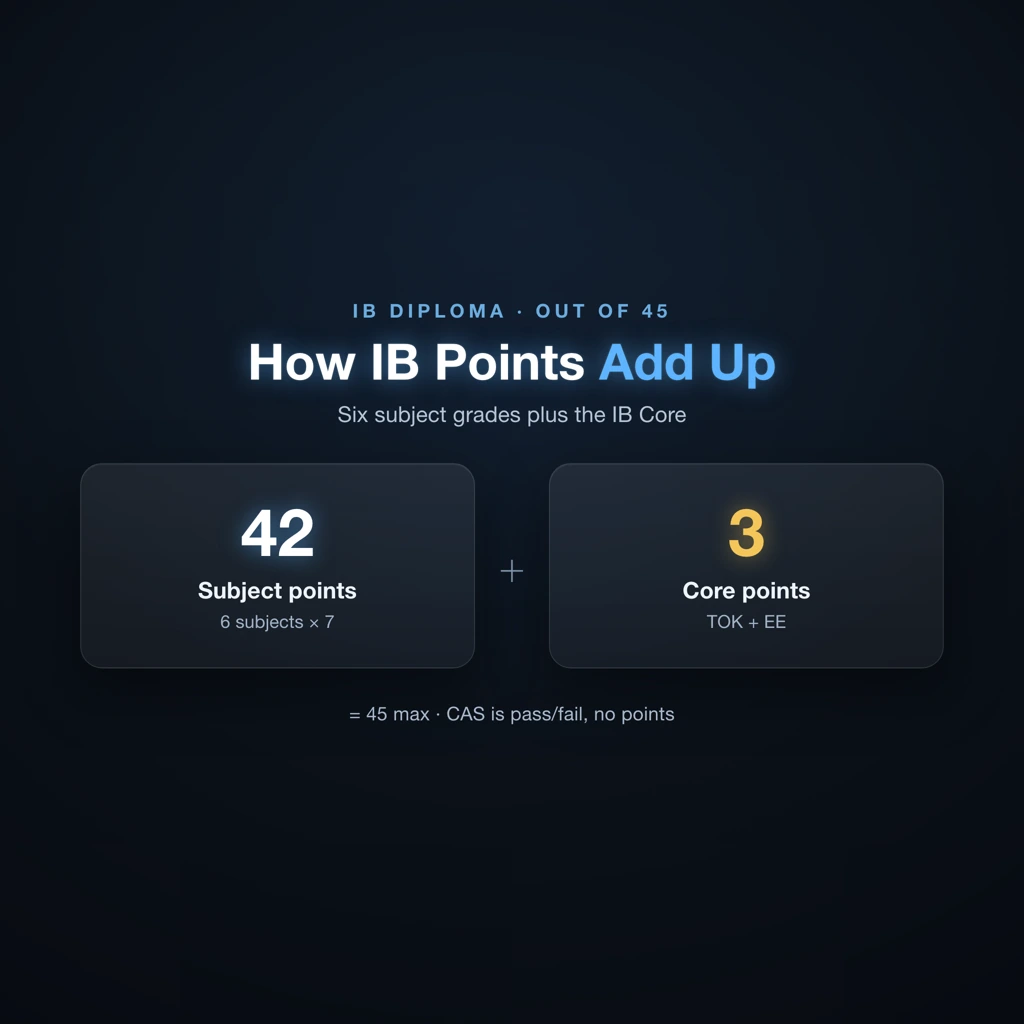
The IB Diploma is scored out of 45 points, and an IB core points calculator helps you understand exactly where each point comes from. That total splits into two distinct parts: your six subject grades, and the bonus points generated by the IB Core.
Six subjects, graded 1 to 7 each, give you a maximum of 42 points. You choose subjects across the IB's required groups, sitting at least three at Higher Level and the rest at Standard Level. Every grade from every subject adds directly to your tally.
The remaining three points come from the IB Core, which has three components:
- Theory of Knowledge (TOK) - a course in epistemology assessed by an essay and an exhibition
- Extended Essay (EE) - a 4,000-word independent research paper supervised by a school mentor
- Creativity, Activity, Service (CAS) - a programme of extracurricular experiences
Here is the counterintuitive part: CAS generates no points at all. It is entirely pass or fail, assessed separately from your numerical score. A student who completes outstanding CAS work gains nothing in the points column, but one who fails to meet the requirements cannot be awarded the Diploma regardless of how high their subject grades are.
Only TOK and EE combine to produce bonus points, anywhere from zero to three, depending on the grades awarded in each. How that combination works is covered in the next section.
2. The TOK and EE Points Matrix Explained
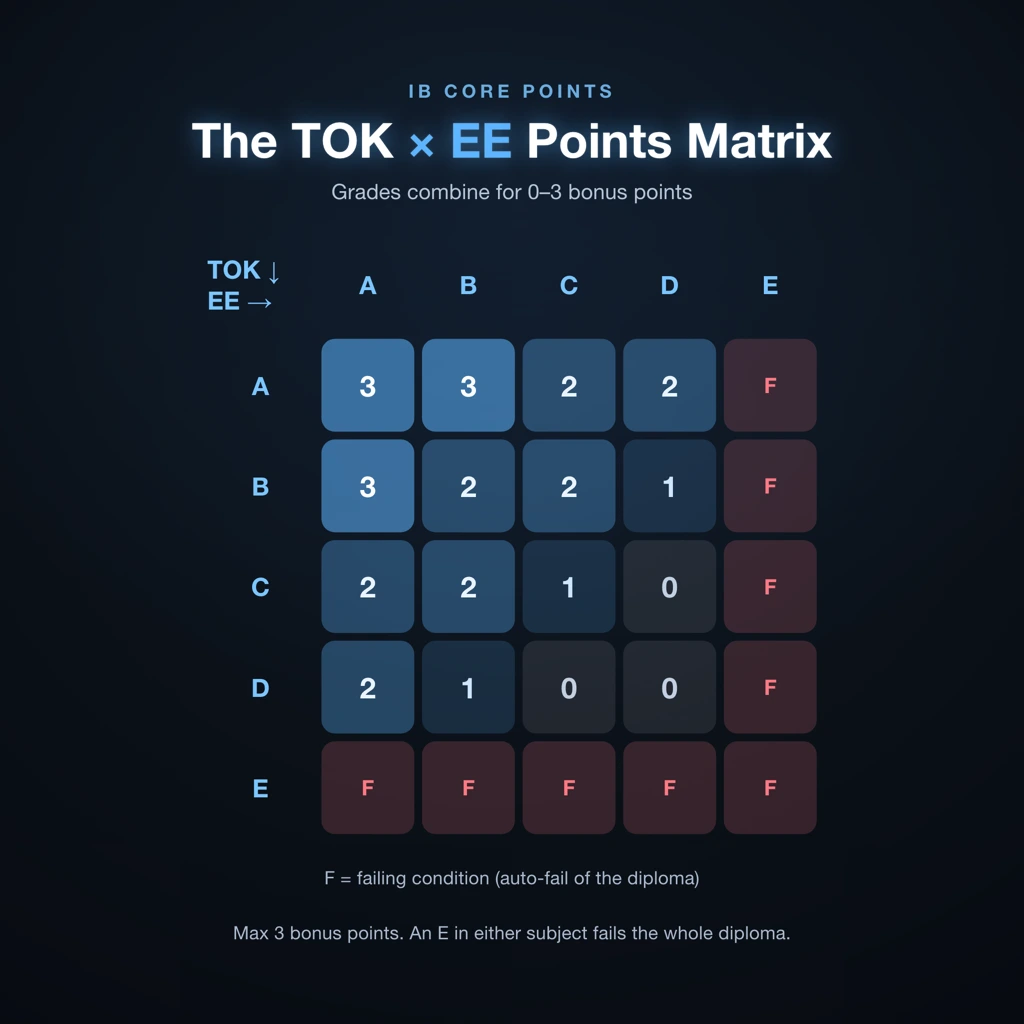
The bonus points from Theory of Knowledge and the Extended Essay do not come from adding two grades together. The IBO awards them through a combined matrix: your TOK grade and your EE grade are looked up together to produce a single bonus figure of 0, 1, 2, or 3 points.
Here is the full matrix:
| EE: A | EE: B | EE: C | EE: D | EE: E | |
|---|---|---|---|---|---|
| TOK: A | 3 | 3 | 2 | 2 | Fail |
| TOK: B | 3 | 2 | 2 | 1 | Fail |
| TOK: C | 2 | 2 | 1 | 0 | Fail |
| TOK: D | 2 | 1 | 0 | 0 | Fail |
| TOK: E | Fail | Fail | Fail | Fail | Fail |
The key thing to notice is how the two grades combine. A student with TOK: A and EE: A earns 3 bonus points, the maximum. A single strong grade still counts even when the other is weak: TOK: A and EE: D earns 2 points, the same as a balanced TOK: B and EE: B. But the bottom of the matrix bites hard - TOK: C and EE: C earns only 1, and TOK: C and EE: D drops to 0. Because the grades are read together, nudging one grade up does not always add a point: TOK: B with EE: C earns 2, and lifting that TOK grade to an A still earns 2.
In effect the matrix treats the five grades as three bands:
- Strong: A or B
- Satisfactory: C
- Weak: D (contributes 0 points when paired with a C or another D, and at most 2, reached only when the other grade is an A)
The practical implication worth flagging: a student with a C in TOK and a D in the EE earns 0 bonus points - exactly the same as a student with a D in TOK and a C in the EE, since both combinations fall to zero. The matrix makes a D a significant cliff edge at the lower grades. Students who coast on a low D in one subject while assuming the other grade compensates them often find the bonus point total lower than their subject scores would suggest.
An E in either TOK or EE, regardless of the other grade, triggers an automatic fail of the whole diploma. That rule sits separately from the matrix itself, covered in the next section.
3. The Automatic Fail Rule: E Grade in TOK or EE
An E grade in either Theory of Knowledge or the Extended Essay is an automatic disqualification from the IB Diploma, regardless of how many points you scored across your six subjects. The IBO does not average these results away or apply any discretion. The diploma is simply not awarded.
The less obvious detail: the fail is triggered by each condition independently. A student who scores E in TOK and A in the Extended Essay fails. A student who scores E in EE and writes a perfectly competent TOK essay also fails. They are assessed separately, and each carries its own threshold.
All IB Diploma failing conditions, listed:
- CAS requirements not completed
- Total score below 24 points
- An N (no grade) for Theory of Knowledge, the Extended Essay, or a contributing subject
- E grade in Theory of Knowledge or the Extended Essay
- Grade 1 awarded in any subject
- Grade 2 awarded three or more times (HL or SL)
- Grade 3 or below awarded four or more times (HL or SL)
- Fewer than 12 points across Higher Level subjects (for candidates with four HL subjects, the three highest grades count)
- Fewer than 9 points across Standard Level subjects (candidates with two SL subjects need at least 5 points at SL)
- A penalty for academic misconduct from the IB's final award committee
The practical implication is stark. A student with 40 subject points - comfortably above the passing threshold - who receives an E in TOK does not receive the diploma. Those 40 points become irrelevant. This is why any honest IB core points calculator must flag E grades before it even shows a total.
The counter-intuitive gotcha here is that students who coast through TOK, treating it as a minor add-on to their subject workload, can fail a diploma they otherwise earned comfortably. Treat both the TOK and EE as pass-or-fail gates first, point-scorers second.
4. IB Diploma Pass Requirements: Minimum Points to Pass
Passing the IB Diploma requires meeting several thresholds simultaneously. The minimum total score to be awarded the Diploma is 24 points, but that number is not a single gate you either clear or you don't. It is the last check in a sequence.
The subject-level minimums apply before the total is even considered:
- Higher Level subjects: at least 12 points combined across your three HL courses (an average of 4 per subject)
- Standard Level subjects: at least 9 points combined across your three SL courses (an average of 3 per subject)
- Core: TOK and EE together must not produce a failing condition (covered in section 3)
The counter-intuitive part is that a student can score 25 or 26 total points and still not receive the Diploma. If those points are unevenly distributed, with strong SL results compensating for weak HL performance, the 12-point HL floor can remain unmet regardless of the overall total. A student with 11 HL points and a strong core bonus sits above 24 overall and still fails.
The same logic works in reverse. Scoring exactly 24 points with all subject minimums met and no failing conditions in place is a valid pass. The Diploma is awarded on the full picture, not any single number in isolation.
When you use an IB core points calculator to check your predicted total, always run the subject-level check separately. A passing total is necessary but not sufficient.
5. Use the IB Core Points Calculator
Our free IB Points Calculator takes three types of input:
- TOK grade (A to E)
- Extended Essay grade (A to E)
- A score for each of your six subjects (1 to 7 per subject)
Enter your current predicted grades or your actual results, and the calculator returns three figures: the bonus points awarded by the TOK/EE matrix, your raw subject total, and your combined IB Diploma score out of 45.
One thing worth noticing: the subject scores and the matrix bonus are calculated independently. You can have a strong subject total of 40 points and still lose the diploma outright if either your TOK or EE grade is an E. The calculator makes this separation visible in a way that a simple sum in your head does not.
Try at least two scenarios, not just your expected grades. For example:
- What happens to your total if TOK drops from a B to a C while your EE stays at an A? The matrix shifts from 3 bonus points to 2 - a one-point swing that matters if you are sitting near a university's conditional offer threshold.
- What if you improve one Standard Level subject from a 5 to a 6? That single mark adds one point to your subject total, independent of the matrix.
Mapping these scenarios before results day gives you a clear picture of where a grade shift has the most impact.
6. Maximum IB Points and What Top Scores Look Like
The maximum IB score is 45 points: 42 from six subjects (each marked 1 to 7) plus 3 bonus points from the TOK and EE matrix, awarded when both are graded A, or one is an A and the other a B. Fewer than 1% of candidates worldwide achieve 45 in any given session, so a perfect score is genuinely rare.
Here is how the point ranges tend to sit in practice:
| Score range | Rough context |
|---|---|
| 43-45 | Very few candidates; highly competitive for any university globally |
| 38-42 | Broadly competitive for selective UK universities, including many Russell Group courses |
| 34-37 | Solid result; meets entry requirements for a wide range of UK degree programmes |
| 28-33 | Passes the diploma; sufficient for many non-selective institutions |
| 24-27 | Still accepted by some universities, such as BIMM University, which sets a minimum of 24 points for certain courses |
One non-obvious point: the IB Diploma carries no classification equivalent to a UK undergraduate degree. There is no "first class" or "upper second." Universities set their own IB entry thresholds independently, which means a score of 38 might comfortably exceed one institution's offer and fall short of another's for a similar subject. Always check the specific offer condition rather than assuming a bracket is "good enough."
The counter-intuitive trade-off with the bonus points is also worth noting: a student who scores A in the Extended Essay but D in TOK receives 2 bonus points, not the full 3. The matrix rewards the combination of both grades, not standout achievement in either component alone.
7. IB Scores and UCAS Tariff Points for UK Universities
UK universities use UCAS Tariff points to compare qualifications on a common scale, letting admissions teams set entry requirements that apply equally to IB Diploma students, A-level students, and BTEC applicants. The conversion does not start from your IB total: UCAS prices each HL and SL grade, the EE and TOK separately, so the bonus points from the TOK and EE matrix do not feed into it. The UCAS Tariff calculator is the official tool for working out exactly where your score sits.
The counterintuitive detail worth knowing: the Tariff converts individual IB subject certificates separately, not just the overall diploma total. Per UCAS, both the IBO Certificate in Higher Level and the IBO Certificate in Standard Level each receive their own Tariff allocation. The EE and TOK have their own allocations too, from 12 points at A to 4 at E; the 3 bonus points from the core matrix count towards your diploma total but not towards the Tariff.
This matters most if you are applying without a full IB Diploma. Rather than being locked out, you can convert your individual certificate scores using the UCAS Tariff calculator and apply on that basis. BIMM University makes this explicit in its IB statement: applicants without a full diploma are considered provided their certificate scores meet the minimum Tariff threshold for the course. Check the IBO recognition database to find each university's position before you apply.
8. Common Mistakes When Calculating Your IB Total
Three errors come up repeatedly when students work out their predicted or final diploma score.
Quoting the subject total as the diploma total. Your six subject scores add up to a maximum of 42 points, not 45. The final diploma total includes up to 3 bonus points from the TOK and EE matrix. If you tell a university you scored 38, but you mean 38 out of 42, your actual diploma score could be anywhere from 38 to 41. Always state your score out of 45.
Treating TOK and EE as independent contributors. This is the counter-intuitive one. A student who earns an A on the Extended Essay but a D on TOK receives 2 bonus points - the same as a student who earns a B on both, and short of the full 3. The two grades are read together on the matrix, not summed separately, so it is the specific combination that decides the bonus.
Underestimating the automatic fail rule. A total of 38 subject points is a competitive score. An E grade in TOK or the EE makes it irrelevant. The diploma is not awarded, regardless of subject performance. Students who know their subject grades are strong sometimes stop worrying about TOK or the EE entirely, which is exactly the wrong response.
Before you use any IB core points calculator, confirm your TOK grade, your EE grade, and that neither is an E.
9. Extended Essay Grade Boundaries and Theory of Knowledge Assessment
How the Extended Essay is graded
IBO examiners mark the Extended Essay on a numerical scale, then convert that mark to a letter grade from A (excellent) to E (failing). The grade boundaries are set by the IBO after each examination session, which means the raw mark needed for a B or C can shift slightly from May to November depending on how examiners assess that cohort's work. One non-obvious consequence: two students submitting essays of similar quality in different sessions can receive different letter grades, even if their underlying mark is almost identical.
How Theory of Knowledge is assessed
The Theory of Knowledge assessment has two components:
- TOK exhibition - assessed internally by your teacher, then externally moderated by an IBO examiner.
- TOK essay - marked externally by an IBO examiner against a set of prescribed titles released each session.
The combined performance across both components produces a single A-E grade for TOK. Our guide to TOK and EE grade boundaries explains how the IB sets the A-E cut-offs for TOK and the EE each session, and why the new 30-mark EE has none until the May 2027 results.
Using this knowledge strategically
Because EE and TOK letter grades are published alongside your subject results, you can use the TOK and EE matrix before results day to map every possible grade combination to its bonus-point outcome. If your predicted EE grade is a B and your predicted TOK grade is a C, you already know you are on course for two bonus points rather than three. That kind of forward planning is exactly where an IB core points calculator earns its keep: it removes the ambiguity before results arrive.
10. Where to Go From Here
Open the IB Core Points Calculator above right now, enter your latest predicted grades, and identify the single component where moving up one grade band changes your bonus points total. That shift is often non-obvious: a student sitting on a C in TOK and a C in the Extended Essay is one grade away from gaining an extra point - lifting either grade to a B moves the bonus from one point to two - the same one-point gain as lifting a subject from a 5 to a 6.
Once you know your pressure point, these guides give the surrounding context:
- How UCAS Tariff points price your IB grades for UK offers
- IB grade boundaries by subject, so you can judge how close each grade threshold actually is
- How UK universities construct IB conditional offers, and when they specify TOK or EE grades separately
Students who understand the failing conditions in the matrix can focus revision where it counts. Check your grade predictions with your IB coordinator this week and confirm whether your current trajectory clears every pass condition, not just the overall points total.
FAQ
How do IB points work?
Your IB Diploma total is made up of points from six subjects (each graded 1-7, giving a maximum of 42) plus up to 3 bonus points determined by combining your TOK and Extended Essay grades through the IBO's bonus points matrix, for a maximum of 45.
How many points do you need to pass the IB?
You need a minimum of 24 total points, at least 12 points across your three Higher Level subjects, at least 9 points across your three Standard Level subjects, no E grade in TOK or the Extended Essay, and completed CAS requirements - all conditions must be met simultaneously.
What is the maximum IB score?
The maximum IB Diploma score is 45 points: 42 from six subject grades (7 points each) plus 3 bonus points, awarded when TOK and the Extended Essay are both graded A, or one is graded A and the other B.
Is 30 points in IB good?
30 points is above the minimum pass threshold and meets the entry requirements for many UK universities, but selective universities typically set offers well above 30 - the threshold depends on the institution and the specific course.
What happens if you get an E in TOK or the Extended Essay?
An E grade in either TOK or the Extended Essay is an automatic failing condition for the IB Diploma - you will not be awarded the diploma regardless of your subject points total, even if you have met the 24-point minimum in all other respects.
How does the TOK and EE bonus points matrix work?
The matrix maps every combination of your TOK grade (A-E) and EE grade (A-E) to a bonus points outcome of 3, 2, 1, or 0. Because the two grades are read together as a pair, it is the specific combination that sets your bonus, not either grade on its own.
References
- University Statement - https://recognition.ibo.org/en-US/university-statements/?id=a5a39ee4-f3a1-ed11-aad1-000d3a85c377&university=BIMM%20University&countryID=f4436145-efa1-ed11-aad1-000d3a85c377&country=United%20Kingdom&stateID=&state=
- Calculate your UCAS Tariff points | UCAS - https://www.ucas.com/applying/before-you-apply/what-and-where-to-study/entry-requirements/calculate-your-ucas-tariff-points