IB Global Politics Extended Essay: The Complete Guide
By Michael Thompson · Education Specialist; 10 years teaching the IB at Bromsgrove School · Published 4 September 2026 · Updated 4 October 2026
The global politics extended essay is one of the few places in the IB Diploma Programme where you choose the political question and find your own evidence to answer it. That freedom is also the most common source of lost marks: vague research questions, over-description of events, and weak links to political theory. This guide covers every component you need to plan - the essay itself, the five assessment criteria of the new extended essay (first assessed in May 2027), the engagement project you complete for the course's internal assessment, and how to manage both pieces alongside your other commitments.
Key Takeaways
- Research question quality is everything: A strong global politics EE question is political, contested, and answerable with available evidence - not a description of events or a question with an obvious answer.
- Five criteria, 30 marks total: From May 2027 the essay is marked on framework for the essay, knowledge and understanding, analysis and line of argument, discussion and evaluation (the heaviest, at 8 marks) and reflection.
- The engagement project is separate from the essay: It is the course's internal assessment: a political issue you investigate through direct engagement and research, written up as a report that your teacher marks and the IB moderates.
- Theory must drive your analysis, not decorate it: Concepts such as power, sovereignty, legitimacy, and interdependence should frame your argument from the introduction - not appear as an afterthought in the conclusion.
- Primary and secondary evidence serve different functions: Your engagement project generates evidence for the IA, not the EE; the essay is built on academic secondary sources, optionally supplemented by primary data you collect for it, and examiners notice when sources are used uncritically.
- The reflective statement is marked separately: Criterion E (4 marks) is applied only to one reflective statement of no more than 500 words on the Reflection and progress form (RPF), written after your three reflection sessions with your supervisor.
In This Article
- What the global politics extended essay actually is
- The five criteria and how marks are allocated
- Writing a research question that works for the global politics extended essay
- Linking political theory to your case study without over-describing it
- The engagement project: how the IA differs from the extended essay
- Sources and evidence: what examiners look for in the global politics EE
- Managing the timeline for your EE and engagement project alongside exams
- What to do next
1. What the global politics extended essay actually is
The global politics extended essay is a 4,000-word independent research paper and a compulsory component of the IB Diploma Programme core. According to the International Baccalaureate, all extended essays are externally assessed by IB-appointed examiners. Under the new extended essay, first assessed in May 2027, essays are marked out of 30 and graded from A to E. No grade boundaries exist yet for the 30-mark scale; senior examiners set them after the May 2027 session.
Students have two routes into the EE. The first is a subject-focused essay rooted in one DP subject, in this case global politics. The second is the interdisciplinary pathway, which integrates two DP subjects. The IB's curriculum updates page sets out these two pathways for the new extended essay, launched in February 2025, and the interdisciplinary pathway replaces the former World Studies Extended Essay.
One non-obvious implication of that change: if you plan to combine global politics with, say, economics or history, you are writing an interdisciplinary EE, which is registered under one of five broad frameworks. It is marked against the same five criteria as a subject-focused essay; what changes is that both subjects have to do real analytical work.
Regardless of pathway, the process is the same. Three mandatory reflection sessions with a supervisor are required, ending with the viva voce, a short concluding interview after the essay is complete. Your reflective statement, not the sessions themselves, is what examiners mark.
2. The five criteria and how marks are allocated
Every extended essay first assessed from May 2027, in any subject or pathway, is marked against the same five criteria, totalling 30 marks, as set out in the IB's Extended essay guide (first assessment 2027):
| Criterion | Marks | What it rewards |
|---|---|---|
| A Framework for the essay | 6 | Research question, research methods, structure |
| B Knowledge and understanding | 6 | Relevant research materials, terminology, concepts |
| C Analysis and line of argument | 6 | Analysis that produces findings; a sustained argument from question to conclusion |
| D Discussion and evaluation | 8 | Balanced discussion of findings; strengths and limitations of the essay |
| E Reflection | 4 | Evaluative reflection; growth and transfer of learning |
| Total | 30 |
Criteria A to D are applied to the essay as a whole. Criterion E is applied only to your reflective statement on the Reflection and progress form (RPF), a single piece of no more than 500 words written at the end of the process. A strong 4,000-word paper cannot compensate for a thin statement, so do not leave it to the last night.
For global politics, the individuals and societies guidance asks for a research question and methods that clearly align with the subject, accurate use of its terminology and concepts, and a balanced discussion that weighs different perspectives - for a political question, that usually means the competing positions of the actors involved. Presentation is no longer a separate criterion; headings, labelled figures and referencing count through criterion A's structure strand.
November 2026 candidates only: the final session on the old model marks essays out of 34 - Focus and method (6), Knowledge and understanding (6), Critical thinking (12), Presentation (4) and Engagement (6) - with Engagement taken from the three-entry Reflections on planning and progress form (RPPF).
3. Writing a research question that works for the global politics extended essay
A good research question for the global politics extended essay must do three things: address a genuinely political issue, be contested rather than factual, and be answerable using sources you can actually obtain. If the question could be resolved by reading a single government report or Wikipedia article, it is descriptive, not analytical, and examiners will mark it down accordingly.
The contested-but-answerable tension is where most questions fail. Questions that are too broad generate summary essays; questions that are too narrow run out of arguable ground before 4,000 words. The 4,000-word limit, confirmed by the International Baccalaureate, is tight enough that a well-scoped question is not a luxury but a structural necessity.
Weak versus stronger questions (written-for-this-guide examples)
| Type | Example question | Why it falls short or works |
|---|---|---|
| Too descriptive | "What has the UN done to address climate displacement?" | Invites a list, not an argument |
| Too broad | "How does nationalism affect international relations?" | Cannot be argued meaningfully in 4,000 words |
| Stronger | "To what extent did the EU's 2015 relocation scheme fail because of intergovernmental bargaining rather than logistical constraints?" | Scoped actor, policy, and period; forces a causal argument |
| Stronger | "How far did economic sanctions shape Iran's nuclear negotiating position between 2012 and 2015?" | Defined timeframe and mechanism to evaluate |
Notice that the stronger questions name a specific actor, policy, or period. That specificity is what makes genuine argument possible rather than coverage.
Interdisciplinary pathway
The IB's new extended essay, first assessed in May 2027, has two pathways: subject-focused or interdisciplinary (integrating two DP subjects). If you combine global politics with, say, economics or history, the rationale for crossing disciplines must be explicit from the research question itself. Both subjects must each do analytical work; one cannot simply provide background for the other. A question like "How far did austerity economics constrain Greece's political sovereignty during the 2010-2015 debt crisis?" genuinely requires both disciplinary lenses. One that merely describes economic events before a political conclusion does not.
Aim to have a draft research question by your interim reflection session - the guide treats the first session as the place to explore topics and develop an initial question. Revising it late costs you argument-building time you cannot recover.
4. Linking political theory to your case study without over-describing it
The most common structural failure in the global politics extended essay is spending the bulk of the essay retelling events. An examiner reading a 4,000-word account of the Syrian refugee crisis, with two paragraphs of "analysis" at the end, will find almost nothing to reward under criterion C (analysis and line of argument) or criterion D (discussion and evaluation). The case study is not the argument. It is the evidence you use to test one.
The fix is to commit to a theoretical lens before you write a single word of the body. Concepts like hard and soft power, sovereignty, legitimacy, and interdependence should appear in your research question itself, not be introduced in your conclusion as an afterthought. A question such as "To what extent did the EU's loss of normative legitimacy constrain its response to the 2015 refugee crisis?" forces you to define legitimacy upfront, apply it to specific decisions, and reach a defensible conclusion. The case study provides the evidence; the concept does the explanatory work.
A practical structure that follows from this:
- Introduction: define the theoretical concept precisely, explain why your case is a useful test of it, and state your argument.
- Each body section: open with a claim about the concept, present the minimum factual context needed to make that claim legible, then analyse how the evidence supports or complicates it.
- Factual narrative: limit it to what a reader genuinely needs to follow your analysis. If a paragraph could appear unchanged in a history textbook, cut it.
One counter-intuitive trade-off worth knowing: students who choose highly dramatic cases (wars, coups, humanitarian disasters) often produce weaker essays, because the temptation to describe rather than analyse is hardest to resist when the events themselves feel important. A quieter case with a sharper conceptual fit frequently produces cleaner arguments.
This structure directly serves criterion B, where concepts are one of the three strands, and criterion C, where marks go to a line of argument that demonstrates conceptual command, not factual recall.
5. The engagement project: how the IA differs from the extended essay
The engagement project is the internal assessment component of the IB Global Politics course; it was called the engagement activity before the current course, first examined in May 2026. It is marked by your teacher and moderated by the IB, and it is entirely separate from the extended essay, which is a DP core requirement assessed externally. Students sometimes confuse the two because both involve independent research, but the underlying task is different.
What counts as engagement
The project centres on a political issue you investigate through direct, personal engagement as well as research. Typical engagements include:
- Attending a local council or planning committee meeting
- Participating in a Model UN conference
- Joining an organised protest or public demonstration
- Interviewing an elected official, candidate, or political activist
- Taking part in a community campaign that has a clear political dimension
Watching a documentary, reading news coverage, or attending a lecture as a passive observer does not qualify. The engagement must be something you did, not something you witnessed from a distance.
The written report
The report has a strict word limit, so check the current figure in the subject guide with your teacher. It requires you to connect your personal experience directly to the political concepts, theories, or tensions studied in the course. The marking rewards how well you move from lived experience to analytical argument, not how dramatic the event was.
Where marks are lost
The counter-intuitive pitfall is this: students who had a genuinely significant experience often write the weakest reports, because they spend most of the word count describing what happened rather than analysing it. A half-page on a small parish council meeting, analysed rigorously through the lens of legitimacy or sovereignty, will outscore a vivid account of attending a national protest that never touches theory.
A separate, practical error: do not recycle secondary sources you used for the global politics extended essay into your engagement report. The IA is assessed on the quality of your engagement and your analytical response to it. Padding the report with academic references dilutes the score rather than strengthening it.
6. Sources and evidence: what examiners look for in the global politics EE
Examiners expect two distinct types of sourcing, and the balance between them signals your academic maturity more than your word count does.
Primary sources are the raw material of political analysis: UN Security Council resolutions, treaty texts, government white papers, official statistical datasets, and NGO field reports. They give you direct evidence of what states, institutions, or actors actually said or did.
Secondary sources interpret and contextualise that raw material: peer-reviewed journal articles, quality newspaper reporting from outlets with editorial standards, and think-tank analysis. The 2027 guide says every extended essay must include secondary research, and for global politics it expects relevant academic secondary sources to carry your line of argument, with or without primary data you collect. The IB's published global politics EE examples, accompanied by examiner commentaries, show that strong essays draw on both layers rather than leaning entirely on one.
A non-obvious gotcha: your engagement project generates evidence, but only for the IA. It cannot substitute for rigorous secondary sourcing in the EE itself. Attempting to use your own engagement interviews as the analytical backbone of the essay is a category error that examiners will flag.
Common source errors to avoid:
- Citing Wikipedia or unattributed web content as evidence for a contested claim
- Quoting a source without interrogating its institutional perspective or funding interests
- Building an argument almost entirely from one ideological direction on a disputed issue
That last error does the most damage under criterion D, which rewards a balanced discussion and an evaluation of your sources' strengths and limitations. If your research question touches a genuinely contested political issue, for example, the legitimacy of humanitarian intervention, you should be able to name sources that argue opposing positions and explain why you find one more persuasive. Sourcing diversity is not a box-ticking exercise; it is the evidence that you can think critically rather than just report.
7. Managing the timeline for your EE and engagement project alongside exams
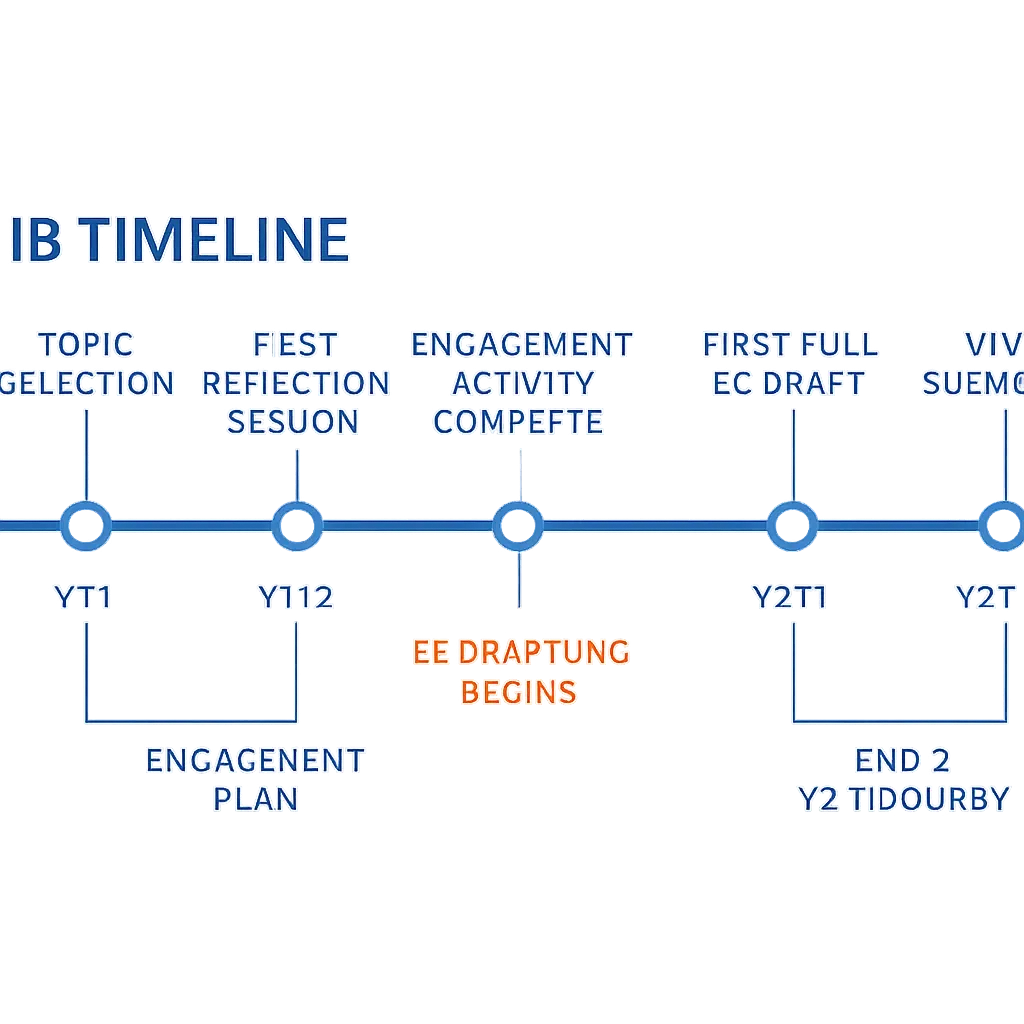
The non-obvious trap here is that the EE and the engagement project run on separate clocks. Students who treat them as a single project tend to let one drift while the other takes over, and end up with both deadlines landing in the same few weeks.
A workable two-year schedule looks like this (school deadlines vary):
| Period | EE milestone | Engagement project milestone |
|---|---|---|
| Year 1, Term 1 | Topic exploration; first reflection session with supervisor | Initial planning; identify the political issue and how you will engage with it |
| Year 1, Term 2 | Draft research question; research under way | Draft engagement plan |
| Year 1, summer | Research and first full draft under way | Complete your engagement; record observations |
| Year 2, Term 1 | Interim reflection session; supervisor comments on one full draft | Write up the engagement report |
| Year 2, Term 1 end | Final EE submission (most schools), then the viva voce and your reflective statement on the RPF | Report submitted to your teacher by the school deadline |
The International Baccalaureate requires three mandatory reflection sessions with your supervisor, ending with a concluding interview called the viva voce once the essay is complete. Attendance at all three is recorded on the RPF, and the sessions are where the material for your reflective statement comes from - turn up unprepared and criterion E suffers later.
The assessed piece of reflection is your reflective statement on the Reflection and progress form (RPF): one statement of no more than 500 words, written at the end of the process. Keep genuine notes after each session, not a polished reconstruction at the end; the statement can only be specific about how your thinking changed if you recorded it at the time.
Anything left unfinished by Year 2 Term 2 competes directly with exam revision. Track both deadlines in your planner as distinct items from day one.
8. What to do next
If you sit your exams in May 2027 or later, you are on the new 30-mark extended essay, so plan around it from the start: criterion D (discussion and evaluation) carries the most marks at 8, and criterion C rewards a line of argument that runs from your research question to your conclusion. That affects how much of your word count goes on argument rather than description, and getting it wrong at the planning stage costs marks you cannot recover later.
Read our guide to the five criteria, then ask your supervisor which pathway, subject-focused or interdisciplinary, suits your question. Do both of those things before your next supervisor meeting.
FAQ
What is a good research question for a global politics extended essay?
A strong global politics EE question identifies a specific political issue, is genuinely contested rather than factually resolvable, and is narrow enough to be argued within 4,000 words - for example, comparing how two states have exercised soft power in a defined region over a defined period.
How is the global politics extended essay marked?
From May 2027 every extended essay is marked out of 30 on five criteria - framework for the essay (6), knowledge and understanding (6), analysis and line of argument (6), discussion and evaluation (8) and reflection (4) - and converted to a grade from A to E; boundaries for the new scale will only be set after the May 2027 session.
What is the difference between the extended essay and the engagement project in global politics?
The EE is a 4,000-word externally assessed research paper forming part of the DP core, while the engagement project (formerly the engagement activity) is the subject's internal assessment - a political issue investigated through direct, personal engagement and research, written up as an analytical report.
Can I do my extended essay on global politics as an interdisciplinary essay?
Yes. From May 2027 the interdisciplinary pathway, which replaces the old World Studies EE, lets you combine global politics with one other DP subject; both subjects must do real analytical work, and the essay is marked on the same five criteria as a subject-focused one.
Where do students most commonly lose marks in the global politics EE?
The most frequent errors are over-describing events rather than analysing them through a theoretical lens, using a vague or descriptive research question, relying on low-authority sources, and failing to engage with more than one perspective on a contested issue.
What counts as engagement for the global politics engagement project?
Engagement means direct, personal involvement with a political issue - such as attending a council meeting, interviewing a public official, participating in a Model UN conference, or joining a political campaign - rather than passive observation or secondary research alone.
References
- What is the extended essay? - International Baccalaureate® - https://ibo.org/programmes/diploma-programme/curriculum/dp-core/extended-essay/what-is-the-extended-essay
- DP extended essay updates - International Baccalaureate® - https://ibo.org/university-admission/latest-curriculum-updates/dp-extended-essay-updates
- Global politics updates - International Baccalaureate® - https://www.ibo.org/university-admission/latest-curriculum-updates/global-politics-updates/