Extended Essay Criteria A-E: Marks, Grades & Tips
By Michael Thompson · Education Specialist; 10 years teaching the IB at Bromsgrove School · Published 4 September 2026 · Updated 4 October 2026
The extended essay criteria determine every mark your 4,000-word essay earns, and they changed for everyone assessed from May 2027 onwards. There are five criteria - Framework for the essay, Knowledge and understanding, Analysis and line of argument, Discussion and evaluation, and Reflection - worth a combined 30 marks. Those marks become an A-E grade, which feeds into the TOK-EE matrix that can add up to three points to your IB Diploma total. Understanding exactly what each criterion rewards, and what it penalises, is the most direct way to write a stronger essay.
Key Takeaways
- Five criteria, 30 marks total: From the May 2027 session, Criteria A, B, C, D and E are worth 6, 6, 6, 8 and 4 marks, per the IB's Extended essay guide (first assessment 2027).
- Criterion D carries the most weight: Discussion and evaluation is worth 8 marks, so weighing what your findings mean and evaluating your own essay is where marks are most strongly won or lost.
- Criterion E is marked from 500 words, not the essay: Reflection is assessed only from your reflective statement on the Reflection and progress form (RPF), written at the end of the process.
- Your supervisor does not mark the essay: All extended essays are externally assessed by IB examiners; the supervisor runs the three reflection sessions and adds comments to the RPF, but does not grade.
- An E grade fails the diploma: You need a D or higher in the extended essay to be awarded the IB Diploma, whatever your subject scores.
- No grade boundaries exist yet for the 30-mark scale: Senior examiners set them after the May 2027 session, so no raw score maps to a fixed grade today, and old 34-mark ranges do not carry over.
In This Article
- What the extended essay criteria are and how they fit together
- Criterion A - Framework for the essay (6 marks)
- Criterion B - Knowledge and understanding (6 marks)
- Criterion C - Analysis and line of argument (6 marks)
- Criterion D - Discussion and evaluation (8 marks): the biggest decider
- Criterion E - Reflection (4 marks) and the RPF
- How the 30 marks become a grade - and feed into the diploma
- What to do next
1. What the extended essay criteria are and how they fit together
The extended essay criteria are the five categories that external IB examiners use to mark every finished essay. They come from the IB's Extended essay guide (first assessment 2027), which applies from the May 2027 session onwards, whether you take the subject-focused or the interdisciplinary pathway. The five criteria and their marks are:
| Criterion | Title | Strands | Marks |
|---|---|---|---|
| A | Framework for the essay | Research question; research methods; structure | 6 |
| B | Knowledge and understanding | Knowledge; understanding - terminology; understanding - concepts | 6 |
| C | Analysis and line of argument | Analysis; line of argument | 6 |
| D | Discussion and evaluation | Discussion; evaluation | 8 |
| E | Reflection | Evaluative reflection; growth and transfer of learning | 4 |
| Total | 30 |
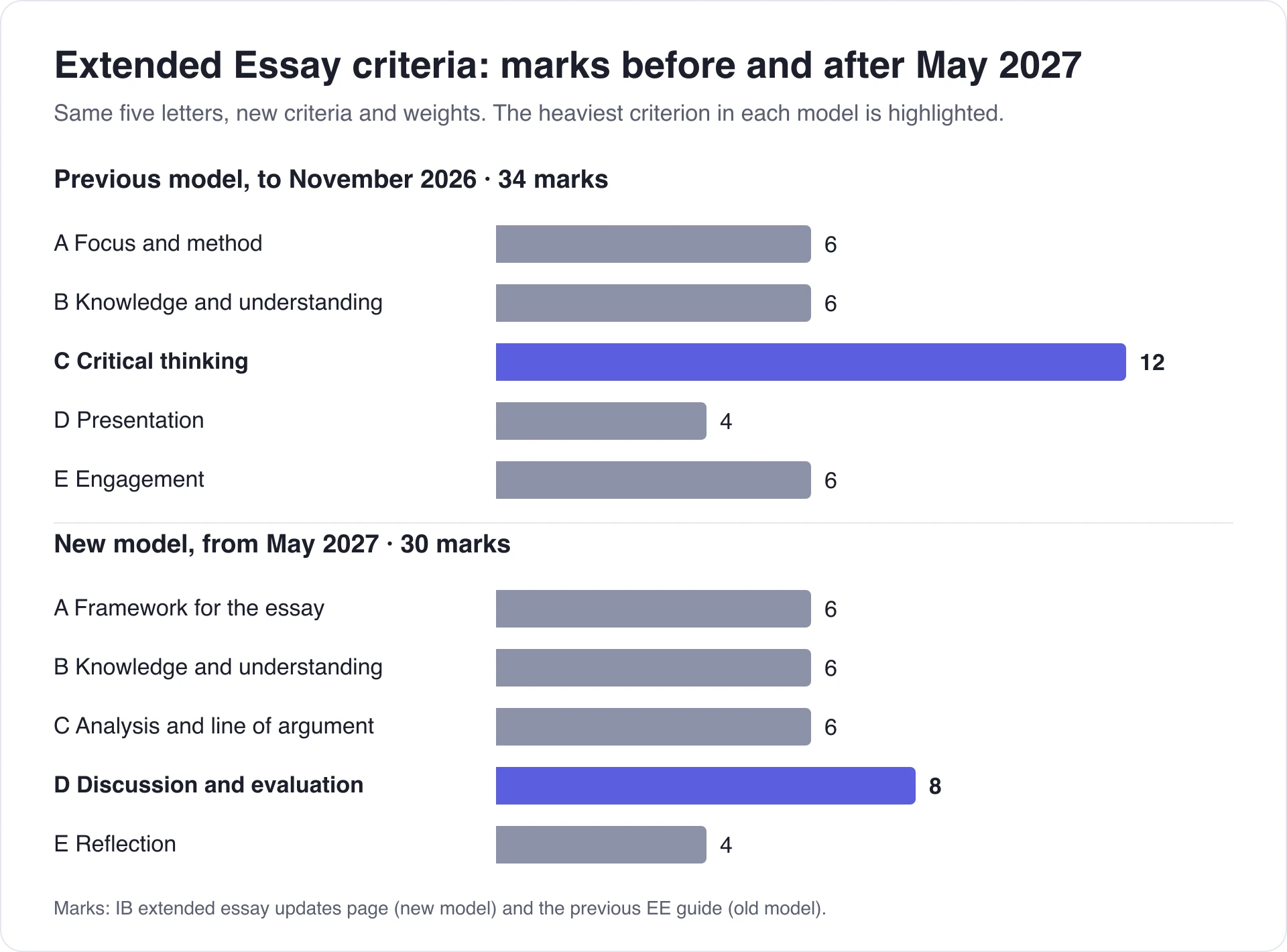
Criteria A to D are applied to the essay as a whole. Criterion E is applied only to the reflective statement on your RPF. There is no standalone Presentation criterion any more: structure is now one strand of Criterion A.
Examiners mark on a best-fit basis: they credit what is there, pick the band that describes your work most accurately, and a top mark does not mean a flawless essay.
One thing many students miss: the marking is done by examiners appointed by the IB, not by your supervisor. Your supervisor comments on one full draft and runs the reflection sessions, but has no role in the final mark. That distinction matters because writing to impress a familiar teacher is a different task from writing to be understood by a stranger.
November 2026 candidates only: your essay is marked under the previous guide, out of 34: A Focus and method (6), B Knowledge and understanding (6), C Critical thinking (12), D Presentation (4) and E Engagement (6), with Engagement judged from the three entries on your Reflections on planning and progress form (RPPF). Everything else on this page describes the 2027 criteria.
2. Criterion A - Framework for the essay (6 marks)
Criterion A asks whether your research question, research methods and structure together give the essay an effective framework. Each of its three strands is judged across three bands:
| Strand | 1-2 marks | 3-4 marks | 5-6 marks |
|---|---|---|---|
| Research question | Stated, but lacking relevance, clarity or focus | Relevant and clear, but only partly focused for the essay's scope | Relevant, clear and focused for the essay's scope |
| Research methods | Used, but mostly unsuitable for the question | Mostly suitable, explained and applied with partial success | Suitable, explained and applied effectively |
| Structure | Conventions present but not helping communicate the research | Conventions help with some of the communication | Conventions effectively support communication of the research |
Paraphrased from the IB's Criterion A markbands.
Research question
The guide steers you towards one specific question that invites analysis rather than narration. Wording such as "to what extent" pushes you towards evaluation; a double-barrelled question usually makes the scope too broad, and one with an obvious answer leaves you nothing to argue.
Research methods and source quality
This is where the quality of your sources is assessed. The guide asks you to explain why your methods suit the question and to make sure there are "sufficient sources of suitable quality" to support them. If there are not, it says you may need to change your question or even your topic. For experiments or fieldwork, describe the method well enough that someone else could repeat it.
Structure
Structure covers the conventions of academic writing in your subject, such as clearly labelled figures and tables that the text actually refers to.
A practical check: if you could drop your methods section into a different essay with a different research question and it would still make sense, it is not tailored enough for the top band.
3. Criterion B - Knowledge and understanding (6 marks)
Criterion B asks whether you show knowledge and understanding of the subject matter your research uses. It has three strands, again marked in bands of 1-2, 3-4 and 5-6:
- Knowledge. Your research materials should establish knowledge of the subject matter. Low-band materials lack relevance; top-band materials are comprehensive as well as relevant. Avoid over-long quotations: the guide wants your knowledge to show in your own writing.
- Understanding - terminology. Subject terms should be used accurately and consistently. Thin or inaccurate use of terminology keeps you in the lower bands.
- Understanding - concepts. The key ideas of your subject should be explained and used effectively, not just named. A concept that is named but only superficially explained, or not relevant, sits at the bottom.
The counter-intuitive point is that breadth without relevance earns nothing. Three paragraphs of general background written to show how much you know will not score higher than a tight section that sets up only what your question needs. If your question is about enzyme inhibition in a particular reaction, examiners want the context of that reaction, not a survey of enzyme biology.
Source quality shows up here too. Because the top band asks for comprehensive, relevant research materials, a thin or off-topic reading list limits Criterion B as well as Criterion A.
Practical check: read each paragraph of your background section and ask whether it would still be necessary if your research question changed. If the answer is yes, it is general background, so cut it.
4. Criterion C - Analysis and line of argument (6 marks)
Criterion C asks whether you analyse the information in your essay and build a coherent argument from it. It has two strands:
- Analysis - breaking the topic down to establish relevant findings, with each analytical point backed by evidence from your research. At the bottom band the essay describes rather than analyses; at the top, analysis is effective and consistently produces relevant findings.
- Line of argument - a reasoned thread linking your research question, your findings and your conclusions. The top band needs that thread to be clear and sustained; a partly consistent thread sits in the middle.
You do not need an extra "argument" paragraph for this strand. Connect the parts you already have - question, findings, conclusions - and signpost where each begins and ends, so the reader never has to work out how they fit together.
A mid-band essay contains analysis, but it keeps slipping back into restating what a source says. A strong essay interrogates its evidence, weighs competing interpretations and reaches conclusions that visibly follow from it.
At 6 marks, Criterion C is worth less than Criterion D, but the two are linked: you cannot discuss the significance of findings you never established.
5. Criterion D - Discussion and evaluation (8 marks): the biggest decider
At 8 of the 30 marks, Criterion D is the heaviest criterion and the only one with four bands (1-2, 3-4, 5-6 and 7-8). If you are short on time, this is where to spend it. It has two strands:
- Discussion - a balanced discussion of what your findings mean and why they matter, supported by appropriate evidence. The bands climb with how consistently evidence backs the discussion: none at the bottom, then sometimes, often and, at the top, fully.
- Evaluation - an evaluation of how effective your essay is, weighing the strengths and limitations of your research and its materials. The bands climb from not stating strengths and limitations at all, to stating some, to describing relevant ones, to explaining them.
The counter-intuitive thing most students miss: examiners are not looking for a confident conclusion. A balanced discussion that is honest about where the evidence is thin scores higher than a tidy argument that ignores inconvenient data. A sentence such as "this result is consistent with X but limited by the small sample" is doing exactly what the strand asks.
Evaluation should run through the essay rather than sit in a section bolted on at the end: appraise each key source or data set as you use it, including its author's position, and your conclusion will read as earned.
The difference between the top two bands on evaluation is the verb. Describing a limitation ("the sample was small") is not the same as explaining it ("the sample was small, so the trend may not hold beyond this school, which weakens the second half of my answer").
6. Criterion E - Reflection (4 marks) and the RPF
Criterion E is the one part of the assessment that examiners never read your essay to judge. It is assessed only from your reflective statement: no more than 500 words, written at the end of the process and included on the Reflection and progress form (RPF). The question behind it is whether you evaluate the effect of the extended essay on you as a learner.
The statement grows out of the three mandatory reflection sessions with your supervisor: a first session on your initial ideas, an interim session on your progress, and a final session called the viva voce, a short concluding interview after the essay is finished. The viva covers what you have learned and the authenticity of your ideas, and the guide calls it an important source of ideas for your statement. Attendance at all three sessions is recorded on the RPF.
Two strands are marked on a scale of 1 to 4:
- Evaluative - reflection that judges the value of the experience, with specific examples. A purely descriptive account earns 1; reflection that is consistently evaluative and specific earns 4.
- Growth - evidence of how you grew and how you could transfer what you learned to other contexts, now and in future. A description of the process with no sign of transfer sits at the bottom.
Three hard rules: examiners do not read beyond 500 words, a missing or blank RPF scores zero on Criterion E, and an RPF written in a different language from the essay also scores zero.
"I collected my sources in week three" is narration. An illustrative alternative: "Struggling to find recent data taught me to check what evidence exists before committing to a question, and I now do that before starting any investigation." That is reflection with transfer.
7. How the 30 marks become a grade - and feed into the diploma
Your extended essay still receives a letter grade from A to E, but your mark out of 30 is converted to a grade using grade boundaries that senior examiners set after each session, guided by grade descriptors that the IB says stay consistent even when boundaries move.
No boundaries exist yet for the 30-mark scale. The first will be set after the May 2027 session, whose results are released from 12:00 GMT on 6 July 2027 (the IB's assessment FAQ gives 6 July as the release date for May sessions). Any table that maps a score out of 30 to a grade today is a guess, and old 34-mark ranges cannot simply be scaled down: the criteria and their weightings are different.
Those grades then feed into your diploma total. The IB combines your TOK and EE grades in a matrix that awards 0 to 3 core points; the IB's Extended essay guide (first assessment 2027) keeps the rule that the EE and TOK together contribute up to three points, and its points table is the same matrix used before 2027. A concrete example from the IB's published matrix: a B in TOK combined with a C in the EE earns 2 core points.
A strong subject performance cannot rescue a failing EE. Grade E is a failing condition: you need a D or higher in the extended essay to be awarded the diploma, however many points you score elsewhere.
The full diploma arithmetic works like this:
- Maximum score: 45 points (42 from six subjects plus 3 core points)
- Minimum to pass: 24 total points, plus the other passing conditions
8. What to do next
Pull up your extended essay draft this week and map every section against Criteria A to D. The most counter-intuitive thing to check: Criterion D carries 8 of the 30 marks, yet many students treat discussion and evaluation as a finishing touch rather than a thread through the whole essay. If your sources and findings are not being weighed as you go, a polished final paragraph will not close that gap.
One concrete action: before your next reflection session, write a one-page outline that names your research question, your methods, your three most important findings and one limitation of each. Ask your supervisor which parts look weakest against the criteria. That conversation is more useful than re-reading any guide.
FAQ
Who marks the extended essay - my supervisor or an IB examiner?
All extended essays are externally assessed by examiners appointed by the IB; the supervisor supports you, runs the three reflection sessions and adds comments to the Reflection and progress form (RPF), but does not award marks.
Is the extended essay marked out of 30 or 34?
Out of 30 from the May 2027 session onwards, under the IB's Extended essay guide (first assessment 2027). November 2026 is the last session marked out of 34 under the old criteria.
Does the reflection form count towards my extended essay mark?
Yes - Criterion E (Reflection) is marked only from the reflective statement of up to 500 words on your Reflection and progress form (RPF), and it is worth 4 of the 30 marks.
What happens if I get an E in the extended essay?
An E grade in the extended essay is a diploma-failing condition: you need a D or higher to be awarded the diploma, regardless of how many points you earn across your six subjects.
How do extended essay grades combine with TOK for bonus points?
The IB uses a combined TOK-EE matrix to award 0-3 bonus points; for example, a B in TOK and a C in the EE gives 2 core points.
Are the mark thresholds for each extended essay grade fixed every year?
No - senior examiners set the A-E grade boundaries after each examination session. None exist yet for the 30-mark scale: the first will be set after the May 2027 session, and old 34-mark ranges do not carry over.
Which extended essay criterion covers the quality of my sources?
Under the criteria used from May 2027, source quality sits mainly in Criterion A, whose research-methods strand expects sufficient sources of suitable quality for your chosen methods. Criterion B rewards comprehensive, relevant research materials, and Criterion D rewards evaluating their strengths and limitations. There is no separate Presentation criterion any more.
References
- DP extended essay updates - International Baccalaureate - https://www.ibo.org/university-admission/latest-curriculum-updates/dp-extended-essay-updates/
- What is the extended essay? - International Baccalaureate® - https://ibo.org/programmes/diploma-programme/curriculum/dp-core/extended-essay/what-is-the-extended-essay
- New guide for the IB extended essay - Hachette Learning - https://www.hachettelearning.com/blog/new-guide-for-the-ib-extended-essay
- The extended essay is evolving: what we know about the 2025 changes - ManageBac - https://www.managebac.com/subject-support/the-extended-essay-is-evolving-what-we-know-about-the-2025-changes
- Assessment FAQ - International Baccalaureate - https://www.ibo.org/programmes/diploma-programme/assessment-and-exams/getting-results/assessment-faq/
- DP passing criteria - International Baccalaureate® - https://ibo.org/about-the-ib/what-it-means-to-be-an-ib-student/recognizing-student-achievement/about-assessment/dp-passing-criteria