Can You Use AI for Extended Essay? The IB Rules Explained
By Michael Thompson · Education Specialist; 10 years teaching the IB at Bromsgrove School · Published 4 September 2026 · Updated 4 October 2026
Can you use AI for your Extended Essay? The short answer is: yes, in limited and specific ways - but the line between permitted support and academic misconduct is narrower than most students expect. The IB has not banned AI tools outright, but its academic integrity policy makes clear that any text, argument, or image generated by AI and submitted as your own work is a breach of that policy. This guide walks through exactly where that line sits, how to cite AI use correctly, how your supervisor and the viva voce fit into the picture, and what you should and should not do at each stage of the writing process.
Key Takeaways
- AI is not banned for Extended Essay work, but the IB's academic integrity policy requires that anything an AI tool produces - even partially - is not presented as the student's own work.
- Permitted uses include brainstorming, checking understanding, and getting feedback on a draft you wrote yourself, while generating text, arguments, or conclusions to submit is treated as misconduct.
- Any AI-generated content included in your essay must be credited in the body of the text and referenced in the bibliography, following the same principle as any other source you quote or paraphrase.
- Your supervisor confirms authenticity through the three reflection sessions, especially the viva voce, so what you say about how you worked, and what your RPF reflective statement records, must be consistent with what is in your essay.
- An essay that is predominantly quotes - from AI or any other source - will not score well under the IB's mark schemes, because the criteria reward your own analysis and argument, not assembled material.
- Talk to your supervisor before using any AI tool in your process, because schools set their own additional expectations within the IB's framework, and those vary.
In This Article
- What the IB's Academic Integrity Policy Actually Says About AI
- Where the Line Sits: Permitted Use vs Misconduct
- How to Cite AI Use in Your Extended Essay
- How Your Supervisor and the Viva Voce Fit In
- Practical Do and Don't: AI Use at Each Stage of the Extended Essay
- Using AI Ethically in School: The Broader IB Principle
- What to Do Next
1. What the IB's Academic Integrity Policy Actually Says About AI
The short answer to can you use AI for extended essay work is: yes, but within strict boundaries. The IB's position, published in March 2023 and updated in February 2026, is that it will not ban tools like ChatGPT outright. What it will do is hold students to the existing academic integrity policy, with AI use treated as a subset of that framework rather than a separate rulebook.
The core rule is blunt. The IB does not regard work produced by AI tools, "even only in part," as the student's own work. That phrasing matters. "Even only in part" means the threshold for misconduct is not "did AI write the whole essay?" but "did AI produce any portion of the content you present as your own?" A paragraph tidied by a generative tool, an AI-drafted introduction you then edited, an image generated by a model: all fall inside that boundary.
One detail worth noting: the IB draws an explicit comparison to excessive quotation. An essay that is predominantly quotes, the statement notes, "will not get many, if any, marks with an IB mark scheme". AI-generated text is treated the same way, not as a citation problem but as a failure to demonstrate your own thinking.
The IB has also committed to working with schools to help students use AI tools ethically, which signals that the policy is intended to guide practice, not simply to punish students after the fact.
2. Where the Line Sits: Permitted Use vs Misconduct
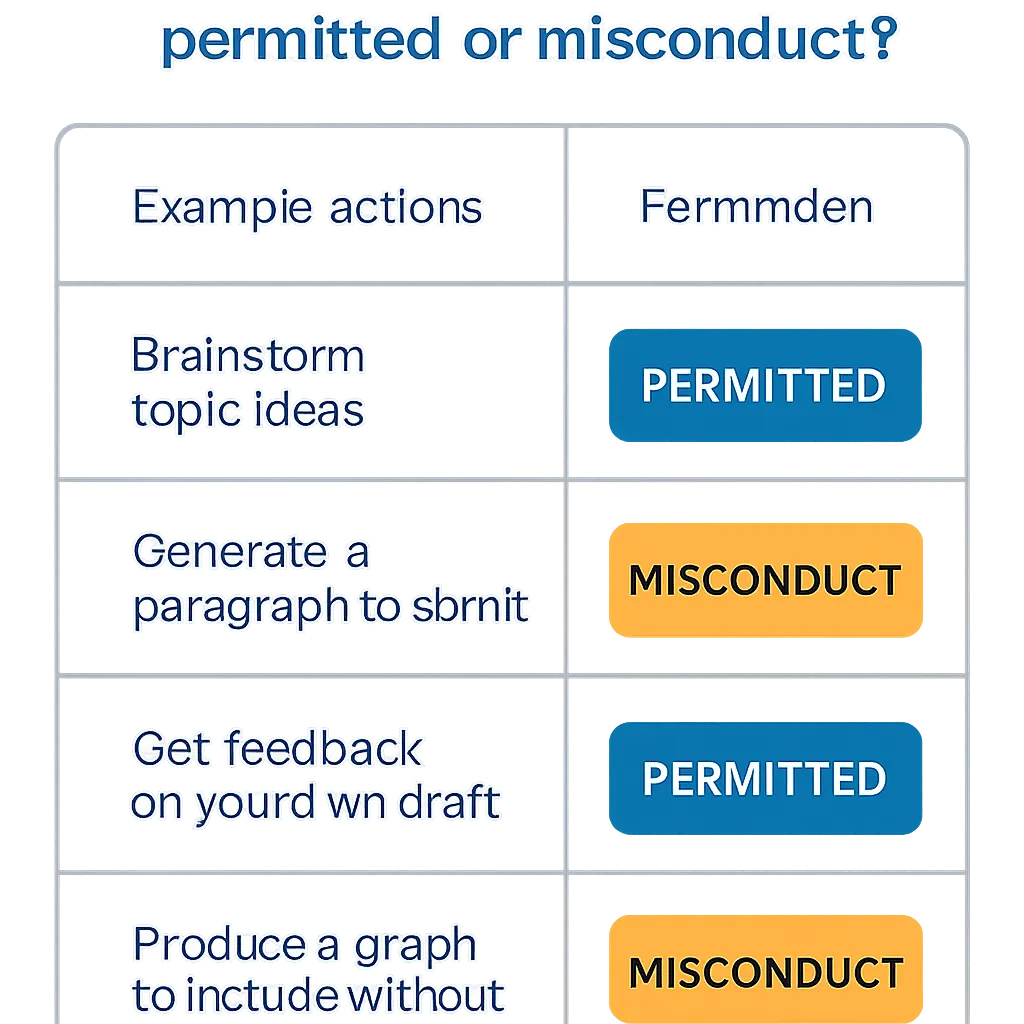
The IB draws the line at a precise point: AI as a thinking aid is permitted; AI as an author is not. The practical difference is whether the words, arguments, and conclusions in your submitted work originated in your own mind.
Permitted uses include:
- Using an AI tool to brainstorm possible research questions before you have settled on a topic
- Asking an AI to explain a concept you have encountered in your reading (checking your understanding, not replacing it)
- Pasting a draft you wrote yourself into an AI tool and asking for feedback on clarity or structure, then deciding which feedback to act on
Misconduct includes:
- Prompting an AI to generate paragraphs, arguments, or conclusions that you paste into your essay
- Using AI-generated images, graphs, or data visualisations without crediting them
- Asking an AI to write your introduction or abstract, even as a "starting point" you plan to edit
The IB is explicit on why editing AI output still fails the test: the organisation does not regard work produced by AI tools, "even only in part," as the student's own work.
The mark-scheme consequence is concrete, not just a rule. The IB has stated that an essay consisting predominantly of quotes "will not get many, if any, marks" under its mark schemes, and AI-generated text sits in the same category as quoted material you did not produce. The EE criteria assess your own research, analysis and argument across every criterion from A to E. An examiner scoring Criterion B (knowledge and understanding) or Criterion C (analysis and line of argument) cannot credit reasoning that was generated outside your own head, because they are evaluating your intellectual process, not the output on the page.
The non-obvious gotcha: lightly paraphrasing AI output does not move it into the permitted column. The IB's position targets origin, not surface form.
3. How to Cite AI Use in Your Extended Essay
If you do include AI-generated text, an image, or a graph directly in your submitted work, the IB requires you to credit it in the body of the text and reference it in the bibliography. The IB's March 2023 statement is explicit on this point: AI-generated content is not your own work, so it must be attributed just as a direct quotation from any other source would be.
What to record for each instance of AI output you use:
- The tool and version (for example, ChatGPT-4o, accessed via OpenAI)
- The exact prompt you entered
- The date you ran the query
- What specifically you took from the output (a sentence, a graph, a summary)
A bibliography entry might read: OpenAI. ChatGPT-4o response to the prompt "[your prompt text]". Generated [date]. Adapted/quoted in Section 2.
Here is the counter-intuitive part that catches students out: citation is not a workaround. The same IB statement warns that an essay which is "predominantly quotes" will not gain many, if any, marks under an IB mark scheme. That logic extends directly to quoted AI output. Citing AI content correctly satisfies the transparency requirement; it does not turn that content into scoreable analysis.
In practice, direct AI output should appear in an Extended Essay only in rare, justified cases, such as when the AI response itself is the object of study. Attribute it in-text at the point of use, then list the full entry in your bibliography.
4. How Your Supervisor and the Viva Voce Fit In
Your supervisor has a specific, bounded responsibility. Under the IB's Extended essay guide (first assessment 2027), they monitor your progress to make sure the essay is your own work, read and comment on one draft, then read the final version and, together with the viva voce, confirm its authenticity before it is uploaded. That means the authenticity check rests heavily on your process and on conversation, not just on inspecting the finished text.
The process has a fixed shape: three mandatory reflection sessions with your supervisor (first, interim and final), plus informal check-ins in between, within a recommended three to five hours of supervision. Your attendance at the three sessions is recorded on the RPF (Reflection and progress form), together with your reflective statement of up to 500 words, written at the end. What you say in those sessions about how your research and writing developed should match the essay. If you used an AI tool to summarise sources in your early research phase but describe your research as though you found and read every source independently, that inconsistency is itself evidence of a problem, regardless of what the essay contains.
The less obvious point: the final session, the viva voce, is where authenticity is checked in person. The IB's guide says it covers the authenticity of your ideas, and it takes place after you have handed in the final version of your essay, which cannot then be changed. Expect to be asked how you reached your argument; a student who cannot explain analysis that appears in their essay creates a visible mismatch. Your reflective statement is also submitted with the essay and marked by the examiner under Criterion E.
Your DP or extended essay coordinator is responsible for making sure you know the IB's Academic integrity policy, whose Appendix 6 covers AI, and its guidance on citing and referencing. That is the point at which your school's specific AI rules should be clarified, not after you have already started writing.
5. Practical Do and Don't: AI Use at Each Stage of the Extended Essay
The counter-intuitive point here is that the same AI behaviour can be acceptable in one stage and misconduct in another. The stage matters as much as the tool.
Research stage
- Do: Use AI to clarify terminology, generate initial angles on a topic, or map out what sub-questions your research question might need to address.
- Don't: Rely on AI output as evidence. The IB's Extended essay guide allows AI-generated material to be used as one of your resources, provided it is acknowledged and cited, but warns that AI can "hallucinate" and tells you to check what it produces against other sources. The IB's academic integrity position is that work produced by AI tools is not the student's own work. Every factual claim needs a verifiable primary or secondary reference behind it.
Example for this guide, not real student work: A student writing on urban poverty uses an AI chatbot to identify that "working poor" is a contested economic category, then goes to verified academic sources to find how economists actually define it.
Drafting stage
- Do: Plan your argument structure independently, write in your own voice.
- Don't: Use AI to draft paragraphs, generate thesis statements, or restructure your argument. The IB treats this as misconduct, "even only in part," per the IB statement on AI in assessment.
Editing and feedback stage
This is where the permitted space is wider than most students realise. DSB International School in Mumbai uses AI to let students self-check whether essay plans address all parts of a question before teacher conferences, with the AI identifying patterns but not rewriting anything. The same logic applies to the Extended Essay: asking an AI to flag whether your argument engages with Criterion B (knowledge and understanding, including accurate terminology and concepts) is analogous to formative feedback, provided the actual rewriting is entirely yours.
- Do: Prompt AI to identify structural gaps or whether a section addresses a specific criterion, then rewrite the relevant passage yourself.
- Don't: Accept AI-suggested sentences or paragraphs and paste them in, even lightly edited.
Sources and bibliography
- Do: Use AI to help you brainstorm search terms for databases.
- Don't: Substitute AI-generated summaries for reading actual sources. Any AI-generated text included in submitted work must be credited in the body of the text and referenced in the bibliography, which means if you include AI output at all, it needs a proper citation, not just a footnote.
The gotcha: students who use AI to summarise sources and then cite those original sources without reading them risk misrepresenting evidence under Criterion B, which rewards knowledge built from comprehensive, relevant research materials. An AI summary and a careful reading rarely produce the same understanding.
6. Using AI Ethically in School: The Broader IB Principle
The IB's position is not to ban AI outright. According to the IB, it will "work with schools to help students use AI tools ethically" rather than prohibit the tools entirely. That framing matters: the goal is responsible use, not avoidance.
The same statement makes clear that schools are expected to discuss types of academic misconduct with their students. That responsibility sits with your school, not solely with you, but it does mean you should have had those conversations before you submit anything.
The underlying principle is straightforward: ethical AI use in education means AI supports your thinking, not replaces it. The Extended Essay is explicitly designed to assess extended, independent thinking over a sustained research process. Outsourcing that process to an AI tool contradicts the entire point of the assessment, regardless of whether the output looks polished.
The less obvious catch is that school-level rules can be stricter than the IB minimum. Some coordinators restrict which tools are permitted, require AI logs earlier than the IB mandates, or prohibit AI use at specific EE stages altogether. The IB sets the floor; your school sets the actual rules you must follow. Confirm the specifics with your EE coordinator before you open any AI tool.
7. What to Do Next
Read the IB's official AI statement this week. It is the primary document and it is short. Then contact your EE supervisor directly to confirm what your school permits, because the IB expects schools to set their own additional boundaries around AI use, and those boundaries vary.
One non-obvious gotcha: the reflection sessions are formal, not an informal chat, and your supervisor uses them, especially the viva voce, to confirm the work is yours. If you have already used an AI tool at any stage, raise it at your next reflection session or check-in. Waiting until the viva voce makes an omission look deliberate.
Read the IB statement, then email your EE supervisor this week to ask for your school's written AI guidance before you open any AI tool for your Extended Essay.
FAQ
Can I use AI for my Extended Essay?
Yes, in limited ways - the IB permits AI for tasks like brainstorming or checking your understanding, but generating text or arguments to submit as your own is academic misconduct under the IB's academic integrity policy.
Do I have to declare AI use in my Extended Essay?
Yes - the IB requires that any AI-generated text, image, or graph included in submitted work is credited in the body of the text and listed in the bibliography, just like any other source.
Can I use AI to help with Extended Essay research?
AI can help you identify angles or clarify concepts at the research stage. If you use AI-generated material, cite it and check it against other sources, because AI can produce false information - every claim in your essay must be backed by verifiable primary or secondary materials you have read yourself.
What happens if I use AI to write part of my Extended Essay?
The IB does not regard work produced by AI tools - even only in part - as the student's own work, so submitting AI-generated content as your own is treated as academic misconduct and risks disqualification.
Can I use AI to edit or proofread my Extended Essay?
Using AI to get feedback on a draft you wrote yourself - for example, checking whether your argument addresses a specific criterion - sits in permitted territory, provided the rewriting is entirely yours and you are transparent with your supervisor about it.
How do the reflection sessions and the RPF relate to AI use in the Extended Essay?
Your supervisor confirms that the essay is your own through the three reflection sessions, especially the final one, the viva voce, which covers the authenticity of your ideas; the RPF records your attendance and your reflective statement. Mention any AI tools you used honestly in those sessions - an account that does not match your essay is itself a red flag.
References
- Statement from the IB about ChatGPT and artificial intelligence in assessment and education - International Baccalaureate® - https://ibo.org/news/news-about-the-ib/statement-from-the-ib-about-chatgpt-and-artificial-intelligence-in-assessment-and-education
- DP extended essay updates - International Baccalaureate - https://www.ibo.org/university-admission/latest-curriculum-updates/dp-extended-essay-updates/
- How AI is reshaping our classrooms - International Baccalaureate® - https://ibo.org/news/how-ai-is-reshaping-our-classrooms