Can You Use ChatGPT for IB IA? The Rules Explained
By Michael Thompson · Education Specialist; 10 years teaching the IB at Bromsgrove School · Published 4 September 2026 · Updated 6 October 2026
Can you use ChatGPT for IB IA work? The short answer is: not to write it for you, but not banned outright either. The IB's official position, confirmed in its March 2023 statement and updated as recently as February 2026, is that AI tools must be used in line with its academic integrity policy - and that any AI-generated content submitted as your own work is treated as misconduct. What counts as a breach, how your teacher checks for it, and where AI is genuinely allowed to help are all questions worth understanding before you open any chatbot near your IA draft.
Key Takeaways
- AI is not banned, but submitting AI-generated text as your own is misconduct: The IB will not prohibit tools like ChatGPT, but it explicitly states that work produced by AI - even only in part - is not considered the student's own work.
- Any AI contribution to submitted work must be cited: The IB requires AI-generated text, images, or graphs to be credited in the body of the work and referenced in the bibliography, just like any other source.
- Rules apply differently across subject groups: Sciences, Mathematics, Humanities, Language orals, and Arts IAs each have distinct formats, and the risk and impact of AI use varies considerably between them.
- Teachers verify authenticity through drafts, supervision sessions, and writing-style checks: Supervisors can compare first drafts to final submissions, use detection software, and interview students - and must report suspected misconduct before final upload.
- A confirmed breach means no IB Diploma: A student found in breach of IB academic integrity regulations will not be awarded their Diploma, making the stakes significantly higher than a lost assignment.
- Legitimate AI use as a study aid is possible: Using AI to explain concepts, brainstorm topic ideas, or check your own understanding - without feeding it your IA draft - sits outside the misconduct boundary.
In This Article
- What the IB Academic Integrity Policy Actually Says About AI
- How the Rules Apply Subject by Subject
- What Teachers Check Before Your IA Is Submitted
- How to Cite AI If It Did Contribute to Your Work
- Using AI Legitimately as a Study Aid - Without Touching the IA
- Practical Do and Don't Examples by Subject
- What to Do Next
1. What the IB Academic Integrity Policy Actually Says About AI
The short answer to whether can you use chatgpt for ib ia is: ChatGPT is not banned, but using it to generate content you then submit as your own will cost you marks and may trigger a misconduct case. The distinction the IB draws is precise, and it matters.
In a statement published 1 March 2023 and updated 19 February 2026, the IB confirmed it will not prohibit AI tools such as ChatGPT outright. Instead, any use must comply with the IB academic integrity policy. The policy's core principle is unambiguous: work produced by AI tools, even only in part, is not considered the student's own work.
That framing carries a practical sting. The IB compares AI tools to spell checkers, translation software, and calculators, which sounds permissive. But a calculator does arithmetic you could do yourself; it does not write your analysis for you. The analogy signals that AI is an acceptable support tool, not an acceptable author.
The mark-scheme consequence follows directly from that principle. Under IB mark schemes, an essay made up predominantly of quoted material earns few or no marks, because quotations are not the student's own thinking. The IB applies the same standard to AI-generated content. An IA built mainly on ChatGPT output is, in that framing, a submission of someone else's work, and it will be assessed accordingly.
If AI did contribute, the IB requires you to credit it in the body of the text and reference it in the bibliography. Silence is where most students come unstuck.
2. How the Rules Apply Subject by Subject
The IB's position is consistent across all subjects: work produced by AI tools, "even only in part", is not considered the student's own. Undeclared AI-generated content is classified as academic misconduct regardless of subject. But the practical risk varies depending on what each IA actually assesses.
Sciences (Biology, Physics, Chemistry)
Data collection must be the student's own, and so must the write-up. Using AI to interpret your results or narrate your analysis is treated the same as asking another person to write that section. The non-obvious trap here: paraphrasing AI-generated interpretation still fails the test if the reasoning isn't yours.
Mathematics (AI and Analysis & Approaches)
The Math exploration is assessed on the student's own mathematical reasoning, not just the correct answer. An AI-generated working or explanation directly undermines the core criterion examiners are marking. A student can arrive at the right conclusion and still score poorly if the demonstrated thinking isn't theirs.
Humanities (History, Geography)
Source evaluation, analysis and argument construction are explicitly assessed, and the History IA also marks your reflection on the process. An AI-drafted commentary cannot credibly demonstrate those skills, and a moderator reading a History investigation will notice generic, undifferentiated argument immediately.
Language Individual Oral
The oral is live and assessed in person, so AI cannot generate the submission directly. The integrity question arises earlier: AI-drafted preparation notes that shape tightly scripted responses blur the line between preparation and authorship.
Arts IAs
In Visual Arts, the art-making inquiry portfolio and the connections study (SL) or artist project (HL) must reflect the student's own creative and critical thinking across documented stages. A portfolio that jumps to polished conclusions without evidenced development is a red flag at moderation.
The bottom line is the same in every subject. Use AI to understand a concept, not to produce or shape the work you submit.
3. What Teachers Check Before Your IA Is Submitted
Supervisors are not simply reading your finished work and hoping for the best. Three safeguards run throughout the IA process: your teacher's ongoing supervision, the feedback on your draft, and the record of how your work developed. Together, these create a paper record of how your work developed, which makes late-stage AI insertion much harder to hide than students tend to assume.
The checks supervisors are explicitly permitted to run include:
- Comparing writing style across different drafts of your work
- Placing your first draft next to your final submission to spot unexplained jumps in quality or register
- Checking that sources listed in your bibliography actually support the claims you attribute to them
- Running your work through plagiarism detection software
- Interviewing you about your work in the presence of a third party
That last point is the one most students do not expect. A supervisor who finds a section they cannot reconcile with your usual voice can simply ask you to explain your own argument out loud.
The concrete non-obvious quirk here: a single bibliography entry is not enough. The IB states that listing a source is insufficient without in-text acknowledgment, so a supervisor comparing citations to body text can flag that mismatch as a red flag independently of any AI check.
If misconduct is suspected at any point before upload, the supervisor must immediately discuss it with you and inform the DP coordinator. They must not complete the final submission and must not sign the authenticity declaration. If the work has already been uploaded and is found not to be entirely your own, the DP coordinator must report this to the IB immediately. The consequence is unambiguous: a student found in breach will not be awarded the IB Diploma.
4. How to Cite AI If It Did Contribute to Your Work
The IB's position is precise: if AI-generated text, images, or graphs appear anywhere in your submitted work, you must credit them both in the body of the text and in the bibliography. Per the IB's official statement on AI in assessment, neither location alone is sufficient. In other words, listing a source in the bibliography alone does not count as acknowledgment.
In practice, a citation entry should capture:
- The tool and version - for example, "ChatGPT (GPT-4o, OpenAI)"
- The date of the exchange - AI outputs are not static; the same prompt can return different answers on different days
- The specific prompt or output used - a vague reference like "AI-generated graph" is not enough
The non-obvious gotcha: citing AI correctly does not make the submission compliant if the contribution is substantial. The IB compares AI-generated content to quotations under its mark schemes. An essay dominated by quotes earns few or no marks, and the same standard applies to AI-generated material. Proper citation shifts the risk from misconduct to a low grade, but it does not recover the marks. If the AI did the thinking, the mark scheme credits very little of it regardless of how honestly you disclosed it.
5. Using AI Legitimately as a Study Aid - Without Touching the IA
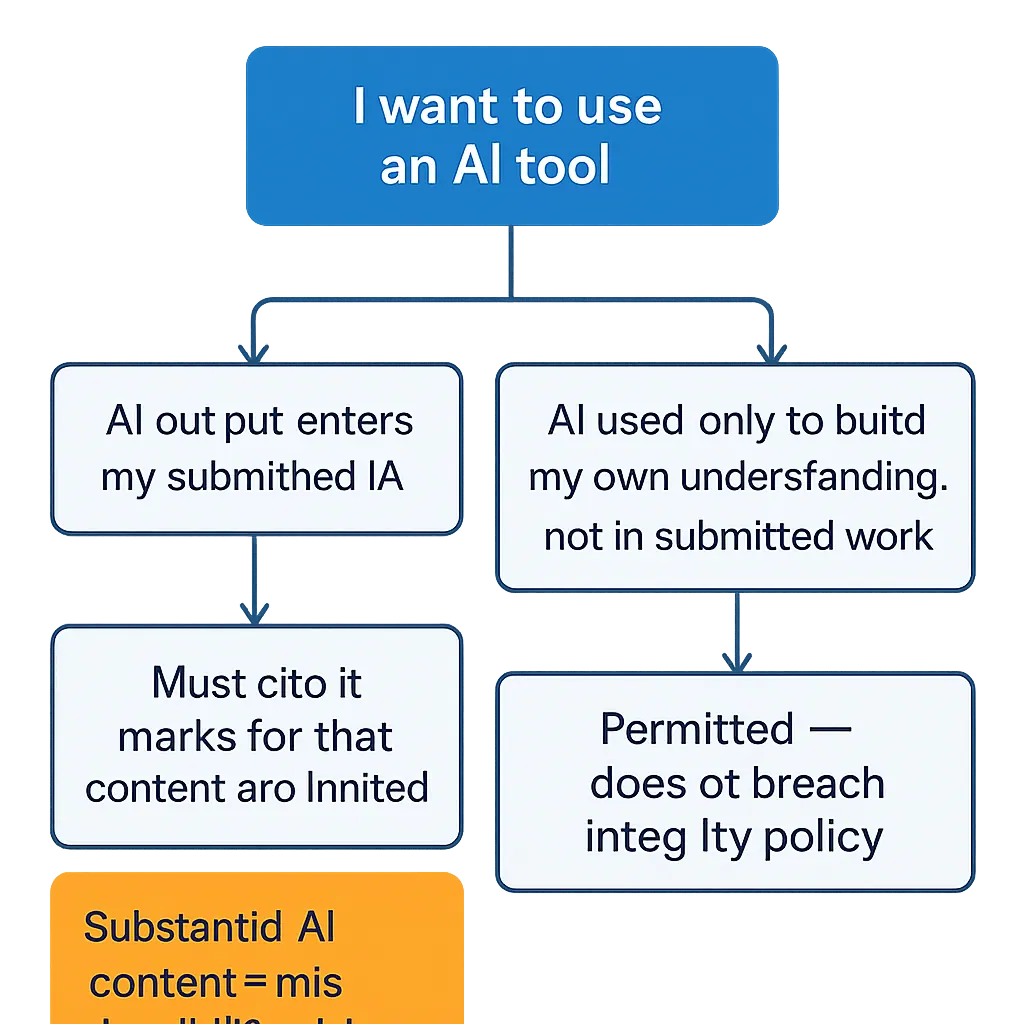
There is a workable middle ground here, and it is worth being precise about where it sits.
AI as a learning tool is fine; AI as a contributor to your submitted document is not. Asking ChatGPT to explain the Henderson-Hasselbalch equation because your textbook's explanation isn't clicking, using it to brainstorm broad topic areas before you settle on your own research question, or testing your own understanding by asking it follow-up questions - none of that touches your IA. The output stays in your head, not on the page.
The line moves the moment AI output enters your document in any form. The IB is explicit that AI-generated text, images, or graphs included in submitted work must be credited in the body and referenced in the bibliography - and once credited, that content counts as a quotation, not your own analysis. An IA heavy in quotations scores poorly under IB mark schemes for the same structural reason.
One specific danger worth flagging: AI tools routinely fabricate citations. A plausible-looking journal article with a real author's name and a realistic DOI can be entirely invented. Using an AI-generated reference without locating the original source is both an integrity risk and an accuracy risk. Always verify in the primary source before your reference list touches the document.
Finally, the IB has stated it will work with schools to help students use AI tools ethically, which means your school's own AI guidance may set stricter rules than the IBO minimum. Check it before your next IA session, not after.
6. Practical Do and Don't Examples by Subject
The line between acceptable and unacceptable AI use often comes down to one question: did the AI produce content you then submitted as your own thinking? The IB's position is explicit - work produced by AI tools, "even only in part", is not the student's own work. Here is how that applies subject by subject.
Biology
- DO: Ask AI to explain what a t-test measures before you run your own statistical analysis on your collected data.
- DON'T: Paste your raw data into ChatGPT and ask it to write your results and analysis section. The written interpretation is a marked criterion - submitting AI-generated analysis is misconduct.
Mathematics (AI or A&A)
- DO: Ask AI to clarify a mathematical concept you came across while forming your exploration idea, so you can understand whether it suits your investigation.
- DON'T: Use AI to generate the mathematical workings, proofs, or written commentary you then submit. The exploration is assessed on your own reasoning, and an examiner reading AI-produced commentary will find it reads like "predominantly quotes" - a description the IB applies to work that earns few or no marks.
History
- DO: Use AI for a plain-English orientation to a historical period before you source primary documents and secondary scholarship.
- DON'T: Use AI to write your source evaluation or reflection sections. These criteria exist specifically to assess your own interpretation.
Geography
- DO: Brainstorm possible fieldwork locations or research angles with an AI tool early in the planning stage.
- DON'T: Use AI to narrate your collected data or write your evaluation. The IA format requires your own analysis of your own fieldwork.
Language Individual Oral (e.g. French)
- The oral cannot be submitted by AI, but the risk is subtler: do not use AI to script talking points you then memorise and present as a spontaneous personal response. Examiners assess your interactive skills in a live conversation, and a rehearsed AI script undermines exactly that criterion.
7. What to Do Next
The IB's position on AI sets a minimum standard, but your school is free to go further. Many do. A supervisor who runs a stricter policy than the IBO baseline governs your IA before it ever reaches an examiner, which means the school's document is the one that actually matters at the point of submission.
The counter-intuitive part: students often read the IB's relatively measured statement and assume that settles it. It doesn't. School-level rules can prohibit tools the IBO merely asks you to cite.
This week, find and read your school's specific AI guidance document. If it isn't published on the school intranet, email your IB coordinator and ask for it by name. Do this before your next IA draft session, not after.
FAQ
Can you use ChatGPT for IB IA analysis?
No - having AI write your analysis means the analytical thinking is not your own, which breaches the IB's academic integrity policy; you may use AI to understand a method before applying it yourself, but the written analysis in your submitted IA must be your own work.
Can you use ChatGPT for IB IA research and finding sources?
With caution - AI tools can suggest research directions or explain background concepts, but they frequently produce inaccurate or fabricated citations, so any source an AI mentions must be independently verified before you use it.
Can you use ChatGPT for IB Maths IA?
No: the Mathematics IA exploration must demonstrate your own mathematical reasoning, and AI-generated workings or written commentary would not satisfy that requirement and would need to be cited, reducing the marks available.
Can you use ChatGPT for IB History IA?
The History IA is assessed on your own source evaluation, investigation and reflection, so AI-drafted commentary cannot credibly demonstrate those skills; use AI only to orient your background reading, never to draft the submitted sections.
Can you use ChatGPT for IB IA in Geography?
You may use AI to brainstorm fieldwork ideas before you begin, but any data narration, evaluation, or written analysis in the submitted Geography IA must be your own - undeclared AI content is treated as academic misconduct.
What happens if your IB IA is suspected of being AI-generated?
Your supervisor must immediately discuss it with you and inform the DP coordinator; if misconduct is confirmed, the IB can withhold the Diploma entirely - not just the mark for that subject.
References
- Statement from the IB about ChatGPT and artificial intelligence in assessment and education - International Baccalaureate® - https://ibo.org/news/news-about-the-ib/statement-from-the-ib-about-chatgpt-and-artificial-intelligence-in-assessment-and-education
- IB Internal Assessment: Marking, Weighting, Deadlines - https://myrevisionagent.com/guides/ib-internal-assessment