IB Extended Essay: The Complete Guide (2026)
By Michael Thompson · Education Specialist; 10 years teaching the IB at Bromsgrove School · Published 21 May 2026 · Updated 6 October 2026
The IB Extended Essay is a 4,000-word independent research paper that every Diploma Programme student must complete. It is one of the most demanding components of the IB - and one of the most misunderstood. Students often lose marks not through weak analysis but through avoidable mistakes: exceeding the word limit, misreading the assessment criteria, or treating supervisor meetings as optional. This guide covers every mechanism you need to know, from choosing a subject and framing a research question to understanding how the 30 marks of the new model, first assessed in May 2027, are awarded and how your grade combines with Theory of Knowledge to unlock bonus points.
Key Takeaways
- 4,000 words is the hard ceiling: Examiners stop reading at 4,000 words; anything beyond that is ignored, which can gut your marks for criteria that depend on your conclusion.
- Five criteria, 30 marks from May 2027: The EE is marked on Framework for the essay (A), Knowledge and understanding (B), Analysis and line of argument (C), Discussion and evaluation (D) and Reflection (E), with Reflection assessed only from the reflective statement on your RPF, not the essay itself.
- The RPF and three reflection sessions are compulsory: You attend three reflection sessions with your supervisor, the last of which is the viva voce, and write one reflective statement of up to 500 words at the end; a blank or missing RPF scores zero on Criterion E.
- Two pathways, one set of criteria: You can write a subject-focused EE in one DP subject or an interdisciplinary EE that integrates two, and both are marked against the same criteria.
- Subject choice affects your bonus-point ceiling: Your EE grade combined with your TOK grade produces 0-3 bonus points via the IB's matrix - the subject you pick for your EE indirectly shapes that calculation.
- Your supervisor can guide, not write: A supervisor may read one full draft and give written feedback once; they cannot edit your work, suggest specific arguments, or provide detailed line edits.
- A strong research question is the single biggest lever: A question that is too broad, too narrow, or untestable with available sources will constrain every other criterion, regardless of how well you write.
In This Article
- What Is the IB Extended Essay?
- Extended Essay Word Count: What's Included and What Isn't
- IB EE Assessment Criteria: The 30-Mark Model
- The RPF and Your Three Reflection Sessions
- Choosing a Subject and Framing Your Research Question
- The TOK-EE Bonus Point Matrix
- The Supervisor's Role: What They Can and Cannot Do
- AI, Academic Integrity, and the Extended Essay
- Common Mistakes That Cost Marks
- Where to Go from Here
1. What Is the IB Extended Essay?
The IB Extended Essay is a formal, independently researched academic essay of up to 4,000 words, compulsory for every student completing the IB Diploma Programme. Unlike coursework that's marked by your school, the EE is submitted externally to the International Baccalaureate Organization and assessed by an examiner who has never met you. The grade runs from A (highest) to E (lowest), and it combines with your Theory of Knowledge grade to determine whether you earn any bonus points toward your final Diploma score.
The purpose is deliberate: the IBO designed the EE to bridge the gap between secondary school and university. You define your own research question, gather sources, build an argument, and defend it in writing, with only limited guidance from a supervisor. That process, not the finished document, is much of the point.
One counter-intuitive detail worth knowing early: an E grade on the EE is an automatic failing condition for the Diploma, regardless of how well you perform elsewhere. A student who scores a perfect 42 points across their six subjects but receives an E still does not earn the Diploma. That makes the EE a threshold requirement, not just a bonus opportunity.
2. Extended Essay Word Count: What's Included and What Isn't
The 4,000-word limit is absolute. IB examiners are instructed to stop reading once the count is reached, which means any argument, analysis, or conclusion that runs past that point is invisible to the person marking your work. There is no grace allowance.
What counts toward the 4,000 words
- The main body of the essay, including your introduction and conclusion
- All quotations embedded in the text
- Footnotes or endnotes that extend your argument - for example, a note that qualifies a claim or adds a secondary line of reasoning
What does not count
- Title page, contents page, and acknowledgements
- The abstract - worth noting that the IB no longer requires an abstract under current rules, so including one wastes space rather than earning credit
- Bibliography and reference list
- Appendices
- Footnotes or endnotes used solely to cite a source (a page reference or a bibliographic note)
The distinction between argument-extending notes and citation-only notes is the non-obvious gotcha here. A footnote that says "see Smith, 2019, p. 45" does not count. A footnote that says "this interpretation is contested by a rival school of thought because..." does count, and will eat into your limit whether you intended it or not.
Practical guidance on length
Falling significantly short of 4,000 words also costs marks - examiners infer that the analysis is underdeveloped. Most well-executed essays land between 3,500 and 4,000 words. Treat 3,500 as a soft floor and 4,000 as a hard ceiling, and plan your sections accordingly before you start writing, not after.
3. IB EE Assessment Criteria: The 30-Mark Model
From the May 2027 session, every extended essay, whatever its pathway or subject, is marked against five common criteria worth 30 marks in total. They are set out in the IB's Extended essay guide (first assessment 2027); the IB summarises the changes on its extended essay updates page.
| Criterion | What it assesses | Marks |
|---|---|---|
| A - Framework for the essay | Research question, research methods, structure | 6 |
| B - Knowledge and understanding | Knowledge from research materials, terminology, concepts | 6 |
| C - Analysis and line of argument | Analysis, line of argument | 6 |
| D - Discussion and evaluation | Discussion of your findings, evaluation of the essay's strengths and limitations | 8 |
| E - Reflection | Evaluative reflection, growth and transfer of learning | 4 |
| Total | 30 |
Criteria A to D are applied to the essay as a whole. Criterion E is applied only to the reflective statement on your Reflection and progress form (RPF), so the examiner does not mark it from the essay itself.
Criterion D, worth 8 of the 30 marks, is the heaviest criterion. It rewards a balanced discussion of what your findings mean, supported by evidence, and an evaluation of your own essay that explains its strengths and limitations. There is no separate presentation criterion: structure is a strand of Criterion A, and the quality of your sources counts under A's research-methods strand and B's knowledge strand. For the level-by-level descriptors, see our Extended Essay criteria guide.
No grade boundaries exist yet for the 30-mark scale. Senior examiners set them after the May 2027 session, and results are released on 6 July 2027, so treat any A-E mark ranges you see for this model as guesswork.
November 2026 candidates only: your essay is marked on the old model, out of 34: A Focus and method (6), B Knowledge and understanding (6), C Critical thinking (12), D Presentation (4) and E Engagement (6), with Engagement marked from the Reflections on planning and progress form (RPPF), which the RPF replaces.
4. The RPF and Your Three Reflection Sessions
Reflection is recorded on the Reflection and progress form (RPF). It holds two things: a record that you attended the three mandatory reflection sessions with your supervisor, and your reflective statement of no more than 500 words, written at the end of the EE process. The RPF is submitted with your essay, and examiners do not read beyond the 500-word limit.
The IB recommends three to five hours of supervision in total, including the three sessions, each of which should last 20 to 30 minutes. Shorter check-ins in between are encouraged but are not recorded on the RPF.
The three sessions follow the shape of the essay process:
- First reflection session - a dialogue based on your initial exploration: possible topics, which pathway and subject or subjects fit, suitable research methods and any ethical issues. You should leave with next steps and the start of a research question.
- Interim reflection session - a check-in once your research is under way. You discuss a completed piece of writing, the challenges you have met, whether your research question needs amending and the line of argument you plan to develop.
- Final reflection session (viva voce) - a short concluding interview after you have handed in the final version of your essay, which cannot be changed afterwards. It covers what you learned and the authenticity of your ideas, and it is the main source of material for your reflective statement.
Criterion E (Reflection, 4 marks) is assessed only from the reflective statement. Examiners look for reflection that is evaluative rather than descriptive, uses specific examples, and shows your growth as a learner and how you could transfer what you learned. A blank or missing RPF, or one written in a different language from the essay, scores zero on Criterion E.
What distinguishes a high-scoring statement is evaluation, not a summary of the process. Explain how a decision changed your direction, what a setback taught you, and where you could use a skill again. Because the statement is written at the end, keep notes after each session (the IB recommends a researcher's reflection space for this); a statement reconstructed from memory tends to read as generic.
5. Choosing a Subject and Framing Your Research Question
The EE must be written in a DP subject available for your exam session, and from May 2027 you choose one of two pathways. In the subject-focused pathway you research a topic within one DP subject. In the interdisciplinary pathway, which replaces the old World Studies EE, you integrate knowledge, concepts, theories or methods from two DP subjects and register the essay under one of five broad frameworks the IB provides. Both pathways are assessed against the same common criteria. Environmental systems and societies (ESS) and literature and performance can only be taken in the subject-focused pathway. Choose the interdisciplinary route only when your question genuinely needs both subjects; the IB strongly recommends that you study at least one of the two.
Choosing a subject you study at Higher Level is generally the safest move. HL study gives you deeper conceptual grounding, familiarity with subject-specific methodology, and a supervisor who can engage meaningfully with your argument. Picking a subject you only know at Standard Level, or not at all, creates a gap that 4,000 words will expose.
Popular subject choices include Biology, History, Economics, English A, Psychology, Business Management, Chemistry, and Physics. The IBO publishes subject-specific guidance for each, and the expectations differ sharply between them.
Subject-specific framing matters more than most students expect
- IB History extended essay questions should be framed around causation, significance, or historical comparison. "Was X a cause of Y?" or "To what extent did Z change between [period A] and [period B]?" are the shapes examiners recognise. Descriptive or purely narrative questions lead to essays that score poorly on Criterion C, which rewards analysis and a line of argument.
- IB Physics extended essay research questions can be answered from primary data you collect in your own experiment or from secondary data such as published datasets. Either way, the data must come from a standardised, controlled method so that your conclusions are valid, and the topic must be realistic for the equipment your school has.
A strong research question is specific, arguable, and answerable within the word limit using sources you can actually access. The counter-intuitive trade-off: a narrower question almost always produces a better essay than a broader one, because scope control is itself evidence of intellectual rigour.
Questions to avoid
- Too broad: "How does climate change affect biodiversity?" has no defensible boundary.
- Yes/no questions with no analytical dimension: "Did the Treaty of Versailles cause World War Two?"
- Questions requiring primary data you cannot realistically collect: surveys of inaccessible populations, lab equipment your school does not have, archives in another country.
Spend time shaping the question before you commit. Changing it at the first reflection session is normal; changing it after the second costs you weeks.
6. The TOK-EE Bonus Point Matrix
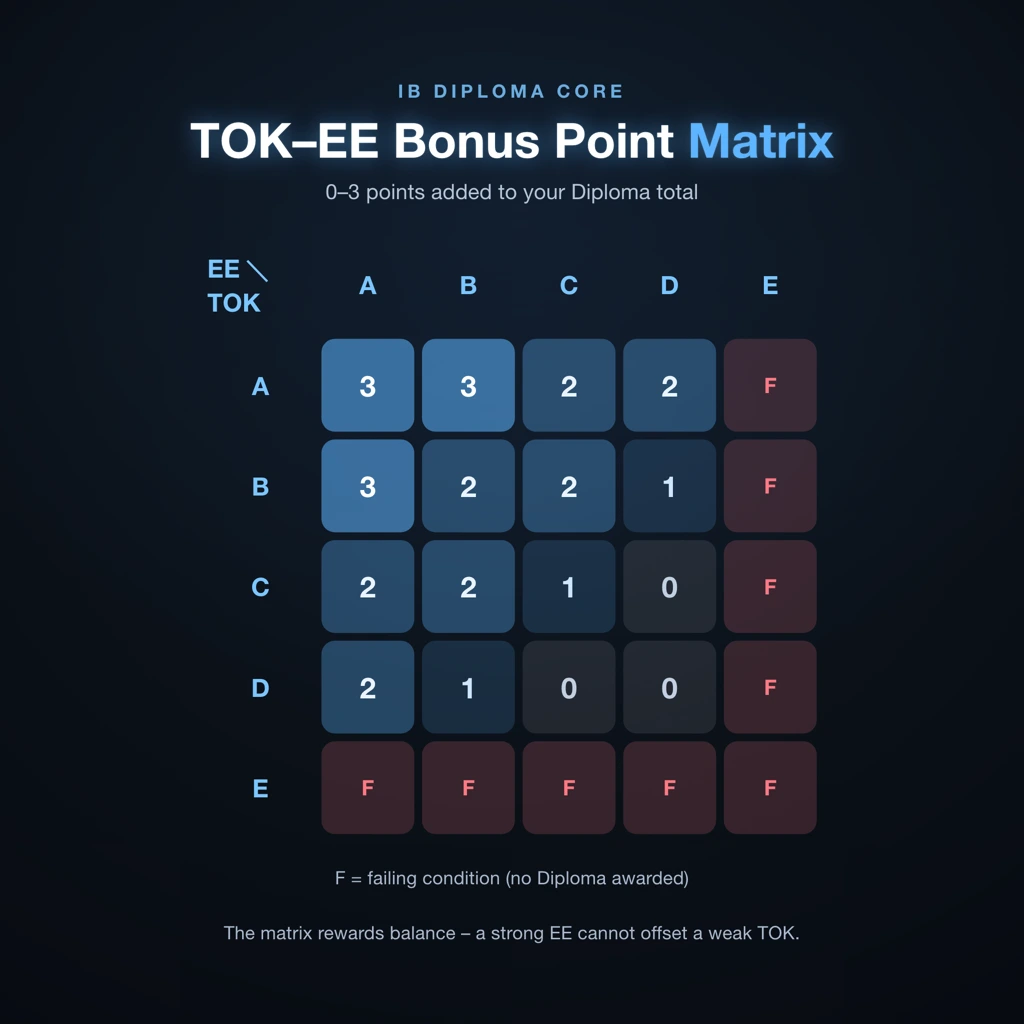
The IB awards between 0 and 3 bonus points based on the combined grades a student achieves in the Extended Essay and Theory of Knowledge. These points are added directly to the Diploma total, which has a maximum of 45 points. The new 30-mark EE still produces a grade from A to E, and the IB's 2027 guide keeps the rule that the EE and TOK together contribute up to three points, using the same matrix as before.
Here is the full matrix:
| EE \ TOK | A | B | C | D |
|---|---|---|---|---|
| A | 3 | 3 | 2 | 2 |
| B | 3 | 2 | 2 | 1 |
| C | 2 | 2 | 1 | 0 |
| D | 2 | 1 | 0 | 0 |
A D grade in either component caps the bonus well below the maximum, and two weak grades can drag it to zero. Any E grade in either the EE or TOK is a failing condition: regardless of how well a student performs across their six subjects, an E means the full IB Diploma is not awarded.
The practical consequence of the matrix is easy to underestimate. A student with a C on the EE and a C in TOK earns one bonus point. Improving that EE to a B, while holding the TOK grade steady, moves them to two bonus points. In a competitive year where a student sits on 37 points from their subjects, that single-point shift takes them to 39, which is a meaningful threshold for many university conditional offers.
The less obvious quirk: because the two grades are read together, the specific pairing matters more than either grade on its own. A student who writes an exceptional EE graded A but neglects TOK and receives a D earns two bonus points - no better than a student who scored a solid B in both, and short of the maximum 3. To reach the top of the matrix you need strength in both components, not a single standout grade.
7. The Supervisor's Role: What They Can and Cannot Do
Every IB student is assigned a supervisor, usually a subject teacher at their school, who oversees the extended essay process from first planning session to final sign-off. The relationship is more formal than it looks, and the IBO draws clear boundaries around what supervisors may and may not do.
What supervisors can do:
- Hold regular check-ins to discuss the student's direction and progress
- Read and comment on ONE draft of the essay, after the interim reflection session and before the final one (not multiple full passes)
- Record the student's attendance at each of the three reflection sessions on the RPF and, after the viva voce, confirm that the final essay is the student's own work
- Point students toward appropriate resources, databases, or methodological approaches
What supervisors cannot do:
- Edit, proofread, or correct the draft
- Write any part of the essay or suggest specific arguments and conclusions
- Give line-by-line comments on language or structure
- Provide feedback on a second full draft
The one-draft rule is the detail most students misunderstand. A supervisor who reads two full drafts and comments on both has exceeded the IBO's permitted involvement, which puts the student's academic integrity record at risk, not just the supervisor's. The safer move is to treat that single read as precious: submit a draft that is already structurally complete, so the feedback addresses substance rather than fixing gaps you could have closed yourself.
Supervisors also carry a formal duty around academic integrity. If they suspect AI misuse, plagiarism, or misrepresentation in the RPF, they are required to flag it to the school's IB coordinator.
One thing supervisors are not obliged to do: chase you. If you miss a reflection deadline or skip a meeting, the responsibility sits with you. Schedule sessions early in each term and confirm them in writing.
8. AI, Academic Integrity, and the Extended Essay
The IBO's academic integrity policy does not ban AI tools, but it does not treat AI-generated material as your own work: anything you use must be credited in the text and the bibliography, and if an AI tool wrote a paragraph and you submitted it as your own, that is misconduct. The consequence can be a null result for the entire IB Diploma, not just the Extended Essay grade.
The line is authorship, not tool use. The IBO distinguishes between using AI to help you understand material and using AI to produce the work itself.
Permitted uses:
- Running a search through an AI-assisted discovery tool to surface relevant literature you then read yourself
- Pasting a dense academic abstract into an AI tool to help you paraphrase it for your own comprehension, before writing your own summary
- Using grammar-checking software (including AI-enhanced tools like Grammarly) to proofread language you wrote
Prohibited uses:
- Prompting an AI to draft arguments, structure analysis, or write any passage that appears in the submitted essay
- Using AI to generate a research question or evaluation section and then editing it lightly
One non-obvious gotcha: your supervisor must confirm that the final essay is authentically yours before it is uploaded, and the viva voce, which covers the authenticity of your ideas, is part of that check. If AI misuse is discovered after submission, the supervisor's confirmation does not protect you - it implicates them too, which means schools have a strong institutional incentive to check drafts carefully before signing off.
Keep every draft, annotated bibliography entry, and working note. A student who can show a paper trail of iterative thinking is in a far stronger position if authenticity is ever questioned than a student who submits a polished final document with no visible working.
9. Common Mistakes That Cost Marks
Most marks are lost in the same four places, every session.
Criteria A and C: a research question that drifts. A question framed as "To what extent does X affect Y in context Z?" must be answered directly in the conclusion. Examiners notice when the conclusion answers a subtly different question from the one posed on page one. Criterion A rewards a clear, focused question and Criterion C a line of argument that links the question, findings and conclusions, so a vague or broadened question at the start costs marks on both. Nail the question before you write a word of the body.
Criterion C: description instead of analysis. A common pattern is spending three paragraphs summarising what a source says, then one sentence on what it means. Examiners reward analysis, not reporting. If your paragraphs could be replaced by an annotated bibliography, they are not analytical enough.
Criterion D: no evaluation of the essay itself. Criterion D, the heaviest at 8 marks, asks you to discuss the significance of your findings and to evaluate your own essay, explaining its strengths and limitations. An essay that ends on a summary of findings leaves part of those marks unclaimed.
Criterion E: a descriptive reflective statement. The statement is written at the end, but one pieced together from memory tends to produce generic lines ("I learned a lot about my topic") rather than an evaluation of your own development. Criterion E rewards specific examples and evidence of growth and transfer of learning, so keep notes after each session and draw on your viva voce.
Word count: both extremes are problems. Exceeding 4,000 words means examiners stop reading at that point, so anything beyond it is unmarked. Submitting well under 3,500 words without a structural reason signals to examiners that the argument lacks sufficient depth, even if every sentence present is strong.
10. Where to Go from Here
The most useful thing you can do this week is ask your EE coordinator for your school's internal submission deadline. Most schools set that date six to eight weeks ahead of the IBO's own submission window, which means your first full draft needs to exist well before most students expect. Work backward from the internal deadline to pick a date for that draft, and block it in now.
One non-obvious point worth acting on: your Extended Essay is citable evidence of independent research in a UCAS personal statement. IB applicants who name their EE topic and its findings give admissions readers something concrete to ask about at interview.
The subject-specific guidance sits in the IB's Extended essay guide, which your school's IB coordinator can share from the Programme Resource Centre. Read the section for your subject before your next supervisor meeting. Contact your coordinator this week and confirm the exact internal deadline in writing.
More on the Extended Essay:
- Extended Essay 2027: What Changed and What Stayed the Same
- Extended Essay Structure: Sections, Format and 4,000 Words
- Extended Essay Research Question: How to Write a Good One
- Extended Essay Viva Voce: What Happens and How to Prepare
FAQ
How many words is the IB Extended Essay?
The IB Extended Essay has a maximum word count of 4,000 words; examiners stop reading at that point, so anything beyond it is not assessed.
What is the IB Extended Essay out of?
From the May 2027 session the EE is marked out of 30 across five criteria, then converted to a grade from A to E, which combines with the TOK grade to award 0-3 bonus points toward the 45-point Diploma total.
Does the IB Extended Essay need an abstract?
No - the IBO removed the abstract requirement under its current assessment model; including one will not harm your mark but it also won't count toward the word limit.
How is the IB Extended Essay graded?
Examiners mark the EE against five criteria (Framework for the essay, Knowledge and understanding, Analysis and line of argument, Discussion and evaluation, Reflection), producing a raw score out of 30 that maps to a letter grade from A to E; the boundaries for the 30-mark scale are set after the May 2027 session.
Is the IB Extended Essay hard?
The EE is demanding primarily because it requires sustained independent work over many months, but students who choose a focused research question, engage genuinely with their supervisor, and start drafting early typically find it manageable.
When is the IB Extended Essay due?
The IBO sets submission windows by exam session (May or November), but your school's internal deadline will be weeks earlier - ask your EE coordinator for the exact date at the start of your DP2 year.
References
- DP extended essay updates - International Baccalaureate - https://www.ibo.org/university-admission/latest-curriculum-updates/dp-extended-essay-updates/