How to Write an EPQ Dissertation: Structure and Word Count
By Michael Thompson · Education Specialist; 10 years teaching the IB at Bromsgrove School · Published 24 October 2026 · Updated 25 October 2026
How to write an EPQ well comes down to one decision made early: treating it as a structured academic project, not a long essay written at the end. Knowing how to write an EPQ starts with the length: on AQA and OCR a dissertation or research-based written report runs to approximately 5,000 words (WJEC asks for at least 5,000; Pearson gives no figure), assessed across four objectives that reward planning, sourcing, argument, and honest evaluation - with the argument, AO3, carrying the largest share of the marks. Each board - AQA, OCR, WJEC, and Pearson - shares the same four assessment objectives but applies its own mark total and documentation requirements. Get the structure right from the start and the word count, the referencing, and the evaluation almost look after themselves.
Key Takeaways
- Word count guidance varies by route and board: A dissertation or research-based written report is approximately 5,000 words under AQA and OCR and at least 5,000 under WJEC; an artefact project needs a shorter accompanying report (1,000 words minimum under AQA and OCR, 1,500 under WJEC); Pearson students should take the figure from their unit guidance.
- All four assessment objectives must be evidenced: AO1 (Manage), AO2 (Use resources), AO3 (Develop and realise), and AO4 (Review) are shared by every board; your log, your sourcing, your argument, and your evaluation each earn separate marks.
- The production log is part of the submission, not an afterthought: Moderators have found that logs completed retrospectively, or sparsely, weaken AO1 evidence regardless of how strong the written report is.
- In-text citations are compulsory - bare hyperlinks are not acceptable: OCR moderators explicitly identified the omission of in-text citations and the use of URLs in place of formatted references as a marker of weaker submissions.
- Scope matters as much as quality of writing: OCR moderators noted that projects too limited or too large in scope for 120 guided learning hours were unsuitable at Level 3, so a focused, answerable question is essential.
- Evaluation must judge, not just describe: OCR's moderators distinguish between evaluations that reflect with genuine insight on strengths and weaknesses and those that merely recount what was done, and AQA's grade descriptions draw the same line between 'full, in-depth evaluations' at A* and giving 'some thought' to the outcome at E.
In This Article
- EPQ Word Count by Board and Route
- Assessment Objectives and How the Marks Split
- Choosing a Question and Scope That Fits 120 Hours
- EPQ Dissertation Structure: Section by Section
- How to Write the EPQ Literature Review
- Writing the EPQ Introduction and Building the Argument
- EPQ Evaluation: Judging, Not Describing
- The Production Log: Why It Is as Important as the Essay
- Pre-Submission Checklist
- What to Do Next
1. EPQ Word Count by Board and Route
The word count for an EPQ depends on which exam board sets your qualification and which route you take. The table below shows the guidance from each board for a research-based written report. These are not uniform across routes: an artefact project carries a much lower written requirement because the product itself is the main outcome.
| Board | Dissertation / research-based written report | Written report accompanying an artefact or non-written outcome |
|---|---|---|
| AQA | Approximately 5,000 words | Minimum 1,000 words |
| OCR (H857) | Approximately 5,000 words | Minimum 1,000 words |
| WJEC | At least 5,000 words | At least 1,500 words (Project Outcome Notes) |
| Pearson (Edexcel) | No figure given on the specification page | No figure given on the specification page |
Sources: AQA 7993 specification, section 2.5.1, OCR H857 specification v2.1, WJEC EPQ Student Guide 2021.
Pearson students should take their word count figure from their unit guidance and tutor-assessor directly, not from the specification landing page, which does not state one.
One point that catches AQA students out: AQA has no separate performance route. If your project is a film, composition, or live performance, it is classified as an artefact product, so the written report minimum is 1,000 words rather than 5,000. WJEC, by contrast, explicitly lists performance alongside artefact and creative writing in its Project Outcome Notes category, requiring at least 1,500 words for that written element.
The "approximately 5,000 words" figure for a dissertation is guidance, not a hard ceiling. Going significantly over suggests scope that is too broad for 120 guided learning hours; going significantly under suggests a question that was too narrow.
2. Assessment Objectives and How the Marks Split
Every EPQ board uses the same four assessment objectives. Understanding their weighting before you start writing tells you exactly where to concentrate your effort.
The four objectives are:
- AO1 Manage - plan and manage the project
- AO2 Use resources - find, select and use appropriate sources
- AO3 Develop and realise - produce the project outcome (the dissertation itself)
- AO4 Review - evaluate the outcome and the process
The mark split differs by board, but one pattern holds everywhere: AO3 carries the highest weighting on every board. The written argument earns more marks than any other single objective - twice as many as each of the others on AQA, OCR and WJEC.
Marks by board
| Board | Total marks | AO1 | AO2 | AO3 | AO4 | Grade scale |
|---|---|---|---|---|---|---|
| AQA | 50 | 10 | 10 | 20 | 10 | A*-E |
| OCR | 60 | 12 | 12 | 24 | 12 | A*-E |
| WJEC | 100 | 20 (LO1+LO2) | 20 (LO3+LO4) | 40 (LO5+LO6) | 20 (LO7+LO8) | A*-E |
| Pearson | 54 | 9 | 12 | 24 | 9 | A*-E |
Sources: AQA 7993 specification / OCR H857 specification / WJEC Level 3 Extended Project specification (April 2023), which sets out the learning-outcome marks / Pearson Level 3 Extended Project specification, Issue 4; Pearson's student guidance gives the same per-objective marks
A practical note on OCR: the qualification is worth up to 28 UCAS points under the new tariff, and its marking criteria use four bands per objective, which makes the descriptors more granular than AQA's grid.
WJEC splits AO4 into two separate learning outcomes: LO7 covers the presentation (10 marks) and LO8 covers the written evaluation and review (10 marks). The presentation is therefore formally assessed, not just a formality.
Which dissertation sections evidence which objective
This mapping is where knowing the AOs pays off practically:
- Introduction and stated aims - evidence AO1 alongside the project log; clear aims show you planned and managed the project purposefully
- Literature review and citations - evidence AO2; the quality and range of your sources, and how you evaluate them, sits here
- Discussion and analysis chapters - evidence AO3; this is the bulk of the word count and the bulk of the marks
- Conclusion and evaluation - evidence AO4; this is where you review the outcome and reflect on the process
Write each section with its objective in mind. If your discussion chapter is thin, your AO3 mark suffers regardless of how thorough your literature review is.
3. Choosing a Question and Scope That Fits 120 Hours
The title is not just a label. It is the decision that shapes everything else, and getting it wrong early is expensive to fix.
OCR moderators' report for Summer 2024 flags this directly: projects that were "too limited or too large in scope" were deemed unsuitable for a Level 3 qualification at 120 guided learning hours. Both failure modes are common. A question like "What causes climate change?" gives you nothing to argue. A question like "How has geopolitical competition shaped renewable energy investment policy across the G20 since 2010?" cannot be researched, analysed, and written up in the same hours you are also managing coursework and A-level revision.
The same report notes that successful candidates "selected a topic which genuinely interested them" and "refined a research question which was targeted and focused." The word "refined" matters. Your first question is almost never the right question. Expect to narrow it at least once after initial reading.
The form your title takes depends on your route. Pearson's student guidance suggests a different form of working title for each of its four units:
| Pearson unit | Suggested form of working title |
|---|---|
| Dissertation | A question |
| Investigation | A hypothesis |
| Performance | A commission brief |
| Artefact | A design brief |
If you are writing a dissertation on any board, frame the title as a question rather than a statement or a topic area: OCR's moderators found that candidates who did well had 'refined a research question' that was 'targeted and focused', while those who did less well 'selected a generic topic'.
AQA, OCR and Pearson all require your title or proposal to be approved by your centre before the project proper begins - on Pearson the project proposal form is signed by your tutor-assessor and a second member of staff, the 'proposal checker', before you carry out any further work - and WJEC's project file opens with a Proposal and Title form. This is not a formality to rush. If the question changes later, record the change and the reason in your log: OCR's moderators credit candidates who 'made and justified changes to their plans and topics', and AQA's Production Log has a section for changes to the plan and the reasons for them.
One detail OCR moderators flag that surprises many candidates: at least some of your stated aims must relate to the steps needed to achieve your planned outcome, not solely to your own skill development. "I want to improve my research skills" is not a project aim. "I will compare three primary theoretical frameworks on X to answer my research question" is.
A focused EPQ question also gives you something concrete for a UCAS personal statement or interview: the OCR specification quotes the University of Manchester saying students 'can refer to the Extended Project in their UCAS personal statement and at interview to demonstrate some of the qualities that universities are looking for'. A well-defined research question gives you something specific to describe, rather than a vague reference to "doing a project."
Before submitting your title for approval, run it through these three checks:
- Could you realistically read the core sources and form an argument in under 120 hours, alongside your other qualifications?
- Does it call for analysis, comparison, or evaluation, rather than description?
- Would a reader know exactly what the essay will and will not cover?
If any answer is no, narrow the question first.
4. EPQ Dissertation Structure: Section by Section
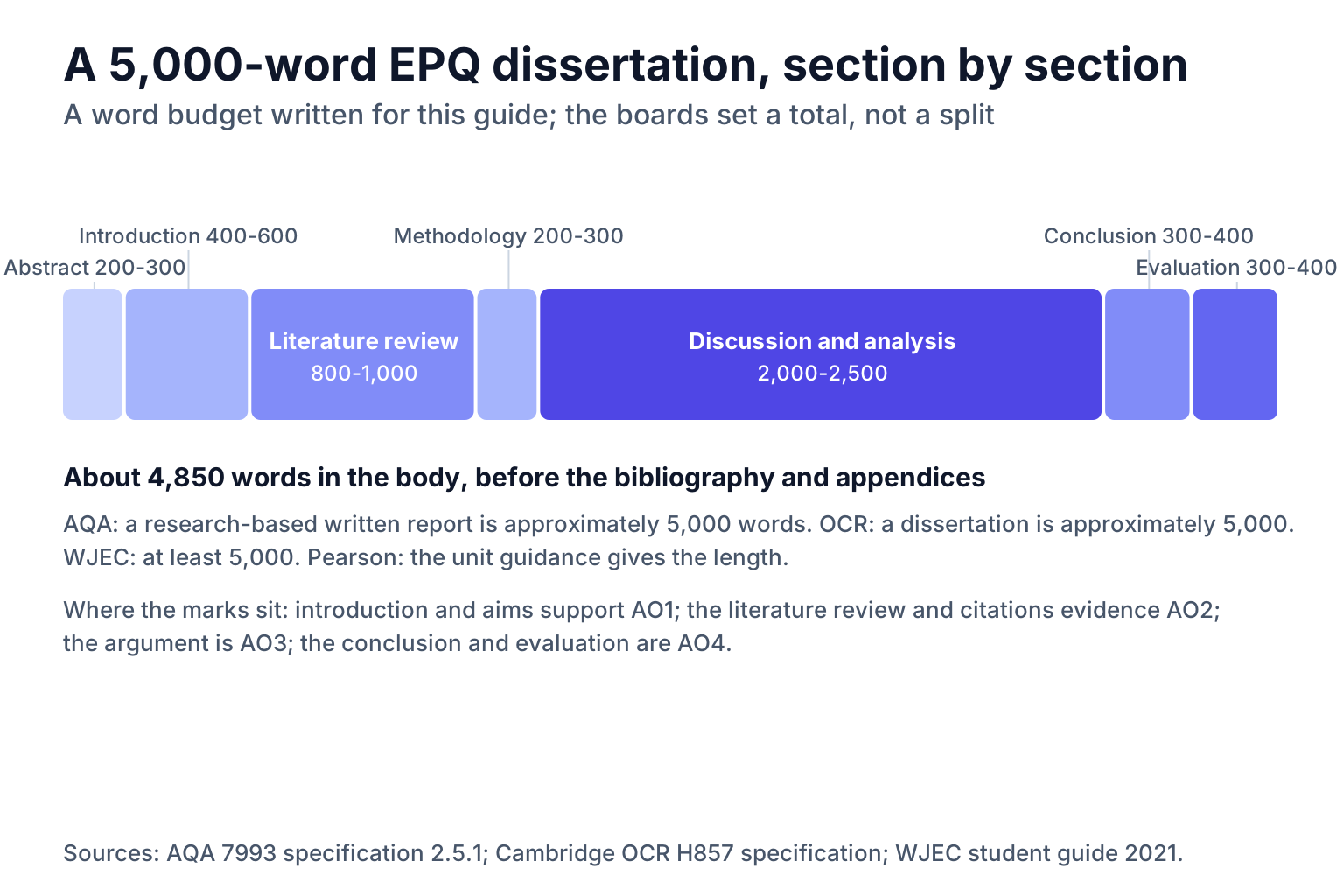
A 5,000-word dissertation is not one long essay. It is a sequence of distinct sections, each doing a specific job and earning marks under a specific assessment objective. Getting the structure right before you write a single word of body text is one of the most practical things you can do.
The table below gives approximate word budgets for each section, written for this guide. Neither the AQA nor the OCR specification says what the approximate 5,000 words includes, so check with your centre whether the title page, contents, bibliography and appendices are counted; OCR's specification does say a learner 'will not be specifically penalised for exceeding the word count'.
| Section | Approx. words | Usually counted? (check with your centre) | Primary AO |
|---|---|---|---|
| Title page and contents | - | No | - |
| Abstract | 200-300 | Usually no | - |
| Introduction | 400-600 | Yes | AO1 |
| Literature/research review | 800-1,000 | Yes | AO2 |
| Methodology (if needed) | 200-300 | Yes | AO2 |
| Discussion/analysis chapters | 2,000-2,500 | Yes | AO3 |
| Conclusion | 300-400 | Yes | AO4 |
| Evaluation | 300-400 | Yes | AO4 |
| Bibliography and appendices | - | No | - |
Abstract (200-300 words)
The abstract summarises the research question, the method used to investigate it, the key findings, and the conclusion. Write it last, once you know what you actually found. Centres often leave it out of the word total, but no board document cited here says so - check with your supervisor, and do not pad it either way.
Introduction (400-600 words) - AO1
State your research question clearly in the first paragraph. Explain why the question is worth investigating, set out your aims, and give the reader a route map through what follows. This section, alongside your Production Log or Project Progression Record, is where AO1 (managing the project) is evidenced.
One counter-intuitive point: the introduction is not the place to start answering the question. Its job is to justify and frame, not to argue.
Literature/Research Review (800-1,000 words) - AO2
Group sources by argument or theme, not in the order you read them. A section that works through source one, then source two, then source three is a list, not a review. Instead, identify two or three positions or debates in the literature and show how your sources map onto them.
For each source, briefly assess its reliability and usefulness: who produced it, for what purpose, and how that affects what weight you give it. Use in-text citations throughout, formatted consistently. The OCR Summer 2024 moderators' report notes that candidates who performed less well "omitted in-text citations and bibliographies OR used hyperlinks or URLs instead of formatting references" - bare URLs do not count as citations.
Methodology (200-300 words) - AO2, where applicable
Only include this section if you conducted primary research: surveys, interviews, experiments, or field observations. Explain what you gathered, how, and why that method suited your question. The OCR moderators' report flags that "surveys should be conducted only where they can meaningfully add to the outcome" - running a survey to bulk out the word count is unlikely to impress.
Discussion/Analysis Chapters (2,000-2,500 words) - AO3
This is where the argument is built and where AO3 marks (worth 40% under AQA, and the largest single objective under OCR and WJEC too) come from. Divide it into titled chapters or numbered sections, each advancing the argument one step. By the end of this block, your research question should be answered, even if provisionally.
Avoid simply describing what sources say. Compare, challenge, and synthesise.
Conclusion (300-400 words) - AO4
Directly answer the research question. State the limits of what your argument can and cannot establish. Introduce no new evidence here - the conclusion draws together what the discussion proved, not fresh ideas.
Evaluation (300-400 words) - AO4
The evaluation covers two things: the quality of the outcome (how well the dissertation answers the question) and the quality of the process (how well you managed the project). The OCR moderators' report distinguishes clearly between candidates who "evaluated with genuine self-reflection and insight" and those who produced evaluations that "were descriptive or lacked awareness of strengths and weaknesses." Describing what you did is not evaluating it.
Bibliography and Appendices
Format every source consistently throughout. Appendices hold material that supports the argument but would interrupt the flow if placed in the body, for example, a full survey instrument or a data table. Keep appendices lean: the dissertation must stand without them.
5. How to Write the EPQ Literature Review
The research review section directly evidences AO2 (Use resources), so how you present your sources matters as much as which sources you chose.
Group sources by argument or theme, not by when you found them. An annotated list - "Smith (2021) argues X. Jones (2019) argues Y." - reads as cataloguing, not thinking. Instead, cluster sources that share a position, then contrast them with sources that challenge it, and show what that tension means for your research question. That structure demonstrates analysis, which is what AO2 rewards.
For each source or cluster, cover three things: what it argues, how reliable and useful it is given its context and method, and how it connects to your specific question. A government white paper and a campaigning think-tank report might reach opposite conclusions on the same topic; noting why that is earns more credit than treating them as equivalent voices.
In-text citations are compulsory. The OCR Summer 2024 moderators' report explicitly identifies omitting citations, or substituting bare hyperlinks for formatted references, as a marker of weaker submissions. Every claim you draw from a source needs a citation in the body of the text, not just a URL in a footnote or bibliography.
Harvard referencing is widely used for EPQ dissertations. No board prescribes a single style unless their own published documentation says so, so follow your centre's guidance. The format differs by source type:
- Journal article: author(s), year, title, journal name, volume, issue, page range.
- Book: author(s), year, title, edition, place of publication, publisher.
- Website: author or organisation, year, page title, URL, date accessed.
- Interview or survey you conducted: interviewee name or survey description, date, medium (e.g. personal interview).
If your centre requires you to declare AI use, follow your centre's instructions on how and where to do that.
One counter-intuitive point worth knowing: the OCR moderators' report notes that successful candidates "narrowed and deepened research as they progressed." Collecting twenty shallow sources looks less impressive than working closely with eight strong ones. A smaller, well-interrogated reading list almost always outperforms a long one where no source is properly assessed.
6. Writing the EPQ Introduction and Building the Argument
The introduction
If you are wondering how to write an EPQ introduction, it must do four things: state the research question, explain why it is worth asking, set out the aims of the project, and give a brief route map of how the essay will answer it. Four things, four paragraphs - it is that mechanical, and that is fine.
The aims deserve particular care. The OCR moderators' report for Summer 2024 is explicit: at least some aims must relate to the steps needed to achieve the planned outcome, not only to skills development. An aim written for the guide might read: "To compare peer-reviewed clinical evidence on X with public health guidance on Y in order to evaluate the extent of any gap." That is project-specific and testable. "To improve my research skills" is not an aim in this sense - it may count under AO3, but it cannot anchor your introduction.
Building the analytical chapters
Each discussion or analysis chapter should open with the claim it is making, support that claim with cited evidence, and connect the point back to the research question. Think of each chapter as a single answer to a sub-question that, when stacked with the others, adds up to your overall answer.
A counter-intuitive note: the chapters do not need to build chronologically. They need to build logically. If chapter two undermines something chapter one assumed, that is good argument, not bad structure.
The conclusion (and what it is not)
The conclusion answers the research question directly, states the limits of the evidence used, and introduces no new material. It is not the same as the evaluation. The conclusion belongs to the argument (AO3); the evaluation judges the process and the outcome (AO4). Mixing them muddies the evidence for both.
As the OCR moderators' report notes, successful candidates made and justified changes to their plans - record those decisions in the log so the conclusion's scope matches what the project actually investigated.
7. EPQ Evaluation: Judging, Not Describing
The evaluation is a distinct section, not a longer conclusion. It evidences AO4 (Review), and the difference between a strong and a weak one comes down to a single word: judgement. OCR moderators reviewing the Summer 2024 series noted that weaker evaluations were "descriptive or lacked awareness of strengths and weaknesses", while stronger ones showed "genuine self-reflection and insight." Describing what you did is not evaluating it.
Cover two distinct dimensions:
- Evaluation of the outcome. Does the dissertation actually answer the research question? How well does the evidence support each part of the argument? Where are the gaps, contradictions, or limits of the sources used?
- Evaluation of the process. How effectively was the project planned and managed across the 120 hours? What went wrong, why, and what a more effective approach would have looked like?
For each decision you reflect on, the structure is: what you chose, why you chose it, what effect it had, and what you would do differently. A list of things that happened is not an evaluation.
One non-obvious point: the evaluation section of your written report is not the only place AO4 is assessed. The AQA Production Log and Assessment Record, the OCR Project Progression Record, and the WJEC Candidate Production Record all contribute AO4 evidence in their own right. For WJEC specifically, AO4 is split: LO7 (the presentation) carries 10 marks and LO8 (evaluation and review) carries 10 marks, which means the presentation itself is assessed as part of the review objective, not separately from it. If your presentation is thin on reflective commentary, you are leaving AO4 marks on the table before the written evaluation is even read.
Keep the evaluation focused and honest. A candid acknowledgement of a genuine weakness, clearly explained, scores better than vague claims that everything went to plan.
8. The Production Log: Why It Is as Important as the Essay
Every board requires a project log submitted alongside the written outcome. The names differ:
| Board | Document name |
|---|---|
| AQA | Production Log and Assessment Record |
| OCR | Project Progression Record (PPR) |
| WJEC | Candidate Production Record and Candidate Assessment Record |
| Pearson | Activity Log |
The log is not an afterthought. The AQA specification requires that all substantive advice given to you is recorded by you in the Production Log and confirmed by your supervisor. Miss that step and the advice is, from a moderation standpoint, invisible.
The stakes are explicit. The AQA June 2023 examination report notes that the Production Log contains a written notice stating: "failure to complete or submit a compulsory element may result in a mark of zero being awarded." The same report found that moderators identified cases where students had completed logs retrospectively, and flagged that high AO1 marks require evidence of detailed project planning in the log, not essay planning alone. Several centres awarded strong AO1 marks based only on essay plans, which was not sufficient.
OCR moderators want to see "a curated portfolio of evidence," meaning a coherent selection that shows development across all objectives, not every draft and printout you produced.
Practical habits that keep the log defensible:
- Write your plan into the log before you start drafting the essay.
- Keep dated draft versions as evidence that the work developed over time.
- Record every significant change you make and your reason for making it.
- Note every supervisor meeting, including the date and what was discussed.
- Log all substantive feedback at the time it is given, then ask your supervisor to confirm it.
A log written in the final week before submission will look exactly like what it is.
9. Pre-Submission Checklist
Work through this list before you hand anything to your supervisor for final sign-off. One missing element can result in a mark of zero on AQA: AQA's specification lists the Production Log and Assessment Record and the project product with its written report as the evidence for assessment, and AQA's June 2023 examiner report quotes the Production Log's own note that 'failure to complete or submit a compulsory element may result in a mark of zero being awarded'.
Written report
- Your research question is answered directly and explicitly in the conclusion, not implied.
- Every factual claim has an in-text citation. Bare URLs are not citations; OCR moderators flagged this as a common weakness in 2024.
- The limits of your argument are stated: what your evidence does not settle, what a wider study would need.
- Word count sits within your board's guidance range (approximately 5,000 words for a dissertation-route report under AQA and OCR; at least 5,000 under WJEC).
Literature or research review
- Sources are grouped by argument or theme, not listed one after another.
- Each source has a brief evaluation of its reliability and usefulness, not just a summary of what it says.
- The bibliography is formatted consistently throughout. One style applied everywhere is enough; none of the board documents cited here prescribes a specific style, so pick one with your centre and stick to it.
Evaluation
- The evaluation judges the outcome and the process: what worked, what you would change, and why.
- It does not simply describe what you did. If your evaluation reads like a project diary, rewrite it.
Production log or diary
- Entries are dated and were clearly made throughout the project, not written up at the end. Retrospective logs were identified as a problem in AQA's 2023 examiner report.
- All changes to the plan are recorded with a reason.
- Supervisor meetings are documented, and all substantive advice is confirmed by the supervisor, as AQA's specification requires.
Presentation evidence
- WJEC: presentation evidence attached (the WJEC student guide gives 'scanned cue cards and your slides' as examples), with the supervisor's signed statement on the presentation and its Q&A - the Presentation Reviewer Statement inside the Candidate Assessment Record in WJEC's 2023 specification.
- AQA: Presentation Record completed, including examples of the supervisor's questions and your responses, as the specification requires.
- OCR: the presentation and evidence that it took place included in the portfolio, which the OCR moderators' report lists among the items every portfolio must contain.
Submission bundle by board
| Board | Compulsory elements |
|---|---|
| AQA | Report, Production Log and Assessment Record (including Project Proposal Form, Presentation Record, Candidate Record Form) |
| OCR H857 | URS, PPR, diary, outcome, written piece (if artefact), presentation and evidence of presentation |
| WJEC | Candidate Assessment Record, Candidate Production Record, Presentation Reviewer Statement, presentation evidence |
| Pearson Edexcel | Project proposal form, activity log, records of the research, the project outcome (or records and supporting evidence of it for Performance and Artefact), the evaluation, evidence of the presentation |
10. What to Do Next
Before you draft a single sentence, open the official specification for your board and read the word count guidance and log requirements in full. The count that appears in a school handout may differ from the current published specification, and each board names its log differently: AQA's Production Log and Assessment Record, OCR's Project Progression Record, WJEC's Candidate Production Record, Pearson's activity log. Knowing which document governs your submission before you start writing means you will not discover a formatting or evidence requirement at the end when there is no time to fix it.
This week: download your board's current specification, locate the section on appropriate evidence and the log requirements, and check those against whatever your centre has told you. If anything conflicts, ask your supervisor to clarify in writing so the answer becomes part of your log record.
FAQ
How many words does an EPQ dissertation need to be?
A research-based written report or dissertation is approximately 5,000 words under AQA and OCR and at least 5,000 under WJEC; where the project product is an artefact, the accompanying written report has a lower minimum (1,000 words under AQA and OCR; 1,500 words under WJEC); Pearson students should check their unit guidance.
How do you write an EPQ introduction?
The introduction should state the research question, explain why it is worth asking, set out the aims of the project, and provide a brief route map of how the essay will answer it; aims should relate to the concrete steps needed to achieve the planned outcome, not solely to skills development.
How do you write an EPQ literature review?
Group sources by argument or theme rather than listing them sequentially; for each source or cluster, explain what it argues, assess its reliability and usefulness, and show how it relates to your research question; use in-text citations throughout - bare hyperlinks are not acceptable.
How do you write an EPQ conclusion?
The conclusion must directly answer the research question, state the limits of the evidence used, and not introduce new material; it is a separate section from the evaluation, which judges the process and outcome rather than answering the question.
How do you write an EPQ evaluation?
Cover two dimensions: an evaluation of the outcome (how well the dissertation answers the question and whether the evidence supports the argument) and an evaluation of the process (how effectively the project was managed and what would be done differently); moderators distinguish evaluations that reflect with genuine insight from those that merely describe what was done.
How do you write an EPQ abstract?
The abstract is a concise summary - typically around 200-300 words - covering the research question, the method used, the key findings, and the conclusion; it is written last, after the full report is complete, so it accurately reflects the finished work.
References
- AQA Level 3 Extended Project Qualification (7993) Specification v1.4 - 2.5.1 Assessment evidence and project product - https://filestore.aqa.org.uk/subjects/AQA-W-7993-SP-19.PDF
- Cambridge OCR Level 3 Extended Project Qualification H857 Specification v2.2 (October 2026) - Assessment, PPR, marking criteria bands, overlap with other qualifications - https://www.ocr.org.uk/Images/414382-specification.pdf
- WJEC Extended Project Qualification Student Guide 2021 - https://www.eduqas.co.uk/media/1tzjusk5/epq-student-guide-2021.pdf
- Guidance for students | Pearson qualifications - https://qualifications.pearson.com/en/qualifications/edexcel-project-qualification/level-3/student-support/guidance-for-students.html
- Cambridge OCR Extended Project H857 Moderators' report - Summer 2024 - https://www.ocr.org.uk/Images/727849-moderators-report.pdf
- AQA Level 3 Extended Project Qualification 7993 - Report on the examination, June 2023 - https://www.aqa.org.uk/files/sample-papers-and-mark-schemes.2023.june.AQA-7993-WRE-JUN23_PDF/fa246dd5d7dc686c17d93e113bdfafcea9e00317.pdf