EPQ Mark Scheme Explained: All Four Assessment Objectives
By Michael Thompson · Education Specialist; 10 years teaching the IB at Bromsgrove School · Published 24 October 2026 · Updated 25 October 2026
The EPQ mark scheme is built on four assessment objectives - AO1 Manage, AO2 Use resources, AO3 Develop and realise, and AO4 Review - and every board uses that same wording. What differs is the total marks available and how those marks are split: AQA awards 50 marks, Pearson Edexcel 54, Cambridge OCR 60, and WJEC 100. Across all boards, AO3 carries the heaviest weighting (40-44%), because the project product itself is the centrepiece of the qualification. Understanding where the marks live - and what the band descriptors reward - is the most practical thing you can do before you write a single word of your project.
Key Takeaways
- Four shared assessment objectives: AO1 Manage, AO2 Use resources, AO3 Develop and realise, and AO4 Review are used by AQA, Pearson Edexcel, OCR, and WJEC, though mark totals differ by board.
- AO3 is worth roughly twice any other objective: Every board allocates 40-44% of total marks to AO3, making your project product and the skills shown producing it the single biggest determinant of your grade.
- Marking is best-fit, not a tick list: Markers choose the band that best describes the overall quality of evidence - strong work in one area can compensate for a weak point within the same objective.
- The Production Log (or equivalent) is assessed, not just submitted: AO1 marks come directly from the log's proposal, planning entries, and records of changes - a log written after the event will not earn high marks.
- Three compulsory elements must all be present for AQA: The written report, the Production Log and Assessment Record, and evidence of a live presentation must all be submitted, or a mark of zero may be awarded for missing components.
- Critical evaluation beats description every time: The AQA grade descriptions and OCR moderators both distinguish high-band work by genuine self-reflection and judged conclusions - not a summary of what happened.
In This Article
- The EPQ Assessment Objectives and Mark Totals, Board by Board
- AO1 Manage: Where Planning Evidence Lives
- AO2 Use Resources: Research Quality and the Bibliography
- AO3 Develop and Realise: The EPQ Marking Criteria That Matters Most
- AO4 Review: Evaluation and the Presentation
- How the AQA EPQ Mark Scheme Works: Best-Fit Bands, Not Tick Lists
- The Mistakes That Cost Marks - Across Every Board
- What to Do Next
1. The EPQ Assessment Objectives and Mark Totals, Board by Board
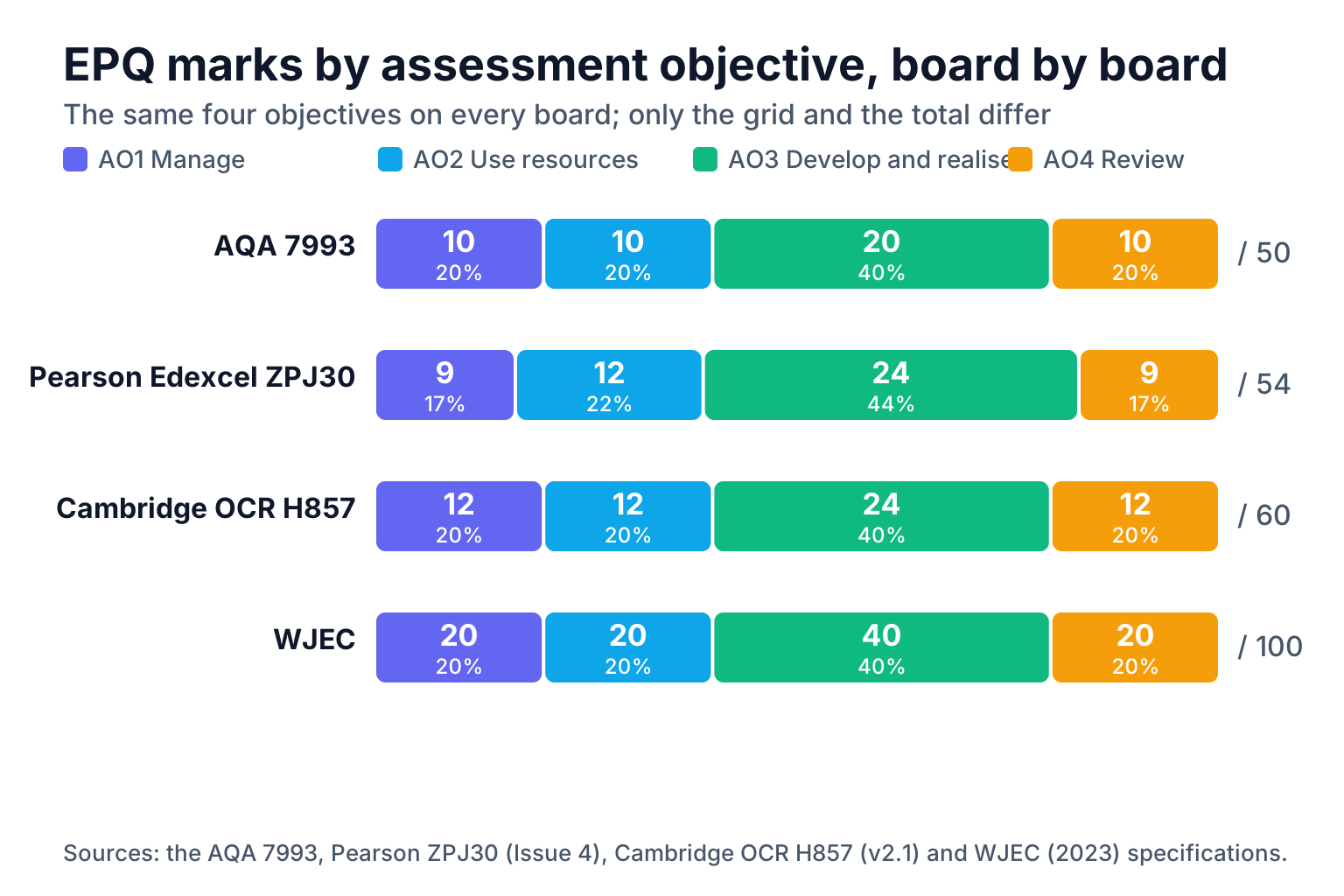
The EPQ mark scheme is built on four assessment objectives shared, word for word, by every UK board that offers the qualification: AO1 Manage, AO2 Use resources, AO3 Develop and realise, and AO4 Review. The boards set their own mark totals and band structures, but the underlying framework is identical. That means the skills being assessed are the same whether you are entered through AQA, Pearson Edexcel, Cambridge OCR, or WJEC - only the arithmetic differs.
The table below shows how each board distributes marks across the four EPQ assessment objectives.
| Board | AO1 Manage | AO2 Use resources | AO3 Develop and realise | AO4 Review | Total |
|---|---|---|---|---|---|
| AQA 7993 | 10 marks (20%) | 10 marks (20%) | 20 marks (40%) | 10 marks (20%) | 50 |
| Pearson Edexcel ZPJ30 | 9 marks (17%) | 12 marks (22%) | 24 marks (44%) | 9 marks (17%) | 54 |
| Cambridge OCR H857 | 12 marks (20%) | 12 marks (20%) | 24 marks (40%) | 12 marks (20%) | 60 |
| WJEC Level 3 | 20 marks (20%) | 20 marks (20%) | 40 marks (40%) | 20 marks (20%) | 100 |
AO3 is the heaviest-weighted objective on every board, ranging from 40% to 44% of the total. The reason is straightforward: AO3 covers the product itself, whether that is a dissertation, an artefact, a performance, or a field study. The marks awarded here reflect the skills shown in actually making the thing, not just planning or reflecting on it.
Two boards have structural features worth noting before you read the sections that follow.
WJEC divides the four AOs into eight learning outcomes, two per objective, each worth 10 marks (except AO3, where LO5 and LO6 are 20 marks each). The EPQ marking criteria are therefore applied at learning outcome level rather than objective level, which gives WJEC candidates a more granular view of where marks sit.
Pearson Edexcel offers four distinct units under the same qualification: P301 Dissertation, P302 Investigation/Field Study, P303 Performance, and P304 Artefact. Each unit is assessed against the same four AOs and the same 54-mark total, so the AQA EPQ mark scheme and the Edexcel EPQ mark scheme differ in scale but not in structure.
All four boards grade A* to E. A result below the minimum standard is recorded as unclassified on the certificate, and no grade is awarded.
2. AO1 Manage: Where Planning Evidence Lives
AO1 is about project management, not essay planning. That distinction matters more than it sounds. The AQA June 2023 examiner report flagged that some centres had encouraged students to use the Production Log to plan an essay rather than to plan and manage a project. High AO1 marks went to students who could demonstrate they had run a project over time, not simply outlined an argument before writing it up.
Where the evidence lives depends on your board. Each uses a different document, but the underlying requirement is the same:
- AQA - Production Log and Assessment Record
- Pearson Edexcel - activity log and project proposal form
- Cambridge OCR - Project Progression Record (PPR)
- WJEC - Candidate Production Record
Per the AQA specification, the Production Log must record: the formal proposal and approval; the initial idea and outline plan; advice received and action taken; and any changes made to the plan with reasons for those changes. That last point is often the one students underweight. A log that records only what you planned to do, and not why you changed course, gives markers very little to credit.
The OCR Summer 2024 moderators' report noted that high-band candidates "planned and managed work carefully and painstakingly" and "made and justified changes to their plans and topics." The justification is the evidence. Changing your research question without recording why it changed reads, to a moderator, as though the change never happened.
One firm warning from the AQA June 2023 examiner report: "Retrospective diaries were not an adequate replacement for the Log entries." A log written in one sitting at the end of the project, however detailed, does not demonstrate that you managed your time and decisions as they unfolded.
The practical rule: start logging from day one, and record every significant decision, not just the final plan. A brief note explaining why you narrowed your research question, or why a planned interview fell through, is worth more to AO1 than a polished Gantt chart produced after submission.
3. AO2 Use Resources: Research Quality and the Bibliography
AO2 rewards how well you select, evaluate, and apply sources, not how many you collect. A log showing forty sources but no critical engagement with any of them will score lower than one showing fifteen sources that were genuinely interrogated and used to shape the argument or artefact.
The evidence for AO2 sits in three places: the research record within your Production Log (AQA) or Project Progression Record (OCR), any source evaluation notes you made as you went, and your final bibliography or reference list.
The OCR moderators' report for Summer 2024 is direct on what separates the bands. High-band candidates '"narrowed and deepened research as they progressed"' and '"produced well-formatted in-text citations and bibliographies"'. Low-band candidates '"omitted in-text citations and bibliographies OR used hyperlinks or URLs instead of formatting references"' and had researched '"broadly and shallowly OR narrowly and shallowly"'. The same report flags a less obvious issue: '"surveys should be conducted only where they can meaningfully add to the outcome"', so designing a survey to tick a methodology box, rather than because your question genuinely requires primary data, can work against you.
On the AQA side, the June 2023 examiner report found that logs completed with little evidence '"of the research journey and the decision-making that brought about the eventual product"' do not support high marks. The log needs to show why you chose certain sources, what they contributed, and what you decided to set aside.
Practical takeaway: add in-text citations as you write each section of your report or written piece, not at the end. A bibliography of bare URLs tells the moderator you treated referencing as an afterthought. Formatted citations woven into the text show the research was part of the thinking.
4. AO3 Develop and Realise: The EPQ Marking Criteria That Matters Most
AO3 carries the heaviest weight of any objective: 40% of total marks on the AQA, OCR and WJEC schemes, and 44% on Pearson's. It covers the project product itself, whether that is a dissertation, artefact, investigation, performance, or creative piece, and the documented record of how it was built.
Where AO3 evidence lives
The finished product is only half the picture. Examiners and moderators also assess the record of how the product came to exist: which skills you selected, how you solved problems, and what new techniques you learned along the way. Without that developmental record, a polished artefact tells the assessor almost nothing about the process behind it.
OCR moderators (Summer 2024) made this explicit: they want "a curated portfolio of evidence" demonstrating candidate development across objectives, not bulk materials. Submitting everything you produced is not the same as demonstrating how you progressed.
Word count requirements by board
| Board | Dissertation or written project | Non-written outcome |
|---|---|---|
| AQA | ~5,000 words | Written report minimum 1,000 words |
| OCR | ~5,000 words | Written piece minimum 1,000 words |
| WJEC | At least 5,000 words | Project Outcome Notes at least 1,500 words |
The 1,000-word figure is a floor, not a ceiling. The AQA June 2023 examiner report notes that "many students seemed to think that 1,000 words is a maximum number of words for their written report. It is in fact a minimum." Some students submitted only a Production Log and an artefact with no written report at all, which risks a mark of zero for a compulsory element.
Scope matters as much as execution
OCR moderators (Summer 2024) also flagged that some projects were "too limited or too large in scope" to suit a Level 3 qualification with 120 guided learning hours. A topic that cannot be meaningfully addressed in 120 hours will produce thin AO3 evidence regardless of effort. Getting scope right at the proposal stage is not just good planning; it directly protects your AO3 mark.
Takeaway: Keep a running record of decisions, dead ends, and revisions as you build your product. Those notes are the raw material for AO3 marks. The finished outcome shows what you made; the developmental record shows how and why.
5. AO4 Review: Evaluation and the Presentation
AO4 has two distinct homes: the written evaluation of your completed project product, and the live presentation with its Q&A. Both count. Examiners and moderators assess how honestly and precisely you judge what you produced - not just whether you describe it.
What high-band AO4 looks like varies slightly by board, but the direction is consistent. The AQA 7993 specification describes A* candidates as producing "full, in-depth evaluations," while Grade E candidates present conclusions with only "some supporting evidence." The gap is between judging and reporting: top-band evaluations weigh evidence against criteria; lower-band ones summarise what happened.
The OCR Summer 2024 moderators' report was pointed about this. Low-band evaluations were "descriptive or lacked awareness of strengths and weaknesses." High-band work showed "genuine self-reflection and insight" - candidates who acknowledged where their process went wrong and explained why.
The AQA June 2023 examiner report identified a specific mechanism behind weak evaluations: some students "did not clarify what they meant" by a key term in their title, meaning "not establishing the criteria by which they could judge their conclusions was a significant issue." If you never define your central term, you have no fixed standard to measure your outcome against - so any evaluation you write floats.
Board-by-board presentation requirements differ at the margins:
- Pearson Edexcel: the presentation is assessed as part of AO4 and anticipates a face-to-face oral with Q&A.
- OCR H857: a presentation with Q&A is a required portfolio component.
- WJEC: the specification requires a presentation to a non-specialist audience; WJEC's 2021 student guide suggests it 'should take around 20 to 30 minutes, including time for questions', adding that this depends on the student and the topic.
Takeaway: define your key term or terms before you start writing the evaluation, not after. Without a clear definition, there is no standard to judge your conclusions against - and that gap shows up directly in the AO4 mark.
6. How the AQA EPQ Mark Scheme Works: Best-Fit Bands, Not Tick Lists
The EPQ mark scheme on every board runs on a best-fit principle, not a checklist. Pearson's specification states that tutor-assessors should "select appropriate bands not on the basis of a 'tick list' but rather in terms of 'best fit'" and "adopt a holistic approach". AQA's specification says the criteria are "used to judge which mark best fits the candidate's work", that "an isolated example of performance at a different level should not be used to raise or lower the overall assessment", and that "shortcomings in some aspects of the project may be balanced by a better performance in other aspects"; the OCR specification likewise has teachers mark "using a 'best fit' approach". In practice that means a weak moment in one piece of evidence does not fix your mark on its own.
How the band logic works in practice: each board's grid divides every objective into mark bands with descriptors - three bands on AQA and Pearson, four on OCR, while WJEC marks each of its eight learning outcomes separately. The marker reads all the evidence relevant to that objective, then picks whichever band best represents the overall picture. A single weak piece of evidence does not drop you a band on its own.
The mark totals differ by board:
| Board | AO1 | AO2 | AO3 | AO4 | Total |
|---|---|---|---|---|---|
| AQA | 10 | 10 | 20 | 10 | 50 |
| Pearson Edexcel | 9 | 12 | 24 | 9 | 54 |
| OCR | 12 | 12 | 24 | 12 | 60 |
For OCR, AO1, AO2 and AO4 each carry 12 marks across four bands; AO3 carries 24 marks across four bands, per the OCR H857 specification.
Who marks and who moderates: your supervisor or centre marks your work. The board then moderates a sample, and marks can be adjusted at that stage. You will never see or interact with the moderator directly.
One persistent misconception flagged in the OCR Summer 2024 moderators' report: a portfolio template is not required, and moderators do not want bulky artwork or photocopied books. They want a curated portfolio that shows your development across the objectives.
The practical consequence: read your board's band descriptors for each AO before you begin, then collect evidence with those descriptors in mind from day one.
7. The Mistakes That Cost Marks - Across Every Board
Examiner and moderator reports point to the same errors appearing every cycle. Here they are, grouped by the objective they damage.
AO1 Manage
- Logs that record essay planning - section headings, argument structure, word counts - rather than project management decisions. The AQA June 2023 examiner report is explicit: "High marks in AO1 require evidence of detailed project planning and not just a focus on essay planning."
- Retrospective diaries. The same report states these "were not an adequate replacement for the Log entries." Entries written after the fact read differently from contemporaneous ones, and moderators notice.
- No record of plan changes with reasons. The AQA specification lists "note of any changes made to plan and reasons for the changes" as a required element of the Production Log and Assessment Record.
AO2 Use Resources
- Bibliographies consisting of bare URLs or hyperlinks. The OCR Summer 2024 moderators' report identifies this as a recurring problem across underperforming candidates.
- Research that is "broadly and shallowly" collected rather than narrowed and deepened as the project develops, per the same OCR report. Gathering sources is not the same as using them.
- Surveys included without a clear rationale for how they add to the outcome. OCR moderators note surveys should only be used where they can meaningfully contribute.
AO3 Develop and Realise
- Treating 1,000 words as a ceiling. The AQA June 2023 examiner report states plainly: "Many students seemed to think that 1000 words is a maximum number of words for their written report. It is in fact a minimum."
- Submitting only a Production Log and an artefact with no written report. AQA requires a written report as a compulsory element for all project types.
- Project scope that is too large or too small for 120 guided learning hours, flagged by the OCR moderators' report.
- No record of how the product was made. Without this, the log cannot support high AO3 marks.
AO4 Review
- Evaluations that describe what happened rather than judge how well it happened. OCR moderators contrast candidates who evaluated "with genuine self-reflection and insight" against those who "produced evaluations which were descriptive or lacked awareness of strengths and weaknesses."
- Failing to define key terms in the title. The AQA report identifies this as a significant issue: without a definition, there are no criteria against which to judge conclusions.
A zero-mark warning specific to AQA
The AQA Production Log states directly: "failure to complete or submit a compulsory element may result in a mark of zero being awarded." The three compulsory elements are the written report, the Production Log and Assessment Record, and evidence of the live presentation.
Takeaway: Print this list and check your submission draft against each point before your centre's internal deadline. The errors above are not rare edge cases; they appear in official reports as recurring patterns.
8. What to Do Next
The EPQ mark scheme is a public document, and most students never read it. That gap is where marks are lost before the project even starts.
This week, go to your exam board's website and download the current specification. Every band descriptor for AO1, AO2, AO3, and AO4 is there, free, written by the people who set the marking criteria. Read the top band first, then the band below it, and note exactly what separates them - that gap is where the top marks are won or lost.
The stakes are concrete: the OCR H857 specification says the EPQ is 'worth up to 28 UCAS points in the new tariff', and Pearson's guidance for students says 'the grade you receive is worth up to 28 UCAS points'. Knowing exactly how those points are awarded is a practical priority, not an academic one.
Download your board's specification and read the band descriptors for all four AOs this week.
FAQ
How many marks is the EPQ out of?
The total marks depend on your board: AQA awards 50 marks, Pearson Edexcel 54, Cambridge OCR 60, and WJEC 100 - all graded A* to E.
How is the EPQ marked?
Your supervisor or centre marks your work against four assessment objectives using band descriptors on a best-fit basis; the awarding board then moderates a sample of centres and can adjust marks.
What are the four EPQ assessment objectives?
AO1 Manage, AO2 Use resources, AO3 Develop and realise, and AO4 Review - these four objectives and their wording are shared by AQA, Pearson Edexcel, OCR, and WJEC.
Does the EPQ mark scheme change between years?
The assessment objectives and their weightings are set by each board's specification, which is updated periodically; always check the current version on your board's website rather than relying on older PDFs.
How many marks does the EPQ presentation carry?
The presentation is assessed as part of AO4 (Review), which is worth 10 marks on AQA, 9 on Pearson Edexcel, 12 on OCR, and 20 across LO7 and LO8 on WJEC.
What is the minimum word count for an EPQ written report?
For AQA, a dissertation is approximately 5,000 words and an artefact's written report must be at least 1,000 words - the AQA June 2023 examiner report explicitly warned that 1,000 words is a minimum, not a maximum.
References
- AQA EPQ 7993 Specification - 2.5.2 Assessment Objectives, 3.6 Awarding grades, Appendix A grade descriptions - https://www.aqa.org.uk/subjects/projects/level-three/projects-7993/specification
- Pearson Edexcel Level 3 Extended Project (ZPJ30) Specification Issue 4 - Assessment objectives, the presentation, assessment evidence - https://qualifications.pearson.com/content/dam/pdf/Project-Qualification/Level-3/2010/Specification/project-specification-level-3.pdf
- Cambridge OCR Level 3 Extended Project Qualification H857 Specification v2.2 (October 2026) - Assessment, PPR, marking criteria bands, overlap with other qualifications - https://www.ocr.org.uk/Images/414382-specification.pdf
- WJEC Level 3 Extended Project Specification v2 (April 2023) - Assessment objectives, learning outcomes and marks - https://www.wjec.co.uk/media/iuphacwi/wjec-level-3-extended-project-spec-e-26-04-23.pdf
- AQA Level 3 Extended Project Qualification 7993 - Report on the examination, June 2023 - https://www.aqa.org.uk/files/sample-papers-and-mark-schemes.2023.june.AQA-7993-WRE-JUN23_PDF/fa246dd5d7dc686c17d93e113bdfafcea9e00317.pdf
- AQA Level 3 Extended Project Qualification (7993) Specification v1.4 - 2.5.1 Assessment evidence and project product - https://filestore.aqa.org.uk/subjects/AQA-W-7993-SP-19.PDF
- Cambridge OCR Extended Project H857 Moderators' report - Summer 2024 - https://www.ocr.org.uk/Images/727849-moderators-report.pdf