EPQ Production Log: What to Write in It, Board by Board
By Michael Thompson · Education Specialist; 10 years teaching the IB at Bromsgrove School · Published 24 October 2026 · Updated 25 October 2026
Your EPQ production log is not a diary - it is the primary evidence that you managed a project and reflected on it, and those two things together account for 40% of your total marks on AQA, OCR and WJEC and 34% on Pearson. AQA calls it the 'Production Log and Assessment Record'; Pearson calls it the 'activity log' alongside a 'project proposal form'; Cambridge OCR calls it the 'Project Progression Record (PPR)'; WJEC calls it the 'Candidate Production Record' within the broader 'Candidate Assessment Record'. The document you complete is different in each case, but the underlying requirement is the same: a running, dated record of every decision, source used, piece of advice received, and change of plan - made at the time, not reconstructed afterwards. The AQA June 2023 examiner report found that centres with the most seriously off-standard marks had, for the most part, submitted projects with very sparsely completed production logs.
Key Takeaways
- Every board has its own name for the log: AQA: 'Production Log and Assessment Record'; Pearson: 'activity log'; OCR: 'Project Progression Record (PPR)'; WJEC: 'Candidate Production Record' - use your board's exact term.
- The log carries marks for managing and reviewing: On AQA the manage (AO1) and review (AO4) objectives together account for 40% of available marks; the pattern is similar across all four boards.
- Retrospective diaries do not earn the marks: The AQA June 2023 examiner report explicitly stated that 'retrospective diaries were not an adequate replacement for the Log entries'.
- Record every piece of advice and what you did about it: On AQA, 'all substantive advice given to the students should be recorded by them in the Production Log and Assessment Record and confirmed by the Supervisor'.
- Changes of plan must be justified in writing: AQA's specification lists 'a note of any changes made to plan and reasons for the changes' as a required element of the Production Log.
- A weak log can cost marks across multiple objectives: OCR's Summer 2024 moderators' report found that lower-scoring candidates 'stuck to topics and plans even when they weren't on track' and produced evaluations that 'lacked awareness of strengths and weaknesses'.
In This Article
- What the EPQ production log is and why it carries marks
- What the AQA production log must contain
- Pearson, OCR and WJEC: how the activity log and PPR differ
- What a strong EPQ log entry looks like: three examples
- Recording advice and supervision in your EPQ log book
- Timing: when to start and how often to write
- Common EPQ log mistakes and what they cost you
- What to do next
1. What the EPQ production log is and why it carries marks
The EPQ production log is not a progress diary. It is the primary evidence record that assessors use to judge how well you managed your project and how honestly you reviewed it. Those two things, managing (AO1) and reviewing (AO4), together account for 40% of your marks on AQA, OCR and WJEC, and 34% on Pearson. A log that reads like a to-do list, or one that was clearly written in a single sitting the week before submission, cannot support those marks no matter how strong your written report is.
Each board uses its own name for this document:
- AQA calls it the Production Log and Assessment Record, which includes the Project Proposal Form, Presentation Record and Candidate Record Form. Per the AQA Level 3 EPQ specification, it must document your formal proposal, your initial plan, your research record, all advice received, any changes to the plan with reasons, a review of the completed product, and a record of the presentation.
- Pearson Edexcel uses an activity log alongside a project proposal form; Pearson's own guidance for students describes the activity log as "a key document you will use to tell the story of your project to assessors." The Pearson Level 3 Extended Project specification lists both as evidence for learning outcome 1 (AO1 Manage), and the evaluation they feed sits under AO4.
- Cambridge OCR calls its record the Project Progression Record (PPR), which runs from the planning stage through to the final evaluation and must be submitted for moderation. The OCR H857 specification describes it as 'a structured approach to managing their project, from initial planning to the end of project evaluation' - a running record, not a retrospective summary.
- WJEC uses the Candidate Production Record, which sits inside the broader Candidate Assessment Record submitted at the end of the project. The WJEC Level 3 Extended Project specification includes supervisor meeting records and a Skills Development Log as required components.
The marks at stake
| Board | AO1 Manage | AO4 Review | Total marks | AO1 + AO4 share |
|---|---|---|---|---|
| AQA | 10 marks (20%) | 10 marks (20%) | 50 | 40% |
| Pearson Edexcel | 9 marks (17%) | 9 marks (17%) | 54 | 34% |
| Cambridge OCR | 12 marks (20%) | 12 marks (20%) | 60 | 40% |
| WJEC | 20 marks (20%) | 20 marks (20%) | 100 | 40% |
The log is the main, sometimes only, evidence for AO1. It also feeds directly into AO4, because your evaluation of what went wrong and what you would change depends on having recorded what you actually planned, what changed, and why. A log with no detail makes a reflective evaluation almost impossible to write convincingly.
The stakes if you ignore this are not abstract. The AQA June 2023 examiner report found that the centres whose marks were most seriously off-standard had, for the most part, submitted projects with very sparsely completed logs. The same report notes that the Production Log itself carries a warning: failure to complete or submit any one of the three compulsory elements (the log, the written report, and evidence of the live presentation) "may result in a mark of zero being awarded."
The non-obvious point worth noting early: the log is not just about recording what you did. On AQA, "all substantive advice given to the students should be recorded by them in the Production Log and Assessment Record and confirmed by the Supervisor." That means a supervisor meeting where you agree to narrow your research question needs to appear in the log, in your words, with a note of what you then did differently. The log is a decision trail, not a timeline.
2. What the AQA production log must contain
The AQA Level 3 EPQ specification (7993) v1.4 lists seven required elements for the Production Log and Assessment Record. Every one of them must be present before the log is complete:
- Formal proposal and approval - the signed-off project proposal that confirms your title and approach.
- Initial idea and outline plan - your starting point, including early thinking about scope and method.
- Record of research carried out and resources used - sources consulted, evaluated, and connected to your developing argument.
- Record of advice and support offered and action taken - what your supervisor told you, and what you did about it.
- Note of any changes made to plan and reasons - not just what changed, but why.
- A review of the completed project product - a genuine evaluation of outcomes against your original aims.
- A record of the presentation with the supervisor's record of relevant questioning - evidence the live presentation happened.
On supervision, the specification is direct: 'All substantive advice given to the students should be recorded by them in the Production Log and Assessment Record and confirmed by the Supervisor.' Omitting a meeting from the log does not erase it from the process. It removes your evidence that you acted on feedback, which costs marks in AO1.
The non-obvious point concerns the written report. The AQA June 2023 examiner report flagged that many students treated 1,000 words as a ceiling rather than a floor. For artefact-based projects, 1,000 words is the minimum, not the target.
The same report identified a specific log failure that examiners see repeatedly: logs that show 'little evidence of the research journey and the decision-making that brought about the eventual product.' The consequence is direct. As the report states, 'High marks in AO1 require evidence of detailed project planning and not just a focus on essay planning.' A log full of reading lists but empty of choices, rejections, and pivots will not reach the top band.
3. Pearson, OCR and WJEC: how the activity log and PPR differ
Each board uses its own vocabulary, and the differences matter when you are pulling together your submission.
Pearson (Edexcel) splits the documentation into two linked pieces: the activity log and the project proposal form. Pearson's student guidance describes the activity log as "a key document you will use to tell the story of your project to assessors", and the proposal form as where you set out your objectives, reasons, stages, timescales and resources. The tutor-assessor who supports you through the project also assesses your presentation as part of AO4, which is worth 9 of the 54 available marks. That means the same person who sees your plan at the start is also judging your review at the end, so the two documents need to tell a consistent story.
OCR uses the Project Progression Record (PPR), which runs from initial planning through to the final evaluation and must be submitted for moderation. The Summer 2024 OCR moderators' report is specific about what distinguishes stronger work: candidates who did well "made and justified changes to their plans and topics" and "narrowed and deepened research as they progressed." Those who struggled "stuck to topics and plans even when they weren't on track." The PPR is where that adaptation becomes visible to moderators.
WJEC uses the term Candidate Production Record, which sits within the broader Candidate Assessment Record. The WJEC specification lists the contents of the final Candidate Assessment Record, which alongside the mark sheet, declarations and Presentation Reviewer Statement include:
- Skills Development Log
- Stage 1 Planning
- Supervisor meeting records (Stages 2-4)
- The written or non-written outcome
- Presentation evidence
One point worth noting across all three boards: format is less important than content. OCR moderators observed that centre-issued templates "can also stifle creativity and independence," and that project-management apps were "often successful." The epq activity log or PPR can take different forms; what moderators and tutor-assessors are looking for is evidence of decisions made and adjusted over time, not a neatly filled grid.
4. What a strong EPQ log entry looks like: three examples
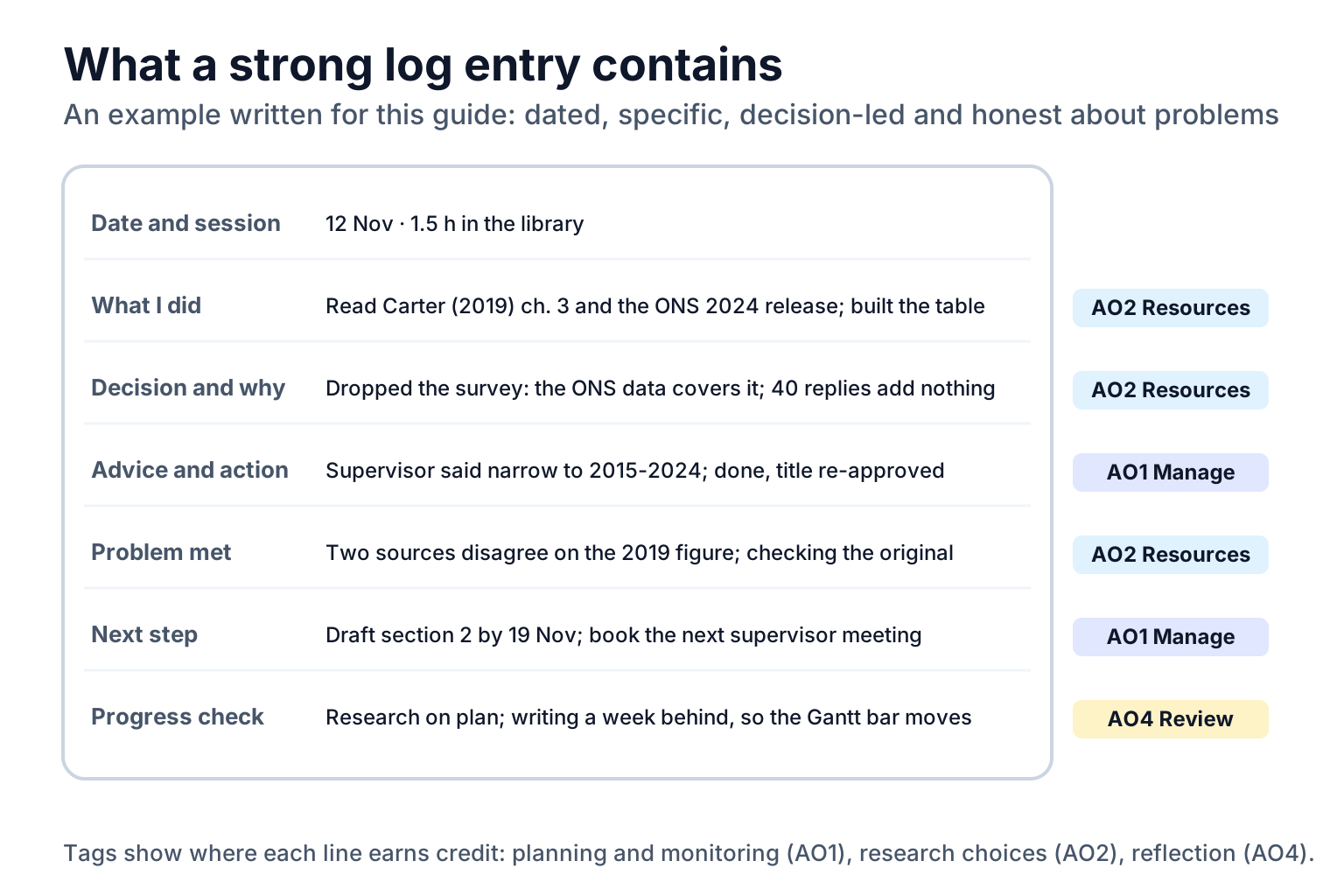
Every entry in your log, whatever board you are following, should do four things: carry a date, name something specific (a source, a decision, a conversation), explain the reasoning behind a choice, and be honest when something did not go to plan. Vague entries like "did some research today" are not evidence of managing a project. They are a diary, and the AQA specification is explicit that the log must record research carried out, resources used, and changes to plan with reasons.
The three examples below illustrate what that looks like in practice. None of them is a board exemplar or real student work.
Example 1: A planning entry (Example written for this guide. Supports AO1 Manage.)
> "14 October. Having had my proposal approved, I have broken the project into four stages: background reading (weeks 1-3), primary source analysis (weeks 4-6), drafting (weeks 7-9), and revision after supervisor feedback (weeks 10-11). By week 3 I aim to have read at least six peer-reviewed articles and to have narrowed my research question from the broad framing in the proposal. If the reading throws up a gap I had not anticipated, I will log it and discuss scope at my next supervision session."
This entry names a stage goal, attaches a timeline, and links back to the proposal. That is the kind of detailed project planning, not just essay planning, that AO1 rewards.
Example 2: A research entry (Example written for this guide. Supports AO2 Use resources.)
> "29 October. I read a think-tank report from several years ago on graduate earnings premiums. The data are robust and the methodology is explained clearly, but the study predates the most recent changes to student loan terms, so its figures may not reflect the current debt burden. I will use it for the historical trend but will search for a more recent official dataset to cover the latest years before drawing conclusions."
Naming the source, recording a specific limitation, and stating what you did as a result is what the AQA specification means by a "record of research carried out and resources used." The OCR moderators' report for summer 2024 flags that weaker candidates research "broadly and shallowly" and never fill identified gaps: this kind of entry is the evidence that you did.
Example 3: A change-of-plan entry (Example written for this guide. Supports AO1 Manage and AO4 Review.)
> "12 November. I had planned to include a case study on Company X's supply-chain model, but the only detailed source I could locate is a paywalled trade journal my school library cannot access. I have adjusted the plan: I will replace that case study with one on a publicly documented competitor whose annual reports are available. The research question is unchanged, but I have updated the outline in section 2 of my project proposal form to reflect the new case study. Supervisor informed at today's meeting."
Change-of-plan entries are where two assessment objectives meet. Acknowledging the problem demonstrates honest management (AO1). Explaining how you adapted your sources demonstrates the evaluative thinking that feeds into AO4. A counter-intuitive point: a log with no changes of plan does not look thorough; it suggests the student either did not encounter the expected obstacles or did not record them when they did.
Keep each entry short enough to write in five minutes after a working session. Depth of reflection matters more than word count.
5. Recording advice and supervision in your EPQ log book
Supervision records are where many students lose marks they have genuinely earned. A conversation with your supervisor counts for nothing if it is not written down, dated, and confirmed.
On AQA, the specification is explicit: 'All substantive advice given to the students should be recorded by them in the Production Log and Assessment Record and confirmed by the Supervisor.' In practice, that means four things for every meeting:
- Date the entry on the day the meeting happens, not retrospectively.
- Summarise what was said specifically, for example which sources your supervisor suggested, or which part of your argument they questioned.
- Record what you did as a result - did you change your research direction, revise your title, or decide not to act on the advice and why?
- Ask your supervisor to sign or confirm the entry before your next session. An unconfirmed record of advice is weaker evidence than a confirmed one.
The non-obvious catch: a Gantt chart or general progress note is not the same as a supervision record. The AQA June 2023 report draws the line between planning an essay and planning and managing a project, and a record of advice received and acted on is part of the evidence for the latter.
On Pearson Edexcel, the specification says the project proposal form is 'completed by the learner, signed by the tutor-assessor and the proposal checker' before work begins, that the tutor-assessor 'should meet regularly with the learner to monitor the project' with interim reviews 'documented', and that the tutor-assessor later assesses the presentation as part of AO4. The evidence list names no separate supervision record, so a clear activity-log record of meetings and the actions you took as a result is how you demonstrate responsiveness to feedback.
On WJEC, supervisor meeting records for Stages 2 to 4 are a named required element of the Candidate Assessment Record. Missing those records at a specific stage is a gap in compulsory submission content, not just a style issue.
On OCR, the Summer 2024 moderators' report noted that moderators want to see 'a curated portfolio of evidence', not bulk printouts. A single focused entry recording what your supervisor challenged and how you responded carries more weight than three pages of photocopied notes with no commentary.
After every supervision session, write your entry the same day. Memory degrades fast, and a retrospective reconstruction is exactly what AQA examiners have flagged as inadequate.
6. Timing: when to start and how often to write
Start before you submit the proposal. Your initial idea, the reasons you narrowed the title, and the first sources you ruled out are all evidence for AO1 (manage) and AO2 (use resources). If that thinking happens before the log opens, it is gone. Open the log on the day you start considering topics, not the day your supervisor signs the proposal form.
After that, write an entry after every working session or supervisor meeting. The AQA June 2023 examiner report was explicit: 'Retrospective diaries were not an adequate replacement for the Log entries.' Batch-writing a fortnight of entries in one sitting is not a workaround; moderators can tell, and the entries will lack the decision-making detail that marks require.
Keep writing all the way to the evaluation. The OCR Summer 2024 moderators' report noted that weaker candidates produced evaluations that were 'descriptive or lacked awareness of strengths and weaknesses.' That weakness is almost always visible in a Project Progression Record that trails off before the project ends, leaving the candidate with no recorded reflection to draw on.
The other reason to run the log to the finish is the presentation. Every board assesses your ability to explain how the project developed and what you learned. The log is where that material lives. If you stopped writing three weeks before the presentation, you are reconstructing from memory material that should already be documented.
A useful rule of thumb: if you did something that changed your plan, your sources, or your thinking, it belongs in the log the same day.
7. Common EPQ log mistakes and what they cost you
Most log problems fall into a small number of patterns. Each one maps to a specific mark band.
Planning the essay instead of the project. The AQA June 2023 examiner report identified centres where "students were encouraged to use the Production Log to plan an essay rather than to plan and manage a project." AO1 (Manage) covers the whole project: sourcing, scheduling, decision-making. A log that only maps out essay structure misses most of that evidence.
A Gantt chart that was never revisited. A timeline is evidence of planning, but only if the log shows you checked progress against it and recorded what slipped and why. A chart with no monitoring notes tells a moderator you planned; it does not show you managed.
Completing the log retrospectively. The AQA 2023 report flagged this directly: "Retrospective diaries were not an adequate replacement for the Log entries." A log written after the fact cannot function as contemporaneous evidence of decision-making.
Stopping before the evaluation. AO4 (Review) requires genuine self-reflection. OCR's Summer 2024 moderators' report noted candidates whose evaluations "were descriptive or lacked awareness of strengths and weaknesses." If your log entries dry up once the artefact or dissertation is drafted, the evaluation section will have no evidence trail to draw on.
Failing to define a key term in the title. The AQA 2023 report noted that some students "did not clarify what they meant" by a central term, so "not establishing the criteria by which they could judge their conclusions was a significant issue." This should be settled in an early log entry, not left implicit.
Scope that was never adjusted. OCR moderators noted projects "too limited or too large in scope" for 120 guided learning hours. The Project Progression Record is the correct place to record a scope change and justify it. If no adjustment appears there, there is no evidence you managed the problem rather than ignored it.
8. What to do next
Open your log this week and read every entry you have written so far. For each one, check three things: is it dated, does it record a specific decision or piece of advice received, and does it note what you did as a result? If any entry is missing one of those elements, fill it in now while the sessions are still fresh in your memory. A gap you leave for a fortnight becomes very hard to reconstruct accurately, and AQA examiners have flagged retrospective diaries as inadequate replacements for contemporaneous entries.
The counter-intuitive point worth remembering: a log entry that records a dead end or a plan you abandoned is often stronger evidence of managing your project than one that records smooth progress. Write it up honestly. That is what the manage objective rewards.
FAQ
What is an EPQ production log?
It is the running document in which you record every key decision, source used, piece of advice received, and change of plan throughout your EPQ; each board uses a different name - AQA calls it the 'Production Log and Assessment Record', Pearson the 'activity log', OCR the 'Project Progression Record (PPR)', and WJEC the 'Candidate Production Record'.
How many words should an EPQ production log be?
None of the documents in this guide gives a word count for the log itself; the AQA specification and June 2023 examiner report are clear that where the product is an artefact the accompanying written report has a minimum of 1,000 words (not a maximum), while a solely research-based report should be approximately 5,000 words - and the log should be as detailed as necessary to evidence planning, resource use, advice received, and reflection throughout the project.
Can I write my EPQ production log after the event?
No - the AQA June 2023 examiner report stated explicitly that 'retrospective diaries were not an adequate replacement for the Log entries'; entries should be written at the time of each working session or meeting, not reconstructed later.
What happens if I don't submit my EPQ production log?
On AQA, the production log is one of three compulsory submission elements, and the Production Log itself notes that 'failure to complete or submit a compulsory element may result in a mark of zero being awarded'; check your own board's submission requirements with your supervisor.
How does the EPQ activity log differ between Pearson Edexcel and AQA?
Pearson's 'activity log' - which Pearson's student guidance calls 'a key document you will use to tell the story of your project to assessors' - runs alongside a 'project proposal form' setting out your objectives, stages, timescales and resources; AQA's 'Production Log and Assessment Record' requires the supervisor to confirm all substantive advice recorded by the student.
Does the EPQ project progression record need to follow a template?
Your centre may issue a template, but OCR's Summer 2024 moderators' report noted that templates 'can also stifle creativity and independence' and that project-management apps were 'often successful' - the content and quality of evidence matters more than the format it takes.
References
- AQA Level 3 Extended Project Qualification (7993) Specification v1.4 - 2.5.1 Assessment evidence and project product - https://filestore.aqa.org.uk/subjects/AQA-W-7993-SP-19.PDF
- Pearson Edexcel Level 3 Extended Project (ZPJ30) Specification Issue 4 - Assessment objectives, the presentation, assessment evidence - https://qualifications.pearson.com/content/dam/pdf/Project-Qualification/Level-3/2010/Specification/project-specification-level-3.pdf
- Cambridge OCR Level 3 Extended Project Qualification H857 Specification v2.2 (October 2026) - Assessment, PPR, marking criteria bands, overlap with other qualifications - https://www.ocr.org.uk/Images/414382-specification.pdf
- WJEC Level 3 Extended Project Specification v2 (April 2023) - Assessment objectives, learning outcomes and marks - https://www.wjec.co.uk/media/iuphacwi/wjec-level-3-extended-project-spec-e-26-04-23.pdf
- AQA Level 3 Extended Project Qualification 7993 - Report on the examination, June 2023 - https://www.aqa.org.uk/files/sample-papers-and-mark-schemes.2023.june.AQA-7993-WRE-JUN23_PDF/fa246dd5d7dc686c17d93e113bdfafcea9e00317.pdf
- Guidance for students | Pearson qualifications - https://qualifications.pearson.com/en/qualifications/edexcel-project-qualification/level-3/student-support/guidance-for-students.html
- Cambridge OCR Extended Project H857 Moderators' report - Summer 2024 - https://www.ocr.org.uk/Images/727849-moderators-report.pdf