IB Biology IA: Criteria, Structure and Top Tips
By Michael Thompson · Education Specialist; 10 years teaching the IB at Bromsgrove School · Published 4 September 2026 · Updated 5 October 2026
The IB Biology IA is a 24-mark independent investigation that contributes 20% of your final Biology grade under the syllabus with first assessment in 2025. It replaced the older five-criterion model with four criteria - and dropped personal engagement as a scored element, which changes how you should frame your work. This guide explains exactly what each criterion demands, what separates a 6-7 from a 4-5, and the structural rules you need to follow before you submit.
Key Takeaways
- Four criteria, 24 marks total: The 2025 Biology IA is marked on Research Design (6), Data Analysis (6), Conclusion (6), and Evaluation (6) - personal engagement is no longer a scored criterion.
- Personal engagement still matters indirectly: An authentic, student-driven research question signals the genuine curiosity that once scored marks under personal engagement, and it underpins strong research design.
- 3,000 words is the hard limit: The IB sets a 3,000-word maximum for the IA report; charts, data tables, equations and calculations do not count towards it.
- Biological variation must be addressed explicitly: Top-band data analysis requires you to discuss sources of biological variation in your dataset, not just calculate means and standard deviations.
- Safety, ethics, and environmental statements are compulsory: Every investigation must include explicit statements on ethical, safety, and environmental considerations - their absence costs marks at the research design stage.
- The three most common examiner mistakes involve the research question, raw data, and evaluation depth: Vague RQs, missing units or uncertainties in raw data tables, and surface-level evaluations that list weaknesses without explaining their impact are the most frequently penalised errors.
In This Article
- What Is the IB Biology IA and What Has Changed for 2025?
- IB Biology IA Criteria: What Each One Requires
- Sample Size, Replication, Controls and Biological Variation
- What a 7-Level Biology IA Has That a 4-5 Level One Does Not
- Three Mistakes Examiners Report Most Often
- IB Biology IA Structure, Word Count and Page Limit
- Good IB Biology IA Topics and Biology IA Research Questions
- What to Do Next
1. What Is the IB Biology IA and What Has Changed for 2025?
The IB Biology IA (Internal Assessment) is an independent scientific investigation you design, carry out, and write up yourself. It counts for 20% of your final IB Biology grade and is submitted during the second year of the Diploma Programme, making it one of the most consequential pieces of coursework you will complete.
The revised Biology course, with first assessment in May 2025, assesses the IA against four criteria totalling 24 marks: Research Design, Data Analysis, Conclusion, and Evaluation.
The most significant change from the previous syllabus is the removal of Personal Engagement as a separately scored criterion. Under the old structure, examiners awarded dedicated marks for demonstrating curiosity and ownership of the question. That discrete mark no longer exists.
What this means in practice is subtler than it first appears. A well-justified, clearly personal research question was what Personal Engagement rewarded, and that expectation has been folded directly into Research Design. Examiners will still expect to see that you have a genuine, specific reason for your investigation, not just a topic you copied from a past example. The intellectual ownership of the question still matters; it simply lives inside a different criterion now.
2. IB Biology IA Criteria: What Each One Requires
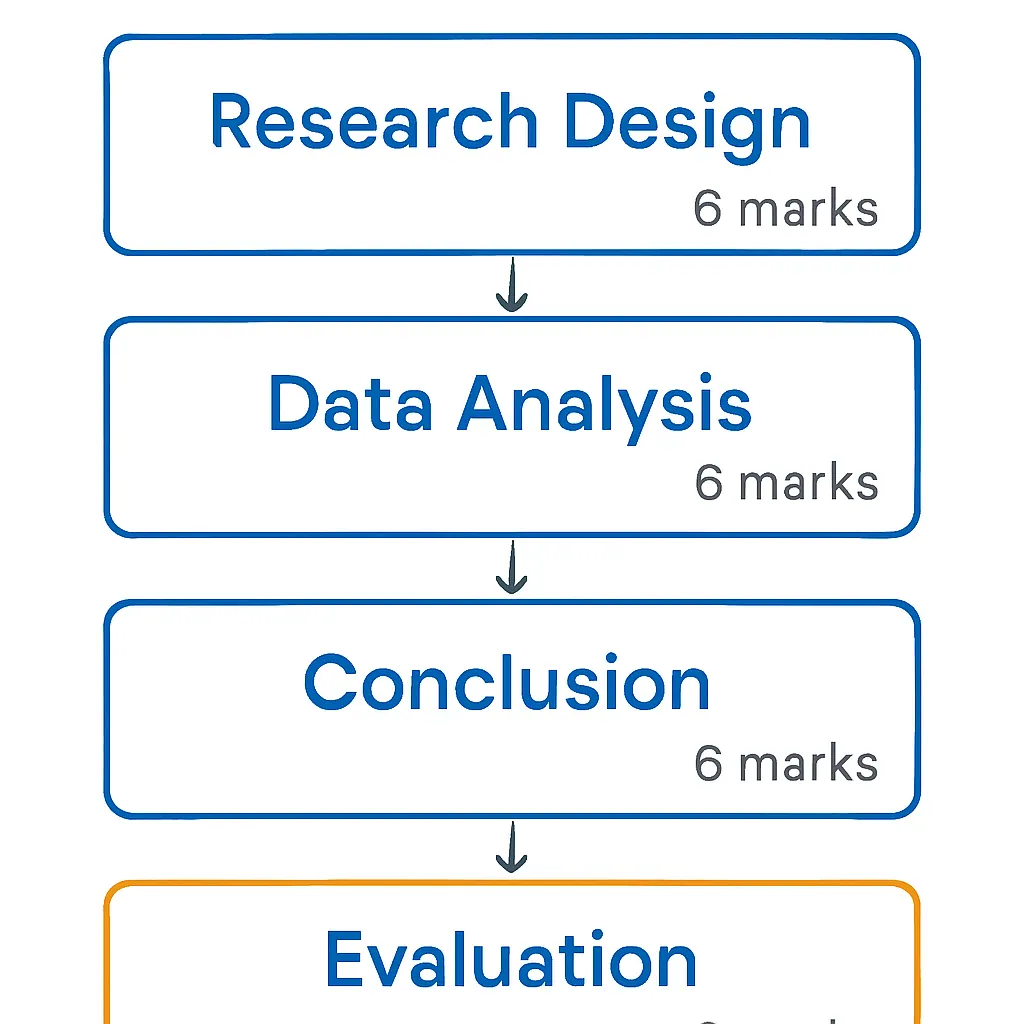
The IB Biology IA is marked against four criteria, each worth 6 marks, giving a total of 24 marks. Examiners award marks holistically within bands, so a student who scores 5-6 on all four criteria is not just doing more of the same thing - they are demonstrating qualitatively different thinking at each stage.
| Criterion | Marks | Core question it asks |
|---|---|---|
| Research Design | 6 | Is this a rigorous, reproducible investigation? |
| Data Analysis | 6 | Has the data been processed with biological understanding? |
| Conclusion | 6 | Does the evidence actually answer the question? |
| Evaluation | 6 | What went wrong, and how would you fix it? |
Research Design (6 marks)
Top-band work here means the research question is narrow enough to be testable in a school lab - something like "the effect of pH on the rate of amylase activity measured by starch disappearance" rather than a broad topic like "enzymes and temperature." The independent, dependent, and controlled variables must be explicitly named and operationalised. A common non-obvious gotcha: a method section that is clearly written but not fully reproducible - if a second scientist could not repeat the experiment without asking you a question, it is not yet top band. Ethical, safety, and environmental statements must be specific to the actual organism or substance used, not copied from a generic template.
Data Analysis (6 marks)
At the top band, raw data alone is not enough. For an ib biology ia, the expectation is that you select a statistical test that matches your data type and sample distribution, carry uncertainties through to processed results, and explicitly discuss biological variation rather than dismissing outliers as "errors." A student who runs a t-test but never explains why that test is appropriate for their data will lose marks even if the arithmetic is correct.
Conclusion (6 marks)
The conclusion must open with a direct answer to the research question, supported by specific values from the data. It then needs to place those findings in scientific context, typically by comparing the trend or magnitude against published enzyme kinetics, known physiological ranges, or accepted ecological models. Stating that results "agree with the literature" without quoting a specific relationship scores poorly.
Evaluation (6 marks)
This criterion separates good biology students from good writers. Identifying a weakness is only the first step - the examiner needs to see how that specific weakness affected the specific results. Suggesting "use more replicates" as an improvement without explaining which data points showed the most variability, and why, is the single most common reason students plateau at the 3-4 band here.
3. Sample Size, Replication, Controls and Biological Variation
Organisms are not machines. A single enzyme assay or one germinating seedling tells you almost nothing on its own, because biological systems carry inherent variability that no amount of careful pipetting can remove. That variability is the point of working with living things, and your investigation design has to account for it from the start.
Replication across conditions is the practical fix. For most common IB biology IA designs, a minimum of five trials or replicates per condition is the accepted working standard:
- Enzyme experiments (e.g. amylase and starch): five repeated runs per substrate concentration, keeping temperature and pH constant across all runs.
- Plant growth studies: five individual plants per treatment group, because genetic and epigenetic differences between seeds mean one plant could be an outlier that skews every mean you calculate.
- Microbial growth rates: five replicate culture wells or plates per condition, since contamination, inoculation density, and micro-environmental differences make single cultures unreliable.
The counter-intuitive point: more replicates per condition is usually more valuable than more conditions. Three concentrations with five replicates each produces stronger analysis than six concentrations with two replicates each.
Controlled variables vs the control group
These are not the same thing, and conflating them is a consistent mark-losing move.
| Term | What it means | Example |
|---|---|---|
| Controlled variable | A variable kept constant across all conditions | Water volume, incubation temperature |
| Control group | A baseline treatment with no independent variable applied | Enzyme assay with no substrate added |
You need both. Controlled variables reduce confounding. The control group gives you a baseline against which to judge whether your independent variable actually caused an effect.
Biological variation as a source of uncertainty
Equipment error (parallax, balance precision) is one source of uncertainty. Biological variation is a separate one: differences between organisms arising from genetics, developmental stage, prior environment, or stress responses. Top-band data analysis in the IB Biology IA requires you to identify and discuss this variation explicitly, not simply minimise it with error bars and move on. State where it came from, why it was unavoidable, and what effect it likely had on your results.
Safety, ethics, and environmental considerations
These belong in your Research Design write-up, not as an afterthought. Absence costs marks at that criterion.
- Ethics: required when your investigation involves human subjects (even anonymous surveys), vertebrate animals, or any organism where pain or distress is plausible. Name the principle you applied.
- Safety: identify hazardous reagents (acids, oxidising agents, biological cultures) and state the control measures, not just the hazard.
- Environmental: mandatory for field work and for any protocol involving the disposal of organisms, genetically modified material, or chemical waste. State the disposal method specifically.
4. What a 7-Level Biology IA Has That a 4-5 Level One Does Not
The gap between a mid-range IA and a top-scoring one is rarely about the topic chosen. It almost always comes down to four specific qualities: precision in the research question, replicability in the method, statistical depth in processing, and specificity in evaluation.
Research question
A 7-level IA opens with a research question that names the independent variable, the dependent variable, the measurement technique, and a defined range. A well-constructed example:
> How does temperature between 20°C and 60°C affect the rate of amylase activity in human saliva, measured by iodine colour change at 2-minute intervals?
A 4-5 level IA typically asks something like "How does temperature affect enzymes?" The method cannot reliably follow from a question that broad, so every subsequent section is weakened before it starts.
Method
A top IA method reads as if a different student in a different school could repeat it exactly. That means concentrations (not just "dilute"), equipment models where relevant, volumes in millilitres, and the sequence of steps written in the order they are performed. The non-obvious detail most students miss: a replicable method also describes what was held constant and how, not just what was varied. Listing controlled variables in a table without explaining how they were controlled is a mid-level habit that examiners notice immediately.
Processing
Mid-level IAs calculate a mean and plot a bar chart. A 7-level IA selects a statistical test appropriate to the data structure: a t-test when comparing two means from normally distributed data, a Spearman correlation for ranked or non-parametric paired data. Critically, it then states what the result means biologically, not just whether p is above or below 0.05.
Evaluation
The clearest differentiator at the top end is evaluation that connects a specific weakness to a specific effect on the data. Compare:
| Level | What the student writes |
|---|---|
| 4-5 | "Human error may have affected results. More trials would improve reliability." |
| 7 | "Temperature fluctuations of approximately ±2°C between trials, caused by the water bath's thermostat cycling, likely introduced variation in enzyme activity and inflated the standard deviation across replicates." |
Generic weaknesses are not evaluated weaknesses. Naming the mechanism by which a flaw distorts the data is what separates a critique from a list.
5. Three Mistakes Examiners Report Most Often
These three problems appear repeatedly in moderator feedback and, between them, cost marks across every criterion.
Mistake 1 - A vague or untestable research question
"Does exercise affect the body?" names neither an independent variable nor a dependent variable, which means the method has no anchor and the conclusion has nothing precise to return to. Both Research Design and Conclusion marks suffer as a result.
The fix: write the research question in this shape - "How does [independent variable, with range] affect [dependent variable, measured how] in [organism or system]?" Every subsequent methodological decision then follows from that sentence.
A counter-intuitive gotcha here: IB examiners treat a research question that is too narrow almost as generously as one that is too vague. A tightly scoped question about the effect of pH on catalase activity in Solanum tuberosum (potato) discs is far easier to defend in evaluation than a broad question that the student quietly narrowed in practice without updating the stated RQ.
Mistake 2 - Raw data tables with missing units, uncertainties, or inconsistent decimal places
Column headers without units, absent instrumental uncertainty, and values recorded to mixed significant figures all sit under the Data Analysis criterion. A common pattern: a student records absorbance to three decimal places in most rows, then to two in a row where they copied from a partner's sheet. Examiners notice the inconsistency immediately.
The fix: record every measurement to the precision of the instrument used, state instrumental uncertainty in the column header or table title, and check that every row has the same number of decimal places before submission.
Mistake 3 - Surface-level evaluation
Writing "parallax error may have affected results" or "more repeats would improve reliability" with nothing else attached is the most common evaluation failure across IB science subjects. The IBO's criterion descriptors for the top band require you to explain how a weakness affected the data, not simply that it might have.
The fix: for each weakness, write three things - the source of error, the likely direction of its effect on the dependent variable (did it inflate or suppress the measured values?), and a specific, feasible improvement. "Using a colorimeter instead of visual colour matching would remove observer subjectivity and is available in most school labs" is the kind of improvement comment that earns marks. "Using better equipment" does not.
6. IB Biology IA Structure, Word Count and Page Limit
The IB Biology IA has a 3,000-word maximum under the syllabus first assessed in 2025; the old 12-page guidance belonged to the previous course. Charts, data tables, equations and calculations do not count towards the 3,000 words, so the limit falls on your prose. Treat it as a hard cut-off: a tight report that spends its words on analysis and evaluation scores better than a sprawling one.
Standard sections, in order:
- Title page
- Research question and background context
- Methodology / research design
- Results and data analysis
- Conclusion
- Evaluation
- References / bibliography
- Appendices (if any)
Appendices sit outside the report and can hold bulky raw data tables or additional graphs, but examiners are not required to consult them when marking. Do not hide anything mark-bearing in an appendix.
Formatting: The IB does not specify double-spacing, but legibility is expected. An 11-12pt font with standard margins is the working norm. Cramming text into 9pt to fit more content is a false economy - it signals poor planning and makes it harder for an examiner to credit your research design.
Background context should be one to two paragraphs of directly relevant science, not a literature review. It earns no marks on its own, but a well-placed reference back to your background in the Conclusion can strengthen your scientific reasoning marks.
References: the IB accepts MLA, APA, Vancouver, and other standard formats. Pick one and apply it consistently throughout your ib biology ia. Switching between styles within a single report is the kind of inconsistency that signals a rushed draft.
7. Good IB Biology IA Topics and Biology IA Research Questions
A viable ib biology ia topic meets three conditions at once: you can test it experimentally in a school lab within the time you have, it produces numerical data you can process statistically, and the variables are controllable enough to isolate cause and effect. Topics that tick all three tend to cluster into a handful of well-established areas.
Strong category areas by topic type:
- Enzyme kinetics - effect of pH, temperature, or substrate concentration on reaction rate (amylase, catalase, and lipase are school-lab staples because they are cheap, safe, and produce measurable output)
- Plant biology - light intensity and transpiration rate via a potometer; germination percentage across temperature or salinity gradients
- Microbiology - growth inhibition zones using disc diffusion; note the IB restricts bacterial work to non-pathogenic Risk Group 1 organisms only, and you must document the specific organism and its risk classification in your safety statement
- Ecology - field-based biodiversity indices such as Simpson's or Shannon's; abiotic factors (soil pH, light levels) and species distribution
- Human physiology - reaction time or heart rate recovery; human-subject work requires a signed ethics consent form before any data collection begins
One counter-intuitive trade-off worth knowing: human physiology topics often look easy but produce high biological variation, which forces you to justify your sample size carefully in Research Design. Enzyme kinetics looks harder but gives tighter, more controllable data.
On secondary data IAs: the IB permits database-based investigations, but examiners apply the same scrutiny to data selection as they do to primary data. You must justify why those specific datasets are appropriate in your Research Design section.
On topic lists online: searching for ideas for ib biology hl ia ideas surfaces many ready-made topic lists. Treat them as a starting point only. Your task is to narrow a broad category into a specific, testable biology ia research question - for example, moving from "enzymes and temperature" to "how does increasing temperature from 20 degrees C to 60 degrees C in 10-degree increments affect the rate of catalase activity in potato tissue, measured by oxygen displacement volume over 60 seconds?"
8. What to Do Next
Your research question is chosen, your structure is clear, and you know what separates a Band 7 IA from a Band 4. The single most preventable failure from here is not a weak analysis or a thin conclusion. It is missing your school's internal submission deadline.
Schools must send moderated samples to the IB by a fixed date, so your biology teacher or coordinator will set an internal deadline several weeks earlier than that. Many students only discover this gap when they ask. Ask now.
This week: contact your IB biology coordinator and confirm the exact internal IA deadline for your cohort. Write it in your calendar alongside your exam timetable. That date, not the IB's own moderation window, is the one that governs your available revision time.
More on IB Biology:
FAQ
How long should an IB Biology IA be?
The IB Biology IA has a maximum of 3,000 words under the syllabus first assessed in 2025; charts, data tables, equations and calculations do not count towards the limit, and appendices containing raw data are not marked.
Does the IB Biology IA have to be double spaced?
The IB does not mandate double spacing for the Biology IA; any legible format (typically 11-12pt font, standard margins) is acceptable; the constraint is the 3,000-word limit, not a page count.
What is the IB Biology IA?
The IB Biology IA is an independent scientific investigation that students design and carry out themselves; it is marked out of 24 across four criteria and counts for 20% of the final Biology grade.
What are the IB Biology IA criteria for the 2025 syllabus?
The four criteria for the 2025 Biology IA are Research Design, Data Analysis, Conclusion, and Evaluation, each worth 6 marks, for a total of 24; personal engagement is no longer a scored criterion.
Can I use secondary data for my IB Biology IA?
Yes, secondary data investigations are permitted, but students must justify their data selection within Research Design and apply the same statistical rigour to processing as they would to primary data.
When is the IB Biology IA due?
The IB itself sets a moderation deadline in the examination year, but each school sets its own internal submission deadline that is always earlier - check with your biology teacher or DP coordinator for your school's specific date.