IB Biology: The Complete Guide for 2026
By Michael Thompson · Education Specialist; 10 years teaching the IB at Bromsgrove School · Published 21 May 2026 · Updated 4 October 2026
IB Biology is a two-year Diploma Programme course that covers molecular genetics, ecology, cell biology, and evolution - all reorganised in 2025 into four conceptual themes rather than the older topic-by-topic format. The restructure affects how you revise, which resources are still valid, and what examiners will ask. Whether you are choosing between Standard Level and Higher Level, planning your Scientific Investigation, or looking for the best notes sites, the structure of the course shapes every decision. This guide covers the 2025 syllabus, the paper format, the IA, and the free tools worth your time.
Key Takeaways
- Four new themes replace the old topic list: Unity and Diversity, Form and Function, Interaction and Interdependence, and Continuity and Change organise all content in the 2025 syllabus.
- HL adds roughly 90 extra teaching hours and longer papers: Both levels sit the same Paper 1 (multiple-choice plus data-based) and Paper 2 structure, but the HL versions carry more questions, more marks, and HL-only extension content.
- The Scientific Investigation (IA) is worth 20% of your final grade: It is an independent inquiry assessed on four criteria worth 6 marks each: research design, data analysis, conclusion, and evaluation.
- The Collaborative Sciences Project replaces the old Group 4 Project: It is a mandatory school-based activity but is not externally assessed and does not count toward your final grade.
- Free resources cover most of the syllabus: BioNinja, Znotes IB Biology, and IB Questionbank (via school licence) are the three most-used tools among IB Biology students.
- Grade boundaries vary by year and component: Check the IBO's published statistical bulletins after each May and November session - do not rely on third-party boundary estimates.
In This Article
- What Is IB Biology and Who Is It For
- The 2025 Syllabus: Four Themes Explained
- SL vs HL IB Biology: What Actually Differs
- Paper Format: Every IB Biology Assessment Explained
- The Scientific Investigation: Your IB Biology IA
- The Collaborative Sciences Project (Replacing Group 4)
- Best Free Study Resources for IB Biology
- How to Revise IB Biology: A Practical Approach
- Grade Boundaries and What a 7 Looks Like
- Where to Go from Here
1. What Is IB Biology and Who Is It For
IB Biology is a two-year science course offered through the International Baccalaureate Diploma Programme (DP), available at Standard Level (SL) and Higher Level (HL). The IB Diploma Programme is a globally recognised pre-university qualification taken by students aged 16-19, typically as an alternative to A-Levels in the UK. Biology is one of the Group 4 experimental sciences, and students study it alongside five other subjects across the six DP groups.
The distinction between SL and HL matters more in biology than in some other subjects. HL is a hard requirement at many UK universities for courses in life sciences and medicine. The University of Sussex BSc Biology, for example, requires a minimum grade 5 in IB HL Biology, Chemistry, or Physics as part of a 32-point Diploma offer. SL alone will close doors at universities like this before your application is even read.
One counter-intuitive point worth knowing early: the IB does not name the course "IB Biology" in its official documentation. It is called "Biology: DP Sciences." That matters when searching for official syllabus documents.
The 2025 syllabus is a substantial restructure. Four broad conceptual themes replace the previous topic-by-topic layout, changing both what is assessed and how students are expected to connect ideas across the course.
2. The 2025 Syllabus: Four Themes Explained
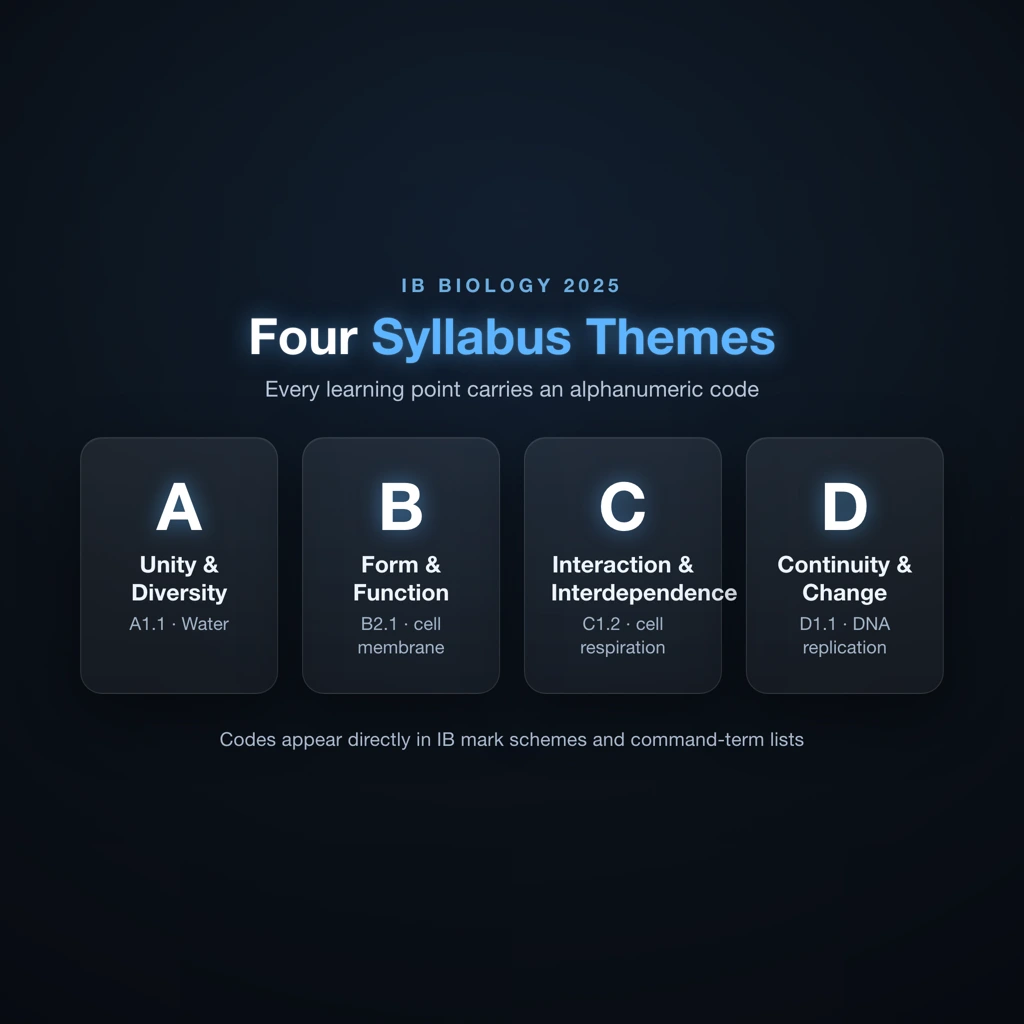
The 2025 IB Biology syllabus replaces the old topic-by-topic structure (Topic 1: Cell Biology, Topic 2: Molecular Biology, and so on) with four conceptual themes that run across both SL and HL:
- A. Unity and Diversity - cells, viruses, classification, and the shared biochemistry of life
- B. Form and Function - how structure relates to job, from organelles to organ systems
- C. Interaction and Interdependence - ecosystems, symbiosis, and physiological coordination
- D. Continuity and Change - genetics, evolution, and inheritance
Each theme is divided into numbered sub-topics, and each sub-topic into specific understandings. This gives every learning point an alphanumeric code: A1.1 covers the structure of the cell membrane, B2.1 moves into the form of the heart, C1.2 addresses ecosystems, and D4.2 deals with speciation. The codes matter because IB examiners use them directly in mark schemes and command-term lists, so knowing which code a question references tells you exactly how deep the expected answer goes.
This is where older resources cause real problems. Any IB Biology textbook or revision guide written before 2023 maps to the previous syllabus, and the content does not line up cleanly with the new theme structure. A resource covering "Topic 2: Molecular Biology" may include material now scattered across themes A, B, and D. Checking the publication date before trusting a source is not optional.
One non-obvious quirk: the IB data booklet and command terms are no longer presented as standalone documents sitting outside the syllabus. They are embedded within the theme structure, which means command terms like "evaluate" or "deduce" appear alongside the specific understanding they apply to. A student revising D3 who skips the command-term column is studying incomplete information.
3. SL vs HL IB Biology: What Actually Differs
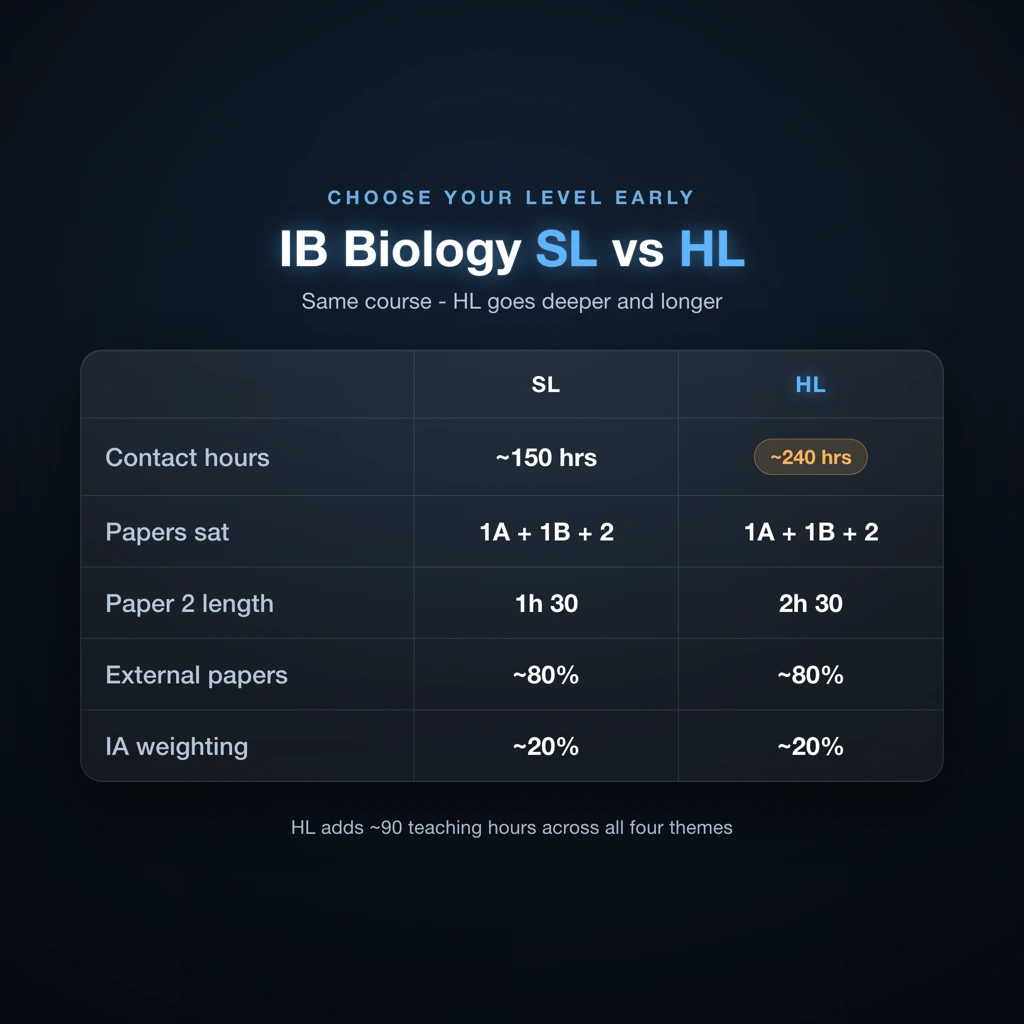
The most common mistake students make is choosing SL to reduce workload, then discovering their university requires HL. Sort this decision early.
Contact hours are the headline difference. SL runs at roughly 150 hours of teaching time; HL runs at roughly 240. That extra 90 hours is not padding. It maps to genuine additional content across all four themes, with each theme carrying HL-only extension material. The extensions go deeper into molecular mechanisms, homeostatic regulation, and quantitative ecology rather than introducing entirely new topics, so HL feels like a harder version of the same course rather than a separate subject.
Assessment is where the structure actually splits. Both levels sit Paper 1A (multiple choice), Paper 1B (data-based short answer), and Paper 2 - the HL versions are longer and carry more marks. Paper 1B is the section that catches people out: it presents unfamiliar experimental data and asks you to interpret, calculate, and evaluate, all without the scaffolding you get in Paper 2. This is where students either gain or lose marks relative to their expected grade. Practising Paper 1B questions on novel contexts is not optional if you want a 6 or 7.
The non-obvious trade-off: HL Biology and HL Chemistry together is a heavy combination that most timetables place in the same block, which can limit your Group 4 and Group 5 options. Check your school's blocking before committing.
Choose HL if you are targeting medicine, dentistry, veterinary science, or bioscience at a competitive UK university. Many Russell Group programmes list HL Biology as a preferred or required subject. SL is sufficient for non-science degrees that include a biology prerequisite, and for students whose strongest subjects sit in other groups.
4. Paper Format: Every IB Biology Assessment Explained
IB Biology assessment splits into external papers (sat in the exam hall) and one internal component. Together they cover the four themes of the 2025 syllabus in two papers, with Paper 1 split into two sections, 1A and 1B.
| Paper | Who sits it | Format | Weighting |
|---|---|---|---|
| Paper 1 (1A + 1B) | SL and HL | 1A multiple-choice; 1B data-based questions | 36% |
| Paper 2 | SL and HL | Data-based and short-answer questions, then extended response | 44% |
| Scientific Investigation (IA) | SL and HL | Internal assessment | 20% |
Paper 1A is a standard multiple-choice paper, but SL and HL candidates sit different versions with a different number of questions and allocated time. Questions test recall and application across all four themes, with a strong emphasis on understanding mechanisms rather than memorising vocabulary.
Paper 1B catches many students off guard. It is not multiple-choice: candidates receive stimulus material, typically data sets or experimental scenarios, and write short analytical responses. The skill tested is reading unfamiliar evidence quickly and applying IB Biology concepts to it, which is a different cognitive demand from Paper 2.
Paper 2 is taken by both SL and HL. It opens with compulsory data-based questions drawn from novel research contexts, then moves to short-answer and extended-response questions. HL candidates face additional questions and a longer sitting time.
Taken together, the two external papers account for 80% of the final grade at both SL and HL: 36% for Paper 1 and 44% for Paper 2. The remaining 20% comes from the Scientific Investigation (covered in section 5), which means a weak IA can meaningfully pull a borderline grade down, even after a strong exam performance.
5. The Scientific Investigation: Your IB Biology IA
The Scientific Investigation (SI) is the mandatory internal assessment for IB Biology from the 2025 syllabus onwards, replacing the older IA format. It counts for 20% of your final grade, making it the single largest chunk of marks outside the written papers. The SI is moderated externally by the IB, so your teacher's mark is not the final word.
The four assessment criteria
Your work is scored across four criteria, each worth 6 marks:
- Research design - a focused research question, justified methodology, and awareness of variables.
- Data analysis - appropriate recording and processing of data, including statistics where the data warrants it.
- Conclusion - an answer to your research question that engages with the accepted scientific context.
- Evaluation - honest appraisal of your method's weaknesses and realistic suggestions for improvement.
Investigation types
The IB accepts several formats. Common approaches include controlled lab experiments (enzyme kinetics, photosynthesis rates), fieldwork (comparing biodiversity across habitats), and database analysis (mining published datasets on gene expression or disease prevalence). Database studies trip up many students because examiners expect the same rigour around variables and limitations as a bench experiment.
If you want to see how examiners actually respond to student work, the IB Questionbank includes subject reports and markschemes that reveal where marks were lost in past cohorts. BioNinja also annotates IB biology IA examples with criterion-by-criterion commentary, which is useful for calibrating your own draft.
Pitfalls worth knowing
Three problems appear repeatedly in moderated scripts:
- A vague research question - "How does temperature affect enzymes?" is not a research question. Name the enzyme, the substrate, the concentration range, and the measurable outcome.
- Insufficient data range - five data points across a narrow range rarely support a meaningful trend, and examiners will say so under Analysis.
- Weak evaluation of methodology - listing "human error" as a limitation is not evaluation. Identify the specific procedural step, explain the direction of the error, and propose a concrete fix.
The non-obvious trade-off: a tightly scoped question that you can answer with reliable data scores better than an ambitious question undermined by uncontrolled variables. Narrower is almost always stronger.
6. The Collaborative Sciences Project (Replacing Group 4)
The Collaborative Sciences Project (CSP) is the 2025 IB replacement for the old Group 4 Project. Like its predecessor, it is a mandatory, school-based activity completed by all science students working together across disciplines. Unlike the Group 4 Project, which sometimes felt like a one-day checkbox exercise, the CSP is designed to embed interdisciplinary thinking across a longer span of the course.
The most important thing to understand: the CSP is not assessed externally and does not contribute to your final IB grade. Your school will confirm completion, but no mark from this project appears on your diploma score.
Its purpose is to develop collaborative and interdisciplinary scientific skills. Students from different science subjects, Biology, Chemistry, Physics, work toward a shared scientific question, bringing their subject-specific knowledge to a joint investigation.
The non-obvious gotcha is that students frequently confuse the CSP with the Scientific Investigation (your internally assessed IA). These are entirely separate requirements:
- Scientific Investigation (IA): individual, externally moderated, worth 20% of your final IB Biology grade.
- Collaborative Sciences Project (CSP): group-based, school-confirmed only, carries no grade weighting at all.
Conflating the two is a real risk early in the course. Treat the CSP as professional development, not exam preparation.
7. Best Free Study Resources for IB Biology
Finding reliable IB biology material has become easier since the 2025 syllabus settled, but the quality gap between resources is still wide. Here are the ones worth your time.
BioNinja (bioninja.com.au) is the closest thing to an unofficial textbook for the new four-theme syllabus. Its diagram library is unusually thorough, which matters in IB biology because examiners regularly ask you to label or interpret figures you have never seen before. Self-studiers rate it highly because every page maps to a specific syllabus point.
Znotes IB Biology offers concise, theme-aligned revision notes that track the 2025 restructure closely. The format suits last-minute consolidation rather than first-pass learning; use it to confirm you have covered a topic, not to learn it from scratch.
IB Questionbank is the official past-question platform created by the International Baccalaureate. It holds questions with full markschemes and subject reports, and it now offers DP Biology in both the pre-2025 and the first-assessment-2025 versions. The catch: a school licence is required, so access goes through your teacher. Ask them to pull custom paper sets filtered by theme and paper number rather than printing generic past papers.
Anki decks for IB biology are widely searched (the query "ib biology anki deck" has clear autocomplete demand) and community-built decks covering Themes A through D exist on shared repositories. The non-obvious problem: most decks were built for the old Option-based syllabus, so check the deck's creation date before committing hours to it.
YouTube attracts the query "best IB biology youtube channel" repeatedly. BioNinja and Richard Thornley both produce structured video content aligned to the course. Richard Thornley's channel is particularly useful for worked data-analysis questions, which are consistently underweighted in written notes.
IB Biozone workbooks are print-based and widely used alongside digital notes. Their structured write-on format suits students who retain information better when they work through problems on paper rather than passively reading screens.
8. How to Revise IB Biology: A Practical Approach
The IB Biology syllabus uses an alphanumeric structure (A1.1, B2.3, D4.x and so on) that doubles as a ready-made revision checklist. Work through each sub-topic in order, tick it off when you can answer a past-paper question on it cold, and you have a reliable map of what is done and what still needs work. This is more reliable than revising by theme or by textbook chapter, because the IB marks against sub-topics, not chapters.
Command terms are not decorative. The IB Biology mark scheme distinguishes sharply between "outline" (brief account, no explanation required) and "explain" (mechanism required) and "evaluate" (judgement with evidence required). Writing an explanation when the question says outline costs you time without gaining marks. Practise spotting the command term before you write a single word.
Use the three paper types for different purposes:
- Paper 1A - multiple-choice recall. Good for identifying gaps quickly.
- Paper 1B - data sets requiring interpretation. Practise reading axes and identifying anomalies, not just repeating theory.
- Paper 2 - extended-response writing. Time yourself strictly; most marks are lost to poor time allocation, not missing knowledge.
Required drawings are the highest-value, lowest-effort marks in IB biology. The syllabus specifies which diagrams you must be able to produce, including cell ultrastructure and mitosis stages. A well-labelled, accurate diagram can earn full marks in under three minutes. Practise each one until the proportions are automatic.
Finally, read the data booklet before your first mock. It contains formulae and constants you do not need to memorise. Knowing what is already provided stops you spending revision sessions on material the IB has already given you for free.
9. Grade Boundaries and What a 7 Looks Like
Grade boundaries for IB Biology are set by the IBO after each exam session and published in the organisation's statistical bulletin. They are not fixed percentages. The boundary for a 7 at HL in one May session can differ noticeably from the boundary at SL, or from the same level in a previous year, depending on how the cohort performed and how the papers were calibrated.
One non-obvious consequence: a student who scores, say, 75% cannot assume that is a 7. In a harder session the boundary might sit lower; in an easier one it might sit higher. Chasing a raw-mark target based on third-party estimates is unreliable at the best of times, and those estimates are built on pre-2025 session data. The 2025 syllabus had its first assessment in May 2025, so boundaries from earlier sessions applied to a structurally different course and should not be treated as benchmarks.
What does distinguish a grade 6-7 response, regardless of where the boundary lands in a given year:
- Precise terminology. Examiners penalise loose substitutions. Writing "breaks down" instead of "hydrolyses" in an enzyme question costs marks even if the underlying understanding is correct.
- Command-term compliance. "Outline" requires less depth than "explain"; "evaluate" requires a conclusion. Misreading the command term is one of the most consistent sources of avoidable mark loss.
- Annotated diagrams. A diagram with unlabelled structures rarely earns full credit. Labels and annotations that connect structure to function are what push responses into the top band.
Work from mark schemes on past papers to internalise what each grade band actually requires, not what a third-party boundary chart predicts.
10. Where to Go from Here
Download the 2025 IB Biology Subject Guide from the IBO's programme resource centre (MyIB) this week and cross-reference it against your school's scheme of work. The sub-topics run from A1.1 through to D4.x, and a surprisingly common problem is schools teaching the content but not in the lettered structure the examiner marks against, which costs students easy command-term marks.
If you are still deciding between SL and HL, check the specific entry requirements of your target universities on UCAS before your school's options deadline. Some courses, including Biology at Sussex, specify a minimum grade at Higher Level, so confirming this now protects your options later.
Open MyIB this week and pull up the Subject Guide. Confirm every sub-topic is covered before your first internal assessment deadline.
FAQ
What is IB Biology?
IB Biology is a two-year International Baccalaureate Diploma Programme science course available at Standard Level and Higher Level, covering molecular biology, genetics, ecology, and evolution, restructured in 2025 into four conceptual themes.
How hard is IB Biology HL?
IB Biology HL is widely considered one of the more demanding DP science courses because of its extended content, longer exam papers with more data analysis, and the depth of evaluation expected in Paper 2 responses.
What is IB Biology Paper 1B?
Paper 1B is the data-based section of Paper 1, sat by both SL and HL candidates alongside the Paper 1A multiple-choice booklet; it requires candidates to interpret experimental data, graphs, and scientific information rather than answer straightforward multiple-choice recall questions.
How do I structure an IB Biology IA?
The Scientific Investigation is assessed against four criteria - research design, data analysis, conclusion, and evaluation, each worth 6 marks - and should open with a focused research question, followed by a justified methodology, processed data with uncertainties, and a critical evaluation of limitations.
How long is IB Biology Paper 2?
Paper 2 runs for 1 hour 30 minutes at SL and 2 hours 30 minutes at HL, combining a data-based question with short-answer and extended-response sections.
How should I revise IB Biology?
Revise by working through the syllabus sub-topics in alphanumeric order (A1.1 to D4.x), practising past-paper questions by command term, learning the required biological drawings, and using the data booklet actively so you know exactly what to memorise and what to look up in the exam.
References
- Biology | University of Sussex | UCAS - https://www.ucas.com/explore/courses/c724057b-2667-9211-3c86-7e1beabd551a/biology?optionId=b9f46fa6-69cd-4d1a-8cc8-0750790d2bff
- IB Questionbank - https://questionbank.ibo.org/