IB Physics IA: Criteria, Structure and Topic Ideas
By Michael Thompson · Education Specialist; 10 years teaching the IB at Bromsgrove School · Published 4 September 2026 · Updated 4 October 2026
The IB Physics IA is a single investigation that counts towards your final Diploma grade, assessed entirely by your teacher and then moderated by the IB. Under the syllabus with first assessment in 2025, the assessment criteria changed - personal engagement was removed and the IA is now marked across four criteria worth 24 marks in total. That shift matters for how you frame your research question and structure your report. This guide explains what each criterion requires in physics, how the top mark band differs from the middle, and the mistakes that cost students the most marks.
Key Takeaways
- Four criteria, 24 marks total: The 2025 syllabus IA is marked on Research Design (6), Data Analysis (6), Conclusion (6), and Evaluation (6) - personal engagement is no longer a scored criterion.
- Personal engagement still shapes the work: Although it is no longer a marked criterion, an authentic, well-justified research question remains the foundation of a high-scoring IA because it drives a coherent methodology.
- Error analysis links every criterion together: Propagating uncertainties through your calculations, displaying error bars on graphs, and discussing systematic versus random errors is what separates a 5-6 from a 7.
- The word limit is 3,000 words: Charts, data tables, equations and calculations do not count towards it, and anything in an appendix is not marked, so the report itself must contain the core investigation from research question to evaluation.
- A weak research question is the single most common mark-loser: Examiners flag vague questions ('how does temperature affect a resistor?') that do not state the independent and dependent variables or the range being tested.
- Gradient-based analysis is expected in physics: Extracting a physical constant or verifying a relationship from the gradient and intercept of a linearised graph is a standard technique the top mark band requires.
In This Article
- What the IB Physics IA Is and How It Is Assessed
- The Four Criteria Explained: What Top Marks Require
- Variables, Graphs, and Error Analysis in a Physics IA
- IB Physics IA Format: Length, Structure, and the Word Limit
- Easy IB Physics IA Ideas and What Makes a Good Topic
- What a 7-Level IA Has That a 4-5 Level One Does Not
- The Three Mistakes Examiners Flag Most Often
- What to Do Next
1. What the IB Physics IA Is and How It Is Assessed
The IB Physics IA is a student-designed investigation submitted as part of the IB Diploma Programme physics course. You design the research question, collect your own data, and write up the report independently. Your teacher marks it first, then the IB externally moderates a sample of submissions from your school to ensure consistency across centres.
The current criteria belong to the DP Physics syllabus with first assessment in 2025, which replaced the previous syllabus (last assessed in 2024). The two syllabuses are not interchangeable, so check with your teacher which version applies to you.
The IA is marked out of 24 across four criteria, and it contributes 20% of your final Diploma physics grade. That weighting is fixed regardless of whether your school is higher level or standard level.
One structural change worth knowing: the previous syllabus included personal engagement as a standalone criterion. The 2025 syllabus removed it as a separate mark. That does not mean the concept vanished. The expectation that your research question is genuinely your own, clearly motivated, and well-justified is now built into the other criteria rather than sitting in its own box. Picking a generic question and dressing it up is harder to hide under the revised mark scheme than many students assume.
2. The Four Criteria Explained: What Top Marks Require
The IB marks the Physics IA against four criteria, each worth 6 marks, giving a total of 24. Examiners award marks within bands, so the difference between a 4 and a 6 on a criterion is often a matter of specificity, not effort. Here is what the top band actually demands for each one.
Research Design (6 marks)
Your research question must be focused enough that it could be answered in a single experiment. A question like "how does physics affect pendulums?" fails immediately. Top band requires the independent and dependent variables to be named explicitly in the research question itself, and every significant controlled variable to be identified with a reason for why it was controlled, not just listed. The methodology must be justified, not just described. One non-obvious requirement: examiners check whether the planned data range is wide enough to support a meaningful trend, so five or more data points across a sensible range matters at the design stage, not just the collection stage.
Data Analysis (6 marks)
Raw data alone scores nothing in the top band. Processed data must include propagated uncertainties carried through calculations, not just the original measurement uncertainties. Graphs need labelled axes with units, error bars, and a best-fit line or curve. The critical step most students miss: the analysis must link back to the research question quantitatively. A gradient calculation that extracts a physical constant (refractive index, spring constant, acceleration due to gravity) is the standard route to full marks. Describing a trend without a quantitative result leaves marks on the table.
Conclusion (6 marks)
The conclusion must answer the research question directly using the numbers from your analysis. Where an accepted or literature value exists, you must compare your derived value against it and comment on whether the discrepancy falls within your uncertainty range. If it does not, you need to suggest why. A conclusion that says "the results support the hypothesis" without quoting a value scores in the middle band at best.
Evaluation (6 marks)
This criterion separates the most polished work from the merely competent. Examiners explicitly penalise vague improvements such as "repeat more trials" or "use better equipment." Top band requires you to distinguish between systematic errors (which shift all results in one direction) and random errors (which scatter results), explain how each affected your data specifically, and propose realistic, targeted improvements tied to those named errors. An improvement like "use a light gate instead of a stopwatch to eliminate reaction-time error in timing pendulum oscillations" is the kind of specificity the top band rewards.
3. Variables, Graphs, and Error Analysis in a Physics IA
These three elements sit at the core of the Data Analysis criterion, and getting them right is what separates a competent report from one that reads like a school lab write-up.
Controlling variables
Every IB Physics IA must name and distinguish between three types of variables:
- Independent variable - the one you deliberately change.
- Dependent variable - the one you measure as a result.
- Controlled variables - everything else that could affect the dependent variable if left to vary.
The critical requirement is to identify at least three controlled variables and explain how each is kept constant. Listing "temperature" as controlled is not enough. You need to say how: for example, by conducting all trials in the same room within a single session to avoid ambient temperature drift. Examiners specifically look for this justification, not just the list.
Graph presentation
A graph in a Physics IA must include:
- Quantity and unit on each axis (e.g. "Period T / s", not just "T")
- An appropriate scale - no large unused regions of white space
- Error bars on data points, vertical or horizontal (or both) where uncertainty is non-negligible
- A best-fit line or smooth curve, never a dot-to-dot line joining adjacent points
Dot-to-dot lines are one of the most common reasons graphs fail to earn full marks.
Linearisation and gradient analysis
Where a relationship is non-linear, linearise it before graphing. For a simple pendulum, plotting T against L gives a curve; plotting T² against L gives a straight line whose gradient equals 4π²/g, allowing you to extract g directly. This technique also makes uncertainty analysis tractable. Draw a steepest and a shallowest plausible line through the error bars to find the maximum and minimum gradient, then take half the difference as the uncertainty in the gradient.
Feeding error analysis into your conclusion
Propagated percentage uncertainties do real work in the Conclusion and Evaluation section. If your calculated value of g carries a total uncertainty of ±5%, and the accepted value of 9.81 m/s² sits inside that range, say so explicitly. That one sentence demonstrates that your discrepancy is within experimental error rather than evidence of a systematic flaw. Many students compute the uncertainty and then forget to use it when commenting on their result.
4. IB Physics IA Format: Length, Structure, and the Word Limit
The IB Physics IA has a 3,000-word limit for the report under the syllabus first assessed in 2025; the old 12-page guidance belonged to the previous course. Charts, data tables, equations and calculations do not count towards the word limit. Bulky raw data and photographs of apparatus can sit in a clearly labelled appendix, but the appendix is not marked, so do not hide analysis there; use it only for supporting material the examiner might want to cross-reference.
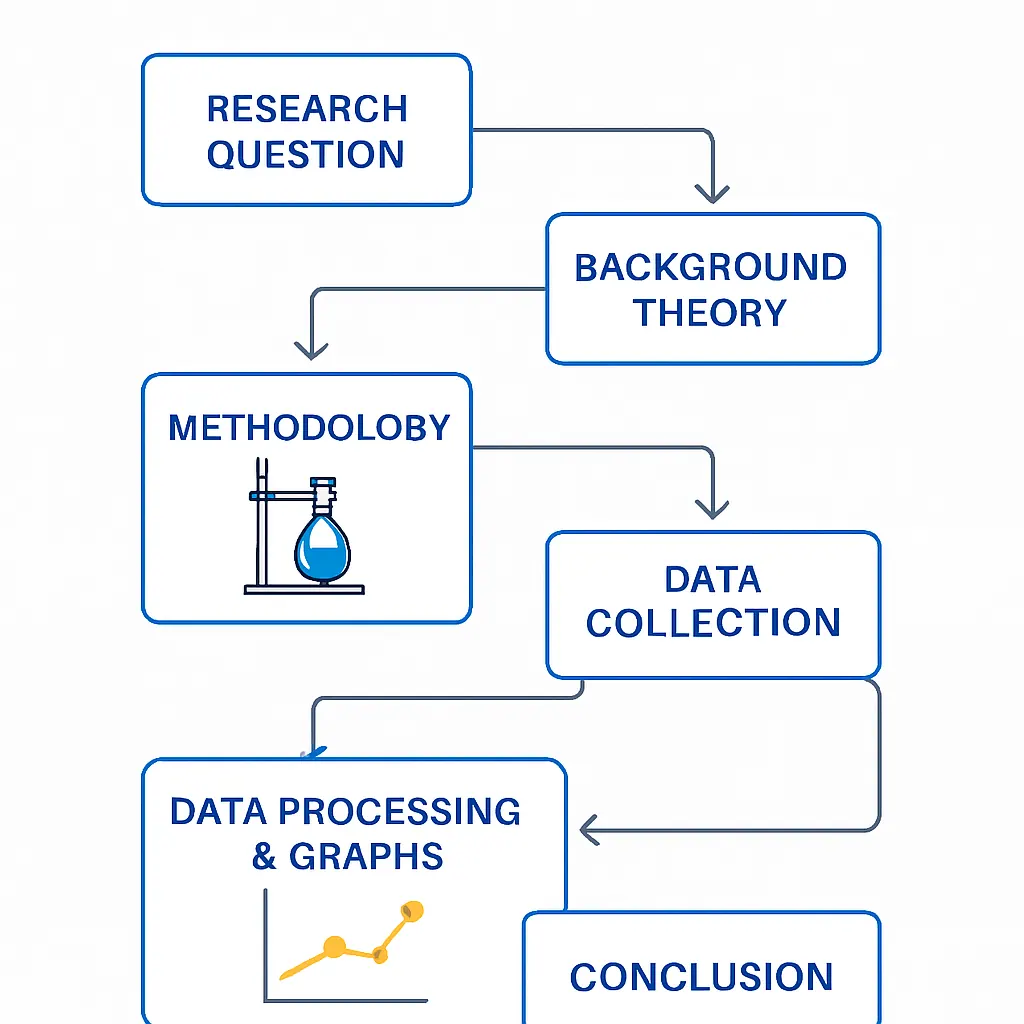
A workable section order for the ib physics ia is:
- Title and research question - one focused sentence stating the independent and dependent variables
- Background theory - brief, enough to justify your method and define the physics quantities you are measuring
- Methodology - including a labelled diagram of the apparatus drawn by hand or in software
- Data collection tables - with units and uncertainties in every column header
- Data processing and graphs - showing propagated uncertainties and lines of best and worst fit
- Conclusion - answering the research question with reference to your processed data
- Evaluation - assessing weaknesses and suggesting specific, realistic improvements
What goes at the start of the report: the subject guide asks for the title of the investigation, your IB candidate code (and those of any group members) and the number of words; a cover page or contents page is not required. Leave your name off entirely. Moderation is anonymous, and an examiner who can identify you is a procedural problem.
The 3,000-word limit is the governing constraint, so cut description before you cut analysis. Dense, hard-to-read pages still cost marks indirectly: an examiner who cannot follow your method or your processing will struggle to credit your research design and data analysis.
IB Physics HL and SL share identical IA criteria and the same 24-mark total. The difference is expectation: HL investigations are held to a higher standard of physical complexity and mathematical rigour, even though the mark scheme applies the same descriptors to both.
5. Easy IB Physics IA Ideas and What Makes a Good Topic
A good IB physics IA topic has four qualities: a clear, measurable relationship between exactly two variables, equipment your school lab already owns, a range of values wide enough to produce five to eight distinct data points, and an obvious link to a named physical law or constant. That last point is easy to underestimate. Anchoring your investigation to Hooke's law or Newton's law of cooling gives you a theoretical prediction to compare your results against, which makes the analysis and evaluation sections far easier to write.
Topic areas that tend to work well at school level:
- Mechanics: pendulum period vs. string length (links to the simple harmonic motion equation), spring constant via Hooke's law
- Waves: string tension vs. frequency of a standing wave (links to the wave speed equation)
- Optics: focal length of a converging lens by varying object distance (links to the thin lens equation)
- Electricity: resistance of a nichrome wire vs. length or temperature
- Thermodynamics: rate of cooling of water vs. surface area (Newton's law of cooling)
One non-obvious pitfall: topics involving human reaction time as a variable look simple but introduce uncontrollable random error that is very hard to reduce systematically, which drags down the analysis marks even if everything else is solid.
Avoid questions framed at the level of "how does gravity affect objects?" The scope is too wide to produce a single graph with a clear gradient. Equally, if the investigation requires a spectrometer, a ripple tank, or temperature-controlled water baths your school does not own, the data collection will stall before it starts.
A genuine question, something you actually want to find the answer to, makes the research question easier to justify and the evaluation easier to write. The old personal engagement criterion no longer appears as a standalone mark in the IB physics internal assessment format, but the examiners' reports consistently note that investigations driven by real curiosity tend to produce sharper, more specific evaluations.
6. What a 7-Level IA Has That a 4-5 Level One Does Not
The difference rarely comes down to the experiment itself. Two students can investigate the same wire resistance setup and score very differently. What separates them is specificity at every stage.
Research question. A 7-level IA names the independent variable with a precise range: "How does the length of a nichrome wire, varied between 10 cm and 60 cm, affect its resistance at constant temperature and cross-sectional area?" A 4-5 level IA asks "How does length affect resistance?" That vagueness leaves the examiner guessing about the method before the method section even starts.
Method justification. A 7-level IA explains why choices were made. Why that range? Because below 10 cm contact resistance at the crocodile-clip junctions becomes comparable in magnitude to the wire's own resistance, distorting the trend. A 4-5 level IA lists steps in order, but offers no reasoning. The steps might be identical. The marks are not.
Data processing. A 7-level IA carries uncertainties through every calculation, so derived values arrive with propagated error bars on the final graph. A 4-5 level IA records raw data with uncertainties noted in the table and then quietly abandons them before drawing the graph.
Evaluation. This is where the gap is sharpest. A 7-level IA names the specific systematic errors in this experiment: contact resistance at junctions; resistive heating from the current altering the wire's resistance mid-measurement; and proposes targeted fixes for each. A 4-5 level IA writes "take more readings" and "use more accurate equipment." Those phrases signal to an examiner that the student has not thought about the physics of their own experiment.
7. The Three Mistakes Examiners Flag Most Often
These three errors appear repeatedly across moderated IB Physics IAs. They are not obscure edge cases - they are the gaps that separate a 4 from a 6.
Mistake 1: A vague research question. "How does temperature affect resistance?" looks reasonable until an examiner asks: which material, which temperature range, and how is temperature controlled? Without those specifics, the Research Design criterion takes an immediate hit because the method cannot be fully justified against the question. A less obvious consequence: a vague question weakens Conclusion and Evaluation too, since you cannot assess whether your result answers something that was never precisely defined.
Mistake 2: Missing or misused uncertainties. Recording "10.2 cm" with no stated uncertainty, or plotting a graph without error bars, directly costs marks in Data Analysis. The counter-intuitive part is that uncertainties matter most in the conclusion. Without them, the examiner cannot judge whether your result agrees with an accepted value within the bounds of experimental precision, so the conclusion becomes qualitatively empty regardless of how tidy the data looks.
Mistake 3: Generic evaluation. "Results could be improved by repeating the experiment more times" is the single most common low-scoring comment in IB Physics IAs. Examiners expect named, physics-specific sources of error - heat loss through convection in a thermal experiment, contact resistance in an electrical circuit - paired with specific, feasible improvements that address each one directly.
8. What to Do Next
This week, write a draft research question. Then test it against the Research Design criterion before you speak to your supervisor.
A strong research question names four things explicitly: the independent variable, the dependent variable, the range over which you will vary the independent variable, and at least one control strategy. If any of those four elements is missing, the question will cap your Research Design score regardless of how well the rest of the report is written. That is the non-obvious trap: supervisors often approve a question that sounds scientific but cannot reach the top band because the control strategy is implied rather than stated.
Write the question, check it against those four elements, revise it, and then book time with your supervisor to discuss it. Do not bring the question to your supervisor first - revise it yourself at least once before that conversation.
FAQ
What is the IB Physics IA out of?
The IB Physics IA is marked out of 24, split equally across four criteria - Research Design, Data Analysis, Conclusion, and Evaluation - each worth 6 marks, under the syllabus with first assessment 2025.
How long should an IB Physics IA be?
The IB Physics IA report has a maximum of 3,000 words under the syllabus first assessed in 2025; charts, data tables, equations and calculations do not count towards the limit, and anything placed in an appendix is not marked.
What percentage of the IB Physics grade is the IA worth?
The IA contributes 20% of the final IB Physics grade at both Standard Level and Higher Level.
What happened to personal engagement in the new IB Physics IA?
Personal engagement was a scored criterion in the previous syllabus (last assessment 2024) but was removed in the 2025 syllabus; the expectation of an authentic, well-justified research question remains, it simply is not awarded separate marks.
What are good IB Physics IA topics?
Strong topics have a measurable relationship between two variables, use standard school lab equipment, and connect to a known physical law - mechanics, waves, optics, electricity, and thermodynamics all offer accessible starting points.
When is the IB Physics IA due?
The submission deadline is set by each school and uploaded to IBIS by the teacher; students should check their school's internal deadline, which is typically several weeks before the IB's own school submission window in the spring.