IB Chemistry IA: Criteria, Structure and Top Tips
By Michael Thompson · Education Specialist; 10 years teaching the IB at Bromsgrove School · Published 4 September 2026 · Updated 4 October 2026
The IB Chemistry IA is an independently designed experiment that counts for 20% of your final chemistry grade. For first assessment in May 2025, the IB updated the criteria - personal engagement was removed and the report is now marked on four criteria worth 24 marks in total. That shift changes how you should plan and write your investigation from the start. This guide covers every criterion, what examiners want to see at the top mark band, how to handle uncertainties correctly, and the structural mistakes that cost marks most often.
Key Takeaways
- Four criteria, 24 marks: The 2025 syllabus marks Research Design (6), Data Analysis (6), Conclusion (6), and Evaluation (6) - personal engagement no longer appears on the rubric.
- Authentic research question matters more than ever: Although personal engagement has no dedicated marks, a focused, chemically justified research question still underpins every criterion.
- Uncertainties must be propagated, not just recorded: Absolute and percentage uncertainties need to flow through all calculations, with systematic and random error addressed separately in the evaluation.
- The 3,000-word limit is firm: Charts, data tables, equations and calculations do not count towards it; bulky raw data and spectra can go in an appendix, but the appendix is not marked.
- Top-scoring reports justify every methodological choice: A 7-level IA explains why each variable was controlled, not just that it was, and links evaluation weaknesses to specific modifications with predicted impact.
- Examiners flag three recurring mistakes: Unprocessed uncertainties, a conclusion that merely restates data without referencing literature, and insufficient replication to justify the method's reliability.
In This Article
- What the IB Chemistry IA is and how it fits into your grade
- The 2025 criteria: what changed and what each criterion requires
- Uncertainties and error propagation in your IB Chemistry IA
- What separates a 7-level IA from a 4-5 level one
- Best IB Chemistry IA ideas: choosing a research question that works
- Structure, word count and page limit for the IB Chemistry IA
- Three mistakes examiners report most often - and how to avoid them
- What to do next
1. What the IB Chemistry IA is and how it fits into your grade
The IB Chemistry IA (internal assessment) is an independent scientific investigation that you design and carry out yourself. Your teacher marks it internally, and the IB then moderates a sample of submissions externally to ensure consistency across schools. It applies to both SL and HL students, and counts for 20% of your final chemistry grade, making it one of the most consequential pieces of work you will complete outside the exam room.
The current specification, with first teaching from August/September 2023, means the first cohort sat assessment under the new criteria in May 2025. The IBO's DP chemistry curriculum page is the authoritative reference for what is required.
One non-obvious point: because the IA is externally moderated rather than externally marked, your teacher's score can shift up or down after moderation. A school where all teachers consistently overmark will see every student's IA score adjusted downward. Your raw mark is not your final mark.
2. The 2025 criteria: what changed and what each criterion requires
From first assessment 2025, the IB Chemistry IA is marked on four criteria, each worth 6 marks, giving a total of 24 marks. Personal engagement no longer appears as a separate criterion. The rubric now reads:
| Criterion | Marks available |
|---|---|
| Research Design | 6 |
| Data Analysis | 6 |
| Conclusion | 6 |
| Evaluation | 6 |
| Total | 24 |
What the removal of personal engagement actually means
Dropping personal engagement as a named criterion does not mean your motivation for the topic is irrelevant. There are no dedicated marks for it, but a generic or copied research question will cost you across Research Design, Conclusion and Evaluation, because those criteria all reward a question that is focused, original and genuinely investigable. The counter-intuitive implication: personal engagement now matters more than before, not less, because a weak research question drags down every criterion simultaneously rather than just one.
What each criterion requires at the top mark band
Research Design (6 marks)
The research question must be specific and testable, with a clearly stated independent variable and a written justification for why that variable was chosen. All relevant controlled variables must be listed alongside a reasoned strategy for controlling each one. The method has to be detailed enough that another chemist, working from your written description alone, could replicate the experiment and obtain comparable results. Vague instructions such as "heat the solution" without specifying temperature, duration and equipment are a common route to losing marks here.
Data Analysis (6 marks)
Raw data is not enough. You must process it quantitatively, propagating uncertainties through every calculation, not just quoting them for the initial measurement. Graphs need error bars, and any trend you describe must be justified mathematically or statistically, not just asserted. A straight-line graph with no gradient calculation, for example, will sit in the middle mark band regardless of how tidy the data looks.
Conclusion (6 marks)
The conclusion has to answer the research question directly, using your processed data as evidence. It should compare your result with an accepted literature value or a theoretical explanation, and it must state explicitly whether your hypothesis was supported, partially supported, or refuted. Describing what happened without linking it back to the original question is the single most common reason a conclusion stays below the top band.
Evaluation (6 marks)
Generic weaknesses such as "human error" or "the equipment was not accurate enough" will not reach the top band. You need to name specific methodological limitations, classify each error as systematic or random, and propose realistic improvements with a reasoned prediction of how each change would affect the results. An improvement that cannot plausibly be implemented in a school laboratory will also lose credit.
3. Uncertainties and error propagation in your IB Chemistry IA
Uncertainty handling is where many IB Chemistry IA reports lose marks that are genuinely easy to keep. The rules are mechanical once you know them, but examiners consistently note that students record raw data without uncertainties, then wonder why their evaluation scores are weak.
Recording absolute uncertainties
Every piece of apparatus needs its uncertainty recorded alongside every raw data value, not buried in a footnote. Use the manufacturer's stated uncertainty where one exists. Where it does not, use half the smallest scale division. A burette reading, for example, should appear as 24.35 ± 0.05 cm³ in your data table. A digital balance reading to 0.01 g carries ± 0.01 g (the full last digit, not half, because digital displays truncate rather than round continuously).
Percentage uncertainty and which apparatus dominates
The formula is straightforward:
percentage uncertainty = (absolute uncertainty ÷ measured value) × 100
Its real use is diagnostic. Calculate it for every piece of apparatus and compare. A 50 cm³ measuring cylinder with ± 0.5 cm³ used to measure 8 cm³ carries a 6.25% uncertainty. A burette measuring the same volume carries roughly 0.6%. That difference identifies the measuring cylinder as the dominant source of imprecision, which feeds directly into a credible evaluation.
Propagating uncertainties through calculations
The IB expects you to apply these three rules in your processed data table:
- Addition or subtraction - add the absolute uncertainties.
- Multiplication or division - add the percentage uncertainties.
- Powers - multiply the percentage uncertainty by the exponent.
Work these through numerically in the table itself, not as a separate paragraph. Examiners check that the final calculated uncertainty is consistent with the propagation shown.
Systematic vs. random error in the evaluation
This distinction matters for your improvement proposals. Random errors scatter results around a true value and reduce with more trials. Systematic errors shift every reading in the same direction throughout the experiment, so averaging more trials changes nothing. A balance that reads 0.2 g high on every measurement is a systematic error. You cannot average it away, and proposing "repeat the experiment more times" as a fix for a systematic error signals to the examiner that you have misidentified the problem.
For each weakness you identify, state which category it belongs to and propose an improvement that actually addresses that category. That specificity is what distinguishes a strong evaluation from a list of vague limitations.
4. What separates a 7-level IA from a 4-5 level one
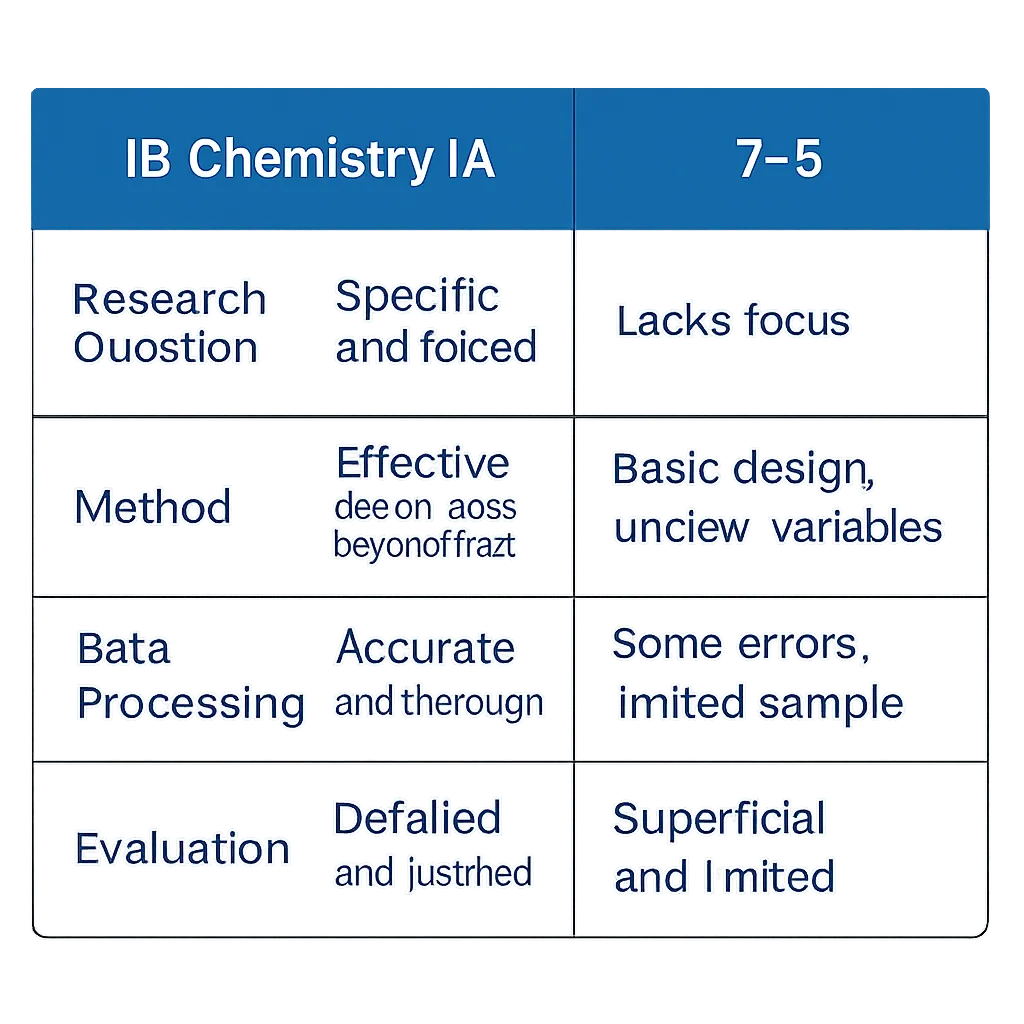
The gap between a middling IA and a top-scoring one usually comes down to four specific habits, and they show up in the same four places every time.
Research question precision. A 7-level IA names the independent variable, the dependent variable, and the chemical system in the question itself. "How does temperature affect the rate of hydrolysis of ethyl ethanoate in 1.0 mol dm⁻³ HCl?" is precise enough that an examiner can immediately picture the experiment. "How does temperature affect rate?" could describe almost any reaction in a textbook. The vague version forces the examiner to infer your intent, and inferring is not their job.
Justified method. A 4-5 level report lists steps in order. A 7-level report explains the reasoning behind each choice: why this concentration range rather than a wider one, why a colorimeter rather than a UV-vis spectrophotometer, why 5-minute intervals rather than 2-minute ones. The non-obvious insight here is that justifying a choice you rejected (and saying precisely why you rejected it) is often more convincing than justifying the choice you made.
Data processing with propagated uncertainties. Averaging repeats satisfies almost nothing. A 7-level report carries uncertainties through every calculation step, presents error bars on graphs, and then uses the gradient or intercept to extract a physically meaningful quantity (a rate constant, an activation energy). A graph with no error analysis tells the examiner the data processing criterion was treated as decoration.
Specific, directional evaluation. The difference between a 4-level and a 7-level evaluation is not length. It is specificity. Compare these two:
| Level | Example evaluation statement |
|---|---|
| 4-5 | "Heat loss occurred due to equipment limitations." |
| 7 | "Heat loss through the uninsulated calorimeter wall is systematic: it reduces the measured temperature change and therefore causes the calculated enthalpy value to be less exothermic than the true value. Adding a polystyrene lid and an insulating jacket would reduce the rate of heat transfer to the surroundings." |
The 7-level version names the weakness, classifies it (systematic), states the direction of its effect on the result, and proposes a modification with a reason. Writing "human error" without explaining which step, in which direction, and by how much is the single most common route to losing marks on the Evaluation criterion.
5. Best IB Chemistry IA ideas: choosing a research question that works
A strong IB Chemistry IA research question does three things: it names a measurable dependent variable, fixes a chemically defined system, and connects to a named syllabus concept. "Does temperature affect reaction rate?" fails all three. "How does temperature affect the initial rate of the sodium thiosulfate-hydrochloric acid clock reaction, measured as 1/time?" passes all three.
Topic areas that consistently produce strong IAs:
- Rates of reaction - effect of concentration or temperature on a clock reaction or enzyme-catalysed reaction. Specify the reaction, the variable, and the measured quantity (initial rate from a time-of-colour-change method or a data-logger pressure reading). A common mistake is treating time-of-disappearance as the dependent variable without converting it to an initial rate - examiners notice the distinction.
- Electrochemistry - effect of electrolyte concentration on cell potential, linked to the Nernst equation.
- Acid-base chemistry - buffer capacity comparisons across different buffer systems at matched pH.
- Colorimetry - absorbance-concentration calibration to verify Beer-Lambert Law, which gives a clean quantitative relationship and natural error analysis.
Rate of reaction IAs are among the most popular choices and can score well, but only when the student moves beyond a results table to analysis of mechanism or activation energy.
Avoid questions that are too qualitative (such as "which substance is a better conductor?") or that depend on equipment your school does not stock. Confirm your method with your supervisor before you collect a single data point - changing your system mid-investigation is one of the most common causes of a structurally weak IA.
6. Structure, word count and page limit for the IB Chemistry IA
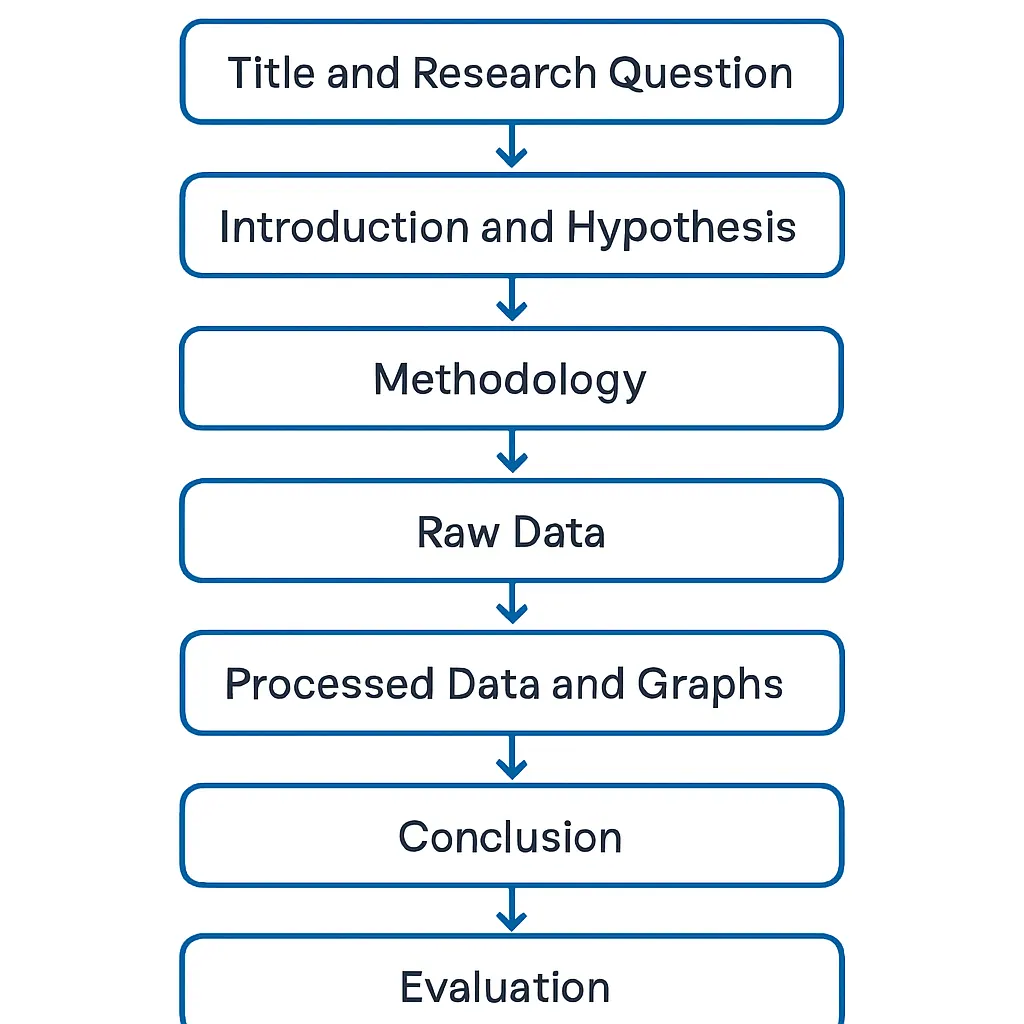
The IB sets a 3,000-word limit for the report under the syllabus first assessed in 2025; the old 12-page guidance belonged to the previous course. Charts and diagrams, data tables, equations and calculations, headings and references do not count towards the 3,000 words, so the limit falls on your prose: background, method, conclusion and evaluation.
Recommended section order:
- Title and research question
- Introduction and background, including a reasoned hypothesis
- Methodology: independent, dependent and controlled variables; materials list; step-by-step procedure; safety and ethical considerations
- Raw data with units and uncertainties
- Processed data, including propagated uncertainties and fully labelled graphs
- Conclusion
- Evaluation
- References
What belongs in the appendix (supporting material only):
- Full raw data sets that are too large to present cleanly in the body
- Repeat calculations beyond the worked examples you show in the report
- Spectra, chromatograms, or gel images
- Ethics or risk-assessment forms
The appendix is not marked, so anything the examiner needs in order to credit you, including a worked example of each type of calculation, belongs in the report itself. Equations and calculations do not count towards the 3,000 words, so there is no word-count reason to move them out.
Practical formatting tips:
- Font size 11-12 pt, consistent throughout
- Caption every table and figure (Table 1, Figure 2, etc.)
- Number equations so you can cross-reference them
- Graphs must show labelled axes with units and, where appropriate, uncertainty bars
7. Three mistakes examiners report most often - and how to avoid them
These three patterns appear repeatedly in IB moderation reports and account for a disproportionate share of lost marks across the Data Analysis and Evaluation criteria.
Mistake 1: Uncertainties recorded but never propagated
Students list ± values neatly in their raw data tables, then ignore them entirely once calculations begin. The examiner sees no uncertainty carried through to processed data, no final uncertainty on the calculated rate constant or enthalpy value, and awards zero on the relevant Data Analysis descriptor.
The fix is mechanical: treat uncertainty propagation as a parallel calculation. Every time you process a value, perform the matching uncertainty operation immediately beneath it and show it explicitly in the processed data section. A worked example, even a short one, signals that you understand what the number means, not just how to record it.
Mistake 2: A conclusion that only restates the data
"As concentration increased, rate increased" is a description, not a conclusion. A conclusion at the top mark band requires a link to an accepted literature value, a named theoretical framework (collision theory, the Arrhenius equation), and an explicit statement of whether your result supports or contradicts the hypothesis.
A counter-intuitive point worth noting: examiners penalise a conclusion that agrees with the literature but gives no discussion of discrepancy more harshly than one that disagrees and explains why clearly.
Mistake 3: Generic evaluation
"Human error may have occurred" scores nothing at the top band. The IB requires you to name the specific source (for example, heat loss to the surroundings during a calorimetry experiment), classify it as systematic or random, describe its directional effect on the dependent variable, and propose a realistic improvement. "Use better equipment" is not a realistic improvement. "Replace the polystyrene cup with an insulated Dewar flask to reduce systematic heat loss, lowering the measured enthalpy value" is.
8. What to do next
One detail trips up more students than any other: the last-assessment-2024 and first-assessment-2025 versions of the DP Chemistry course use different assessment criteria, and submitting work benchmarked against the wrong version can cost you marks before an examiner reads a single word of your analysis.
Before you write another sentence of your scientific investigation, visit the IB's official DP Chemistry page this week and download the subject brief for your cohort's assessment year. Confirm with your teacher which version applies to you. The brief is the authoritative source, and the criteria document your examiner uses sits inside it. Check it now, then align every section of your IA to that specific rubric.
FAQ
What is the IB Chemistry IA?
The IB Chemistry IA (internal assessment) is an independently designed scientific investigation that students plan, carry out, and write up; it is marked by their teacher, externally moderated by the IB, and counts for 20% of the final chemistry grade at both SL and HL.
What are the IB Chemistry IA criteria for 2025?
From first assessment May 2025, the IA is marked on four criteria - Research Design, Data Analysis, Conclusion, and Evaluation - each worth 6 marks, giving a total of 24 marks; personal engagement is no longer a separate assessed criterion.
How long should the IB Chemistry IA be?
The IB sets a maximum of 3,000 words for the report under the syllabus first assessed in 2025; charts, data tables, equations and calculations do not count towards the limit, and anything placed in an appendix, such as large raw data sets or spectra, is not marked.
How do I write a strong IB Chemistry IA conclusion?
A top-band conclusion directly answers the research question with evidence from the processed data, compares the finding to a published or theoretical value, and states clearly whether the result supports the original hypothesis - it does not simply restate what the data tables show.
What are the best IB Chemistry IA topics or ideas?
High-scoring investigations typically involve a quantitative, measurable variable within a well-defined chemical system - popular areas include rates of reaction (clock reactions, Arrhenius investigations), electrochemical cell potential, acid-base buffer capacity, and Beer-Lambert colorimetry - provided the research question is specific and the method is feasible in a school laboratory.
Does personal engagement still matter in the IB Chemistry IA?
Personal engagement is no longer a separately marked criterion from first assessment 2025, but an authentic, self-chosen research question that is clearly justified still underpins Research Design and the overall coherence of the report, so genuine motivation for the topic remains practically important.
References
- Chemistry in the DP - International Baccalaureate® - https://ibo.org/programmes/diploma-programme/curriculum/sciences/chemistry