IB Chemistry Data Booklet: Complete Guide (2025)
By Michael Thompson · Education Specialist; 10 years teaching the IB at Bromsgrove School · Published 4 September 2026 · Updated 4 October 2026
The IB chemistry data booklet is the reference document provided to every candidate sitting DP Chemistry papers, and knowing how to use it efficiently can be the difference between a confident answer and a missed mark. The booklet was revised for the new syllabus with first assessment in May 2025, so students who trained on the 2016 edition will find the structure and content have changed. This guide walks through every section, flags the parts students most often overlook, and explains how to practise so that locating any value feels automatic on exam day.
Key Takeaways
- New booklet for the 2025 syllabus: The data booklet was updated alongside the new DP Chemistry course (first teaching August/September 2023, first assessment May 2025) - the 2016 fourth-edition booklet no longer applies to current candidates.
- Provided in Papers 1 and 2: The booklet is given out at the start of both Paper 1 and Paper 2 at SL and HL; you do not need to memorise the values it contains.
- Every section has a specific use: From the activity series to spectroscopic data, each section maps directly to question types - understanding those links is more useful than reading the booklet cover-to-cover.
- Hidden marks in overlooked sections: Sections covering electrochemical series, spectroscopic correlations, and mathematical relationships are frequently ignored but contain information that answers exam questions directly.
- Practise with the real document: Timed retrieval practice - opening the booklet and locating a specific value within a few seconds - is the single most effective preparation habit.
- Download the official version only: The IBO publishes the current booklet on ibo.org; annotated third-party versions may contain errors or reflect the old syllabus.
In This Article
- What the IB Chemistry Data Booklet Is and Which Syllabus It Covers
- Which Papers Include the IB Chemistry Data Booklet
- Every Section of the IB Chemistry Data Booklet Summarised
- The Sections Students Forget - and the Marks They Leave on the Table
- How to Practise with the IB Chemistry Data Booklet for Exam Speed
- New IB Chemistry Syllabus Data Booklet vs the Old 2016 Edition
- Where to Download the Official IB Chemistry Data Booklet
- What to Do Next
1. What the IB Chemistry Data Booklet Is and Which Syllabus It Covers
The IB Chemistry data booklet is an official reference document published by the International Baccalaureate Organisation and handed to every candidate in the exam room. It is not a revision aid to memorise. It is a tool to navigate quickly under timed conditions, and how well you use it separates confident answers from guesswork.
The booklet belongs to the revised DP Chemistry syllabus, which is built around two core concepts, Structure and Reactivity, with first teaching from August/September 2023 and first assessment in May 2025. If you started the course in September 2023 or later, this is your booklet.
That matters because the previous edition, used by students on the fourth-edition 2016 syllabus, has different content, a different layout, and different section numbering. The two booklets are not interchangeable. Revision resources written for the old course will reference sections that either no longer exist or now cover something else entirely.
One detail worth noting early: both SL and HL candidates receive the same physical booklet. Content that is HL-only is flagged within the booklet itself, so you will see data and equations that SL students are not required to apply. Knowing which rows or tables fall outside your level stops you from second-guessing yourself during Paper 1 or Paper 2.
2. Which Papers Include the IB Chemistry Data Booklet
The IB chemistry data booklet is distributed at the start of both Paper 1 and Paper 2 at Standard Level and Higher Level. Candidates do not sit any exam paper without it.
What each paper looks like in practice:
- Paper 1 is multiple-choice. Questions test conceptual understanding quickly, but several items require you to read off electrode potentials, look up bond enthalpies, or check spectral data. The booklet is available here too, which surprises some students who assume multiple-choice means memory-only.
- Paper 2 is data-based and extended writing. This is where the booklet earns its keep: calculations involving thermodynamic values, electrochemical series comparisons, and mathematical equations all draw on it directly.
Both papers are sat at SL and HL as part of the International Baccalaureate Diploma Programme Chemistry course, which began first teaching in August/September 2023.
The practical consequence is this: you do not need to memorise the Faraday constant or standard electrode potentials, but you do need to know which section of the booklet holds them and be able to turn to it in under ten seconds under exam conditions. Speed of retrieval is what the booklet rewards, not passive familiarity.
The internal assessment (the scientific investigation) is a separate school-based component. There is no official exam booklet distributed during that work, though students may consult the data booklet during laboratory sessions at their school's discretion.
3. Every Section of the IB Chemistry Data Booklet Summarised
The IB Chemistry course is structured around structure and reactivity, and the data booklet maps directly onto that framework. Each section below is available during exams unless otherwise noted.
One non-obvious gotcha: the section numbers in the 2025 booklet do not match the 2016 edition. Students who search "section 11 IB Chemistry data booklet" or "section 12 IB Chemistry data booklet" while using older revision resources may be looking at the wrong tables entirely. Always verify numbering against the current official document.
| Section | What it contains | When you need it | SL or HL? |
|---|---|---|---|
| Fundamental constants and units | Physical constants (speed of light, Avogadro's number, Planck's constant, gas constant) plus SI unit definitions | Any quantitative calculation | SL + HL |
| Periodic table | Full periodic table with atomic number, relative atomic mass, and element symbols | Identifying elements, molar mass calculations, period/group trends | SL + HL |
| Electron configuration and atomic data | Ionisation energies, electron affinity values, electronegativity, atomic radii | Bonding questions, periodic trends, reactivity comparisons | SL + HL |
| Electrochemical series (standard electrode potentials) | E° values for half-reactions in volts under standard conditions | Predicting cell voltage, spontaneity of redox reactions, electrochemical cells | SL + HL |
| Activity series | Ranked list of metals and non-metals by relative reactivity | Displacement reactions, predicting whether a reaction will occur | SL + HL |
| Bond enthalpies | Mean bond enthalpy values for common covalent bonds | Estimating enthalpy changes using bond-breaking and bond-forming arithmetic | SL + HL |
| Thermodynamic data | Standard enthalpy of formation, standard entropy, and standard Gibbs energy values for substances | Hess's law calculations, entropy and spontaneity problems | SL + HL |
| Acid-base data | pKa values for weak acids; Kw | Buffer calculations, pH problems, comparing acid strength | SL + HL |
| Mathematical and graphical tools | Logarithm rules, uncertainty expressions, graph linearisation guidance | Data analysis in papers and the scientific investigation | SL + HL |
| Spectroscopic data | IR absorption ranges, common mass spectrometry fragmentation patterns, proton NMR chemical shift ranges | Structure determination questions, especially in organic chemistry | SL + HL |
A point worth flagging on the electrochemical series: the booklet lists half-reactions in a specific direction. Students who reverse a half-reaction to calculate a cell potential must flip the sign of E° themselves. The booklet does not do this for you, and forgetting that step is one of the most common sources of dropped marks on Paper 2.
The IB Chemistry equation sheet is not separate. Everything, formulas and data, lives inside the same booklet, so knowing where each table sits is as important as understanding what it contains.
4. The Sections Students Forget - and the Marks They Leave on the Table
Most students open the data booklet for molar masses and stop there. The sections below get used far less often than they should, and each one hands you marks directly.
The activity series ranks metals and non-metals by reactivity. A displacement question asks whether zinc displaces copper from copper sulfate solution. You do not need to remember the order. The series gives it to you. Read the ranking, compare positions, answer in seconds. Memorising this list is revision time spent on something the booklet already holds, with the added risk of getting the order slightly wrong under pressure.
Standard electrode potentials let you calculate standard cell EMF by subtracting the less positive half-cell potential from the more positive one. They also tell you whether a redox reaction is spontaneous: a positive E-cell value means it proceeds. Paper 1 electrochemistry questions on cell voltage or reaction direction are often one subtraction away from the answer, provided you know the table is there.
Spectroscopic correlation tables cover IR absorption wavenumbers, ^1H NMR chemical shift ranges, and common mass spectrometry fragment masses. Structure determination questions hand you a spectrum and ask you to identify a functional group or confirm a structure. The IR table maps a broad absorption around 1700 cm^-1 to a carbonyl group. The NMR table places a singlet near 9-10 ppm at an aldehyde proton. Neither number needs to be in your head.
The counter-intuitive point: the mathematical and graphical tools section, which covers mathematical relationships and graphical conventions, is the one students most often overlook entirely. It defines what a tangent to a concentration-time graph represents, which matters the moment a question asks about rate at a specific point.
If a booklet section answers a question directly, the only preparation you need is knowing the section exists and being able to find it quickly.
5. How to Practise with the IB Chemistry Data Booklet for Exam Speed
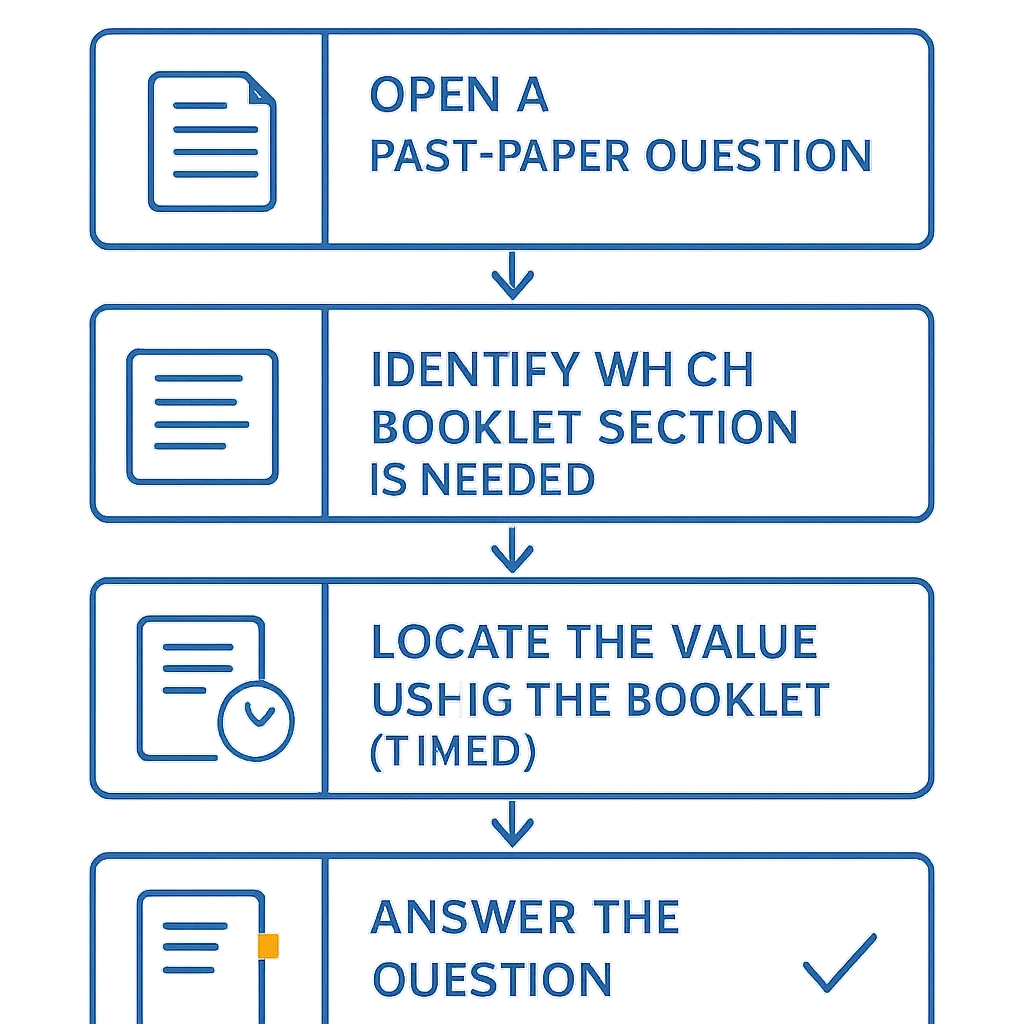
The counter-intuitive truth about the IB Chemistry data booklet is that familiarity, not content knowledge, is what separates quick navigators from students still flicking pages in the final minutes of Paper 2. The booklet does not reward reading - it rewards drilling.
Timed retrieval is the core method. Set a 10-second timer, call out a specific value ("standard electrode potential for Cu²⁺/Cu"), then open the booklet cold and locate it. If you miss the 10-second mark, the tab or section layout is not automatic enough yet. Repeat until the location is instinctive. This is worth doing for electrode potentials, thermodynamic data, and spectroscopic correlations - the sections students spend the most time hunting under exam conditions.
Build a personal index on a practice copy. Sticky-tab every major section break and write a two-word label on each tab (e.g., "E° values", "IR absorptions", "bond enthalpies"). This is your learning copy only. The clean copy you receive in the IB exam permits no annotations whatsoever - no tabs, no pencil marks, no underlining. Using a marked-up practice copy and a clean exam copy in parallel is the point: you are ingraining spatial memory, not creating a cheat sheet.
Never consult a textbook or your memory during past-paper sessions. Every time you reach for a value, go to the booklet. The friction is deliberate. Over several sessions, your hand learns which third of the booklet to open automatically.
Map syllabus topics to booklet sections before you start past papers:
- Structure 1 (atomic theory) - relative atomic masses, electron configurations
- Structure 2 (bonding) - electronegativity values, bond enthalpies
- Structure 3 (classification) - spectroscopic data
- Reactivity 1 (thermodynamics) - standard enthalpy, entropy, Gibbs energy tables
- Reactivity 2 (kinetics/equilibrium) - the IB chemistry equation sheet formulas for rate and K expressions
- Reactivity 3 (redox/electrochemistry) - the activity series in the IB chemistry data booklet and the full electrode potential table
Once the topic-to-section mapping is automatic, you stop treating the booklet as a document to search and start treating it as a tool with a known layout.
6. New IB Chemistry Syllabus Data Booklet vs the Old 2016 Edition
The data booklet that matters for you depends entirely on which syllabus you are sitting. The current booklet accompanies the revised syllabus with first assessment May 2025. The fourth-edition booklet, published in 2016, belongs to the outgoing syllabus, which had its last assessment in 2024.
Why the two editions are not interchangeable. The new syllabus is organised around the concepts of Structure and Reactivity, replacing the old numbered topic system (Topics 1-21 at HL). That structural shift changed which data appears in which section, and some table layouts were redesigned to match the new unit sequence. A section number that meant one thing in the 2016 edition refers to different content in the current booklet.
The IB Questionbank lists these as two separate entries, "DP Chemistry (last assessment 2024)" and "DP Chemistry (first assessment 2025)", which reflects the fact that past papers from each era come with a different booklet.
Matching searches to the right edition:
| Search term | Relevant cohort | Correct booklet |
|---|---|---|
| IB chemistry data booklet 2016 | Old syllabus students | Fourth edition (2016) |
| IB chemistry data booklet 2022 / 2023 | Old syllabus students | Fourth edition (2016) |
| IB chemistry new syllabus data booklet | First assessment May 2025 | Current (2025) edition |
Using the 2016 edition to practise new-syllabus papers is a concrete problem: section references in examiner mark schemes will not align, and some constants or tables have been revised. Check the syllabus entry date on your past paper before selecting a booklet.
7. Where to Download the Official IB Chemistry Data Booklet
The only authoritative source for the IB chemistry data booklet is the IBO's DP Chemistry subject page. From there, you can access the booklet as a PDF through the IBO's resources section. Your school's DP coordinator can also download it directly.
Do not use third-party copies. Unofficial annotated PDFs circulate widely, and they frequently reflect the old 2016 syllabus rather than the version for first assessment 2025. Some have pages missing or equations subtly altered. In an exam, the invigilator hands you the IBO-printed copy, so any annotations on a downloaded version are for study only.
One non-obvious gotcha: the IB Questionbank is a separate licensed product for past exam questions. It is not the data booklet and does not contain the equation sheet or physical constants tables. Students sometimes search for the booklet there and come away empty-handed.
If you are sitting exams in May 2025 or later, confirm the PDF you download is labelled for first assessment 2025. The cover page states this clearly. Using the 2016 edition means missing revised constants, updated electrochemical series values, and restructured section numbering.
8. What to Do Next
The most common mistake students make is treating the data booklet as something to explore under exam pressure for the first time. That is backwards. Familiarity with the booklet's layout is itself a testable skill.
This week, go to the IB DP Chemistry page on ibo.org and download the current data booklet PDF. Then run one focused session where you map each booklet section to the syllabus unit, either Structure or Reactivity, where it is directly applied. The IBO's syllabus organises the course around those two concepts, so the mapping is clean and finite.
Once you have that reference sheet, use it every time you attempt a practice paper. Do not wait until the week before your exams. Open the PDF tonight and start the mapping now.
FAQ
How does the IB chemistry data booklet work?
The booklet is an official IBO reference document handed out at the start of Papers 1 and 2; it contains constants, tables of data, and spectroscopic correlation charts that candidates can consult freely throughout the exam, meaning these values do not need to be memorised.
How do you cite the IB chemistry data booklet in an extended essay or IA?
Cite it as an official IBO publication - include the title, the edition or syllabus year (first assessment 2025), the publisher (International Baccalaureate Organization), the year, and the URL of the ibo.org page where it is hosted; follow the referencing style required by your school or supervisor.
Is the IB chemistry data booklet the same for SL and HL?
Yes - SL and HL candidates receive the same booklet, but certain sections or sub-tables within it are designated HL-only and are labelled accordingly.
Can I annotate my IB chemistry data booklet in the exam?
No - the copy provided in the exam room must not be annotated; you may write on a practice copy during revision, but the clean exam copy is issued by the invigilator.
Does the IB chemistry data booklet cover the new 2025 syllabus or the old one?
There are two editions: the current booklet is aligned with the new syllabus (first assessment May 2025, organised around Structure and Reactivity), while the 2016 fourth-edition booklet applies to the old syllabus with last assessment 2024 - using the wrong edition in practice is a genuine preparation risk.
References
- Chemistry in the DP - International Baccalaureate® - https://ibo.org/programmes/diploma-programme/curriculum/sciences/chemistry
- IB Questionbank - https://questionbank.ibo.org