IB Chemistry: The Complete Guide (Current Syllabus)
By Michael Thompson · Education Specialist; 10 years teaching the IB at Bromsgrove School · Published 21 May 2026 · Updated 6 October 2026
IB Chemistry was redesigned for first assessment in 2025, replacing the old 11-topic model with a two-strand framework called Structure and Reactivity. If you started the Diploma Programme in August 2023 or later, this is the syllabus you are sitting. This guide covers how the course is organised, what separates SL from HL, what the Data Booklet gives you, how the Scientific Investigation is assessed, and what to expect from each exam paper - so you can plan your study from the first week rather than the final month.
Key Takeaways
- New Structure & Reactivity syllabus: The 2025 course replaces the old 11-topic model with six strands - Structure 1-3 and Reactivity 1-3 - examined from May 2025 onwards.
- SL vs HL is a depth question: Higher Level adds content across both Structure and Reactivity and sits longer papers, but both levels share the same core concepts and the same Internal Assessment.
- The Data Booklet is your open resource: The IB provides a Data Booklet in every exam containing constants, equations, and periodic table data - you do not need to memorise those values, but you must know how to use them.
- The Scientific Investigation counts for 20%: Your IA is an individually designed experiment worth 20% of your final grade, assessed on Research Design, Data Analysis, Conclusion, and Evaluation.
- The Collaborative Sciences Project has replaced the Group 4 Project: This cross-subject team project is now a compulsory part of the programme but is not externally assessed.
- Past papers are your best revision tool: Because the 2025 syllabus is new, specimen papers from the IBO are the closest match to what will appear in your exam - prioritise those before older papers.
In This Article
- What Is IB Chemistry and Who Is It For
- The 2025 IB Chemistry Syllabus: Structure and Reactivity
- IB Chemistry SL vs HL: What Actually Differs
- The IB Chemistry Data Booklet Explained
- The Scientific Investigation: Your IB Chemistry IA
- The Collaborative Sciences Project (Replacing the Group 4 Project)
- IB Chemistry Exam Papers: Format and Timing
- How to Study IB Chemistry: Practical Strategies
- Where IB Chemistry Can Take You: University and Beyond
- Where to Go From Here
1. What Is IB Chemistry and Who Is It For
IB chemistry is a Group 4 (Sciences) subject within the International Baccalaureate Diploma Programme, offered at Standard Level (SL) and Higher Level (HL). Both routes cover the same two-part framework, Structure and Reactivity, but HL students go deeper into each topic and sit more examination time. This guide focuses on the 2025 syllabus, which is the version currently examined worldwide.
The course suits students aiming for university programmes in chemistry, medicine, pharmacy, engineering, biochemistry, or any science-heavy discipline. The less obvious point: HL is not just "more chemistry" - it is a different conceptual depth, and UK admissions teams treat it as a direct signal of readiness for lab-intensive degrees.
UK universities specify HL Chemistry explicitly in their IB offers. The University of Reading requires 30 IB points with Chemistry at HL grade 5 for its Pharmaceutical Chemistry degree. Queen's University Belfast sets a 33-point offer with HL Chemistry as a named condition for Food Science with Nutrition. Choosing SL when a target course requires HL closes doors before you apply, so confirming entry requirements early is not optional.
2. The 2025 IB Chemistry Syllabus: Structure and Reactivity
The IB overhauled its chemistry course for first assessment in 2025, replacing the old eleven-topic model with a two-strand framework built around a single organising question: how do we understand matter, and how does it change? Every part of the IB chemistry course now sits under either Structure or Reactivity, each divided into three sub-strands. The full topic list, with teaching hours and paper weights, is on our IB chemistry syllabus page.
Here is what each strand covers:
Structure
- Structure 1 - Models of the Particulate Nature of Matter. Atomic theory, electron configuration, and periodicity. This is where students build the conceptual vocabulary the rest of the course depends on.
- Structure 2 - Models of Bonding and Structure. Ionic, covalent, and metallic bonding, then intermolecular forces. The VSEPR model and molecular geometry sit here.
- Structure 3 - Classification of Matter. Functional groups, organic compound families, and the distinction between pure substances and mixtures.
Reactivity
- Reactivity 1 - What Drives Chemical Reactions. Thermodynamics, enthalpy, entropy, and Gibbs energy. The central question is whether a reaction is feasible, not just possible.
- Reactivity 2 - How Much, How Fast and How Far. Stoichiometry, reaction kinetics, and chemical equilibrium treated as one connected system rather than separate topics.
- Reactivity 3 - What Are the Mechanisms of Chemical Change. Redox chemistry, acid-base theory, and organic reaction mechanisms.
One counter-intuitive feature of the new design: Structure and Reactivity are meant to be taught in parallel, not sequentially. A teacher who finishes all of Structure before touching Reactivity is working against the framework's logic, because topics like Gibbs energy (Reactivity 1) require bonding concepts from Structure 2 to make sense.
Both SL and HL students follow the same two-strand framework. The difference lies in the depth of treatment and additional HL-only content woven throughout, rather than separate HL topics bolted on at the end. More on that distinction in section 3.
3. IB Chemistry SL vs HL: What Actually Differs
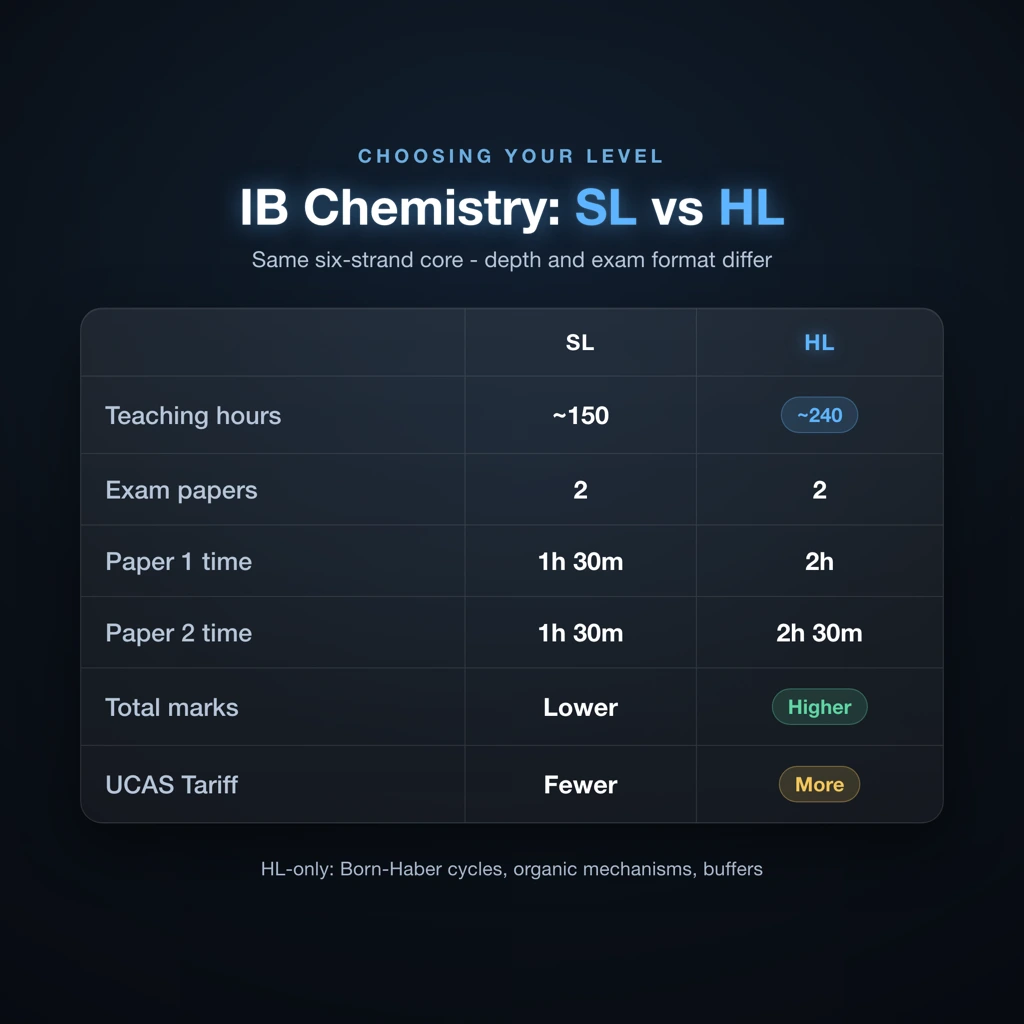
Both SL and HL IB chemistry are built on the same six-strand framework of Structure and Reactivity, and every student sits the same Internal Assessment regardless of level. The difference is depth, volume, and exam format.
Teaching hours tell the clearest story. HL requires approximately 240 hours of teaching time; SL requires approximately 150. That extra 90 hours is not spread evenly across all topics. The bulk of HL-only content sits in additional Reactivity strands: multi-step organic mechanisms, Born-Haber cycles, and more advanced acid-base equilibria that SL students never formally encounter.
One non-obvious quirk: the HL organic content introduces formal arrow-pushing mechanisms (nucleophilic substitution, electrophilic addition) that look straightforward on paper but require a mental model most students need several weeks to build reliably. SL students who later study chemistry at university will hit this content in first-year lectures without the IB scaffolding.
Exam structure reflects the content split:
| SL | HL | |
|---|---|---|
| Papers | 2 | 2 |
| Exam time | Paper 1: 1h 30m; Paper 2: 1h 30m | Paper 1: 2h; Paper 2: 2h 30m |
| Total marks | Lower | Higher |
Choosing between the two is consequential in a practical sense. HL carries more UCAS Tariff points than SL, which affects competitive applications in the UK. More specifically, some course requirements are level-sensitive: the University of Reading's Pharmaceutical Chemistry degree, for example, requires Chemistry at Higher Level grade 5 as part of a 30-point IB offer. Taking SL closes that door entirely, regardless of your grade.
If you are aiming at chemistry, biochemistry, medicine, or engineering, HL is worth the workload. If chemistry supports a different primary focus, SL is the appropriate level. Check the specific entry requirements of your target courses before your subject choices are finalised.
4. The IB Chemistry Data Booklet Explained
Every IB Chemistry exam sitting comes with the official IB Data Booklet, issued by the IB alongside your paper. You do not need to memorise standard electrode potentials, thermodynamic values, physical constants, or the periodic table - all of it is in there. For a section-by-section walkthrough of the booklet and when each table comes up in Papers 1 and 2, see the IB Chemistry data booklet guide.
What the Data Booklet contains:
- Physical and chemical constants (Avogadro's constant, Faraday's constant, the gas constant)
- A full periodic table with relative atomic masses
- The electrochemical series (standard reduction potentials)
- Thermodynamic data tables (standard enthalpies of formation, bond enthalpies)
- IR absorption ranges and proton NMR chemical shift data for spectroscopy questions
- Mathematical equations used across the course
What it does not contain - and you must know cold:
- Definitions of key terms (examiners expect precise, command-term-matched answers)
- Organic reaction mechanisms and named reactions (such as SN1, SN2, electrophilic addition)
- How to interpret spectroscopic data, not just read it off the table
- Responses to command terms: "deduce", "outline", and "evaluate" each require a different type of answer
The non-obvious gotcha: the IR and NMR tables list ranges, not answers. A student who has only ever memorised values will still stall in the exam when the actual question requires them to match a spectrum to a structure. The Data Booklet gives you the ruler; you still have to do the measuring.
One practical point: the 2025 Data Booklet has been updated to align with the new Structure and Reactivity syllabus, so confirm you are working from the current version, not an older copy circulating online.
Practise with the Data Booklet open during every past-paper session. By exam day you want to know instinctively that the electrochemical series is on page three and the bond enthalpies are two pages later - flicking through under timed conditions costs marks.
5. The Scientific Investigation: Your IB Chemistry IA
The Internal Assessment in IB Chemistry is called the Scientific Investigation. It is worth 20% of your final IB Chemistry grade at both SL and HL, making it the single largest non-exam component you control entirely.
You design and carry out an original investigation on a topic of your own choosing, provided it sits within the IB Chemistry syllabus. That freedom is both the opportunity and the trap: students who pick a vague topic early spend weeks revising their research question instead of collecting data.
Assessment criteria
The Scientific Investigation is marked against four criteria worth 6 marks each, 24 in total: Research Design, Data Analysis, Conclusion, and Evaluation.
Half the total sits in the back half of the report - the conclusion and the critique of your method - so do not let the write-up tail off after the data tables. A report that ends with a one-paragraph conclusion leaves a quarter of the total on the table.
Length and format
The report has a maximum of 3,000 words under the syllabus first assessed in 2025 (the old 6-12 page guidance belonged to the previous course). Charts, data tables, equations and calculations do not count towards the limit. Writing up to the limit rarely improves marks if the extra words are padding rather than analysis.
The non-obvious gotcha
Uncertainty propagation is where marks are lost, not the experiment itself. Many students record raw data carefully and then process it with no error bars, no calculated percentage uncertainty, and no discussion of how measurement errors compound through their calculations. Examiners expect you to track uncertainty from raw readings through to your final result and comment on whether it affects your conclusion.
Common mistakes to avoid
- Research question too broad to test with school equipment
- Insufficient trials to distinguish a trend from noise
- Conclusions that introduce new claims not supported by the collected data
- Treating the evaluation as a formality rather than a genuine critique of the method
The Scientific Investigation must be your own independent work and is subject to IB academic integrity requirements. You may collect data in a group of up to three, but each student needs their own research question, must not present the same set of raw data as another student, and writes the whole report alone. Sharing analysis or writing is collusion.
6. The Collaborative Sciences Project (Replacing the Group 4 Project)
The Collaborative Sciences Project (CSP) replaces the old Group 4 Project for students following the 2025 IB Diploma Programme syllabus. The change is more than cosmetic: where the Group 4 Project was often run within a single subject cohort, the CSP is explicitly cross-disciplinary. Chemistry students work alongside peers from Biology, Physics, Environmental Systems, and other Group 4 subjects on a shared scientific theme or problem.
The CSP is compulsory for all DP science students, but it carries no external assessment and contributes nothing to your final IB grade. That second point catches students out. Because it does not feed into a score, some schools schedule it loosely, but the IBO still requires evidence of completion, so your school cannot simply skip it.
The purpose is deliberate: the IBO wants students to practise collaboration, cross-subject communication, and the kind of messy, applied scientific thinking that single-subject exams rarely demand. A chemistry student explaining a reaction mechanism to a biology student who then connects it to a metabolic pathway is closer to how professional science actually works.
One non-obvious gotcha: the CSP theme is chosen at school level, not set by the IBO. This means timing, scope, and even the format of the final output vary considerably between schools. Speak to your DP coordinator early in Year 1 to find out when your school runs it and what the expected deliverable looks like. Do not assume it mirrors what students at another school describe online.
7. IB Chemistry Exam Papers: Format and Timing
IB Chemistry external assessment accounts for 80% of your final grade at both SL and HL. The remaining 20% comes from your internal assessment. Understanding exactly what each paper demands is not optional preparation - it is the preparation.
Exam structure at a glance
| Paper | SL | HL |
|---|---|---|
| 1A (multiple choice) | 30 questions | 40 questions |
| 1B (data-based questions) | sat with 1A; Paper 1 totals 1h 30m | sat with 1A; Paper 1 totals 2h |
| 2 (extended response) | 1h 30m | 2h 30m |
HL Paper 2 is significantly longer - 150 minutes against SL's 90 - and that difference compounds under exam conditions. Plan your pacing in timed practice, not the night before.
The Paper 1B trap
Paper 1B is the section students most frequently underprepare for. It tests your ability to interpret experimental data you have never seen before - unfamiliar graphs, novel data sets, results that don't resolve neatly. You cannot revise your way out of it using notes alone. Practising with past papers and reading IBO subject reports from previous sessions is more useful here than re-reading the textbook.
Command terms are not decoration
The IBO's command terms carry precise meaning. 'State' wants one correct fact. 'Explain' requires mechanism. 'Deduce' means draw a conclusion from the data in front of you. 'Suggest' accepts a reasoned answer even without a definitive right answer. 'Evaluate' demands both sides and a judgement. Misreading a command term is one of the most common sources of avoidable mark loss - examiners award marks against a markscheme built around the specific term used.
Grade boundaries
Boundaries shift by session. Check past IBO subject reports for context, but do not anchor your target to a specific number from a previous year. A hard paper moves the boundary down; an easy one moves it up.
8. How to Study IB Chemistry: Practical Strategies
Start with the 2025 IB Chemistry syllabus document itself. Print or download the learning objectives for Structure and Reactivity, then tick each one off as your class covers it. Any objective still unmarked two months before exams is a revision priority, not a vague worry.
Use specimen papers before older past papers. The 2025 syllabus reorganises content significantly, so past papers from 2023 and earlier will contain questions on topics that no longer exist and miss topics that now do. Work through the official specimen papers first to calibrate, then use pre-2025 papers selectively for additional practice on shared content.
For recall, re-reading notes is among the least efficient methods available. Build Anki decks organised by syllabus topic, with reaction mechanisms and definitions on one side and explanations on the other. The production of a card forces you to phrase a concept precisely, which is where most gaps surface.
Useful resources include:
- ZNotes IB Chemistry summary sheets for concise topic overviews
- The IB Chemistry Course Companion (Oxford University Press) for worked examples and depth
- YouTube channels dedicated to IB Chemistry for visual explanations of mechanisms
HL-specific warning: Born-Haber cycles, buffer calculations, and organic mechanisms appear frequently in HL Paper 2. These topics reward methodical written practice, not just watching worked solutions.
One non-obvious gotcha: uncertainty propagation is tested in Paper 1B as well as the IA. Many students treat it as an IA-only skill and are caught short in the exam. Practise calculating absolute and percentage uncertainties for multi-step calculations under timed conditions.
Finally, explain mechanisms out loud to a study partner. Verbal explanation exposes gaps in understanding faster than any passive review method, because you cannot gloss over a step you cannot articulate.
9. Where IB Chemistry Can Take You: University and Beyond
IB Chemistry HL is not just preferred by UK universities for science courses, it is frequently a hard requirement. The University of Reading requires IB 30 points with Chemistry at HL grade 5 for its Pharmaceutical Chemistry degree. Queen's University Belfast sets the bar at 32 or 33 points with HL Chemistry for Food Science and Nutrition. These are typical of the sector, not outliers.
The stakes matter. The UK pharmaceutical sector employs 67,000 people and contributes £30.4bn to the national economy annually. IB Chemistry provides a genuine foundation for entering it, covering the atomic structure, organic reactivity, and quantitative reasoning that undergraduate programmes build on directly.
The less obvious point: ib chemistry skills transfer well outside the lab. The quantitative reasoning and systematic data analysis you build through the Scientific Investigation are readable by employers and admissions tutors in engineering, environmental science, materials science, and even finance.
Personal statements for chemistry courses need specifics, not enthusiasm. Andrew Pike, Admissions Tutor at Newcastle University, warns against generalisations and asks applicants to show what they personally did, not to explain how a theory works. Dr Simon Gerrard, UG Admissions Tutor at Imperial College London, says he looks for genuine enthusiasm rather than career certainty. Both emphasise concrete engagement over polished narrative. Your IA topic, any independent reading, lab experiences with specific analytical techniques, these are exactly the kind of material that lands.
10. Where to Go From Here
The 2025 syllabus reorganises IB chemistry around Structure and Reactivity rather than the old topic list, which means past papers from before 2025 test a different sequence of content. That gap catches students out: they practise with familiar-looking questions and assume they are prepared, when the new Paper 1A multiple-choice set is calibrated against different conceptual groupings entirely.
This week, download the 2025 IB Chemistry specimen papers from the IBO's Programme Resource Centre and attempt Paper 1A under timed conditions, no data booklet shortcuts on questions that do not permit it. That single session will show you exactly where the new syllabus diverges from your current knowledge.
From there, check how your predicted IB points translate to UK university offers using our guide to UK university offers for IB students, and read our IB study strategies guide for structured revision methods that work across all DP subjects.
More on IB Chemistry:
- IB Chemistry Paper 1A and 1B: How the Paper Works
- IB Chemistry IA: Criteria, Structure and Top Tips
- IB Chemistry Extended Essay: Guide for the 2027 Criteria
- How to Get a 7 in IB Chemistry: A Complete Guide
FAQ
How hard is IB Chemistry?
IB Chemistry is widely considered one of the more demanding Group 4 subjects, particularly at Higher Level, because it combines abstract conceptual content (bonding models, thermodynamics) with quantitative problem-solving and a self-directed Internal Assessment - but students who keep up with the syllabus checklist and practise past papers consistently tend to find it manageable.
What is the IB Chemistry IA?
The IB Chemistry Internal Assessment is called the Scientific Investigation - a self-designed experiment worth 20% of the final grade, assessed across four criteria: Research Design, Data Analysis, Conclusion, and Evaluation, each worth 6 marks for a total of 24.
How long is IB Chemistry Paper 2?
At SL, Paper 2 is 90 minutes of extended-response questions; at HL, Paper 2 is 150 minutes - the longer duration reflects the additional depth and volume of HL content.
What is in the IB Chemistry Data Booklet?
The Data Booklet provided in every IB Chemistry exam contains physical constants, a full periodic table, the electrochemical series, standard thermodynamic values, and spectroscopic data tables for IR and NMR - you do not need to memorise these, but you must know how to locate and apply them quickly.
What is the difference between IB Chemistry SL and HL?
Both levels follow the same Structure and Reactivity syllabus framework, but HL requires approximately 240 teaching hours compared to 150 for SL, includes additional Reactivity content (such as Born-Haber cycles and advanced organic mechanisms), and sits longer versions of the same two exam papers rather than an extra paper.
How should I study for IB Chemistry?
Work through the 2025 syllabus checklist objective by objective, use specimen papers under timed conditions, build active recall with Anki-style flashcards, and make sure you can propagate uncertainties confidently before your IA and Paper 1B.
References
- Pharmaceutical Chemistry with a Year in Industry/Research | University of Reading | UCAS - https://www.ucas.com/explore/courses/03f3f431-d4e4-4f10-a643-60582e9ea28f/pharmaceutical-chemistry-with-a-year-in-industry-research?optionId=26025d06-4356-400d-87b1-f98fc3feb77d
- Food Science and Nutrition with Professional Studies | Queen's University Belfast | UCAS - https://www.ucas.com/explore/courses/c7a04c96-3947-3438-d430-31382c2633ad/food-science-and-nutrition-with-professional-studies?studyYear=2027
- Chemistry personal statement guide | UCAS - https://www.ucas.com/applying/applying-to-university/writing-your-personal-statement/personal-statement-guides/chemistry-personal-statement-guide