How to Get a 7 in IB Chemistry: A Complete Guide
By Michael Thompson · Education Specialist; 10 years teaching the IB at Bromsgrove School · Published 4 September 2026 · Updated 6 October 2026
How to get a 7 in IB Chemistry is one of the most searched questions among DP students - and the answer is more mechanical than most people expect. A 7 is not reserved for students with a natural gift for science; it goes to students who understand exactly what the mark scheme rewards and practise giving it. The IB Chemistry course, restructured around the themes of structure and reactivity for first teaching from August 2023, tests both conceptual understanding and precise scientific communication. This guide breaks down the assessment components, the command-term habits that separate a 6 from a 7, how the internal assessment fits in, and what a realistic revision plan looks like across two years and the final twelve weeks.
Key Takeaways
- The 7 boundary shifts each session: Grade boundaries are not fixed percentages - they are set after each examination session, so your target should be to maximise marks rather than chase a fixed threshold.
- Command terms are the hidden syllabus: Words like 'deduce', 'evaluate', and 'construct' carry specific mark-scheme meanings; misreading them is the single most common reason a strong student loses marks.
- The internal assessment is worth 20%: Students routinely underperform in the IA not because of weak chemistry but because of avoidable errors in methodology, data processing, and evaluation writing.
- Spaced topic practice beats marathon cramming: Working through past-paper questions by topic across Year 1 and Year 2 builds the retrieval strength that exam conditions demand.
- Five mark-losing habits account for most grade slippage: Identifying and fixing these habits - vague conclusions, missing units, ignoring significant figures, restating the question, and skipping worked justifications - is the fastest route to a higher score.
- SL and HL share the same grade descriptors: The 7 at HL requires a higher raw mark than at SL, but the approach to exam technique and IA quality is identical for both levels.
In This Article
- What a 7 in IB Chemistry Actually Requires
- How IB Chemistry Is Structured: Papers, Weightings and the IA
- Command Terms and Mark Scheme Tricks That Separate a 6 from a 7
- IB Chemistry Internal Assessment: Grades, Criteria and Where Marks Are Lost
- A Realistic Revision Structure Across Two Years and the Final 12 Weeks
- The Five Most Common Mark-Losing Habits - and How to Fix Each
- What to Do Next
1. What a 7 in IB Chemistry Actually Requires
Knowing how to get a 7 in IB Chemistry starts with understanding exactly what the number means in practice. A 7 is not a percentage score - it is a grade boundary set by the IB after each exam session, adjusted for that sitting's difficulty. Grade boundaries are session-specific, which means no fixed percentage guarantees a 7.
The current Chemistry course, built around the Structure and Reactivity syllabus introduced for first teaching in August/September 2023, is assessed across external papers and one internal component:
- SL candidates sit Paper 1 (36%) and Paper 2 (44%), which together account for 80% of the final grade.
- HL candidates sit longer versions of the same two papers, with the same weightings, that also cover the additional higher level material.
- The Internal Assessment (IA) counts for 20% of the final grade at both SL and HL.
One counter-intuitive point: HL students need a higher raw mark in absolute terms to hit a 7, because the additional Higher Level (AHL) material in the Structure and Reactivity syllabus expands both the content tested and the total marks available. More marks to earn does not mean more room for error - the boundary still represents roughly the same standard of performance.
A 7 is demanding but achievable with targeted preparation. Only a minority of DP Chemistry candidates globally reach that grade in any given session, which means the gap between a 6 and a 7 is often narrow - and often comes down to command-term precision and IA execution rather than raw content knowledge.
2. How IB Chemistry Is Structured: Papers, Weightings and the IA
The current IB DP Chemistry course, with first teaching from August/September 2023, organises all content around two interlocking themes: Structure and Reactivity. The design principle is deliberate: structure determines reactivity, and reactivity in turn transforms structure. Every topic you study sits inside one of six units.
Structure units:
- S1: Models of the particulate nature of matter
- S2: Models of bonding and structure
- S3: Classification of matter
Reactivity units:
- R1: What drives chemical reactions?
- R2: How much, how fast and how far?
- R3: What are the mechanisms of chemical change?
This interlinked design means exam questions routinely draw on both themes at once. A question on reaction rate (R2) may require you to apply bonding concepts (S2) to explain an activation energy argument. Treating the six units as isolated chapters is a reliable way to lose marks on extended-response questions.
Assessment weightings are the same at both levels. Paper 1 (36%) combines multiple-choice questions (Paper 1A) and data-based questions (Paper 1B); Paper 2 (44%) covers short-answer and extended response. HL students sit longer versions of both papers that include the additional HL content. The full assessment model is set out in the subject brief PDF, available via ibo.org, and is worth checking directly in case of updates.
The IA carries 20% of your final grade. That weighting has a real compounding effect: a student scoring 90% on the IA who achieves 70% on papers will reach a different grade boundary than a student who neglects the IA entirely. The course also requires an interdisciplinary collaborative sciences project, but it is not marked: the scientific investigation is the only practical work that counts towards your grade.
> Callout: Download the IB Chemistry SL and HL subject brief PDF from ibo.org for the authoritative breakdown of paper formats, mark allocations, and assessment criteria.
3. Command Terms and Mark Scheme Tricks That Separate a 6 from a 7
IB Chemistry mark schemes are built around command terms. Each one signals a specific cognitive demand, and examiners are trained to award marks only when that demand is met. Confusing one command term with another is one of the clearest patterns separating a 6 from a 7.
The high-stakes command terms in IB Chemistry
| Command term | What the examiner expects |
|---|---|
| State | One unambiguous fact. No explanation. Extra words risk contradicting yourself. |
| Explain | Mechanism or reasoning, not description. "The rate increases because particles collide more frequently with sufficient energy to overcome the activation energy" beats "the rate increases because it's hotter." |
| Deduce | Use the data given to reach a conclusion. Show the logical step explicitly, even if it feels obvious. |
| Evaluate | Weigh evidence for and against, then reach a justified conclusion. A response that only lists advantages earns partial credit at best. |
| Construct | Produce something precisely formatted: a Lewis structure, an energy level diagram, a Born-Haber cycle. Labelling matters. |
A counter-intuitive quirk with 'state': longer answers actively cost you marks if you introduce an incorrect qualifier. One clean sentence is the correct answer.
What a grade-6 and a grade-7 response actually look like
The prompt: Evaluate the use of hydrogen as a fuel for vehicles.
Grade-6 style response (example written for this guide): > "Hydrogen is a clean fuel because it only produces water when burned. However, it is difficult to store and can be dangerous. It is also expensive to produce."
This hits some correct points but never reaches a justified conclusion and doesn't weigh one side against the other in any structured way.
Grade-7 style response (example written for this guide): > "Hydrogen has a high energy density per unit mass and produces only water on combustion, making it attractive for reducing vehicle emissions. However, current production relies heavily on steam reforming of natural gas, which is carbon-intensive, and storage requires either high-pressure tanks or cryogenic conditions, raising safety and infrastructure costs. On balance, hydrogen is a viable long-term option only if production shifts to electrolysis powered by renewable energy, making its net benefit context-dependent."
The second response explicitly weighs competing factors and commits to a qualified conclusion. That structure is what 'evaluate' demands.
Mark points must be stated, not implied
IB examiners follow a mark-point list. Each distinct mark point must appear explicitly in your answer. Examiners cannot infer intent. If the mark scheme awards a point for "entropy increases because the number of moles of gas increases," writing only "entropy increases" earns nothing for that point.
Own figure forward (ecf) in calculations
A method error in a multi-step calculation does not cascade your mark to zero, provided your working is shown. The IB applies 'own figure forward' (ecf) rules: if you carry an incorrect intermediate value into subsequent steps correctly, you can still earn the remaining method marks. This makes showing every step of working a concrete mark-protection strategy, not just a good habit.
4. IB Chemistry Internal Assessment: Grades, Criteria and Where Marks Are Lost
The IB DP Chemistry independent scientific investigation is assessed on four criteria, each worth 6 marks: Research design, Data analysis, Conclusion and Evaluation. Together they contribute 20% to your final grade, which makes the IA the single largest fixed block of marks you can earn before you sit a single exam paper.
The IA is marked internally by your teacher and then externally moderated by the IB. Moderation can shift marks in either direction, not only downward. A school that consistently over-marks will see scores reduced; one that under-marks may see them rise. That asymmetry matters: your teacher's mark is not final.
The most common mark-losing areas in IB Chemistry IAs are:
- Research design that is not justified. A method listed step by step, without saying why you chose that range, those controls or that technique, caps your Research design mark even when the experiment itself is sound.
- Research question not anchored to a chemical concept. Investigating "how temperature affects reaction rate" without referencing collision theory or activation energy leaves Research design marks on the table.
- Inadequate uncertainty treatment in Data analysis. Propagating uncertainties through calculations, not just listing apparatus errors, is what separates a 4 from a 6 on this criterion.
- Evaluation that lists errors without explaining their impact. This is where most marks are abandoned.
- Graphs and data tables missing labels, units, or error bars.
On that last point, consider the difference between these two Evaluation sentences:
- Weak: "A systematic error may have occurred because the colorimeter was not calibrated."
- Strong: "Failure to recalibrate the colorimeter between trials introduces a systematic error that would shift all absorbance readings in the same direction, making the rate appear consistently lower than the true value and reducing the gradient of the concentration-time graph."
The strong version names the error, explains the direction of its effect, and links it to the specific data being analysed. That is what the mark scheme rewards.
Ask your IB coordinator for the most recent IA grade boundaries and any moderator feedback reports available to your school. These documents are published and genuinely instructive, and students rarely read them.
5. A Realistic Revision Structure Across Two Years and the Final 12 Weeks
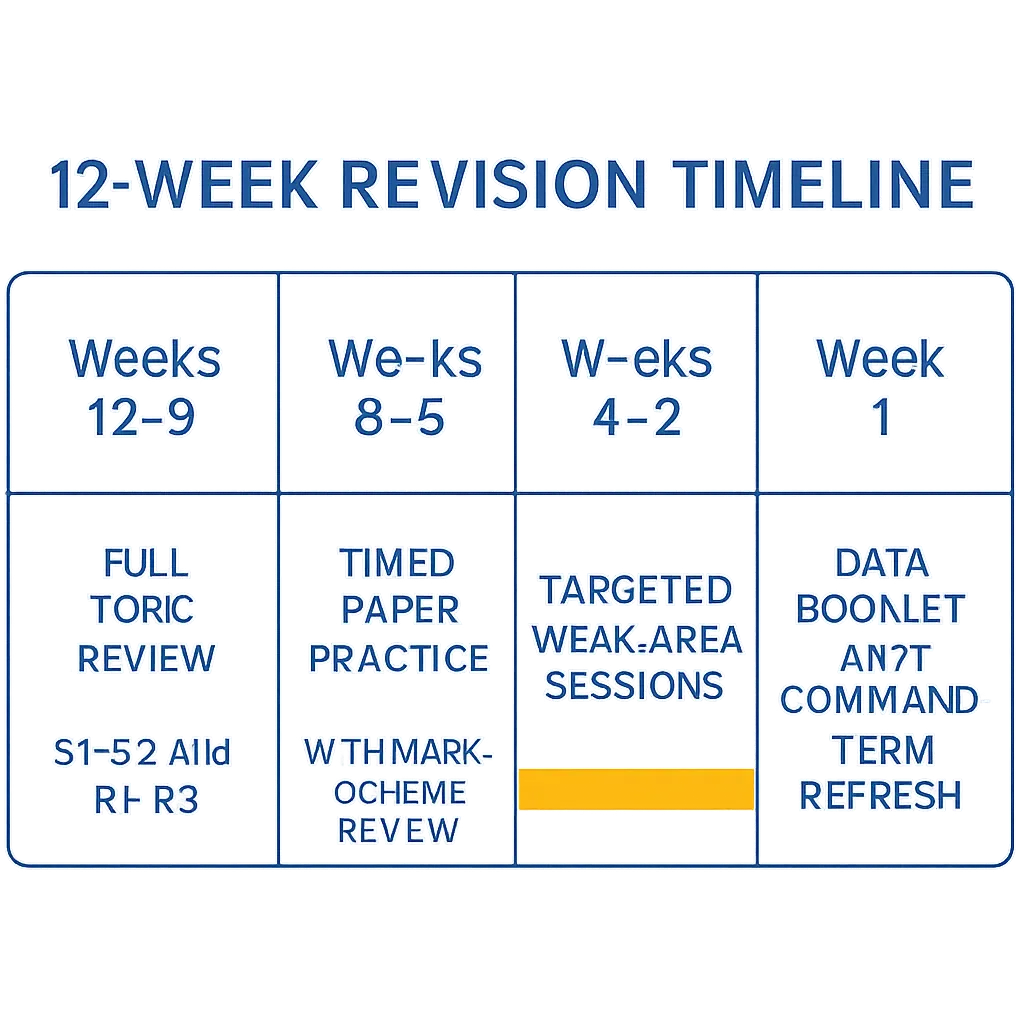
Most students treat IB Chemistry revision as a Year 2 problem. It isn't. The syllabus is organised around two core concepts, structure and reactivity, each split into three units: S1, S2, S3 and R1, R2, R3. That's six distinct bodies of content, and trying to revisit all of them from scratch in the spring of Year 2 is what turns a borderline 6 into a confirmed 6.
Year 1: Unit-by-unit consolidation
After each unit is taught, do 10 to 15 past-paper questions on that topic, untimed first, then timed. One non-obvious point: past papers for the Structure and Reactivity course only go back to May 2025, so the bank is still small. Map older-syllabus questions to their nearest equivalent topic rather than skipping practice entirely.
SL students should attempt HL past-paper questions on shared content. The added difficulty is deliberate, not masochistic. Working at HL standard and then returning to SL questions makes the SL demand feel more manageable under exam pressure.
Year 2: Mixed practice and IA review
Shift from topic-by-topic practice to mixed sessions that mirror real paper conditions. Crucially, revisit your IA Evaluation and data analysis while the experiment is still recent memory. Errors in Evaluation are one of the most common sources of lost marks in the internal assessment, and they are far easier to fix before the memory of your method fades.
The 12-week countdown
| Phase | Weeks | Focus |
|---|---|---|
| Full syllabus review | 12-9 | Work through S1, S2, S3, R1, R2, R3 in sequence |
| Timed paper practice | 8-5 | Paper 1 and Paper 2 under exam conditions; self-mark against mark schemes |
| Weak-area targeting | 4-2 | Use your paper analysis to identify and address specific gaps |
| Light consolidation | 1 | Key definitions, command terms, data booklet layout only |
Use the IB Chemistry data booklet in every single practice session. Students who treat it as something to consult only in exams consistently waste time in Paper 2 locating equations and constants they could have found in seconds. Familiarity with its layout is a skill, and it only develops through repetition.
6. The Five Most Common Mark-Losing Habits - and How to Fix Each
These are the patterns that separate a solid 6 from a 7. None of them require extra content knowledge. They are execution errors, and they are fixable before your next practice paper.
Habit 1: Vague conclusions. Writing "the results show that temperature affects rate" earns nothing on its own. The IB mark scheme expects direction, a value, and a mechanism in the same sentence. A better version: "As temperature increased from 20°C to 60°C, the rate doubled, because higher temperatures increase the average kinetic energy of particles, raising the frequency of successful collisions above the activation energy threshold." Name the trend, quote a number, link to collision theory.
Habit 2: Missing units or wrong significant figures. A correct numerical answer with no unit is wrong. A counterintuitive quirk: giving too many significant figures can also cost a mark, even if your calculation is right. Write units at every step, and match your final answer's significant figures to the least precise data value in the question.
Habit 3: Restating the question. "Enthalpy is important because enthalpy change matters" answers nothing. Before writing, read the command term. If it says "explain", your first word should introduce a cause, not repeat the topic.
Habit 4: No verdict in evaluate or discuss answers. Listing pros and cons without a conclusion drops the mark reserved for judgement. End every evaluate answer with one sentence that states a verdict and cites one piece of supporting evidence.
Habit 5: Not showing working. If your final answer is wrong and you showed no working, you lose everything. If you showed every labelled step (for example, "moles = mass / Mr"), the "own figure forward" rule lets the examiner award method marks even when arithmetic fails. Set out each step on its own line.
7. What to Do Next
The syllabus, assessment details, and subject briefs for the current course (first teaching August/September 2023) are all published on the IB Chemistry curriculum page. Bookmark it now, because the official subject brief is the single document that tells you exactly what is and is not examinable across the Structure and Reactivity units.
This week, open that page, pull up the subject brief, and identify which assessment component is your current weak point: the IA, Paper 1, or Paper 2. Then schedule one focused practice session on that component before your next chemistry class. A counter-intuitive point worth remembering: most students default to re-reading notes when under pressure, but the IB Chemistry mark scheme rewards applied output, not recognition. Practice writing answers, not reading content.
FAQ
How hard is it to get a 7 in IB Chemistry HL?
A 7 in IB Chemistry HL is challenging because it requires both mastery of additional higher-level content and consistent exam technique; the raw mark threshold shifts each session, but students who work through past papers systematically and understand command terms have a realistic path to a 7.
What percentage is a 7 in IB Chemistry?
The IB does not publish a fixed percentage for a 7 in Chemistry - grade boundaries are set after each examination session by the IB based on that cohort's performance, so the threshold varies year to year.
How many people get a 7 in IB Chemistry?
The IB publishes grade distribution statistics each year via ibo.org; historically a minority of Chemistry candidates achieve a 7, making it competitive but not exceptional for well-prepared students.
How does the IB Chemistry internal assessment affect my final grade?
The internal assessment counts for 20% of your final IB Chemistry grade at both SL and HL, is internally marked by your teacher, and then externally moderated by the IB - so a strong IA can meaningfully lift a borderline grade.
How to get a 7 in IB Chemistry SL vs HL - is the approach different?
The exam technique and IA strategy are the same at both levels; the difference is that HL students must also master additional higher-level content and their two papers are longer, with more marks, so the raw mark required for a 7 is higher at HL.
How should I study for IB Chemistry to maximise my grade?
The most effective approach is topic-by-topic past-paper practice starting in Year 1, progressive timed paper practice in Year 2, and focused attention on the five most common mark-losing habits - particularly command-term compliance and showing full working in calculations.
References
- Assessment FAQ - International Baccalaureate® - https://ibo.org/programmes/diploma-programme/assessment-and-exams/getting-results/assessment-faq
- Chemistry in the DP - International Baccalaureate® - https://ibo.org/programmes/diploma-programme/curriculum/sciences/chemistry