IB English Individual Oral: Complete Guide (2025)
By Michael Thompson · Education Specialist; 10 years teaching the IB at Bromsgrove School · Published 4 September 2026 · Updated 6 October 2026
The IB English individual oral is a 15-minute internally assessed exam that counts for 20-30% of your final Language A grade. You speak for 10 minutes about how a global issue of your choosing is presented across two texts, then answer your teacher's questions for 5 minutes. The format sounds straightforward, but most marks are lost through three predictable mistakes: retelling the plot, ignoring one text, and failing to build a clear line of argument. This guide covers exactly how the assessment works, what the four criteria reward, and how to spend those 10 minutes effectively.
Key Takeaways
- 15 minutes total: a 10-minute prepared response recorded by your teacher, followed by 5 minutes of teacher-led questions.
- Two texts, one global issue: Language and Literature students use one literary work and one non-literary body of work; Literature students use two literary works, one of which must be in translation.
- 40 marks across four criteria: the rubric rewards knowledge, analysis of stylistic choices, a focused global issue argument, and language use.
- Your school sets the date: the IB specifies when the IO must be completed within the two-year course, but your teacher schedules it and submits the recording for moderation.
- Ten bullet points maximum: you may bring blank copies of your extracts and up to 10 bullet-pointed notes - nothing else.
- Work restrictions apply: the texts you use for the IO cannot be reused in Paper 2 (SL), and at HL they are also off-limits for the HL Essay.
In This Article
- What Is the IB English Individual Oral and When Does It Happen
- The Individual Oral Format and What You Bring In
- The Four IB English Individual Oral Criteria Explained
- Choosing Your Global Issue and Selecting Extracts
- How to Structure the 10-Minute Individual Oral Response
- What the Individual Oral Mark Scheme Rewards and Penalises
- Language and Literature vs Literature: Key Differences for the IO
- What to Do Next
1. What Is the IB English Individual Oral and When Does It Happen
The IB English Individual Oral (IO) is an internally assessed component of two Language A courses in the IB Diploma Programme: Language A: Language and Literature and Language A: Literature. It was introduced with first assessment in 2021 and replaces the previous individual oral commentary format. The IO is worth 30% of your final grade at SL and 20% at HL for both course options.
The session itself runs 15 minutes: a 10-minute prepared response followed by a 5-minute teacher-led discussion. Your school records the full session and submits a sample to the IB for external moderation. Your teacher sets the exact date within windows the IB specifies, so the IO typically takes place during your second year of the Diploma Programme, though some schools schedule it earlier.
The two main course options differ in the text types you must discuss:
- Language and Literature - one literary work and one non-literary body of work, both examined through a shared global issue.
- Literature - one literary work in your Language A and one literary work in translation, again linked by a common global issue.
One detail that catches students out: in Language and Literature, using two literary works, or two non-literary works, does not meet the task's requirements. The text-type pairing is not a stylistic preference, it is a hard rule.
2. The Individual Oral Format and What You Bring In
The IO runs for 15 minutes in total: a 10-minute prepared response followed by a 5-minute teacher-led discussion, and the whole thing is audio-recorded for moderation by the IB. You bring two things into the room and nothing else:
- Blank copies of your chosen extracts. Each extract is capped at 40 consecutive lines, or one complete short text such as a poem, song, or advertisement. "Blank" means exactly that: no annotations, no highlighted passages, no marginal notes. A copy with even a single underlined phrase is non-compliant.
- Up to 10 bullet-pointed notes. These can prompt your argument, but they cannot be a full script. If your notes read like a transcript, you are over the line.
The official prompt is:
> "Examine the ways in which the global issue of your choice is presented through the content and form of one of the works and one of the bodies of work that you have studied."
A practical point worth noting: comparison between your two texts is not a requirement. You must discuss both, but you are not being asked to contrast them directly. Many students waste time building explicit links between texts when the mark scheme does not reward that structure.
The no-annotations rule has a less obvious implication. Because your extract copies must be clean, any close reading of specific lines has to live in your memory or your 10 bullet points. Plan your extract selection with that constraint in mind.
3. The Four IB English Individual Oral Criteria Explained
The IB English Individual Oral is marked out of 40 across four criteria, each worth 10 marks, using a best-fit approach where examiners select the band that most closely matches the overall quality of the response rather than checking off a rigid list of requirements. Understanding each criterion separately is the fastest way to see where marks are lost.
Criterion A: Knowledge, understanding, and interpretation rewards close reading of the chosen extract and what it reveals about the global issue. The examiner is looking for genuine insight into how the passage works, not a retelling of plot or context. This criterion is also where the task's two hard rules matter most: discuss one global issue only, and in Language and Literature pair one literary work with one non-literary body of work.
Criterion B: Analysis and evaluation of the author's choices focuses on stylistic and formal decisions: structure, syntax, imagery, tone, register, and genre conventions. The question examiners ask is whether you can connect those choices to meaning and effect, not simply name them. Identifying a metaphor without explaining what it does earns partial credit at best.
Criterion C: Focus and organisation rewards a clear, sustained line of argument that connects the global issue across both texts throughout the ten minutes. A response that handles each text in isolation, without threading them together, struggles here even if the individual analysis is strong.
Criterion D: Language covers accuracy, register, and clarity of spoken expression. Formal spoken register is expected. Repeated hesitation, imprecise vocabulary, or slipping into informal speech pulls this mark down independently of how good the ideas are.
One counter-intuitive point: Criterion B and Criterion A can diverge sharply. A student can show genuine knowledge of a text (Criterion A) while describing authorial choices without evaluating their effect (Criterion B). Treat them as separate tasks.
4. Choosing Your Global Issue and Selecting Extracts
A global issue is not a theme. Under the IB's definition, a valid global issue must meet three criteria: significance at wide scale, transnational impact, and observable effects in everyday local contexts. "War" or "identity" fail the third test because they are too abstract to show up concretely in a passage's stylistic choices.
The IB offers two starting frameworks for finding an issue: the five theme categories and the UN Sustainable Development Goals. The five categories are:
- Culture, identity and community
- Beliefs, values and education
- Politics, power and justice
- Art, creativity and the imagination
- Science, technology and the environment
These are entry points, not answers. Your actual global issue sits inside one of these categories but is far more specific. On its own, "gender" is too broad. A workable issue looks more like: "how gender bias shapes self-expression in public discourse." That version is transnational, observable in local moments, and gives you something to trace through an author's formal choices.
Selecting your extracts is where most preparation mistakes happen. Each extract is capped at 40 lines. The counter-intuitive rule: pick a passage that shows the global issue through form and style, not just subject matter. An extract can be entirely "about" your issue thematically and still earn poor marks on Criterion B if there is nothing distinctive to say about structure, voice, syntax, or imagery. Test each candidate extract by asking: what is the author doing formally here, and why does it matter? If you cannot answer that in two or three specific observations, find a different passage.
One constraint that shapes your text selection from the start: at SL, the literary work you use in the IO cannot also be used for Paper 2. At HL, neither work can appear in Paper 2 or the HL Essay. Plan your reading list with this in mind before you commit to any texts.
5. How to Structure the 10-Minute Individual Oral Response
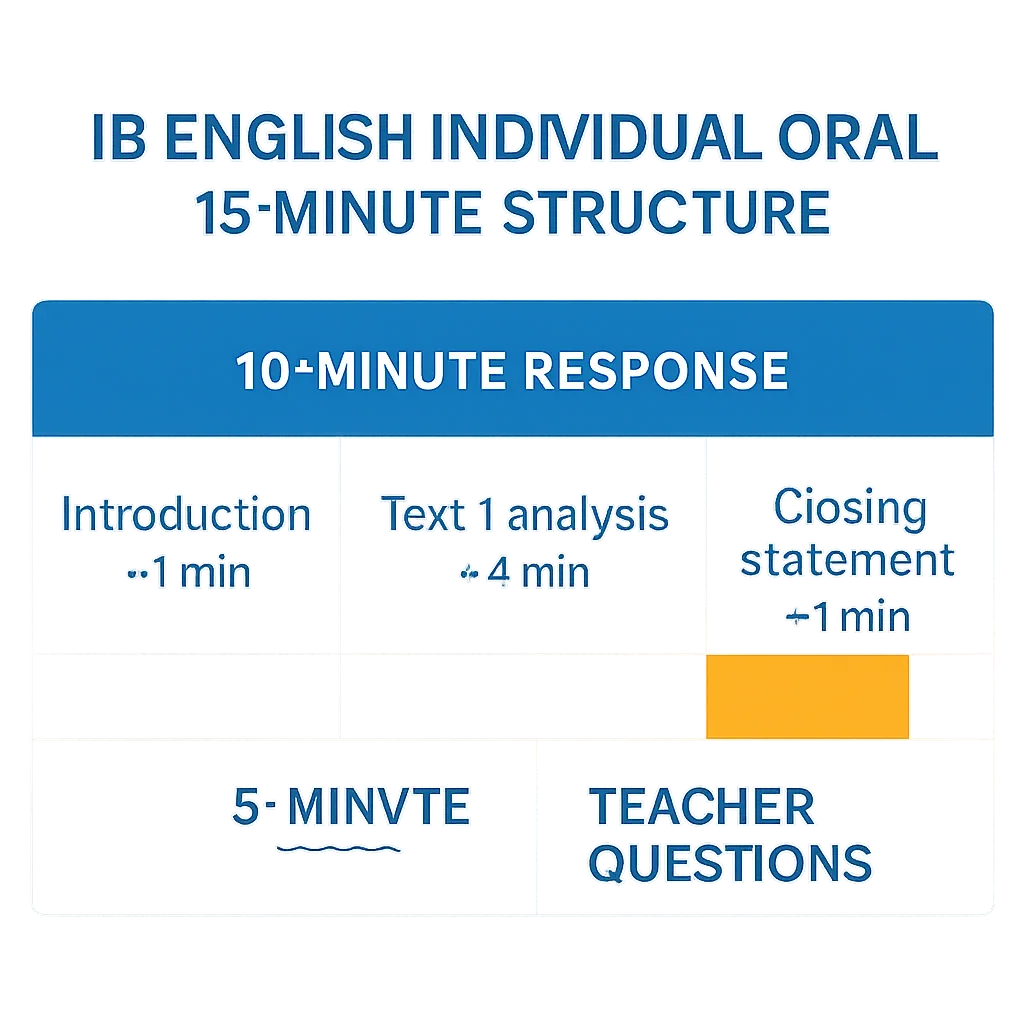
The official IO prompt asks you to examine how your global issue is presented "through the content and form" of both texts. The 10-minute presentation is your answer to that question. A workable time split looks like this:
| Phase | Suggested time | Purpose |
|---|---|---|
| Framing introduction | ~1 minute | State global issue, name texts and authors, deliver interpretive claim |
| Text one analysis | ~4 minutes | Work through extract: content, then form |
| Text two analysis | ~4 minutes | Same method; connect back to global issue |
| Concluding statement | ~1 minute | Restate claim in light of what the analysis showed |
The introduction: claim first, not intention
The opener should name the global issue precisely, name both texts and authors, and land a clear interpretive claim. The distinction matters: "I will discuss how power is shown in both texts" tells the examiner nothing. "Both texts present political silencing as a mechanism that reinforces social hierarchy, achieved through contrasting structural choices" gives them something to assess from the first sentence.
Text analysis sections: content, then form
Move from what the extract says to how it says it. Name the specific device (free indirect discourse, anaphora, juxtaposition), explain what effect it produces, and connect that effect directly back to the global issue. Returning to the global issue at each device, not just at the start and end, is the non-obvious move most students miss.
What your bullet-point notes should contain
Per the IB assessment guidelines, you may bring a maximum of 10 bullet points into the room. Use them for:
- Anchor phrases (short signpost sentences to keep you on track)
- Key quotations you intend to cite
- Device names alongside the effect you plan to attribute to each
- Your interpretive claim, written verbatim so you can return to it
Full sentences written out to be read aloud defeat the purpose. Examiners can hear when a student is reading rather than speaking.
The 5-minute teacher-question phase
The teacher-led discussion follows the presentation. Expect questions on three things: your definition of the global issue, your reasoning for choosing those specific extracts, and any moment in your 10 minutes where you introduced an idea but did not develop it. That last category is worth preparing for deliberately: if you name a device and move on without explaining its effect, the teacher will go back to it.
Common mistakes to avoid
- Retelling plot rather than analysing meaning
- Spending close to 8 minutes on one text and rushing the second
- Defining the global issue in the introduction and never mentioning it again
- Reading bullet points verbatim instead of speaking from them
The time split is a guide, not a rule, but significant imbalance between the two text sections tends to signal a lack of preparation for one of them.
6. What the Individual Oral Mark Scheme Rewards and Penalises
The individual oral mark scheme works on mark bands with descriptors, not a checklist. Examiners read your performance holistically and award the band that best fits the whole response. A single strong moment will not rescue a weak overall argument.
What high bands reward:
- Specific quotation or visual detail drawn directly from the extract, not paraphrase
- Named formal or stylistic choices (syntax, imagery, camera angle, layout) with an explained effect on meaning
- A sustained argument that connects both texts to the same global issue throughout, not just at the start and end
- Fluent, varied spoken language that does not sound read from a script
What low bands typically reflect:
- Assertions about a text's "themes" with no supporting textual evidence
- Plot or content summary substituted for analysis
- Heavily imbalanced treatment, for example spending eight minutes on the literary work and ninety seconds on the non-literary body of work
- A global issue so broad it adds no analytical pressure, such as "inequality" without any narrowing
One counter-intuitive point: a vague global issue hurts you even if your close reading is otherwise sharp. The issue shapes the lens; without a precise lens, the analysis drifts.
The 40-mark total is moderated externally: teachers submit a sample of recordings to the IB, and the moderator can shift the whole school's marks up or down. Your teacher's grade reflects IB standards as they understand them, but the moderator has the final word. A strong internal mark is a good sign, not a guarantee.
7. Language and Literature vs Literature: Key Differences for the IO
The analytical prompt is identical across both courses, but what you bring to the table differs significantly depending on which English A pathway you are taking.
| Feature | Language and Literature | Literature |
|---|---|---|
| Text 1 | One literary work | One literary work (Language A) |
| Text 2 | One non-literary body of work | One literary work in translation |
| Extract source | Selected from within the body of work | Selected from the literary text |
For Language and Literature, the non-literary body of work is assessed as a coherent whole, not as a standalone text. A collection of journalism, a podcast series, or a set of advertisements counts as one body of work, and you select your extract from within it. The gotcha here: two literary works in a Language and Literature IO do not meet the task's requirements, however strong your analysis.
For Literature, one of the two works must be a work in translation. The translation requirement is non-negotiable and cannot be substituted with a work originally written in English.
Students taking Language A: Literature and Performance (SL only) should note that the IO sits within a different combined internal assessment structure worth 40%, which also includes a transformative performance. The oral format runs to the same 15-minute length, but the surrounding requirements differ. Check the specific IB subject guide for that pathway rather than applying the standard IO rules directly.
8. What to Do Next
The most common mistake students make is choosing a text they like and then hunting for a global issue to fit it. That gets the logic backwards. The issue should drive everything, including which extract best exposes it.
This week, confirm with your teacher which texts are assigned to your specific course. Then draft your global issue as a single, precise sentence and test it against three questions: does it cross national boundaries, does it show up in your local or personal context too, and is it specific enough that someone could disagree with your framing? If the answer to any of those is no, revise before your next class.
Getting this right early matters because once your issue is sharp, your extract choices almost select themselves. Nail the sentence first. Everything else follows from it.
FAQ
How long is the IB English individual oral?
The IO is 15 minutes in total: a 10-minute prepared student response followed by a 5-minute question-and-answer session with the teacher.
What global issues can I use for the IB English individual oral?
Any issue that is transnational in scope and visible in local everyday contexts qualifies; the IB's five theme categories and the UN SDGs are starting frameworks, but the issue must be specific - 'gender bias in public discourse' rather than 'gender'.
Can I use notes in the IB English individual oral?
Yes - you may bring blank, unannotated copies of your chosen extracts and a maximum of 10 bullet-pointed notes; no other materials are permitted.
How is the IB English individual oral marked?
The IO is marked out of 40 across four criteria covering knowledge and interpretation, analysis of authorial choices, focus and organisation, and language; your teacher marks it internally and the IB moderates a sample of recordings from your school.
What texts do I need for the IB Language and Literature individual oral?
Language and Literature students must use one literary work and one non-literary body of work; using two literary or two non-literary works does not meet the task's requirements.
How much is the individual oral worth in IB English?
The IO counts for 30% of the final grade at SL and 20% at HL for both Language and Literature and Literature courses.