IB English Explained: Courses, Papers and Assessment
By Michael Thompson · Education Specialist; 10 years teaching the IB at Bromsgrove School · Published 21 May 2026 · Updated 6 October 2026
IB English is not a single course - it is a family of distinct qualifications that students and parents regularly confuse with one another. The first decision you face is whether you are taking a Language A course (your strongest language, usually your mother tongue) or Language B (a language you are learning). Within Language A, you then choose between Literature and Language and Literature, each with its own reading list, paper structure, and assessment weighting. Get the choice wrong and you will spend two years in a course built for a different type of reader. This guide maps every course, every assessment component, and every key distinction so you can make the right call before enrolment.
Key Takeaways
- Language A vs Language B is the foundational split: Language A is studied at near-native level; Language B is for learners still developing proficiency in the language.
- Within Language A, Literature and Language and Literature are separate courses: Literature focuses on literary texts; Language and Literature adds non-literary texts, media, and analysis of how language shapes meaning.
- Paper 1 is an unseen textual analysis: You analyse one or two texts you have never seen before, with no notes - it tests close-reading skills under timed conditions.
- Paper 2 is a comparative essay on works studied in class: You choose one question from a set and write a comparative essay drawing on the literary works from your course.
- HL students complete an HL Essay - SL students do not: The HL Essay is a 1,200-1,500 word formal essay on a literary work, written independently and submitted for external marking.
- The Individual Oral (IO) is the same structure for SL and HL: A 15-minute oral examination (10 minutes of discussion, then 5 minutes of teacher questions) in which you discuss an extract in relation to a global issue, drawing on one literary and one non-literary (or second literary) work.
In This Article
- What Is IB English - and Which Course Are You Actually Talking About?
- Language A vs Language B: The Distinction That Trips Everyone Up
- IB Language and Literature vs Literature: Choosing Your Language A Course
- The Reading List: Works in Translation, Free Choice, and the Prescribed Reading List
- IB Language and Literature Paper 1: Guided Textual Analysis
- IB Language and Literature Paper 2: The Comparative Essay
- The Individual Oral: What It Is and How It Works
- SL vs HL: What Changes and the HL Essay Explained
- Grade Boundaries and How IB English Is Scored
- Should You Take IB English - and at Which Level?
- Where to Go From Here
1. What Is IB English - and Which Course Are You Actually Talking About?
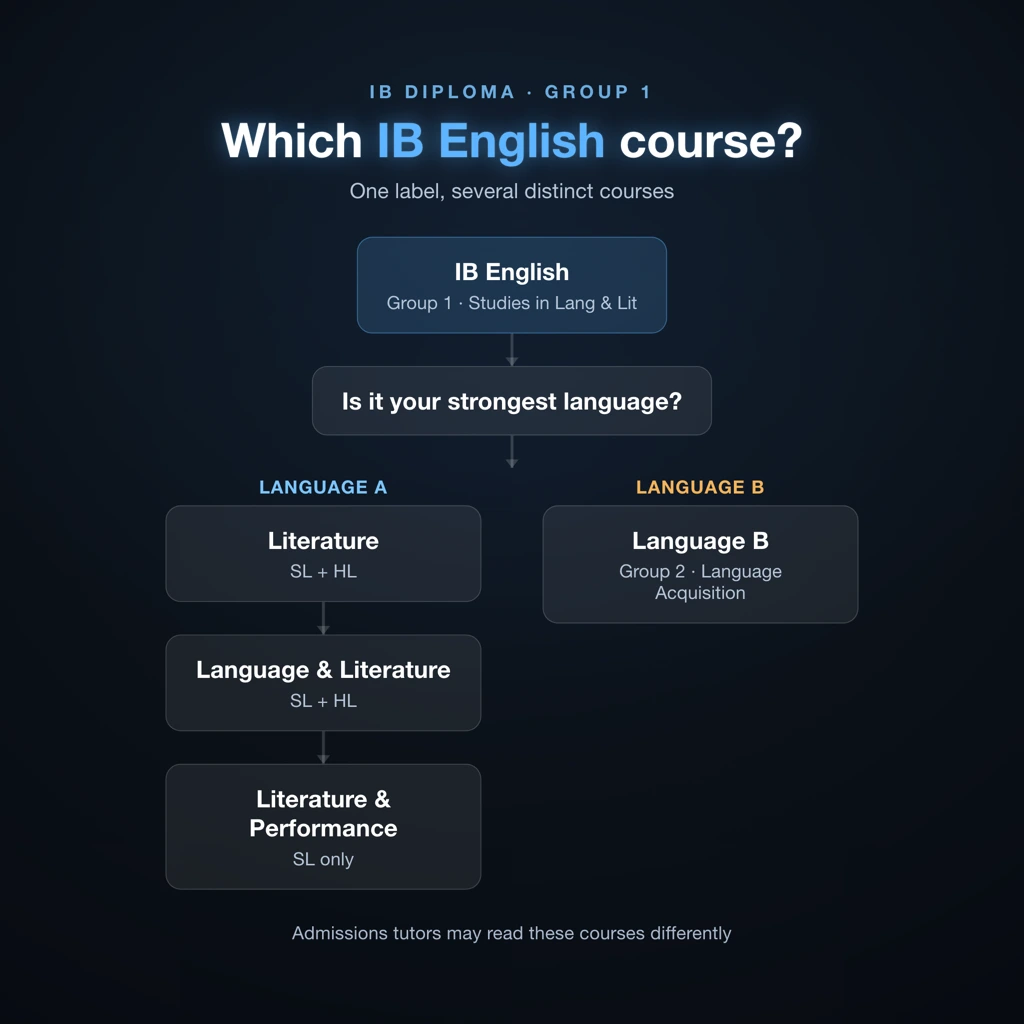
IB English is not a single subject. It sits within Group 1 (Studies in Language and Literature) of the IB Diploma Programme, and the label covers several distinct courses with different reading lists, assessment formats, and workloads. Conflating them is the most common starting mistake students make.
The first split is between Language A and Language B. Language A is designed for your strongest language, typically your mother tongue. Language B is for a language you are actively learning. Most students asking about "IB English" mean Language A taught in English, but the distinction matters: Language B has a completely different syllabus, different papers, and is not always treated equivalently by universities for course entry requirements.
Within Language A, there are three course options:
- Literature - focuses entirely on literary texts across periods and cultures
- Language and Literature - adds non-literary texts (journalism, advertising, speeches) alongside literary works
- Literature and Performance - a specialist course combining textual study with theatre practice, available at SL only
The less obvious point: choosing between Literature and Language and Literature is not simply a question of difficulty. The two courses assess different skills, attract different grade boundaries, and can be read differently by admissions tutors for English-heavy degrees.
The sections below cover each course, its papers, and how to decide which one fits your situation.
2. Language A vs Language B: The Distinction That Trips Everyone Up
Before reading anything about IB English, you need to know which group you are in, because the courses share almost no structure.
Language A is your strongest language, studied at an academic level comparable to a native speaker. It is a literature and language course, not a language-learning course. For most UK students taking the IB Diploma Programme, English is their Language A. The courses covered in this article, including IB DP English Language and Literature and IB English Literature, are both Language A courses.
Language B is a foreign-language acquisition course. It is designed for students who are actively learning a language, not studying it as a first language. IB English B exists and is a legitimate IB course, but it has an entirely different structure: Paper 1 focuses on reading comprehension tasks across a range of text types, and Paper 2 involves written production tasks. There is no comparative literary essay, no Individual Oral analysing a literary work in the way Language A requires.
The non-obvious gotcha: a student who is highly proficient in English but whose home language is, say, Mandarin, may be offered English B by their school rather than English A. That is a meaningful academic distinction. English B does not count as a Language A course for university entry requirements that specify "English at Language A level."
If you are a UK student and someone says "IB English," they almost certainly mean Language A. Confirm this before you use any revision resource, past paper, or grade boundary table, because the two courses are not interchangeable.
3. IB Language and Literature vs Literature: Choosing Your Language A Course
Both courses sit under Language A, so both count as first-language English study. The difference is scope.
Literature deals exclusively with literary works: novels, plays, poetry, and short fiction. Every assessment task asks you to analyse craft, theme, and context within those texts. If you want to spend two years close-reading Toni Morrison and Samuel Beckett, this is the more focused route.
Language and Literature casts a wider net. Alongside literary works, you study non-literary texts: advertising copy, political speeches, news articles, social media. The central question shifts from "how does this novel work?" to "how does language function in the world?" Students who are drawn to media, linguistics, or the mechanics of persuasion tend to find this framing more natural.
A third option, Literature and Performance, combines literary study with practical performance elements. It is genuinely niche in the UK, and most state schools and sixth-form colleges do not offer it. Worth checking, but do not plan around it.
One non-obvious trade-off: Language and Literature students often find Paper 1 less predictable, because the unseen texts can come from almost any non-literary genre, not just prose fiction or poetry. Literature students have a narrower range of text types to prepare for, which makes targeted practice more straightforward.
Both courses run at SL and HL, and universities do not formally distinguish between them for admissions purposes. Your choice shapes your skills, not your offer conditions.
4. The Reading List: Works in Translation, Free Choice, and the Prescribed Reading List
The IBO deliberately requires that at least one work be studied in translation across the Language A courses. This is policy, not accident. The aim is to ensure students engage with literature from outside the English-speaking tradition, which means a UK student taking IB English should expect to read, say, a Scandinavian novel or a Latin American short story collection alongside Shakespearean drama.
The Prescribed Reading List (PRL) is the IBO's curated catalogue of approved authors and texts. Schools build their reading lists by selecting from it. The PRL spans dozens of languages and literary traditions, organised by author nationality and original language, so a school choosing a work "in translation" is choosing from a genuinely wide field, not a token gesture.
Schools are not confined to the PRL. They may propose free-choice works, subject to IBO approval, which gives teachers flexibility to include contemporary or regional texts the PRL has not yet caught up with.
For Language and Literature students, the reading list is broader still. Alongside literary texts, it includes non-literary and media-based bodies of work: advertising campaigns, news corpora, political speeches. A canonical novel and a curated set of opinion columns can sit on the same syllabus.
The non-obvious gotcha: a free-choice work requires formal IBO sign-off before teaching begins. Schools that select a text outside the PRL mid-cycle without approval risk that work being rejected for assessment purposes. Check your school's approved list before assuming a teacher's favourite novel is on it.
5. IB Language and Literature Paper 1: Guided Textual Analysis
Paper 1 is an unseen analysis. You receive texts you have never studied before and must write a formal analytical response on the spot. There is no preparation beyond the skills you have built across the course.
The format differs sharply between SL and HL:
- SL: one text, one guided analysis. Guiding questions are printed on the paper and help you structure your response. Time allowed: 1 hour 15 minutes.
- HL: two texts, one comparative analysis. There are no guiding questions. You must organise your own argument across both texts. Time allowed: 2 hours 15 minutes.
The type of texts you receive depends on which Language A course you are sitting. In Language and Literature, texts can be literary or non-literary, so you might be given a speech, an advertisement, or a newspaper editorial alongside a poem or short prose extract. In Literature, both texts are literary.
The IB assesses Paper 1 across four criteria: understanding of content and context, analysis of the author's choices, organisation and development of ideas, and use of language.
The non-obvious gotcha at HL: removing the guiding questions does not just raise difficulty, it shifts the task entirely. SL students are structuring a response; HL students are constructing an argument. Examiners reward a clear, sustained line of inquiry across both texts, not two separate mini-essays stapled together.
Practically, the criteria reward specific textual evidence and purposeful structure. A thematic overview with no quotations scores poorly regardless of how sophisticated the ideas are.
6. IB Language and Literature Paper 2: The Comparative Essay
Paper 2 tests you on the literary works studied across your course. In the exam, you choose one question from a set of four general questions, then write a comparative essay drawing on at least two of the works you have read. Both SL and HL students sit the same 1 hour 45 minute exam. The difference is not time, it is expectation: HL responses are assessed against higher benchmarks for conceptual complexity and critical nuance.
The closed-book condition is the detail that catches students off guard. No texts, no notes, no annotated copies. Every quotation you use must come from memory, which means selective, deliberate memorisation of key passages is part of exam preparation, not an optional extra.
Assessment focuses on four areas:
- Knowledge and understanding of the works in question
- Analysis of how literary features, structure, and language shape meaning
- The comparative argument itself: how well you connect the two works around a central claim
- Organisation of the essay as a whole
The single most penalised error is description. Retelling what happens in a novel or play scores poorly; arguing about why an author makes a specific choice, and what effect that creates in the reader, is what the mark scheme rewards. A useful discipline is to test every paragraph: if it could appear in a book report rather than a critical essay, it needs reworking.
Compare works thematically and structurally, not text by text in sequence.
7. The Individual Oral: What It Is and How It Works
The Individual Oral (IO) is an internally assessed, externally moderated spoken examination. The format is fixed: roughly 10 minutes of prepared analysis followed by roughly 5 minutes of teacher questions, totalling 15 minutes.
What makes the IO structurally different from the written papers is the student's degree of control. You choose your own global issue and your own extract. That freedom is also the main trap. A vague global issue, such as "conflict" or "identity," gives the examiner nothing to reward, because the criteria specifically assess how precisely the global issue is framed, not simply whether you named one.
The connection between works is the spine of the assessment. Your analysis must link the extract to a second work studied on the course. For Language and Literature students, that means one literary work and one non-literary body of work. For Literature students, both works must be literary. The examiner is listening for a meaningful, textual connection between them, not a surface-level thematic parallel.
A counter-intuitive trade-off worth knowing: choosing a very short extract can seem like the safe option, but it often leaves students with too little textual material to sustain 10 minutes of close analysis. A slightly longer, denser extract is usually easier to work with in practice.
Assessment criteria reward three things:
- The precision of the global issue framing
- The quality of close textual analysis on the chosen extract
- The coherence of connections made between the two works
Prepare the extract annotation thoroughly. The teacher question phase regularly tests whether you can extend your own argument, so arriving with only a rehearsed script tends to collapse under the first follow-up question.
8. SL vs HL: What Changes and the HL Essay Explained
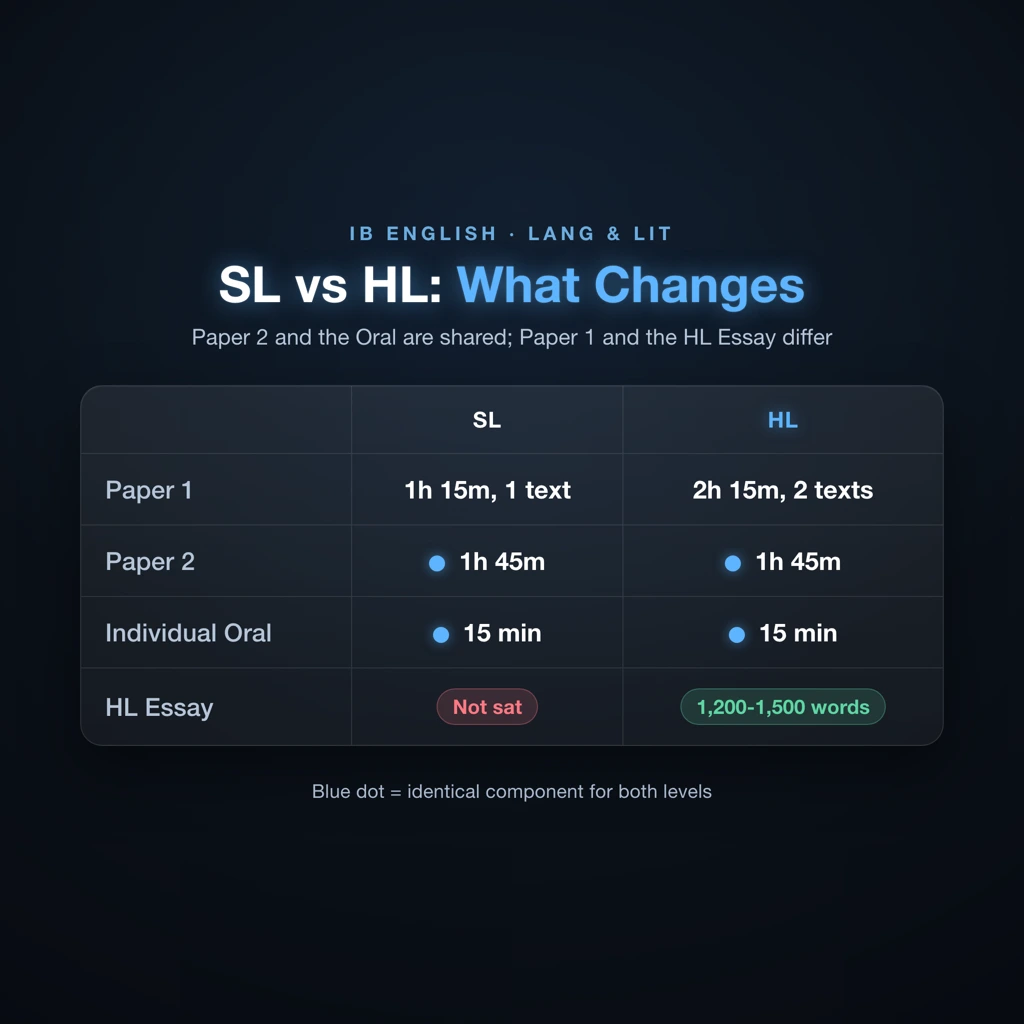
Both SL and HL students sit the same Paper 2 and complete the same Individual Oral. The differences are concentrated in two places: Paper 1 and a component that SL students never touch at all.
Paper 1 is where the first fork appears. SL students analyse a single unseen text and have guiding questions to orient their response. HL students analyse two unseen texts in a comparative response, with no guiding questions provided. That absence is deliberate. The IB is testing whether you can independently identify the analytical frame, not just respond to one handed to you. Students who rely on prompts to structure their thinking tend to find HL Paper 1 disproportionately harder than the rest of the course suggests it should be.
The HL Essay is the more significant difference. It is a formal written essay of 1,200-1,500 words, submitted externally, on a literary work studied during the course. You choose your own focus and frame your own research question. SL students do not complete this component.
The counter-intuitive thing about the HL Essay is that it rewards narrow thinking. Students who try to answer a broad question in 1,500 words consistently produce weaker work than those who constrain their question tightly from the start.
Because the HL Essay is externally assessed and carries its own weighting in the final grade, it shifts the overall balance of HL toward independent extended writing more than any other single component. Before choosing HL, ask yourself honestly whether you enjoy that kind of sustained, self-directed literary research. If the answer is uncertain, SL is not the lesser choice.
9. Grade Boundaries and How IB English Is Scored
IB English is graded on a 1-to-7 scale, where 7 is the highest mark. Unlike A-Level percentage boundaries, which are broadly stable from year to year, IB grade boundaries are set after each examination session by the IBO's grade award committees and shift depending on how candidates performed globally. A raw score that earns a 6 in one May session might earn a 7 the next.
Each component carries a published weighting. For IB DP English Language and Literature, your final grade combines scores from Paper 1, Paper 2, the Individual Oral, and (at HL) the HL Essay, each marked against the IBO's assessment criteria. The weighted totals are mapped against that session's boundaries to produce your 1-7 grade.
The IBO publishes grade boundary tables for Language A Language and Literature and Language A Literature after every May and November session. These are available through the IBO's candidate results portal and grade boundary documents - check the document for your specific course code, since SL and HL boundaries are separate.
One counter-intuitive point worth knowing: the criteria descriptors are the more reliable planning tool than boundary tables. Because boundaries move, aiming to hit a particular raw score is less useful than internalising what a "good" or "excellent" response looks like at each criterion band. Timed practice under exam conditions gives you a realistic sense of where you land.
On UK university equivalencies, a 7 in IB English is broadly treated as equivalent to an A* at A-Level, but individual institutions set their own policies and you should verify directly with each admissions team.
10. Should You Take IB English - and at Which Level?
The first thing to understand is that IB English is not optional. Every IB Diploma student must take a Language A course - the choice is which one, and at which level. Nobody sits the Diploma without it.
That means the real decision has two parts:
- Literature or Language and Literature? Literature stays within fiction, poetry, and drama. Language and Literature pulls in non-fiction, media texts, and the analysis of how language shapes power and meaning. If your instinct is to dissect a novel's imagery, choose Literature. If you find yourself more interested in how a political speech or an advertisement works on an audience, Language and Literature fits better.
- SL or HL? HL adds the extended HL Essay and a heavier external assessment load. For most university courses, SL meets the Group 1 requirement. The exception is degrees in English Literature, Comparative Literature, Journalism, or Media Studies - for those, HL signals genuine engagement with the subject, and some competitive programmes will want to see it.
One counter-intuitive trade-off: Language and Literature HL is not the easier HL option, despite covering more text types. The non-literary analysis on Paper 1 demands a different analytical vocabulary from prose or poetry, and students who chose it expecting straightforward media commentary sometimes find the literary half harder than anticipated.
Compared with A-Level English (AQA, Edexcel, OCR), IB English is broader in its international reading list and includes a formal oral component, but it carries no teacher-assessed coursework in the traditional sense. That distinction matters for students who perform better under timed conditions.
Check the specific entry requirements for any university course you are targeting before making your final choice - requirements vary by institution and by degree.
11. Where to Go From Here
The most useful thing you can do before your first practice paper is read the assessment criteria in full, not a summary of them. The criteria describe exactly what a marker is rewarding at each band, and the Language and Literature criteria differ from the Literature criteria in ways that genuinely affect how you should write a Paper 1 or Paper 2 response.
Download the relevant IB Language A subject guide from the IBO's Programme Resource Centre. Your school's IB coordinator holds access credentials and can share the document directly. Go straight to the assessment criteria section and read each component's descriptors from band 1 to band 7. Do that before you attempt a single timed piece of writing.
Contact your IB coordinator this week and ask for the guide.
More on IB English:
- IB English Individual Oral: Complete Guide (2025)
- IB English Language and Literature: Complete Guide
- IB English B: The Complete Guide for HL and SL
- English A Extended Essay: The Complete IB Guide
FAQ
What is IB English?
IB English refers to the Group 1 (Studies in Language and Literature) courses in the IB Diploma Programme, most commonly Language A: Language and Literature or Language A: Literature, studied at SL or HL - it is not a single unified subject.
How long is IB English Paper 1?
Paper 1 is 1 hour 15 minutes at SL (one text, guided questions) and 2 hours 15 minutes at HL (two texts, no guiding questions, comparative analysis required).
How long is IB English Paper 2?
Paper 2 is 1 hour 45 minutes for both SL and HL; HL students are expected to demonstrate greater analytical depth and complexity within the same time.
What is IB English B?
IB English B is a Language B course - a foreign-language acquisition course for students learning English, not a literature course; it has a different paper structure and is separate from the Language A courses taken by native or near-native English speakers.
What is the IB English Individual Oral?
The Individual Oral (IO) is a 15-minute internally assessed oral exam in which students present a close analysis of a chosen extract and connect it to a global issue and a second work from the course.
How does IB English differ from A-Level English?
IB English requires study of an internationally diverse reading list including works in translation, includes an oral examination component, and at HL adds an independent essay - whereas A-Level English Literature typically focuses on a set UK/US-centred text list without a formal oral component.