IB English B: The Complete Guide for HL and SL
By Michael Thompson · Education Specialist; 10 years teaching the IB at Bromsgrove School · Published 4 September 2026 · Updated 6 October 2026
IB English B is a language acquisition course in the IB Diploma Programme, designed for students who already have a solid grounding in English but are not native or near-native speakers. It sits in Group 2 of the Diploma Programme alongside other additional language courses, and it is distinct from the Group 1 Language A courses taken by first-language speakers. The course is built around five prescribed themes - identities, experiences, human ingenuity, social organisation, and sharing the planet - which frame every piece of reading, listening, and writing you do across two years. Understanding the structure early means you can direct your study purposefully rather than reacting to each assessment as it arrives.
Key Takeaways
- Five prescribed themes: Every task in IB English B - from Paper 1 writing to the individual oral - connects to identities, experiences, human ingenuity, social organisation, or sharing the planet.
- HL adds literary works: Higher Level students study two literary works and sit a more demanding individual oral that includes a literary extract, while SL students focus on non-literary texts only.
- Paper 1 tests productive writing: You produce one or two written responses in a specified text type - such as a blog post, article, or speech - chosen from a menu on the exam paper.
- Paper 2 assesses receptive skills: The reading and listening paper tests your ability to extract, interpret, and respond to a range of authentic texts, with a separate listening component using audio recordings.
- The individual oral is internally assessed: You prepare a spoken response to a stimulus, discuss one of the five themes, and - at HL - respond to a literary extract in a conversation with your teacher.
- A curriculum update is coming: A revised Language B syllabus has first teaching from August/September 2027 and first assessment in May 2029, so check which version applies to your cohort.
In This Article
- What Is IB English B and Who Is It For?
- The Five Prescribed Themes and Conceptual Understanding
- HL vs SL: How IB DP English B Differs by Level
- Paper 1: Productive Writing and Text Types
- Paper 2: Listening Comprehension and Reading in IB English B
- The Individual Oral: Internal Assessment in IB English B
- Assessment Model: Weightings, Papers, and the IA
- IB DP English B Past Papers and Guidelines: Where to Find Them
- Common Pitfalls and How to Avoid Them
- What to Do Next
1. What Is IB English B and Who Is It For?
IB English B is a Group 2 language acquisition course within the International Baccalaureate Diploma Programme, designed for students who have prior experience with English but are not first-language or near-native speakers. The distinction matters: Group 1 courses (Language A) are intended for students who have grown up using English as their primary language, or who have near-native fluency. If you are comfortably bilingual in English, your school will typically steer you toward English A, not English B. Choosing the wrong course is a real risk, and one that affects both your grade ceiling and how universities read your transcript.
The Diploma Programme itself spans two years, during which students study six subjects drawn from six subject groups, alongside a Theory of Knowledge course, an Extended Essay, and Creativity, Activity, Service requirements, per the IB's curriculum overview. English B sits in Group 2 and can be taken at either Standard Level (SL) or Higher Level (HL), which determines contact hours, the depth of literary study required, and the overall grade weighting.
HL is the more demanding route and appears in several of the IB's published sample pathways. In the sample "medic" course selection, for instance, English B HL is paired with Chemistry HL, Biology HL, and Mathematics: analysis and approaches SL, showing that universities accepting HL science combinations also expect rigorous language study alongside them.
The non-obvious catch: English B HL requires the study of literary texts, which SL does not. That single difference shapes the entire course experience.
2. The Five Prescribed Themes and Conceptual Understanding
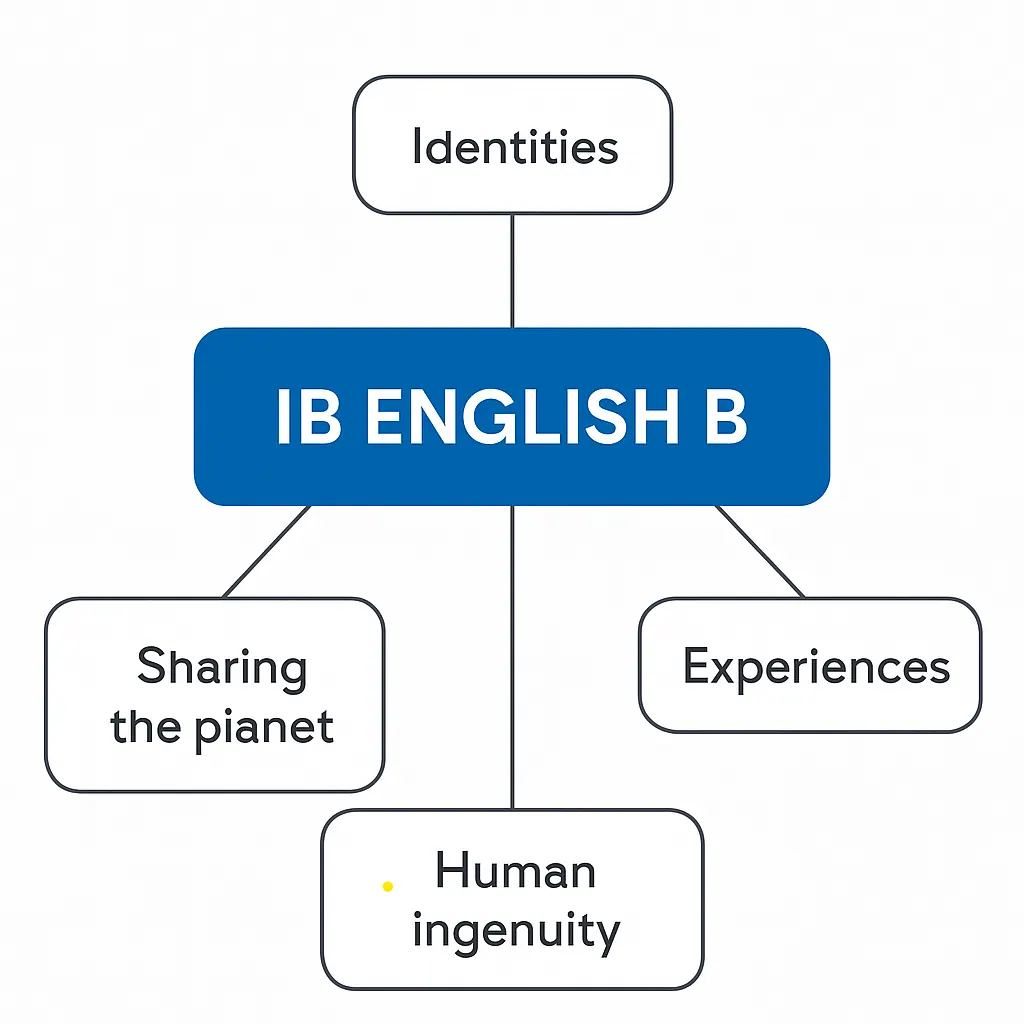
The IB Diploma Programme English B syllabus organises all content around five prescribed themes:
- Identities - personal and cultural identity, values, beliefs, language and the self
- Experiences - daily life, leisure, customs, travel, life milestones
- Human ingenuity - creativity, innovation, technology, arts and entertainment
- Social organisation - community, education, workplace, political structures
- Sharing the planet - environment, global challenges, ethical questions about resources and rights
These are not isolated discussion topics. They form the conceptual framework through which you read texts, construct written tasks, and approach the Individual Oral. Conceptual understanding in IB English B means using these themes as a lens rather than a checklist: you are expected to draw connections across them, not treat each one as a sealed box.
One non-obvious implication: a single text can, and often does, sit across multiple themes. An article about urban farming touches Human Ingenuity, Sharing the Planet, and Social Organisation simultaneously. Students who recognise those overlaps tend to write richer Paper 1 responses than those who force a text into one category.
Within each theme, the IB sets topics and subtopics, but gives teachers considerable flexibility in which specific angles they pursue. This means your school's scheme of work will differ from another school's, while both satisfy the syllabus requirements.
Practical takeaway: build a running vocabulary bank organised by theme from the first week. Because the same themes recur across every paper and the oral assessment, that vocabulary compounds in value throughout the two-year course.
3. HL vs SL: How IB DP English B Differs by Level
The gap between SL and HL is larger than a simple label change. HL requires a minimum of 240 class hours; SL requires a minimum of 150. That extra 90 hours is not padding - it funds a genuinely different syllabus.
The sharpest distinction is literary study. HL students read two works of literature written in English and are assessed on them. SL students work exclusively with non-literary texts throughout the course. This matters at the Individual Oral too: HL candidates must respond to a literary extract in their oral, a component that simply does not exist at SL. Getting comfortable with a novel or play under exam conditions is a distinct skill, and students who choose HL without accounting for this often find the oral the hardest adjustment.
Both levels sit Paper 1 (productive writing) and Paper 2 (receptive skills: listening and reading). The assessment weightings are the same at both levels:
| Component | SL weighting | HL weighting |
|---|---|---|
| Paper 1 | 25% | 25% |
| Paper 2 | 50% | 50% |
| Individual Oral | 25% | 25% |
The counter-intuitive point: HL does not change the weightings at all. The difference lies in what is asked, including the literary extract in the HL oral and more demanding writing tasks.
On university applications, the choice of level carries weight. The IB's own example diploma pathways show English B HL in the sample "medic" route and in the "non-regular diploma" route used by applicants to medicine in countries including India and Pakistan, alongside three sciences and Mathematics. If a programme you are targeting lists a language requirement, HL is the safer choice.
4. Paper 1: Productive Writing and Text Types
Paper 1 tests productive writing: the ability to write accurately, coherently, and in a form that fits the purpose and audience a prompt specifies. You are not just answering a question; you are producing a piece of writing that could plausibly exist in the real world.
Text types in IB English B
The IB syllabus names a fixed set of text types, and knowing their conventions is non-negotiable:
- Article - factual or opinion-based, written for a named publication
- Blog post - informal, first-person, often with headings and a conversational register
- Brochure - concise, persuasive, heavy on subheadings and bullet points
- Diary/journal entry - personal, reflective, dated, no external audience implied
- Essay - formal argumentation, third-person preferred, thesis-driven
- Interview - question-and-answer format, attributed speakers
- Letter - formal or informal depending on recipient; salutation and sign-off required
- Proposal - structured, persuasive, often addressed to a decision-maker
- Report - impersonal, section headings, evidence-based
- Review - evaluative, mixed formal and informal register
- Speech - direct address to audience, rhetorical devices expected
Register and format matter as much as content
The gap between a blog post and a formal report illustrates how much the format shifts. A blog post uses first-person voice, an informal tone, and short paragraphs with headings that guide a casual reader. A formal report uses an impersonal third-person voice, numbered or titled sections, and no subjective commentary without evidence. The non-obvious trap: many students write a competent paragraph but forget the structural shell that signals the text type. A letter without a salutation and sign-off loses marks on conventions, regardless of how good the language is.
SL vs HL requirements
SL students write one text in response to a single prompt. HL students write two texts from two different prompts, each connected to a prescribed theme, typically within the same exam session. That second text is not a bonus; it is a full writing task assessed on the same criteria, so time management under exam conditions becomes a meaningful challenge.
How the work is marked
Criteria cover three areas: language (accuracy, range, and appropriateness), message and organisation (clarity of ideas, logical structure), and text type conventions (format, register, and intended audience). A response can have sophisticated ideas but still score poorly if it ignores the conventions of the chosen text type entirely.
Practical takeaway: before you start writing in Paper 1, spend a few minutes noting the specific formal features your text type requires, salutation, sign-off, headings, or direct address. Getting those visible on the page signals competence to the examiner before they have read a single sentence of your content.
5. Paper 2: Listening Comprehension and Reading in IB English B
Paper 2 is the receptive skills paper for IB English B, and it covers two distinct components in a single sitting: reading comprehension and listening comprehension. Where Paper 1 asks you to produce language, Paper 2 tests how accurately and deeply you can decode it.
Reading
The reading component presents several authentic texts tied to the five prescribed themes. These are not simplified texts written for learners. They are drawn from real-world sources, the kind of registers you find in newspaper features, policy briefs, or documentary transcripts. Questions move across a spectrum:
- Surface comprehension - multiple choice and short answer questions checking factual retrieval
- Vocabulary in context - identifying meaning from surrounding text, not from a dictionary definition
- Inference and interpretation - gap-fill and matching tasks that require reading between the lines
The non-obvious gotcha here is vocabulary questions. Students often pick the word that sounds most similar to the target word rather than the word that fits the context. Training yourself to read the full sentence before selecting an answer makes a measurable difference.
Listening Comprehension
The listening component uses recordings of native or near-native English speakers across a range of registers, from informal conversation to formal interview. You answer questions during or after listening, depending on the task format. The register shift between tracks is deliberate - a speaker with a regional accent or a fast conversational pace is not a production error; it is the assessment working as intended.
Building the receptive competence Paper 2 rewards is straightforward in principle: consistent, varied exposure. BBC Radio 4 documentaries, long-form interview podcasts, and broadsheet features cover both skills and pull from exactly the kind of thematic territory the IB Diploma Programme prescribes.
6. The Individual Oral: Internal Assessment in IB English B
The individual oral is the internal oral assessment in IB English B, conducted by the classroom teacher and then externally moderated by the IB. It carries significant weight in the final grade, so understanding exactly what happens in the room matters.
How the oral works
The student receives a visual stimulus, such as a photograph or infographic, linked to one of the five prescribed themes. After a short preparation period, they deliver a structured response, typically opening with an unprompted monologue before the teacher asks follow-up questions. The conversation tests spontaneous language use, not a rehearsed speech.
The HL difference
At HL, there is an additional component: the student must also discuss a passage drawn from one of the two literary works studied during the course. This extract discussion is assessed alongside the visual stimulus response. It is a meaningful distinction from SL and requires separate preparation. Students sometimes under-prepare the literary extract component because the visual stimulus feels more open-ended, but moderators flag weak literary engagement as a recurring issue.
What the IB assesses
Criteria cover three broad areas:
- Interactive skills: how naturally the student sustains the conversation and responds to the teacher's prompts
- Language proficiency: range, accuracy, and register
- Quality of ideas: whether responses are developed, relevant, and conceptually grounded
A note on circulating examples
"English b internal assessment ib examples" are easy to find online. Use them to understand format and register only. The IB's academic integrity policy explicitly prohibits reproducing or adapting someone else's content, and moderators are trained to recognise it.
Practical preparation
Practise timed responses to unseen visual stimuli, rotating through each of the five themes deliberately. If you always reach for "globalisation" prompts and avoid "sharing the planet", that gap will surface under pressure.
7. Assessment Model: Weightings, Papers, and the IA
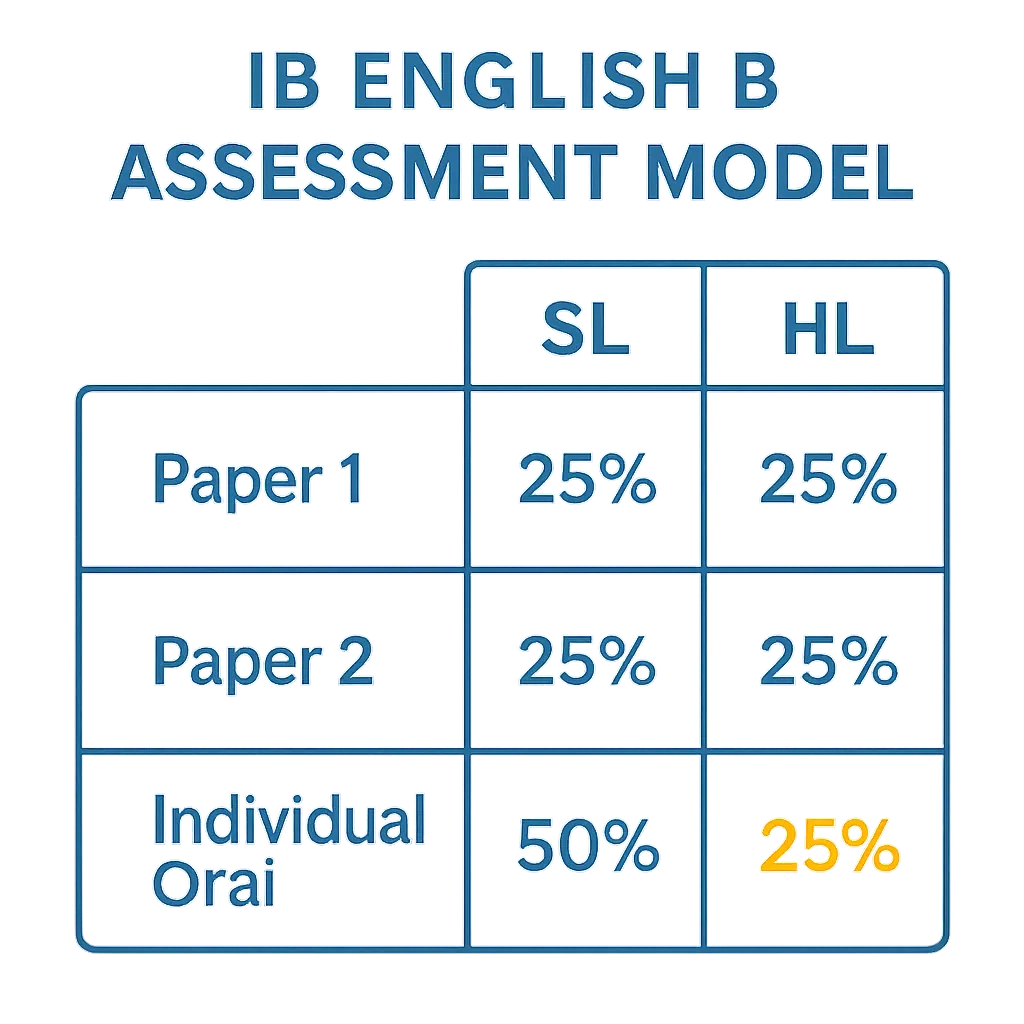
IB English B splits its final grade across three components: two external papers and one internally assessed oral. The split is the same at SL and HL: the HL literary requirement changes what is asked, not the weightings.
The table below shows the weightings. For the precise, authoritative figures, check the official IB subject brief at ibo.org, since reproducing IB copyright material in full is not permitted here.
| Component | SL weighting | HL weighting |
|---|---|---|
| Paper 1 - Productive writing | 25% | 25% |
| Paper 2 - Reading and listening | 50% | 50% |
| Individual oral (IA) | 25% | 25% |
One counter-intuitive point: the oral carries the same 25% at HL as at SL, even though the HL oral is where you discuss a literary extract. The extra literary demand raises the difficulty of the oral, not its weight.
External moderation of the IA: your school teacher marks the recorded oral, but the IB collects a sample of recordings from each school and moderates them centrally. If the moderated sample reveals a pattern of over- or under-marking, the school's marks for the whole cohort are adjusted accordingly. Individual performances are not re-marked in isolation.
Syllabus timeline: the current syllabus applies to everyone who started the DP before August 2027, which covers the May 2027 and May 2028 exam sessions. A revised Language B syllabus has first teaching from August/September 2027, with first assessment in May 2029, per the IB curriculum updates page. If you are starting the DP in 2025 or 2026, the current assessment model applies to you.
8. IB DP English B Past Papers and Guidelines: Where to Find Them
Official past papers for IB DP English B are held in the IB's document store, accessed through IBIS (the IB information system) or IB Follett. Students do not have direct accounts. Your school coordinator or subject teacher is the person to ask.
A non-obvious point worth knowing: specimen papers, not past papers, are the most useful starting point when a new syllabus launches. The IB releases official specimen papers alongside each new curriculum, and these are the only materials guaranteed to reflect current text types, mark schemes, and assessment criteria. Past papers from an earlier syllabus cycle can mislead you on format.
For public-facing guidance, the IB publishes subject briefs at ibo.org. Each brief runs to roughly two pages and covers curriculum structure and assessment methods at both SL and HL. It is the safest free starting point for understanding the course before you have access to the full subject guide.
A few practical rules:
- Grade boundaries are released after each exam session and are available through the candidate results system or via your coordinator. They are not published openly on the IB website.
- Third-party sites hosting past papers and mark schemes are almost certainly distributing copyright-infringing material. The IB pursues takedowns actively. Use them at your own risk, and treat any mark scheme from an unofficial source as potentially out of date or inaccurate.
- Ask your teacher directly for specimen papers and the current subject guide. They have legitimate access and are the fastest route.
9. Common Pitfalls and How to Avoid Them
Five mistakes come up repeatedly across IB English B scripts. Each one is avoidable with the right habit.
Missing text type conventions in Paper 1. The IB assesses format as a distinct criterion. A letter without an appropriate greeting and sign-off, or a blog post without a title and sign-off, drops marks regardless of how fluent the English is. The counter-intuitive reality: a weaker candidate who follows the format correctly can outscore a stronger writer who ignores it. Memorise the required conventions for every text type before you write a word of content.
Treating themes as separate revision silos. A single article about rising sea levels can sit inside Sharing the Planet, Human Ingenuity, and Social Organisation at the same time. Practise reading any text through multiple theme lenses rather than filing it under one label and moving on.
Leaving literary works until the final weeks at HL. The Individual Oral requires close familiarity with both literary texts. Surface-level plot knowledge is not enough when an examiner asks you to discuss a specific extract.
Paraphrasing too loosely in listening comprehension. Paper 2 often targets a precise detail. Writing a rough equivalent of what you heard risks losing the mark entirely. Practise writing answers during playback, not after it ends.
Relying on one register throughout the course. English B rewards range. If every piece of practice writing is formal, an informal text type such as a personal blog or a speech to peers will feel unfamiliar under timed conditions. Alternate registers deliberately from the start.
10. What to Do Next
First, confirm which cohort you are in. If your school begins teaching Language B in August or September 2027 or later, you fall under the revised curriculum with first assessment in May 2029. If you started earlier, you are on the current specification. The distinction matters because specimen papers and assessment criteria documents differ between cohorts.
Contact your IB coordinator this week and ask them to share the subject brief for Language B, the specimen papers, and the official assessment criteria for your cohort. These are the documents that define exactly how your writing, reading, listening, and oral are marked.
Once you have them, map the five prescribed themes against the texts your teacher has already introduced. Building a theme-linked vocabulary bank from the first weeks of the course is one of the least obvious but most practical habits you can form early, when the themes are still new and the connections are easiest to notice.
Check the IB curriculum updates page and confirm your cohort's specification before your next lesson.
FAQ
What is IB English B?
IB English B is a Group 2 language acquisition course in the IB Diploma Programme for students with prior English experience who are not first-language speakers; it is studied at Standard Level or Higher Level over two years, structured around five prescribed themes.
What is the difference between IB English A and IB English B?
English A (Group 1) is for first-language or near-native speakers and focuses on literary analysis; English B (Group 2) is for students with a solid but non-native grounding in English and focuses on language acquisition through thematic content and a range of text types.
What is IB English B Paper 1?
Paper 1 is the productive writing exam in which students write responses in specified text types - such as an article, blog post, speech, or diary entry - linked to the five prescribed themes; SL students write one text and HL students write two.
What level is IB English B HL?
English B HL is a Higher Level course requiring a minimum of 240 class hours; it adds two literary works and a literary extract component in the individual oral that are not required at Standard Level.
Where can I find IB DP English B past papers?
Official past papers are available to registered IB students and teachers through the school's IB coordinator via IBIS or IB Follett; the IB also releases specimen papers for each syllabus, and the subject brief is publicly available on ibo.org.
When does the new IB English B syllabus first apply?
A revised Language B curriculum has first teaching from August/September 2027 and first assessment in May 2029, so students starting the Diploma Programme before 2027 follow the current syllabus.
References
- Example diploma subject choices - International Baccalaureate® - https://ibo.org/programmes/diploma-programme/curriculum/example-subject-choices
- Read curriculum updates - International Baccalaureate® - https://ibo.org/university-admission/latest-curriculum-updates