IB English Language and Literature: Complete Guide
By Michael Thompson · Education Specialist; 10 years teaching the IB at Bromsgrove School · Published 4 September 2026 · Updated 4 October 2026
IB English Language and Literature (Language A: Language and Literature) is one of the most widely taken Group 1 subjects in the Diploma Programme, combining the study of literary texts with non-literary text types such as speeches, advertisements, and journalism. Unlike IB Literature, which focuses exclusively on literary works, this course asks you to analyse how language functions across a range of real-world contexts. The assessments - two written papers, an individual oral, and at least one HL essay - test close reading, comparative argument, and critical thinking about authorial choices. This guide walks through every component, the assessment weightings, the difference between HL and SL, and what examiners are looking for at the top band.
Key Takeaways
- Two courses, one Group 1: IB Language and Literature sits alongside IB Literature in Group 1; the key difference is its inclusion of non-literary text types alongside works of literature.
- Three areas of exploration: Readers, writers and texts; time and space; and intertextuality, connecting texts form the conceptual spine of the course at both SL and HL.
- Seven central concepts: Identity, culture, creativity, communication, perspective, transformation, and representation thread through all areas of exploration and assessment tasks.
- HL carries an extra essay: Higher Level students complete an HL essay (1,200-1,500 words) on a literary work studied during the course, which is externally assessed and carries dedicated weighting.
- The Individual Oral is shared by SL and HL: Both levels deliver a 10-minute oral, based on an extract from one literary work and one non-literary body of work, worth 30% at SL and 20% at HL.
- Paper 1 tests unseen analysis: In Paper 1 you analyse one or two previously unseen texts - the guiding question and the text type are the only scaffolding you get.
In This Article
- What Is IB English Language and Literature?
- IB Literature vs Language and Literature: Which Should You Choose?
- Areas of Exploration and the Seven Central Concepts
- Works, Text Types, and the Learner Portfolio
- The Assessment Model: Papers, Weightings, and the HL Essay
- Paper 1: Guided Textual Analysis
- Paper 2: Comparative Essay
- The Individual Oral and the HL Essay
- How HL Differs from SL
- Assessment Criteria: What Earns a 7?
- What to Do Next
1. What Is IB English Language and Literature?
IB English Language and Literature is a Group 1 Language A subject in the IB Diploma Programme, sitting alongside its sibling course, Language A: Literature. The key distinction is its scope. Where Literature focuses almost exclusively on literary fiction, poetry, and drama, Language and Literature treats language itself as the object of study, asking students to analyse literary texts and non-literary text types with equal seriousness.
That second category is where the course becomes genuinely unusual. Advertisements, political speeches, opinion journalism, social media posts, and documentary film all count as valid study material alongside novels and short stories. Students are expected to examine how meaning is constructed across all of these, not just in canonical fiction. A student who finds the rhetoric of a Brexit campaign poster as interesting as a Kazuo Ishiguro novel is exactly who this course is built for.
The revised syllabus, with first assessment in 2021, restructured the course around areas of exploration and a set of central concepts, replacing the older topic-based framework. One non-obvious trade-off: because the course covers such a wide range of text types, students sometimes find the literary analysis components feel underserved compared to what Language A: Literature students practise. If close reading of literary fiction is your main interest, that tension is worth weighing before you choose.
The course suits students drawn to media, rhetoric, and the mechanics of how language shapes meaning across contexts.
2. IB Literature vs Language and Literature: Which Should You Choose?
Both courses sit in Group 1 of the IB Diploma Programme and fulfil the same requirement. The difference is scope.
IB Literature focuses entirely on literary works - novels, poetry, drama, and short fiction. Every text you study, every assessment you complete, draws from that canon. If close reading of literary form is where you want to spend two years, this is the more focused path.
IB English Language and Literature widens the frame. You study literary works alongside non-literary text types: opinion columns, advertisements, political speeches, film, and digital media. The course treats language itself as the subject, asking how meaning is made across different contexts and audiences.
The less obvious trade-off: Language and Literature students need to be comfortable switching analytical register. Unpacking the rhetoric of a government press release requires different tools than tracing imagery in a Toni Morrison novel. Both skills are tested, sometimes in the same exam.
| If you are drawn to... | Consider... |
|---|---|
| Novels, poetry, drama | IB Literature |
| Media, journalism, advertising, rhetoric | IB Language and Literature |
| Cultural analysis and how texts shape opinion | IB Language and Literature |
| A single disciplinary lens | IB Literature |
Both options are available at Higher Level and Standard Level. Your subject choice does not affect which universities you can apply to - admissions offices treat both as equivalent Group 1 qualifications.
3. Areas of Exploration and the Seven Central Concepts
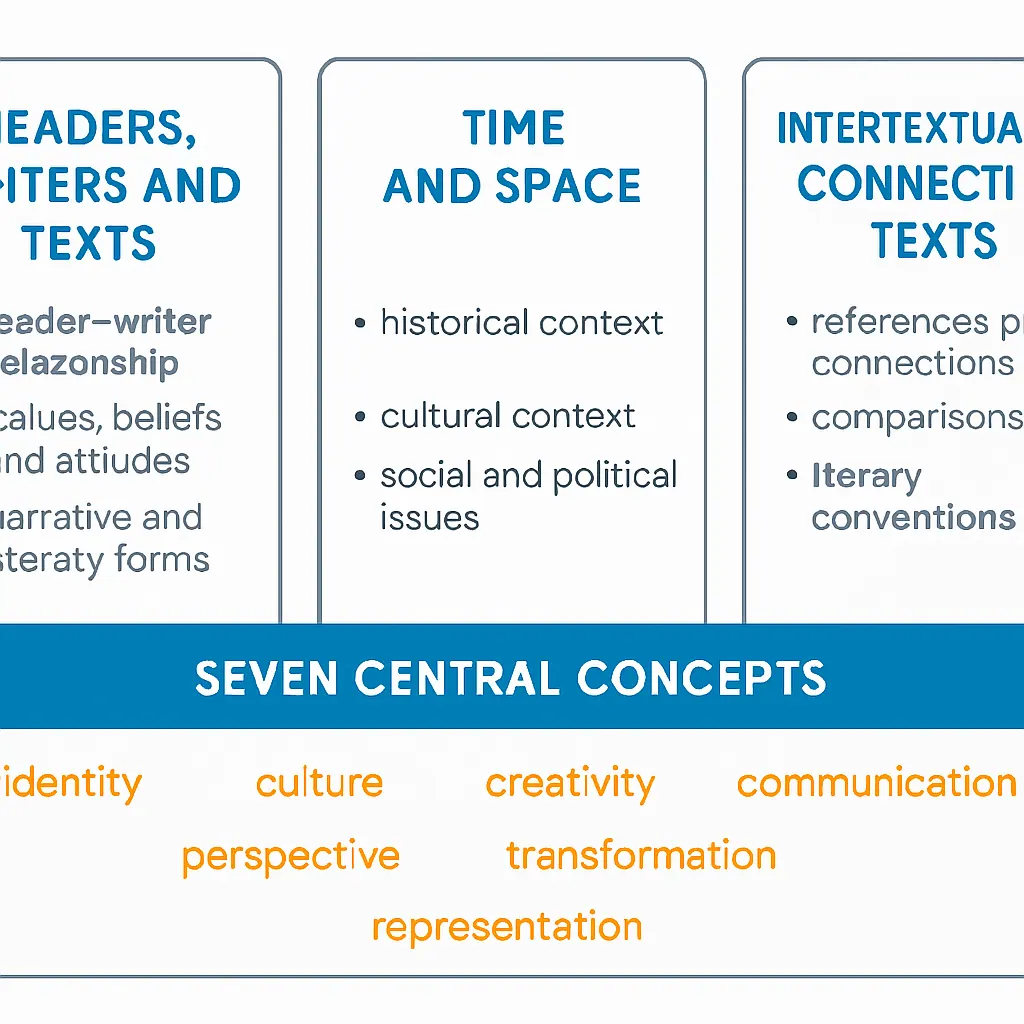
The IB Diploma Programme organises IB English Language and Literature around three areas of exploration, each of which frames a different angle on how texts work and what they do.
- Readers, writers and texts - examines how meaning is constructed through language choices, form, and the relationship between author and audience. It asks: how does a text work, and why does it work that way?
- Time and space - considers how context shapes both the production and reception of texts. The same advertisement, novel, or speech can mean very different things depending on when and where it is encountered.
- Intertextuality: connecting texts - looks at the relationships between texts across time, culture, and genre. This is where the course's dual focus on literary and non-literary material becomes most visible: a poem and a political cartoon can illuminate each other.
Within each area, the IB identifies fields of inquiry - more specific questions that teachers use to structure classroom study. These are prompts, not prescribed units, so two schools teaching the same course can take quite different approaches.
Running across all three areas are seven central concepts, which function as analytical lenses rather than topics to be studied in sequence:
| Concept | What it asks you to consider |
|---|---|
| Identity | How texts construct or challenge a sense of self |
| Culture | How shared values and practices shape meaning |
| Creativity | How writers make deliberate choices of form and language |
| Communication | How context and medium affect what a text can say |
| Perspective | Whose viewpoint is present, and whose is absent |
| Transformation | How texts change over time or across contexts |
| Representation | How language selects, frames, and distorts reality |
The non-obvious point is that the IB does not expect you to address all seven concepts in every assessment. The skill is selecting the two or three most productive lenses for the specific texts in front of you - and being explicit about that choice. Students who try to work through all seven mechanically tend to produce thin analysis; those who apply two or three with precision score significantly higher on the criteria for interpretation and use of literary devices.
4. Works, Text Types, and the Learner Portfolio
The IB does not hand schools a fixed reading list. Instead, the IB defines parameters around text types, language, and areas of exploration, and each school builds its own selection within those constraints. That gives departments real flexibility, but it also means two students sitting the same exam may have studied entirely different works.
How many works you study depends on your level:
- SL students study at least four works across the course.
- HL students study at least six works.
- At both levels, at least one work must be studied in translation, giving the course an explicitly comparative, cross-cultural dimension.
Alongside literary works, the course includes non-literary bodies of work: curated collections of texts grouped by source or type rather than by a single author. A school might, for example, study a politician's speeches across a campaign, a newspaper's coverage of a single event over several years, or a brand's advertising output across different platforms. These sit alongside novels or poetry collections and are treated with the same analytical rigour.
The counter-intuitive trade-off worth knowing: because schools choose their own works, the difficulty of Paper 2 varies less by text than by how well the teacher has framed the comparative angle. Two poorly paired works can make the comparative essay significantly harder than the text complexity alone would suggest.
The learner portfolio is an ongoing, teacher-supervised collection of written and oral activities completed throughout the two years. It is not externally marked. Its purpose is practical: it builds the evidence and thinking you draw on for the individual oral and, at HL, the HL essay. Treat it as working notes, not a separate assessment hurdle.
5. The Assessment Model: Papers, Weightings, and the HL Essay
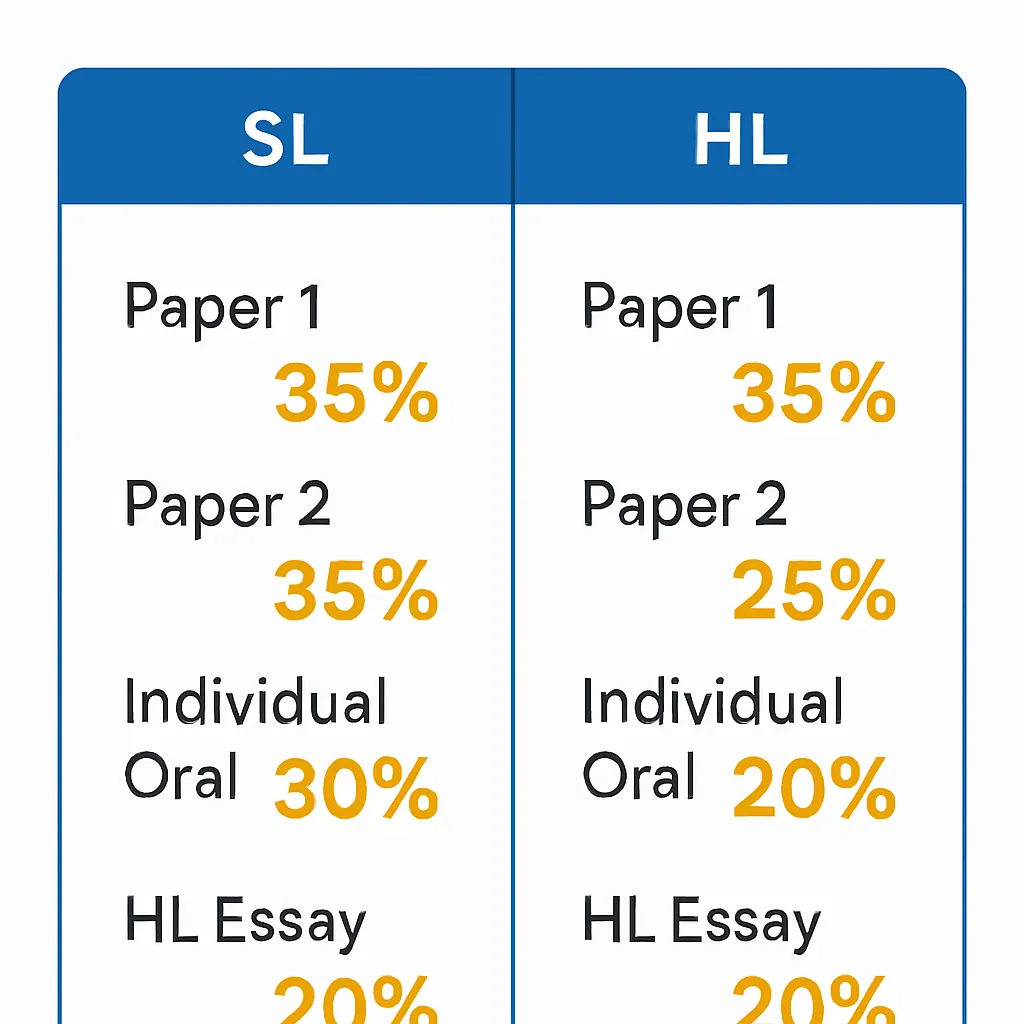
The current assessment model applies from first assessment in 2021. SL students sit three components; HL students sit four, with the addition of the HL Essay pulling weight away from both the oral and Paper 2.
| Component | What it is | SL weighting | HL weighting | How it's assessed |
|---|---|---|---|---|
| Paper 1 | Guided textual analysis of unseen texts | 35% | 35% | External |
| Paper 2 | Comparative essay on studied works | 35% | 25% | External |
| Individual Oral | Recorded discussion with teacher | 30% | 20% | Internal, externally moderated |
| HL Essay | Independent 1,200-1,500 word essay | - | 20% | External |
A few things worth noting before you plan your revision time.
Paper 1 carries the same weight at both levels, which surprises some students. Many assume HL is primarily defined by harder written exams, but the structural difference is the HL Essay, not a heavier Paper 1.
The Individual Oral is internally assessed by your teacher, then externally moderated by the IB. That moderation step matters: if your school's marking is consistently generous, scores get adjusted downward across the cohort, not student by student. A single outlier mark is less exposed than a pattern.
At HL, the four components spread risk more evenly. Dropping marks in one paper is less damaging than it would be at SL, where three components share the entire grade.
6. Paper 1: Guided Textual Analysis
Paper 1 is a closed-book, unseen analysis exam. SL students receive one text and one guiding question; HL students receive two texts, each with its own guiding question, and are not required to compare them. The two papers run at the same time, so the distinction is purely in how many texts you face.
Texts can be literary or non-literary and span a wide range of types: advertisements, opinion columns, political speeches, short story extracts, diary entries, travel writing, and more. The IB deliberately mixes registers and purposes, so you may get a broadsheet editorial alongside a prose poem, or a charity campaign alongside a speech transcript.
What the guiding question actually does
The guiding question points your attention toward one feature of the text, such as the construction of a speaker's voice, or the way structure creates tension. The counter-intuitive gotcha: a response that only answers the guiding question and nothing more will not score in the upper bands. The question is a starting point, not a ceiling. Examiners expect you to identify and analyse additional textual features independently.
What a Band 7 response looks like
- Precise, specific analysis of language choices rather than paraphrase or plot summary.
- A clear, arguable central claim that runs through the whole essay.
- Accurate use of literary devices and text-type conventions. For a speech, that means rhetorical structure and address; for an advertisement, visual language cues and register.
- Attention to specific features: diction, syntax, tone, imagery, structural patterning, and the relationship between form and meaning.
- Coherent organisation with a genuine line of argument, not a feature-by-feature list.
The most common Band 5-to-7 failure is treating literary device identification as an end in itself. Naming a metaphor earns nothing. Explaining what the metaphor does to meaning, and why the writer chose it over a simpler construction, is where marks are won.
7. Paper 2: Comparative Essay
Paper 2 is a closed-book, timed comparative essay. You are given a choice of general thematic questions and must write a sustained analytical response drawing on the works you have studied across the course. The questions never name specific texts, which is the point: the IB is testing whether you can apply your reading to an unseen conceptual prompt, not whether you memorised a pre-written essay.
SL students must discuss at least two works; HL students must discuss at least three. That extra text at HL is not simply more of the same. A third work forces a genuinely triangulated argument rather than a straightforward A-versus-B comparison, and the strongest HL responses use it to complicate or qualify the claim they are building, rather than just confirming it.
A Band 7 response has four recognisable qualities:
- A sustained, consistent argument that runs through every paragraph, not a series of separate mini-essays on each work.
- Precise textual evidence, quoted or closely paraphrased from memory, tied directly to the point being made.
- Genuine comparative thinking: the essay examines how different authors handle the same theme or concept, not just what each author does individually.
- Confident use of literary terminology, applied accurately rather than scattered in for effect.
The closed-book condition is the most misunderstood constraint. Students often rehearse generic essay plans, but the exam rewards those who know their texts well enough to pull specific images, structural choices, or authorial decisions on demand. Revision should prioritise depth over breadth: three texts known precisely will outperform five texts known vaguely.
8. The Individual Oral and the HL Essay
The Individual Oral
The Individual Oral is a 10-minute prepared response, followed by 5 minutes of questions from your teacher. You choose the extracts and prepare in advance; there is no unseen extract. It is internally assessed by your teacher and externally moderated by the IB. You discuss an extract from one literary work studied during the course, then connect it to a non-literary body of work, with both texts anchored to a single global issue.
The global issue is the organising argument of the whole oral, not a vague theme. It must be clearly defined, internationally significant, and genuinely present in both texts. "Gender" is too broad. "The social policing of female ambition through domestic language" is the kind of specificity that earns top marks. A common gotcha: students treat the global issue as a topic to describe rather than an argument to pursue, which collapses the oral into summary.
A Band 7 oral sounds like this:
- A precise, contestable global issue stated within the first minute
- Close reference to specific moments in the extract, not paraphrase
- A clear line connecting textual and linguistic choices to that global issue
- Confident, well-structured delivery that moves between close reading and the wider connection without prompting
The HL Essay
The HL Essay is a 1,200-1,500 word piece of extended writing, externally assessed by the IB. You choose your own focus on one literary work studied during the course, and that work must be different from the one used in your Individual Oral.
The most common Band 3-4 essay retells plot with quotation. A Band 7 essay opens with a focused, independently developed argument, supports it with precise textual evidence, and applies a consistent critical framework. The IB expects you to drive the analytical agenda, not demonstrate that you read the book.
9. How HL Differs from SL
The gap between HL and SL is larger than in some other IB subjects. The extra demands are structural, not just cosmetic.
Works studied: HL students cover at least six works across the course; SL students cover four. That wider reading base is what makes the HL Essay possible, since you need enough material to sustain an independent 1,200-1,500 word extended argument on a single work.
Teaching hours: HL runs to approximately 240 hours against SL's 150. In practice, that difference tends to show up as more time spent on the learner portfolio and deeper work on non-literary text types.
Paper 1: HL candidates analyse two unseen texts and write two separate analyses. SL candidates analyse one. The counter-intuitive catch is that HL students are not asked to compare the two texts, so the task is additive rather than relational.
Paper 2: HL students must draw on three works in their comparative essay; SL students draw on two. One extra work sounds manageable, but sustaining a coherent argument across three bodies of evidence in timed conditions is a distinct skill.
The Individual Oral runs to the same format and time limit at both levels. The weighting, however, differs: it carries more relative weight at SL precisely because SL students do not sit the HL Essay.
| Component | SL | HL |
|---|---|---|
| Works studied | 4 | 6 |
| Paper 1 texts | 1 | 2 |
| Paper 2 works cited | 2 | 3 |
| HL Essay | No | Yes (20%) |
| Teaching hours | ~150 | ~240 |
10. Assessment Criteria: What Earns a 7?
Each assessment component in IB English Language and Literature carries its own distinct set of criteria. The IB publishes the full descriptors in the official subject guide, available at ibo.org, and reading them directly is worth the effort because the band descriptors reveal exactly what markers reward at each level.
Across all components, top-band responses share a recognisable shape:
- A specific, sustained argument rather than a sequence of observations loosely attached to a text.
- Precise, purposeful evidence chosen because it proves a point, not because it fills space.
- Analysis of how language choices create meaning, not just identification of what a device is called.
- Appropriate register and clear structure that serve the argument rather than perform effort.
One counter-intuitive fact experienced teachers note: naming a literary device scores nothing on its own. A student who identifies a metaphor and stops there will land in the lower-middle bands. The marks live in the explanation of what that metaphor does to meaning, tone, or the reader's experience.
Component by component, a Band 7 response looks like this:
| Component | What distinguishes a 7 |
|---|---|
| Paper 1 | Analysis sustained throughout; guiding question addressed insightfully; stylistic features interpreted, not listed |
| Paper 2 | Comparative argument maintained across all works; textual evidence precisely deployed; question answered directly from the first paragraph |
| Individual Oral | Global issue sharply and narrowly defined; both texts used with precision; link between authorial choices and the global issue articulate and convincing |
| HL Essay | Line of inquiry clearly focused; independent critical thinking visible; argument consistently supported by close reading |
For Paper 2 specifically, the comparative structure is non-negotiable at Band 7. Responses that analyse works sequentially rather than weaving genuine comparison throughout typically fall to Band 5, regardless of how good the individual textual analysis is.
11. What to Do Next
One non-obvious thing many students miss: the official IB subject brief for Language and Literature is a public document, not a gated resource. You do not need a school login or a third-party summary to read it.
This week, go to ibo.org and download the Language and Literature subject brief directly. It sets out the full assessment model, the prescribed reading parameters, the fields of inquiry, and the marking criteria in one consolidated document. Everything your school handout references traces back to it, so reading the source removes ambiguity about weighting, word counts, and what each criterion actually rewards.
Do not rely on older versions circulating on study forums. The IB updates subject briefs when the curriculum changes. Check the publication date on the document you download, and email your IB coordinator if the version predates your first examination session.
FAQ
What is IB English Language and Literature?
IB English Language and Literature (Language A: Language and Literature) is a Group 1 Diploma Programme subject that combines the close reading of literary texts with the study of non-literary text types such as speeches, advertisements, and news media, examined through papers, an individual oral, and - at HL - an additional essay.
How is IB English Language and Literature Paper 1 structured?
In Paper 1, SL students write a guided textual analysis of one unseen text, while HL students analyse two unseen texts, each accompanied by a guiding question; the paper tests the ability to identify and analyse language and stylistic features without prior knowledge of the text.
How do I prepare for IB English Language and Literature Paper 2?
Paper 2 is a closed-book comparative essay exam, so effective preparation means knowing your studied works deeply enough to quote or closely paraphrase from memory and practising how to build a comparative argument in response to an unseen thematic question.
Is IB English Language and Literature HL hard?
HL is more demanding than SL because students study at least six works instead of four, analyse two unseen texts in Paper 1, compare at least three works in Paper 2, and complete an externally assessed HL essay - roughly 240 teaching hours compared to SL's 150.
What is the Individual Oral in IB English Language and Literature?
The Individual Oral is a 10-minute internally assessed and externally moderated task in which students discuss an extract from a literary work and connect it to a non-literary body of work through a clearly defined global issue - a structure shared by both SL and HL, though it carries different weightings at each level.
What are the seven central concepts in IB English Language and Literature?
The seven central concepts are identity, culture, creativity, communication, perspective, transformation, and representation; they act as analytical lenses applied across the course's three areas of exploration and underpin every assessment task.