IB History IA: How to Write It and Score Well
By Michael Thompson · Education Specialist; 10 years teaching the IB at Bromsgrove School · Published 4 September 2026 · Updated 4 October 2026
The IB History IA is a historical investigation worth 25% of your final History grade at SL and 20% at HL, and it trips up more students than any other component of the Diploma Programme. The task sounds simple enough: pick a historical question, evaluate two sources in depth, write an investigation, then reflect on the methods historians use. In practice, most students lose marks in predictable ways - weak source evaluation, questions that are too broad, and a reflection section that summarises the investigation instead of engaging with historiography. This guide walks through every section, the mark allocation, and what examiners actually want to see.
Key Takeaways
- Three sections, 25 marks total: The historical investigation is divided into Section 1 (6 marks), Section 2 (15 marks), and Section 3 (4 marks), adding up to 25 marks.
- Hard 2,200-word limit: The entire investigation cannot exceed 2,200 words; examiners stop reading at that point, so word allocation across sections matters.
- OPCVL is a method, not a template: Evaluating origin, purpose, content, values, and limitations should produce an analytical argument about why each source is or isn't useful - not a bullet-point checklist.
- Your question must be genuinely historical: A good IB History IA question is specific, debatable, and set in the past - questions about current events or ones answerable with a single fact will not work.
- Section 3 is about historical thinking, not your opinion: The reflection asks you to discuss the methods and challenges historians face, illustrated by your own investigation experience - not what you personally found interesting.
- Broad questions and shallow OPCVL are the two most common grade-killers: Examiners consistently identify these as the reasons students fall into the lower mark bands.
In This Article
- What the IB History IA Is and How It Is Structured
- Word Limit for the IB History IA and How to Split It
- Choosing a Good IB History IA Topic and Research Question
- Section 1: Evaluating Sources Using OPCVL for the IB History IA
- Section 2: Writing the Investigation
- Section 3: Reflection and the Methods of Historians
- IB History IA Grade Boundaries and Common Examiner Feedback
- What to Do Next
1. What the IB History IA Is and How It Is Structured
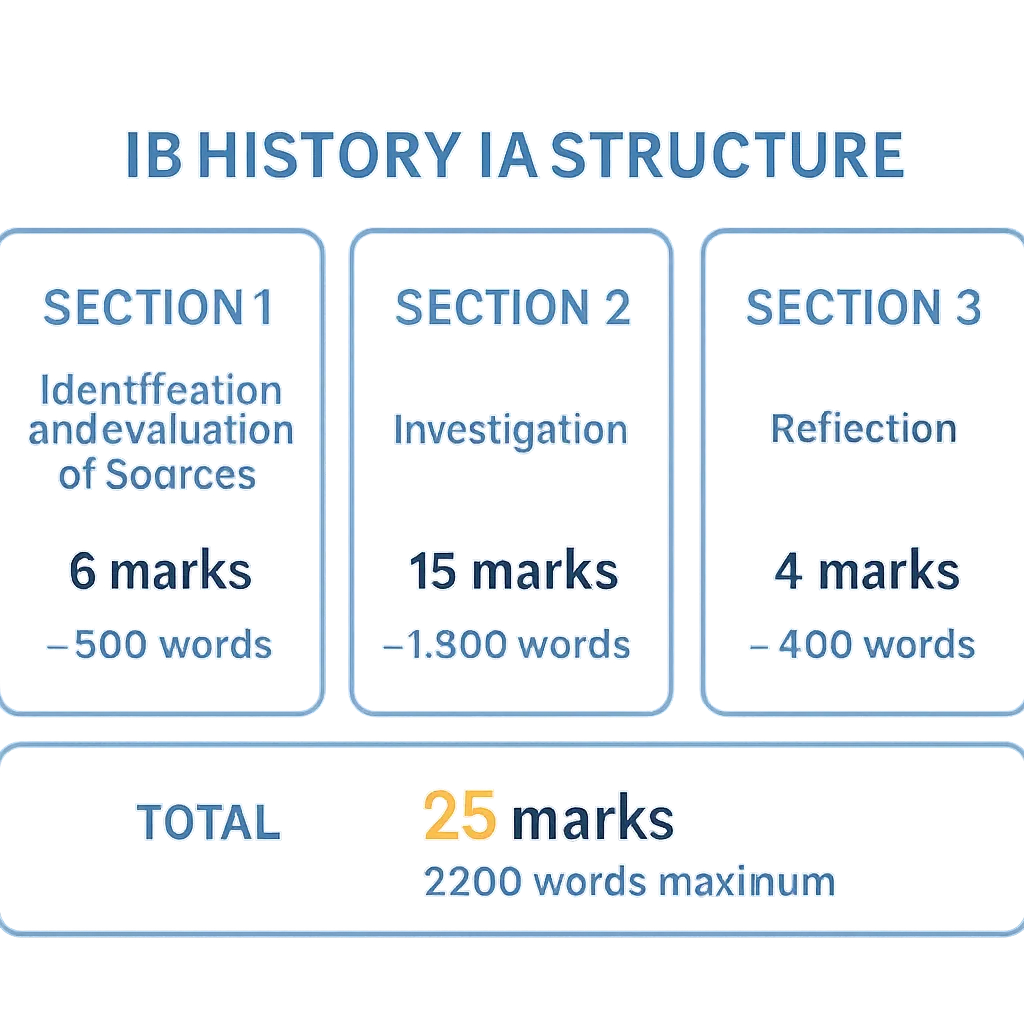
The IB History IA is a historical investigation you research and write independently, counting as internally assessed coursework within the IB Diploma Programme History course at both Higher Level (HL) and Standard Level (SL). Unlike a classroom essay where a teacher sets the question, you choose your own specific historical question and pursue it using primary and secondary sources. The task, marking criteria and 2,200-word limit are identical at HL and SL; only the weighting differs.
Which course this guide covers: everything below describes the current course, which applies to anyone sitting exams in May or November 2027. A new History course was first taught in August 2026 and is first examined in May 2028. Its IA is still a historical investigation, but the reflection section has been removed and the three sections become historical inquiry question, sources and perspectives, and synthesis and evaluation, with a maximum of seven sources, according to the IB's History updates page. If you sit in May 2028 or later, work from the new subject guide with your teacher.
The investigation is divided into three sections, each carrying a fixed mark allocation:
| Section | Title | Marks |
|---|---|---|
| Section 1 | Identification and Evaluation of Sources | 6 |
| Section 2 | Investigation | 15 |
| Section 3 | Reflection | 4 |
| Total | 25 |
Your teacher marks the work first, then the IB externally moderates a sample of submissions from your school, which means your teacher's marks can be adjusted up or down. One consequence worth knowing early: a question that is too broad tends to compress the investigation into superficial coverage, which damages Section 2 marks regardless of how well the sources in Section 1 are handled.
2. Word Limit for the IB History IA and How to Split It
The IB History IA has a 2,200-word ceiling for the entire investigation. Examiners are instructed to stop reading at that point, so anything beyond it is simply not assessed. You do not lose marks for going over, but you lose the words themselves, which is often worse.
A sensible split looks like this:
| Section | Purpose | Rough word budget |
|---|---|---|
| Section 1 | Source evaluation (OPCVL) | ~500 words |
| Section 2 | Investigation | ~1,300 words |
| Section 3 | Reflection | ~400 words |
These are guidelines, not rules set by the IB. A particularly complex research question might warrant a slightly longer investigation and a tighter reflection. Adjust based on what your argument actually needs, not to hit a target.
The less obvious gotcha: Section 2 is where most overruns happen, and it is the worst place for them. A bloated analysis that runs to 1,600 words typically means the reflection gets squeezed or cut entirely, costing marks in a criterion worth 4 of the 25 marks.
What typically does not count toward the word limit: the research question itself, footnotes or endnotes used for citations, the bibliography, and captions on any maps or images. However, this can vary depending on which edition of the subject guide your school is using. Confirm the exclusions with your teacher before you start drafting, not after.
3. Choosing a Good IB History IA Topic and Research Question
The research question is the load-bearing structure of the whole IB History IA. A weak question makes Section 2 nearly impossible to write well, because the IB Diploma Programme expects a genuine historical argument, not a summary of events.
A strong research question has four qualities:
- It names a specific time period (bounded years, not decades or centuries).
- It names specific actors, policies, or events rather than abstract forces.
- It is debatable: a historian could argue different positions, so it cannot be answered by a single fact.
- It is genuinely historical: the events in question have concluded, and there is an established body of scholarship to draw on.
The table below illustrates the contrast using three question shapes written for this guide, not taken from real student work.
| Label | Example question shape | Problem |
|---|---|---|
| Strong | 'To what extent did [specific policy] contribute to [specific outcome] in [country] between [year] and [year]?' | None. Bounded, debatable, historical. |
| Too broad | 'Why did the Cold War happen?' | Decades of events, no focus, no arguable thesis. |
| Too contemporary | 'How is [ongoing conflict] affecting civilians today?' | Events are unresolved; scholarship is thin; not yet historical. |
One counter-intuitive gotcha: a question framed around a single primary source, for example 'What does Source X tell us about [event]?', looks rigorous but is actually weak. The IB History IA requires the question to drive the inquiry. Starting from the source inverts that logic, and examiners will notice the investigation has no real argument beyond what the document contains.
The other practical constraint is familiarity. Section 2 of the IA requires genuine historical knowledge of context, historiography, and causation. If you choose a topic outside your taught course content, that knowledge gap will show. Pick a topic connected to the themes and case studies you have already studied. Faking fluency across 2,000 words of investigation is harder than it sounds.
4. Section 1: Evaluating Sources Using OPCVL for the IB History IA
Section 1 of the IB History IA asks you to identify two sources that are central to your investigation and evaluate each one using five criteria: origin, purpose, content, values, and limitations. The IBO awards up to 6 marks for this section, split across both sources. That ceiling is low enough that a weak Section 1 can meaningfully cap your overall score before Section 2 even begins.
What each OPCVL component means
- Origin - who produced the source, when, and in what context. A memorandum written by a government minister in 1938 has a very different origin from a historian's account published in 1980.
- Purpose - why the source was created. Was it intended to persuade, to record, to report, to rally public support? Purpose shapes what the author chose to include and exclude.
- Content - what the source actually says. This is the shortest element: a concise summary of the relevant material, not a full transcript.
- Values - what makes the source useful as historical evidence, given its origin and purpose. A secret internal dispatch is valuable precisely because it was not written for a public audience.
- Limitations - what reduces the source's reliability or completeness. A speech designed to rally troops tells you about rhetoric, not necessarily about command decisions being made behind closed doors.
Weak Section 1 vs strong Section 1
Weak version: "This source was written by Winston Churchill in 1940. It is a speech. It says that Britain will fight on. It is useful because Churchill was there at the time. It is limited because it is biased."
Strong version: "Churchill's 'We shall fight on the beaches' speech (June 1940) was produced for a parliamentary audience during a moment of acute military crisis. Its purpose was to maintain political will rather than convey strategic reality, which means it cannot be used as evidence of Britain's actual military preparedness, but it is directly relevant to this investigation's question about how wartime rhetoric shaped Allied resolve in 1940-1941."
The difference is the link between the source's characteristics and what can or cannot be argued in Section 2. The strong version tells the examiner why the source's origin and purpose matter for this specific investigation.
The most common mistake: the five-box checklist
Many students treat OPCVL as a form to fill in, ticking each box in sequence without connecting the components. The IB History internal assessment criteria reward analysis, not description. An examiner reading a checklist-style Section 1 will award marks in the lower markband, even if the individual observations are accurate. The goal is an argument about usefulness: given what this source is and why it was created, here is what it can and cannot tell us about the research question.
A counter-intuitive point worth knowing: the IBO does not require both sources to be primary. Secondary sources can be evaluated in Section 1 if they are genuinely central to the investigation. A major historiographical work that shaped the scholarly debate on your topic is a legitimate choice, and evaluating it can demonstrate sophisticated understanding of how historical arguments are constructed.
Choose your two sources before you draft Section 1, and ask one question about each: "Does this source's origin or purpose directly affect what I can claim in my investigation?" If the answer is no, it may not be central enough to feature here.
5. Section 2: Writing the Investigation
Section 2 is the core of your IB History IA. It carries 15 of the 25 available marks, which is 60% of the total, and examiners will read it as a piece of historical argumentation, not a retelling of events. The research question you chose in your introduction should be answered here, directly and in full.
What the investigation must do. You are building a case. That means presenting a clear line of argument, marshalling evidence, and acknowledging where historians or the sources themselves point in different directions. The two sources you evaluated in Section 1 should appear here, but you are not limited to them. Bring in additional evidence where it strengthens or complicates your argument, and engage with historiography where relevant, naming historians whose interpretations you are supporting or contesting.
What examiners penalise. The most common reason students fall into the middle mark bands is narrative drift: summarising what happened rather than arguing why it matters or what it means. A second trap is ignoring counter-evidence. IB examiners are looking for historical complexity; a one-sided argument that never concedes difficulty reads as unsophisticated, even when it is well-written. A third pitfall, and a surprisingly common one, is a conclusion that simply restates the introduction rather than answering the specific question with the evidence gathered.
Mark bands at a glance:
| Band | Marks | What it looks like |
|---|---|---|
| Top | 13-15 | Focused argument, strong evidence, genuine engagement with complexity, clear answer |
| Middle | 7-12 | Some argument but patches of narration, limited counter-evidence, partial conclusion |
| Lower | 1-6 | Mainly narrative, weak or irrelevant evidence, question left unanswered |
Spend proportionate time here. If Section 1 and Section 3 each take a week to draft, Section 2 deserves at least two.
6. Section 3: Reflection and the Methods of Historians
Section 3 is worth 4 marks and has one specific job: to reflect on what conducting the investigation revealed about how historians work and the challenges they face. It is not a personal diary entry. Examiners are not interested in whether you enjoyed the topic or found a particular archive hard to access. They want to see that you understand the nature of historical inquiry itself.
What belongs in a strong Section 3:
- The partial nature of archives: why certain groups (women, colonised peoples, the illiterate poor) are systematically underrepresented in the documentary record, and what that means for any historian working in that period.
- How a historian's own context, nationality, or ideological position shapes which questions they ask and which evidence they prioritise.
- The limitations of specific source types: why state-produced documents tend to record official intent rather than lived experience, or why oral testimony introduces memory distortion across decades.
- The problem of absence: silence in the archive is itself a form of evidence, and recognising that is a mark of genuine historical thinking.
What a weak Section 3 looks like:
- A summary of the argument already made in Section 2.
- "I found this topic interesting because..." or "It was difficult to find sources."
- Generic statements about bias with no connection to the specific investigation.
The counter-intuitive thing many students miss: Section 3 should feel slightly detached from your particular topic. The best responses zoom out to the methodological problem your investigation exposed, then briefly ground it in your own experience. A student writing on Soviet propaganda who only discusses Stalin is thinking too narrowly. One who notes that state censorship means the archive preserves the regime's framing rather than its subjects' responses is thinking like a historian.
400 words is enough. The mark allocation does not reward length. A focused, specific 350-word reflection will outscore a padded 600-word one every time. Write until the methodological point is made clearly, then stop.
7. IB History IA Grade Boundaries and Common Examiner Feedback
The IB History IA is marked out of 25 across three sections, and the mark bands reward a specific quality: the highest bands demand genuine analytical sophistication, not just accurate recall. Examiners distinguish between a student who argues a case and one who describes events competently. That distinction separates the upper bands from the middle bands more than any other single factor.
One non-obvious quirk worth knowing: HL and SL students are assessed on exactly the same criteria and mark bands for the ib history ia. The HL/SL distinction in IB History applies to the external written papers, not the internal assessment, apart from its weighting: 25% of the final grade at SL and 20% at HL. A high-scoring SL student and a high-scoring HL student submit work judged against identical descriptors.
Most frequently cited examiner criticisms
- Research question too broad or descriptive. Questions framed as "What caused...?" across an entire war, for example, rarely allow focused analysis within the word limit.
- Section 1 treated as a checklist. Listing origin, purpose, content, and value/limitation as separate bullet points signals mechanical application rather than evaluative thinking.
- Section 2 narrates rather than argues. The most common mid-band failure is a well-researched account that never advances a clear historical argument in response to the research question.
- Section 3 summarises instead of reflecting. Examiners consistently flag responses that restate the investigation's findings rather than examining what the methods and sources reveal about the challenges historians face.
Because grade boundaries shift year to year, read the current IB History subject guide and any published examiner reports directly via the IB's official website before finalising your draft.
8. What to Do Next
The research question is where most IB History IAs are won or lost, and it is also where students commit too early. A question that sounds specific can still fail two of the three tests: it might not be genuinely debatable (a question with an obvious answer scores poorly on Criterion B), or it might slip into political science rather than historical analysis.
This week, draft your research question and test it against all three criteria: specific, debatable, and genuinely historical. Write it at the top of a page, then write one sentence arguing yes and one arguing no. If you cannot do both, the question is not debatable enough. Take that draft to your History teacher before you commit to a topic or request sources from a library. Change a weak question now; changing it after you have written Section 1 costs you far more than an afternoon.
FAQ
What is the IB History IA?
The IB History IA (internal assessment) is a historical investigation students complete as part of the IB Diploma Programme History course; it is worth 25% of the final grade at SL and 20% at HL and is marked out of 25.
How long is the IB History IA?
The IB History IA has a maximum length of 2,200 words, split across three sections; examiners do not read beyond the word limit, so students must manage their word count carefully.
What is the IB History IA out of?
The IB History IA is marked out of 25, with Section 1 worth 6 marks, Section 2 worth 15 marks, and Section 3 worth 4 marks.
When is the IB History IA due?
Internal deadlines for the IB History IA are set by individual schools and teachers; students should confirm their school's submission date, which is typically several months before the final IB exams in May or November.
How do you write a good IB History IA?
A strong IB History IA starts with a specific, debatable historical question; evaluates two sources analytically using OPCVL in Section 1; builds a well-evidenced argument in Section 2; and reflects on historical methodology - not personal opinion - in Section 3.
Do HL and SL students have different IB History IA requirements?
No - HL and SL students complete the same historical investigation assessed on the same criteria and marked out of the same 25 marks; only the weighting differs (25% at SL, 20% at HL), and the other HL/SL differences in History are in the external written examinations.
References
- History updates - International Baccalaureate - https://www.ibo.org/university-admission/latest-curriculum-updates/history-updates/