IB Internal Assessment: The Complete Guide
By Michael Thompson · Education Specialist; 10 years teaching the IB at Bromsgrove School · Published 21 May 2026 · Updated 6 October 2026
IB internal assessment is the coursework component of the IB Diploma Programme - and for most subjects it counts for 20-30% of your final grade. Unlike written exams, IAs are marked first by your teacher, then moderated by the IB to ensure consistency across schools worldwide. That moderation process can raise or lower your mark, which surprises many students. This guide explains how IAs work subject by subject, what the IB's marking criteria actually test, and how to avoid the academic honesty mistakes that most commonly catch students out.
Key Takeaways
- Teacher-marked, IB-moderated: Your teacher marks your IA first, but the IB externally moderates a sample of submissions from your school, which can adjust every student's mark up or down.
- 20-30% of your final grade: Most DP subjects weight the IA at 20% at HL, and several weight it at 25-30% at SL; some subjects - including Group 6 Arts - weight it higher still.
- Format varies by subject group: Sciences and Math require an investigation or exploration; History uses a historical investigation; Languages use an individual oral - there is no single IA format across the Diploma.
- Deadlines sit alongside EE and TOK: Schools set their own internal IA submission deadlines, usually several months before the IB's May or November exam sessions, so check your school's calendar - not the IBO's.
- AI use is an academic honesty risk: The IBO's academic integrity policy treats undeclared AI-generated content as a form of academic misconduct, so check your school's specific rules before using any AI tool.
- Word and page limits are hard limits: Examiners are instructed to stop reading at the stated limit, so any work beyond it does not count toward your mark.
In This Article
- What Is IB Internal Assessment?
- How IB Internal Assessment Is Marked and Moderated
- IB Internal Assessment Weighting by Subject
- Subject-by-Subject IA Formats: Sciences, Math, Humanities, Languages, and Arts
- IB Internal Assessment Criteria: What Examiners Actually Look For
- IB Internal Assessment Deadlines: When Does Your IA Need to Be Submitted?
- How IAs Fit Alongside the Extended Essay and TOK
- Academic Honesty: Plagiarism, AI Use, and What the IBO Checks
- Common IA Mistakes and How to Avoid Them
- Where to Go from Here
1. What Is IB Internal Assessment?
IB internal assessment is the teacher-marked coursework component built into every subject of the IB Diploma Programme. Unlike the written exams sat in May or November, which are marked anonymously by IB-appointed external examiners, an IA is supervised and initially graded by your own teacher. The IBO then moderates a sample of submissions to check that marking is consistent across schools.
Every DP subject has its own IA format with its own criteria. A Biology IA is a scientific investigation. A History IA is a historical investigation. A Math IA is an exploration of a mathematical concept the student chooses. These are not interchangeable; the format, word count, and assessment criteria differ by subject, and treating them as one generic task is one of the most reliable ways to lose marks.
IAs are compulsory. They form a fixed portion of your final grade in each subject, and a missing or incomplete IA can result in failing that subject outright, regardless of how well you perform in the external exams. They are not optional extensions or enrichment activities added on top of the course.
One non-obvious consequence of teacher marking: your school's internal deadlines will almost always fall months before the IBO's moderation submission window. Miss your school's deadline and you may have no route to resubmission.
2. How IB Internal Assessment Is Marked and Moderated
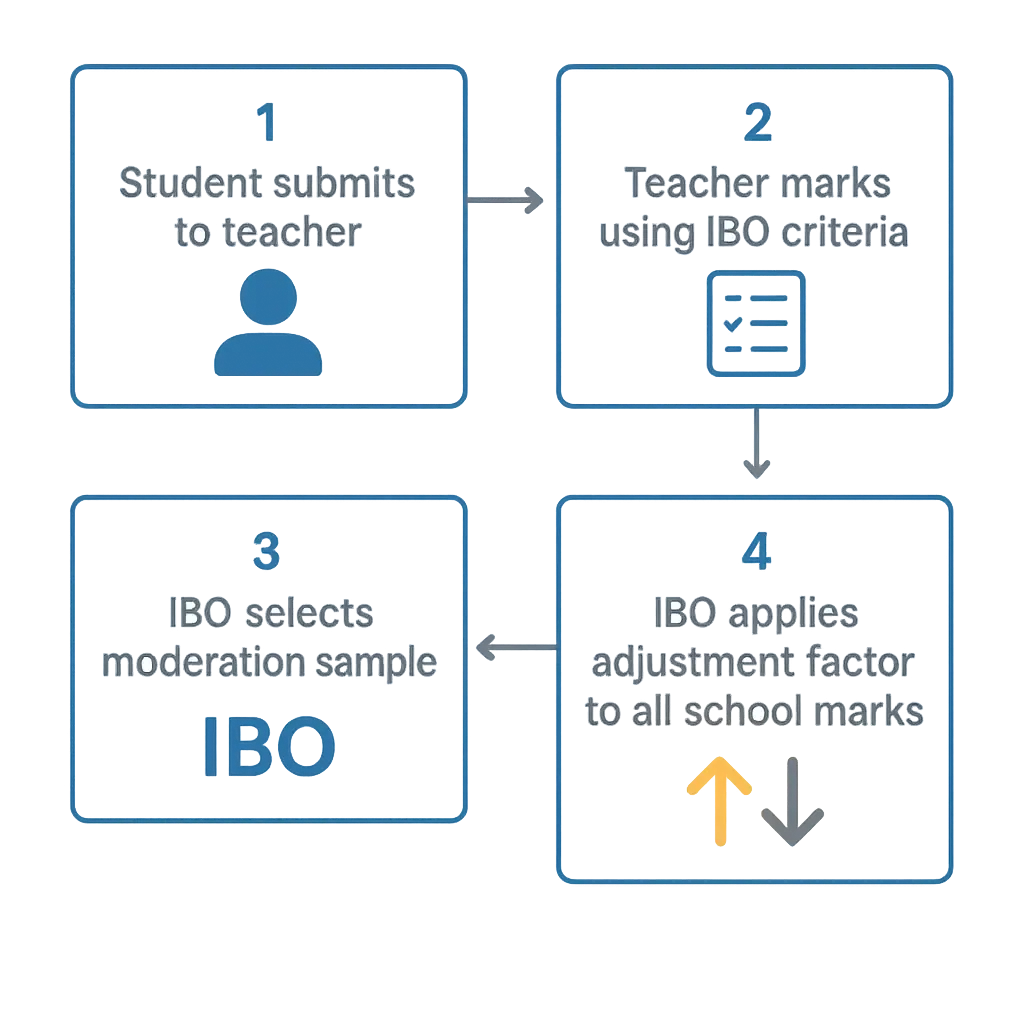
The marking process for IB internal assessment runs in two distinct stages, and the second stage can change the grade your teacher gave you.
Stage 1: teacher marking. Your subject teacher marks your IA against the IB's published criteria for that subject. They award a raw score, which they record alongside a brief justification for each criterion.
Stage 2: IB moderation. The school submits a sample of marked work to the IB. External moderators at the IB then re-mark that sample against the same criteria and compare their scores to the teacher's. If there is a consistent gap, the IB applies an adjustment factor to every student's mark in that subject at that school, not just the students whose work was sampled.
The non-obvious detail here is the direction of the adjustment. Moderation can move marks up as well as down. If your teacher marked conservatively relative to the IB standard, the whole cohort may receive a small uplift. If your teacher marked generously, everyone's mark falls. The teacher's mark is a provisional figure, not a guaranteed one.
One point students often miss: the moderation sample is selected by the IB, not by the teacher or by you. You cannot volunteer your work, and your teacher cannot protect a borderline student by keeping their IA out of the sample.
The practical consequence is straightforward. The mark your teacher tells you in class is an indication of where you stand, not a final result. Keep that distinction in mind when calculating predicted totals or assessing the risk of a conditional university offer. For an independent check before you submit, run your draft through our AI IA grader - it predicts your grade against the official subject rubric and flags exactly where you are losing marks.
3. IB Internal Assessment Weighting by Subject
Across most IB Diploma Programme subjects, the ib internal assessment component accounts for 20-30% of your final grade. The figure is 20% at both levels in Biology, Chemistry, Physics and Mathematics, and 20% at Higher Level in most other Group 1 to 5 courses. At Standard Level, several subjects weight the IA more heavily: 25% in History and 30% in Economics, Business Management and the Language A individual oral. It sounds modest until you remember it is the one part of your grade you can control entirely outside the exam hall.
The table below shows how weighting varies by subject group. Note that the IBO sets these figures individually per subject guide, and SL and HL courses within the same subject sometimes carry different IA weightings.
| Subject Group | IA Component | Approximate Weighting |
|---|---|---|
| Group 1 (Language A: Literature / Lang & Lit) | Individual Oral | 30% SL, 20% HL |
| Group 2 (Language B / Ab Initio) | Individual Oral | 25% |
| Group 3 (Individuals and Societies, e.g. History, Economics) | Written commentary or investigation | 20-30% (higher at SL) |
| Group 4 (Sciences, e.g. Biology, Chemistry, Physics) | Scientific investigation | 20% |
| Group 5 (Mathematics: Analysis / Applications) | Mathematical exploration | 20% |
| Group 6 (Arts, e.g. Visual Arts, Theatre, Music) | Portfolio, exhibition, or performance | 40-60% |
Group 6 is where the standard assumption breaks down. Visual Arts, Theatre, and Music all weight internal and school-based work far more heavily than any other group, because the nature of the subject demands assessed creative output rather than a terminal written exam.
One non-obvious quirk worth knowing: in Group 4, the scientific investigation is assessed internally by your teacher and then externally moderated, while the collaborative sciences project, which the course also requires, carries no marks.
Always check the current subject guide for your specific course. SL and HL weightings often differ - History weights the IA at 25% at SL and 20% at HL, for example - and the IBO revises guides on a rolling cycle.
4. Subject-by-Subject IA Formats: Sciences, Math, Humanities, Languages, and Arts
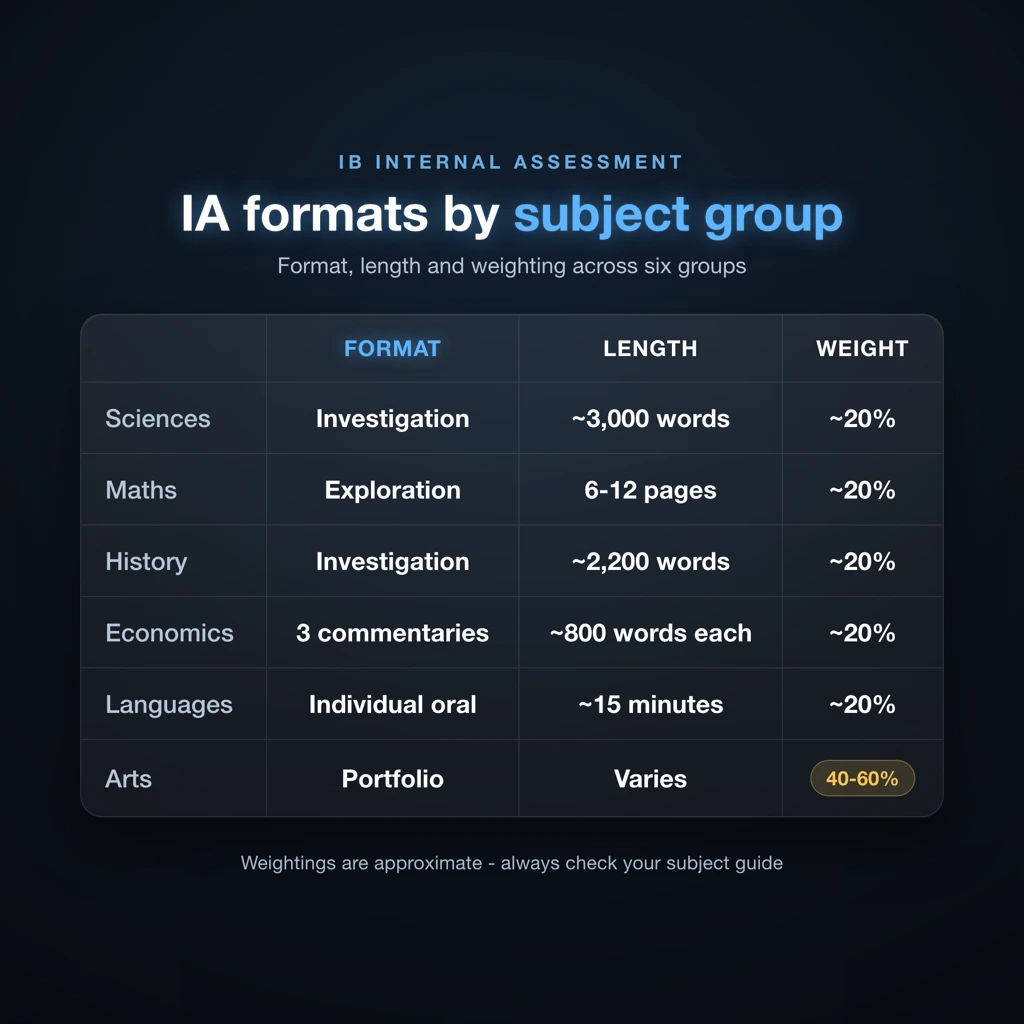
| Subject | IA format | Approximate length |
|---|---|---|
| Sciences (Biology, Chemistry, Physics) | Scientific investigation | Max 3,000 words |
| Mathematics (AA and AI) | Mathematical exploration | 12-20 pages |
| History | Historical investigation | Max 2,200 words |
| Economics | Three commentaries | Max 800 words each |
| Business Management | Business research project | Max 1,800 words |
| Languages A and B | Individual oral | ~15 minutes (recorded) |
| Arts (Visual Arts, Music, Theatre) | Portfolio, process journal, or exhibition | Varies by subject |
No two IB Diploma Programme subjects handle internal assessment the same way. The format, length, and skills being tested differ substantially across subject groups, which matters when you are planning your workload across multiple IAs at once.
Sciences: Biology, Chemistry, Physics
All three sciences share one IA model, first examined in 2025: a scientific investigation of the student's own design, marked on four criteria worth 6 marks each - Research design, Data analysis, Conclusion and Evaluation - for a total of 24. The written report has a maximum of 3,000 words. You may collect data with other students, in groups of up to three, but each student needs their own research question and writes an individual report. One non-obvious gotcha: many exemplars online were marked against the previous science criteria, so check any example against the four current criteria before you copy its structure.
Mathematics AA and AI (SL and HL)
The Mathematics IA is a mathematical exploration, about 12 to 20 pages long, on a topic the student selects themselves. There is no fixed investigation structure, which gives it more freedom than the sciences and more rope to hang yourself with. Choosing a topic that is too broad is the most common error: an exploration of "infinity" or "the Fibonacci sequence" rarely gets past the surface, while a focused question about modelling a specific real-world dataset tends to score better on the criteria for personal engagement and reflection.
History
The History IA is a historical investigation of up to 2,200 words. It has a distinctive three-section structure: an identification and evaluation of two sources, a detailed investigation, and a reflection on the methods used by historians. The reflection section trips up many students because it asks you to evaluate the discipline of history, not just your own sources. This structure applies to May and November 2027 candidates; the new History course, first examined in May 2028, removes the reflection section.
Economics
Economics students produce three commentaries, each of no more than 800 words, each responding to a different real-world news article, covering a different unit of the syllabus (microeconomics, macroeconomics, the global economy) and applying a different key concept. Brevity is the actual challenge here: 800 words forces precision, and examiners penalise padding.
Languages A and Languages B
- Languages A (Language and Literature / Literature): An individual oral, fifteen minutes, built around extracts from two texts linked by a global issue. Preparation happens in class; the oral itself is recorded and submitted for external moderation.
- Languages B: Also an individual oral, conducted entirely in the target language. The prompt - a visual stimulus at SL, an extract from a literary work studied at HL - is seen only shortly before speaking, so fluency under pressure matters more than scripted accuracy.
Group 6 Arts
The arts subjects (Visual Arts, Music, Theatre) replace exams with portfolios or process journals. Weighting is substantially higher than in most other groups, meaning the IA is less a complement to written papers and more the primary means of assessment. Visual Arts changed for May 2027 candidates: the new course is built around an art-making inquiry portfolio, with a connections study at SL and an artist project at HL, so summaries that list a comparative study, process portfolio and exhibition describe the previous course.
Business Management
The Business Management IA is a business research project of no more than 1,800 words, the same task at SL and HL, on a real issue facing a single organisation. It draws on three to five supporting documents and is framed through one of the course's key concepts. A family business can work well, because access to internal data is easier to arrange than with a large corporation.
Subjects with a new IA from May 2027
Three IAs changed for students sitting from May 2027. The Psychology IA is now a research proposal: you design a study using one of the four research methods from your class practicals, but you do not carry it out. The Computer Science IA is now a computational solution, and it no longer needs a client. In Design Technology, the design project now starts from redesign, and you submit an individual report of up to 3,500 words.
5. IB Internal Assessment Criteria: What Examiners Actually Look For
There is no universal IB internal assessment rubric. Each subject has its own published marking criteria, written into the IBO's subject guide for that course. The criteria for a Biology IA look nothing like those for a History investigation, and examiners mark against the subject-specific descriptors, not a generic checklist.
The good news: the criteria are not secret. The IBO publishes them in every subject guide, which your school has access to. Reading the criteria before you start your IA, not after your first draft, is the single most direct way to improve your mark.
Criteria by subject area
Sciences (Biology, Chemistry, Physics)
The IB biology internal assessment criteria and those for chemistry and physics share the same four-criterion framework:
- Research Design - a clear research question, relevant methodology, and appropriate variables
- Data Analysis - correct recording and processing of data, including uncertainties
- Conclusion - an answer to the research question that engages with the accepted scientific context
- Evaluation - honest discussion of limitations and improvements
A non-obvious gotcha: each criterion is worth 6 marks out of 24, and the back half of the report - Conclusion and Evaluation - carries half the total. Students who pour everything into design and data collection routinely lose marks there.
Math Exploration
The IB math internal assessment criteria cover five strands: Presentation, Mathematical Communication, Personal Engagement, Reflection, and Use of Mathematics. The criteria and marks (20 in total) are the same for Analysis and Approaches and Applications and Interpretation; Use of Mathematics, worth 6 of those marks, is judged against more demanding descriptors at HL. These criteria apply to everyone sitting up to and including November 2028.
History Investigation
For May and November 2027 candidates, the IB history internal assessment criteria use three strands: Identification and Evaluation of Sources, Investigation, and Reflection. The Reflection section requires you to discuss what the investigation revealed about the methods used by historians, not simply summarise what you found.
How raw marks become a grade
Examiners score each criterion separately. Those raw marks are summed into a total out of the subject's maximum, then converted to a grade on the IB's 1-7 scale using grade boundaries the IB sets each examination session. Boundaries shift slightly from session to session, so a 22 out of 24 in one session may not convert to the same grade as in the next.
6. IB Internal Assessment Deadlines: When Does Your IA Need to Be Submitted?
There are two separate deadlines for any IB internal assessment, and confusing them is a genuine risk. The IBO sets an upload deadline for schools, typically in the spring for the May session. Your school's DP coordinator sets an earlier internal deadline so that teachers have time to mark, sample, and upload work before the IBO's cutoff. These are not the same date.
The internal school deadline is the one that matters to you. For the May examination session, most schools ask students to submit completed IAs somewhere between November and January. For the November session, that window tends to fall between May and July. Neither date appears on the IBO website, which only publishes the school-facing upload schedule.
A non-obvious gotcha: schools in different time zones or with large cohorts often set internal deadlines earlier than schools with smaller IB programmes, because coordinators need more time to organise sampling across multiple subjects. Your DP coordinator's deadline is the only authoritative date for your situation.
The timing matters beyond the IA itself. The IB Diploma Programme requires students to manage the IA, the Extended Essay, and Theory of Knowledge simultaneously during Year 2. A student who underestimates the IA timeline can find three major pieces of assessed work colliding in the same term.
If you miss your school's internal deadline, the coordinator may submit whatever draft exists at that point. An incomplete IA is assessed on what was submitted, not on what you intended to finish.
Ask your DP coordinator for the exact date in writing, and work backwards from it, not from anything published by the IBO.
7. How IAs Fit Alongside the Extended Essay and TOK
The IB Diploma Programme has three core components running alongside your six subjects: the Internal Assessments (one per subject), the Extended Essay (a 4,000-word independent research essay submitted to external IB examiners), and Theory of Knowledge (an externally assessed essay and an exhibition that your teacher marks). A full DP student completes all of these within the same two academic years.
That workload stacks in a way that catches students off guard. The EE and TOK have their own separate submission timelines and go through a different pipeline from your IAs. Treating them as interchangeable with IA deadlines is one of the most common planning mistakes. Your school submits IAs to subject moderators; the EE and TOK follow a distinct process through your DP coordinator. Mixing up which document is due where, and when, causes avoidable last-minute panic.
A non-obvious gotcha: EE first-draft meetings with your supervisor are often scheduled in the same term as science and mathematics IA draft deadlines. Schools that front-load EE work in Year 1 tend to produce stronger final essays, precisely because Year 2 is when IA drafts across all six subjects converge.
Practical steps:
- Ask your DP coordinator for the full internal calendar at the start of Year 1, not Year 2.
- Map every IA draft deadline, your EE draft meetings, and TOK submission windows onto a single timeline.
- Aim to stagger subject IA drafts so no more than two land in the same fortnight.
8. Academic Honesty: Plagiarism, AI Use, and What the IBO Checks
Every IB internal assessment is submitted under the IBO's academic integrity policy. Your teacher signs off that the work is your own before it goes to moderation, and the IBO retains the right to investigate any suspected breach. That signature carries weight for both of you.
Plagiarism covers more ground than most students expect. Copied text is the obvious case, but paraphrasing a source without citation counts too, as does submitting work that another student produced, in whole or in part. The consequence at the serious end is a grade of N (no award) for the subject, which can collapse a diploma result entirely. The IBO treats misconduct findings across all components, not just the IA in isolation.
AI-generated content is currently treated as undeclared assistance if not disclosed. The IBO's position is that using AI tools to produce content you submit as your own constitutes academic misconduct. Schools vary in how permissive they are about AI for planning or grammar checks, so read your school's specific policy rather than assuming a blanket rule. The counter-intuitive gotcha here: a polished, unusually consistent writing style can trigger a closer look from a moderator, even when the underlying analysis is sound.
Before submission, many schools run drafts through Turnitin or a comparable similarity-checking platform. The IBO does not publicly specify which detection tools it uses at the moderation stage.
Practical steps to protect yourself:
- Keep a working bibliography from day one, not a list assembled the night before submission.
- Draft in visible stages: version-controlled documents or dated drafts create a natural audit trail.
- Ask your IB coordinator for the current IBO academic integrity policy document. It is updated periodically, and the version your school holds may differ from summaries circulating online.
9. Common IA Mistakes and How to Avoid Them
Six mistakes account for the majority of preventable mark loss across IB DP internal assessment subjects.
- Exceeding word or page limits. Examiners are instructed to stop reading at the published limit. Every word you write beyond it is invisible to the marker. Going over signals poor editing, not thoroughness.
- Ignoring the marking criteria. The criteria are published and fixed. Students who write a strong piece of work but fail to address what the criteria actually ask for lose marks that are genuinely easy to recover. Read the criteria before you write a single sentence, not after.
- Misjudging topic scope. Too broad, and your analysis stays surface-level. Too narrow, and you cannot generate enough meaningful material to meet the word count with substance. The counter-intuitive fix: a tighter question with a clear independent variable almost always produces deeper analysis than a wide one.
- Weak referencing, especially in History and Sciences. In History, citation quality is assessed directly. In Sciences, sourcing secondary data without attribution can be treated as an academic honesty concern, not just a style issue.
- Writing the conclusion as a results summary. In Sciences, the Conclusion criterion expects you to answer your research question and compare the outcome with the accepted scientific context. A paragraph that restates your graph does not satisfy it.
- Skipping examiner reports. The IBO publishes subject-specific reports after each examination session. These documents name exactly what markers found missing that year. Reading the most recent report for your subject is the closest thing to a marking preview that exists.
10. Where to Go from Here
The most useful thing you can do right now is not search for IA examples online. It is to open the IBO subject guide for your specific course and read the published marking criteria from start to finish. The criteria document is the examiner's own checklist, and most students only consult it after a draft is already written, which is too late to restructure the approach.
This week, contact your DP coordinator and ask for the school's internal IA deadline calendar, not the IBO's general one. Schools set their own submission windows, which can run weeks or months ahead of the official moderation dates, and missing an internal deadline has the same consequence as missing the real one.
Once you have those two documents in hand, read the Extended Essay guide and the TOK guide alongside them. Managing all three concurrently, rather than sequentially, is where the workload becomes tractable.
Coursework guides added recently:
- IB Computer Science IA 2027: The Computational Solution
- IB English Individual Oral: Complete Guide (2025)
- IB Global Politics Extended Essay: The Complete Guide
FAQ
What is IB internal assessment?
IB internal assessment is the coursework component of the IB Diploma Programme, marked first by your teacher using IBO criteria and then moderated externally by the IBO to ensure consistency across schools.
How are IB internal assessments graded?
Teachers mark IAs against subject-specific criteria published in the IBO subject guide; the IBO then selects a sample from each school, moderates it, and applies an adjustment to all marks in that subject if the teacher's marking differed from the IBO standard.
When are IB internal assessment deadlines?
The IBO sets upload deadlines for the May and November exam sessions, but your school will set earlier internal deadlines - typically several months before - so you should ask your DP coordinator for your school's specific calendar.
Is IB internal assessment compulsory?
Yes - every subject in the IB Diploma Programme includes a compulsory IA component; failing to submit one can result in a grade of N (no award) for that subject, which can prevent you from being awarded the full Diploma.
Can I use AI tools for my IB internal assessment?
The IBO treats undeclared AI-generated content as academic misconduct; you must declare any AI use and follow your school's specific policy, which may be more restrictive than the IBO's baseline rules.
How much does the IA count toward my final IB grade?
In the sciences and Mathematics the IA is worth 20% at both levels; in subjects such as History, Economics and Business Management it is 20% at HL and 25-30% at SL; and some subjects - particularly in Group 6 Arts - weight it considerably higher, sometimes up to 40-60%.