IB Maths AA IA Criteria: What Each of the 5 Criteria Rewards
By Michael Thompson · Education Specialist; 10 years teaching the IB at Bromsgrove School · Published 4 September 2026 · Updated 6 October 2026
The IB maths AA IA criteria break the mathematical exploration into five separate components, each marked independently, adding up to 20 marks that count for 20% of your final grade. Many students treat the IA as one big essay and lose marks unevenly - strong mathematics, weak reflection, and the total suffers. Understanding what examiners are actually looking for in each criterion changes how you plan, draft, and revise. This guide covers every criterion in plain language, explains what separates a top-band score from a middle-band one, and flags the three mistakes that appear most often in moderated work.
Key Takeaways
- 20 marks, 20% of your grade: The exploration is marked out of 20 across five criteria and contributes one fifth of your final IB Maths AA score.
- Use of Mathematics carries the most weight: at 6 marks - more than any other single criterion, so the mathematical content of your topic matters enormously.
- HL students must use HL-level techniques: to access the top band in Use of Mathematics; submitting an exploration that relies only on SL methods caps that criterion regardless of how well those methods are applied.
- Reflection is not a diary entry: High marks require specific, reasoned evaluation of limitations and results - not vague comments like 'my results could be more accurate'.
- Personal engagement must run throughout the whole exploration not appear in a single paragraph at the start; examiners look for evidence of genuine mathematical curiosity woven into the work.
- The 12-20 page guidance is a working limit not a target: appendices do not count toward it, but content beyond the limit is not read by the examiner.
In This Article
- What the IB Maths AA IA Is and How It Is Weighted
- The Five IB Maths AA IA Criteria at a Glance
- Criterion-by-Criterion: Top Band vs Mid Band in Plain Language
- Topic Choice for HL and SL: The Level of Mathematics Expectation
- Reflection and Personal Engagement: What the Criteria Actually Reward
- Length, Structure, Notation, and What Goes in the Appendix
- The Three Mistakes Examiners See Most Often
- What to Do Next
1. What the IB Maths AA IA Is and How It Is Weighted
The IB Maths AA IA is a written mathematical exploration: a self-directed investigation of a mathematical concept the student chooses, developed and written in their own voice. Understanding the ib math aa ia criteria matters from day one, because those five criteria determine every mark you receive. This is not a lab report, not an essay, and not a problem set. It sits in its own category.
The exploration is marked out of 20 points and counts for 20% of your final IB Maths AA grade, whether you are sitting SL or HL, per the IB's subject brief.
Your teacher marks it first. The IB then moderates a sample from your school, re-marking those submissions against the same published criteria. If a consistent gap exists between teacher scores and moderator scores, the adjustment applies to every student in that subject at your school, not only the sampled work, as My Revision Agent explains. That adjustment can move marks up or down.
One non-obvious consequence: a missing or incomplete IA can cause outright subject failure regardless of how well you perform in the written exams.
2. The Five IB Maths AA IA Criteria at a Glance
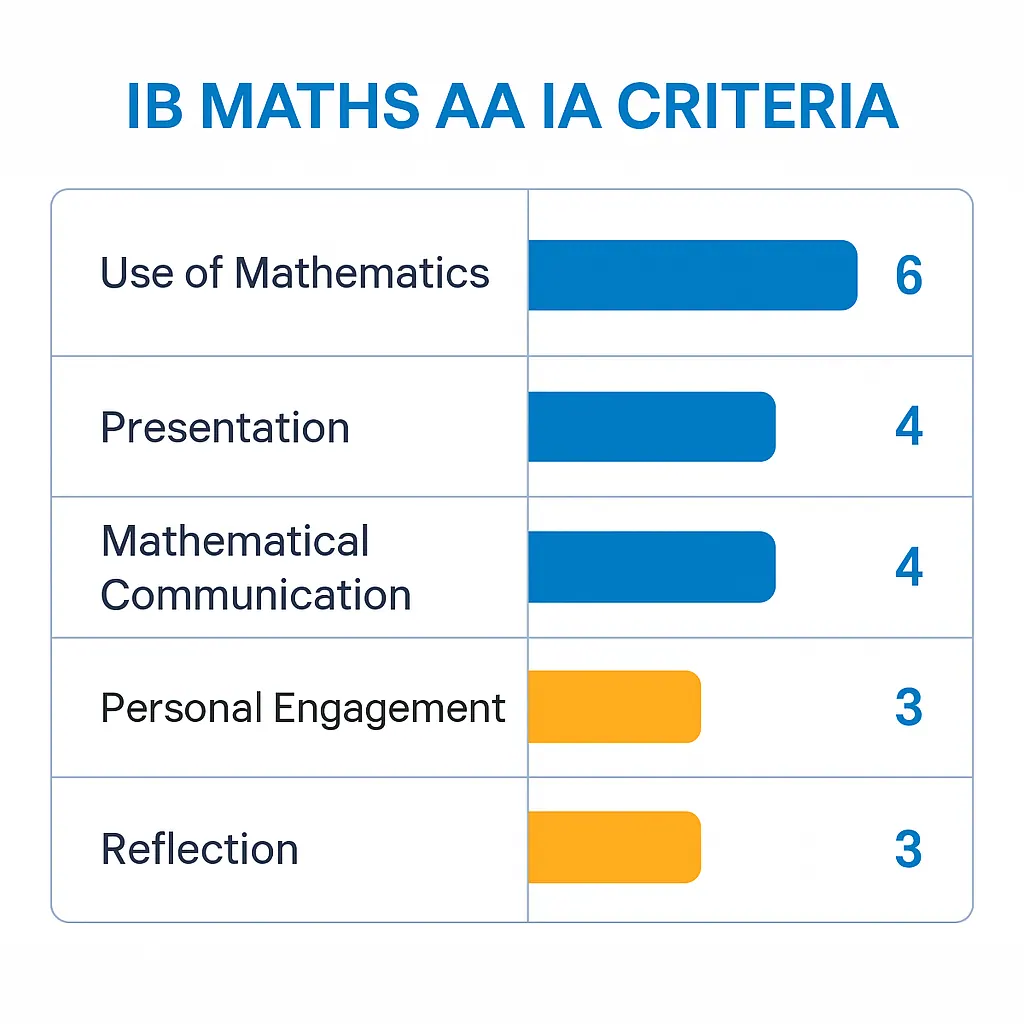
The IB Maths AA IA is marked out of 20 and assessed against five independent criteria, as set out in the IB Mathematics AA guide. Here they are in full:
| Criterion | Name | Marks | What it asks |
|---|---|---|---|
| A | Presentation | 4 | Is the exploration well-organised, coherent, and fit for purpose? |
| B | Mathematical Communication | 4 | Are notation, definitions, and mathematical language used correctly and consistently? |
| C | Personal Engagement | 3 | Does the work show genuine individual interest rather than a generic treatment? |
| D | Reflection | 3 | Does the student critically evaluate their methods, results, and limitations? |
| E | Use of Mathematics | 6 | Is the mathematics relevant, correct, and sufficiently sophisticated? |
Criterion E carries the highest mark allocation at 6 of the 20 available marks, making it the single biggest factor in your final IA score.
The critical structural point: each criterion is marked independently. A polished presentation cannot offset thin reflection, and impressive mathematics will not rescue poor communication. Moderators apply the rubric criterion by criterion, so a gap in any one area costs marks directly, with no mechanism for compensation elsewhere.
3. Criterion-by-Criterion: Top Band vs Mid Band in Plain Language
The IB maths AA IA criteria are each marked independently, so a weak score in one does not drag down another. Knowing exactly what separates the top band from the middle band in each criterion is more useful than a general sense of "write well and do hard maths."
Criterion A: Presentation (4 marks)
Top band: The exploration has a clear, stated aim in the introduction, the sections follow a logical order, and the length sits within the 12-20 page guidance. The reader never has to guess why the next section exists.
Mid band: An aim is present but the structure wanders, sections are not clearly connected, or the work is noticeably under or over length. Length itself is a marker: a 9-page exploration signals underdevelopment; a 25-page one signals poor editing.
Criterion B: Mathematical Communication (4 marks)
Top band: Notation is correct throughout. Every symbol and formula is defined the first time it appears. Graphs and diagrams carry labels, axes, units, and titles, and each one does analytical work rather than filling space.
Mid band: Notation is mostly correct but symbols appear without definition. Diagrams are present but decorative, meaning they illustrate without contributing to the argument. The counter-intuitive point here: a diagram that could be removed without losing meaning counts against you, not for you.
Criterion C: Personal Engagement (3 marks)
Top band: The student's own perspective shapes the mathematical choices, not just the topic framing. Original questions, self-generated data, or an unexpected angle are evident. Personal engagement must run as a consistent thread throughout, not appear in a single opening paragraph.
Mid band: The topic sounds personal ("I chose this because I love basketball") but the mathematics itself could have been written by anyone. No mathematical decisions reflect the student's own thinking.
Criterion D: Reflection (3 marks)
Top band: Reflection is specific and critical. The student identifies concrete limitations, explains the mechanism by which each limitation affects the results, and considers what a different method or dataset might have produced.
Mid band: Reflection exists but stays vague. Comments like "my results could be more accurate" are the clearest example of insufficient reflection: they name a problem without reasoning about its expected impact. Reflection that only appears in the conclusion also falls here.
Criterion E: Use of Mathematics (6 marks)
This criterion carries the highest weighting, at 6 of the 20 available marks, and has an explicit HL/SL distinction built in.
Top band: Mathematics is correct, thorough, and pitched at the appropriate level of sophistication for the course.
Mid band: Mathematics is broadly correct but superficial or mechanical, for example substituting values into a formula without demonstrating understanding of the underlying model.
The HL/SL distinction: HL students must use HL-level techniques to access the top band. They are specifically required to demonstrate sophistication and rigour beyond what is expected at SL. An HL student whose exploration relies entirely on SL methods is capped in this criterion regardless of how cleanly the work is executed. This is the most consequential structural difference between the ib math aa hl ia criteria and the SL equivalent.
4. Topic Choice for HL and SL: The Level of Mathematics Expectation
The techniques you choose determine your ceiling in Criterion E, not just your execution. HL students who rely solely on SL-level methods will have their Use of Mathematics score capped in that criterion, regardless of how well those methods are applied. The top band requires HL-level sophistication: think complex numbers, formal proof, differential equations, or further calculus. A polished SL method is still a SL method.
The same logic applies to purely numerical or calculator-driven explorations at either level. If there is no algebraic reasoning, no proof structure, and no analytical framework, the IB assessment criteria require rigour and depth that a sequence of computed outputs simply cannot demonstrate. Numbers without structure are data, not mathematics.
Concrete topic directions by level:
- HL - sound and Fourier series: Investigate how a square wave can be approximated by summing sinusoidal terms, then prove convergence properties of the partial sums. This draws on series, calculus, and formal reasoning.
- HL - fixed-point iteration: Explore conditions under which iterative sequences converge to a root, and construct a proof around the contraction mapping condition.
- SL - logistic population growth: Model a real or hypothetical population using a logistic differential equation, compare it against exponential growth, and interpret the carrying capacity parameter.
- SL - probability density functions: Use integration to compute probabilities and expected values for a chosen distribution, then assess how changes to parameters shift the curve.
The counter-intuitive trade-off worth knowing: a narrow topic explored with genuine depth consistently outscores a broad topic where the mathematics stays shallow. An exploration titled "Mathematics in Music" that covers five concepts superficially will score lower in Use of Mathematics than one titled "Modelling Harmonic Distortion Using Fourier Approximation" that works through a single idea rigorously. Specificity is not a stylistic preference, it is a marking-criteria requirement.
5. Reflection and Personal Engagement: What the Criteria Actually Reward
Reflection and Personal Engagement together account for 6 of the 20 available marks, so weak execution here is expensive. The good news is that both criteria are more specific in what they reward than most students realise.
Reflection is not a diary entry
The IB Maths AA IA rubric distinguishes sharply between vague commentary and genuine critical thinking. A comment like "the model was not perfect because real data is messy" sits in the low band. It names nothing, explains nothing, and gives the examiner no reason to award more than 1 mark out of 3.
High-band reflection requires three things: a named limitation, a reason it arises from the mathematics, and a reasoned estimate of its effect on your results. Compare these two responses to the same logistic growth model:
- Weak: "The model was not perfect because real data is messy."
- Strong: "The logistic model underestimates growth in the early phase because it assumes a fixed carrying capacity, whereas the real population data suggests the capacity increased as resources expanded. This means my predicted values are likely 10-15% below observed values in years 1-5."
The second version is specific, causal, and quantified. That is what earns top marks.
Personal engagement is mathematical, not biographical
A counter-intuitive point that catches many students out: the Personal Engagement criterion does not reward a moving story about why the topic matters to you personally. It rewards mathematical choices that only you made. Specifically:
- Extending a standard technique beyond what your source material showed
- Asking a follow-up question the original problem did not raise
- Connecting two methods in a non-obvious way
An anecdote about a family member with a medical condition is irrelevant to this criterion. Adapting a standard SIR epidemiological model to incorporate a vaccination rate variable because you noticed the base model did not account for it is exactly what the criterion targets.
Thread both throughout the exploration
Personal Engagement must run as a consistent thread through the whole exploration, not appear in a single labelled paragraph near the end. The same applies to Reflection. Concentrating either into one section reads as a checklist exercise rather than genuine mathematical thinking, and examiners score accordingly.
6. Length, Structure, Notation, and What Goes in the Appendix
The IB specifies approximately 12-20 pages for the exploration. Diagrams and graphs count within that range; the bibliography does not. That distinction matters more than it sounds: a heavily illustrated exploration can hit 20 pages faster than you expect, leaving little room for the mathematical substance that earns marks under Criterion E.
Recommended section order, with approximate lengths:
- Introduction (aim and context): 1-2 pages
- Mathematical Exploration Body (core mathematics): 6-12 pages
- Analysis and Discussion
- Conclusion
- References/Appendices
Appendices sit outside the page count entirely, but there is a catch: you cannot rely on an examiner reading them as part of your argument. Hiding a key proof or a critical derivation in an appendix because the main body felt crowded is a common error. If a piece of mathematics is essential to your argument, it belongs in the body. Appendices should hold only raw data, lengthy intermediate calculations, or supporting tables that the reader might want to verify but does not need to follow your reasoning.
On notation: Criterion B (Mathematical Communication) rewards appropriate notation, symbols and terminology, so define every symbol and formula on first use. Label every graph with titled axes and units. Use standard notation consistently throughout, and do not switch between conventions mid-exploration.
Per My Revision Agent, content beyond the 20-page limit is not read. Concision is not a stylistic preference; it is a marking condition.
7. The Three Mistakes Examiners See Most Often
Three patterns account for the majority of mark losses across the IB maths AA IA criteria. Each maps directly to a specific criterion, so fixing them has a predictable effect on your score.
Mistake 1: Superficial mathematics. An exploration that applies one standard method and stops there will score poorly on Criterion E (Use of Mathematics), which carries 6 of the 20 available marks, the highest of any criterion. The counter-intuitive point is that a technically correct application still earns a mid-band score if it goes nowhere. The fix is to ask "what next" at every stage: extend the method, test it under different conditions, or prove a result rather than just apply a formula.
Mistake 2: Reflection only in the conclusion. Writing one reflective paragraph at the end and nothing else misreads the criterion entirely. Criterion D (Reflection, 3 marks) expects critical evaluation woven in after each stage of analysis. Generic comments earn nothing; what scores marks is a specific, reasoned observation about a result's limits and what you would investigate next.
Mistake 3: Undefined notation and decorative graphs. Symbols used without definition and graphs dropped into the exploration without labels or explanation directly cost marks in Criterion B (Mathematical Communication, 4 marks). The rule is simple: define every mathematical tool and formula on first use. A graph that the text never references is not evidence of communication; it is decoration, and an examiner will treat it as such.
8. What to Do Next
Print the five IB Maths AA IA criteria on a single sheet and place it next to your current draft or draft plan. Read through what you have written and highlight, in five different colours, every paragraph that addresses each criterion. Any criterion with no highlighted text is a gap that needs fixing before your next supervisor meeting, not after.
One non-obvious check worth doing now: look at your Reflection paragraphs specifically. Examiners report that students often write evaluative comments at the end but forget to weave reflection through the body of the investigation. A paragraph discussing a limitation mid-analysis scores differently from the same words tacked on as a final note.
Do that colour-coding exercise before your next supervisor session. Bring the annotated draft, not a clean copy.
FAQ
What are the five criteria for the IB Maths AA IA?
The five criteria are Presentation (4 marks), Mathematical Communication (4 marks), Personal Engagement (3 marks), Reflection (3 marks), and Use of Mathematics (6 marks), totalling 20 marks.
How much is the IB Maths AA IA worth?
The mathematical exploration is worth 20% of the final IB Maths AA grade at both SL and HL, and is marked out of 20.
What is the difference between IB Maths AA HL and SL IA criteria?
The five criteria and their mark allocations are the same for HL and SL, but HL students must demonstrate HL-level mathematical techniques in Criterion E (Use of Mathematics) to access the top band - SL-level methods alone will cap the HL score in that criterion.
How long should an IB Maths AA IA be?
The IB guide specifies approximately 12-20 double-spaced pages; diagrams and graphs count within this range, but the bibliography and appendices do not, and content beyond 20 pages is not read by the examiner.
How hard is IB Maths AA HL?
IB Maths AA HL is widely regarded as one of the most demanding DP courses; the IA reflects this - examiners expect proof, rigour, and techniques from the HL syllabus (such as complex numbers, differential equations, or further calculus) rather than extended SL work.
What counts as good reflection in the IB Maths IA?
Good reflection is specific and critical: it names a concrete limitation, explains why it arises, and reasons about its likely effect on the results - generic comments like 'my model was not perfect' do not meet the top-band descriptor.
References
- IB Internal Assessment: Marking, Weighting, Deadlines - https://myrevisionagent.com/guides/ib-internal-assessment
- Diploma Programme Subject Brief - Mathematics: analysis and approaches, first assessments for SL and HL 2021 (International Baccalaureate Organization) - https://www.ibo.org/contentassets/5895a05412144fe890312bad52b17044/subject-brief-dp-math-analysis-and-approaches-en.pdf