IB History New Syllabus: What Changes for First Exams 2028
By Michael Thompson · Education Specialist; 10 years teaching the IB at Bromsgrove School · Published 4 October 2026
The IB history new syllabus applies to students who began the Diploma Programme in August 2026 and will sit their first exams in May 2028. If you are finishing the course in May or November 2027, you are on the existing syllabus and should use the current subject guide. The redesign replaces prescribed subjects, world history topics and depth studies with new terminology and revised assessment structures across Papers 1, 2 and 3. This guide walks through every change - what the new inquiry contexts cover, how each paper works, what the internal assessment now requires, and how to orient your revision around four specified historical concepts.
Key Takeaways
- First exams are May 2028: Students who started the DP in August 2026 are on the new course; anyone sitting in 2027 remains on the existing syllabus.
- Four specified concepts run through the whole course: Cause and consequence, continuity and change, perspectives, and significance are threaded through every component, and Paper 2 Section A tests them directly.
- Three taught inquiry contexts replace the old structure: Focused study (replacing prescribed subjects), thematic study (replacing world history topics) and regional study (HL only, replacing depth studies) form the teaching backbone, with the historical investigation as the fourth inquiry context. The IB's updates page calls the first three paired case studies, global themes and regional in-depth topics.
- Paper 2 gains a Section A on a specified concept: Alongside a shorter Section B that replaces two full essays with a short response plus one essay on the thematic study.
- Paper 3 is cut from three essays to two: HL students answer two essays from different regional studies, and every question now gives an argument to evaluate rather than an open prompt.
- The IA reflection section has been removed: The new internal assessment has three sections - historical inquiry question, sources and perspectives, and synthesis and evaluation - with a maximum of seven sources.
In This Article
- Which students does the new syllabus affect?
- What changed: old course vs new IB history syllabus
- Four specified concepts: the framework behind every paper
- Focused study, thematic study and regional study: what you choose and study
- Paper 1 source analysis: how the new questions work
- Paper 2 structure: the new Section A and ib history essay format
- Paper 3 and HL topics: two essays, each from a different regional study
- IB history internal assessment: what the new IA requires
- How to choose your topics and prepare for the new course
- What to do next
1. Which students does the new syllabus affect?
The ib history new syllabus applies to students who began the Diploma Programme in August 2026. Their first assessed exams are in May 2028, and they follow the new subject guide for first assessment 2028. Students sitting exams in May or November 2027 remain on the current course throughout, including its IA reflection section. Mixing up the 2027 and 2028 rules is an easy mistake during a curriculum transition, so check which course you are on before you plan anything.
Which course you are on depends on your examination session, not on which document is newest: the IB's history updates page gives first teaching in August 2026 and first assessment in May 2028 for the new course. If you are unsure which session you are entered for, check with your History teacher or DP coordinator.
In short:
- August 2026 starters, exams May 2028 and beyond - use the new course and this article.
- Students finishing in May or November 2027 - remain on the current course, including its existing IA reflection section and current paper structures.
2. What changed: old course vs new IB history syllabus
The IB has renamed the three taught components of the course and restructured all three external papers. The table below maps old names to new ones so you can read both versions of the syllabus without getting lost.
Component names: old vs new
| Old course (through 2027) | New course (first assessment 2028) | Key structural difference |
|---|---|---|
| Prescribed subjects | Focused study / paired case studies | Now five options, each with two focused studies; both studies are compulsory |
| World history topics | Thematic study / global themes | Now four global themes; one is required at both SL and HL |
| Depth studies (HL only) | Regional study / regional in-depth topics | One region, two studies chosen from twelve; essays must come from different studies |
| Historical investigation | Historical investigation | Reflection section removed; three new sections; max seven sources |
The IB's history updates page uses terms like "paired case studies" and "global themes"; the published subject brief settles on "focused study" and "thematic study." Both sets of names refer to the same things.
Paper-by-paper timing changes
| Paper | Old timing | New timing | What changed inside |
|---|---|---|---|
| Paper 1 | 1 hour | 1 hour 15 minutes | Framing inquiry question added; three set questions with more open-ended responses; OPCVL question removed |
| Paper 2 | 1 hour 30 minutes, two essays | 1 hour 45 minutes, three tasks | Gains Section A (concept response) plus a short response before the essay |
| Paper 3 (HL only) | 2 hours 30 minutes, three essays | 2 hours, two essays | Essays must come from different regional studies; every question gives an argument to evaluate |
For Paper 3, total time falls by 30 minutes, but time per essay rises from about 50 minutes to an hour. The IB says the timings across all papers have been adjusted to give more thinking time.
Internal assessment weighting
The IA increases from 25% to 30% at SL; the HL weighting stays at 20%. The reflection section is gone entirely. Outside the IA, the new course also adds topic options that did not exist before, such as the Climate and innovation focused study and the Innovation and transformation thematic study, both listed in the subject brief.
3. Four specified concepts: the framework behind every paper
The IB History subject brief for first assessment 2028 names four specified concepts that run through the entire course: cause and consequence, continuity and change, perspectives, and significance. These are not just revision themes. They are the organising logic behind every inquiry context, and they show up directly in the exam papers.
The clearest signal of this is Paper 2. Section A asks students to analyse one of the specified concepts directly, illustrated with one example from their thematic study. That question cannot be answered by listing events in order. It requires a conceptual argument, supported by selective evidence.
The same logic applies elsewhere:
- Paper 1 Question 3 asks students to synthesise perspectives across three sources, which maps onto the perspectives concept.
- The historical investigation (IA) is assessed partly on how the student formulates an inquiry question and analyses sources, and building the question around one of the concepts is a practical way to keep it analytical.
The practical implication is that chronology is the foundation, not the finish line. Accurate, specific knowledge still matters - Paper 2 Section B part 1 assesses your understanding of a historical example directly - but the course puts the weight on using that knowledge: explaining cause, weighing significance, or accounting for different perspectives with evidence chosen deliberately rather than exhaustively.
Treat the four concepts as the lens, not the content.
4. Focused study, thematic study and regional study: what you choose and study
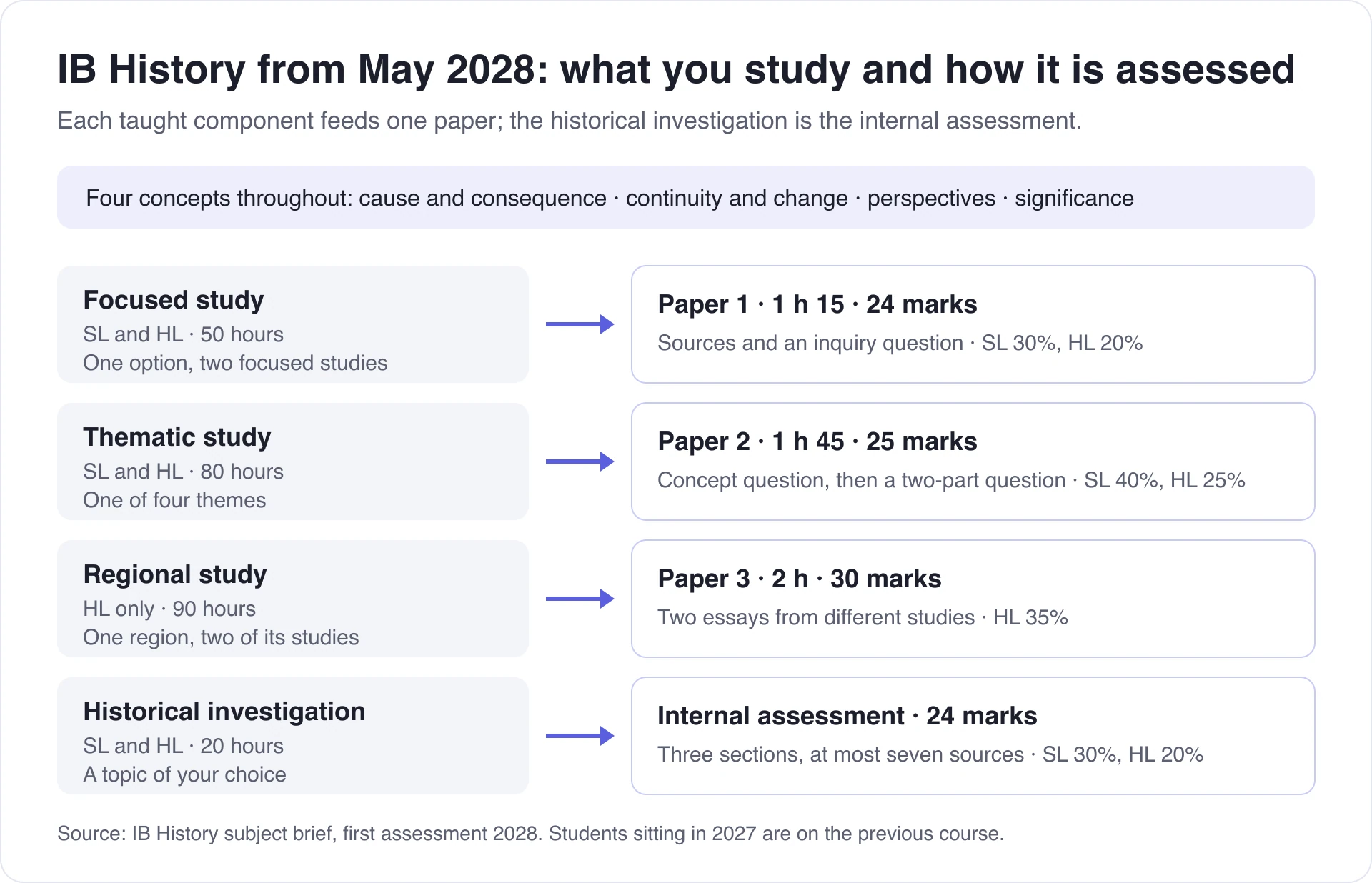
The IB history new syllabus is built on four inquiry contexts: three taught components, each with a fixed teaching allocation, plus the historical investigation. Your teachers pick one option for each taught component (and, for HL, a region and two regional studies), and those choices shape every paper you sit. Understanding the structure before your course starts is worth the effort, because the choices are made by your school, not by you.
Per the IB Diploma Programme Subject Brief for History (first assessment 2028), the breakdown is as follows.
Focused study (50 hours, SL and HL)
Your school chooses one of five options:
- Independence and identity
- Political and economic transitions
- Conflict and displacement
- Climate and innovation
- Protest and change
Each option contains two focused studies, and both must be studied - there is no choice between them. This matters for Paper 1, where you answer all three questions on one focused study. The public subject brief does not say how the two studies in your option will appear on a given paper, so prepare both equally.
Thematic study (80 hours, SL and HL)
Your school selects one of four options:
- Conflict (from 750 CE)
- Innovation and transformation (from 750 CE)
- Authoritarian rule (from 1750 CE)
- Popular movements (from 1750 CE)
Note the different starting dates. The two options anchored at 750 CE cover a significantly longer chronological sweep than those beginning in 1750, which affects the range of evidence you can draw on in Paper 2.
Regional study (90 hours, HL only)
HL students study one of four regions:
- Africa and the Middle East
- The Americas
- Asia and Oceania
- Europe
Within that region, two studies are chosen from the twelve available. Both are examined in Paper 3, and students must answer essay questions from different regional studies in that paper, not two questions from the same one.
Teaching hours at a glance
| Component | SL hours | HL hours |
|---|---|---|
| Focused study | 50 | 50 |
| Thematic study | 80 | 80 |
| Regional study | - | 90 |
| Historical investigation (IA) | 20 | 20 |
| Total | 150 | 240 |
The practical takeaway: your school's choices are made before you arrive in the classroom, so ask your teacher which focused study option and thematic study option you are following at the start of Year 1. Those choices, plus your region and regional studies at HL, determine the content of every exam paper you will sit.
5. Paper 1 source analysis: how the new questions work
Paper 1 runs for 1 hour 15 minutes, carries 24 marks, and is worth 30% of the SL grade and 20% at HL. Critically, the exam is identical at both levels - HL students sit the same paper as SL students, not a harder version.
The structure is built around a single overarching inquiry question that frames all three questions on one focused study. The IB's sample inquiry question, quoted directly from the subject brief, is: 'To what extent was persecution the main reason for post-war mass displacement in Europe?' Each of the three exam questions then asks students to engage with sources in relation to that framing question.
The three questions each test a distinct skill:
- Q1 - understanding the content of two sources in relation to the inquiry question.
- Q2 - analysing how the context of a source shapes how it can be used.
- Q3 - synthesising perspectives across all three sources.
The non-obvious shift is in what Q3 no longer asks. Under the previous course, the final question required students to bring in external knowledge alongside source analysis. The new format removes that formal requirement - outside knowledge is no longer formally assessed, and the question centres on synthesising perspectives across the provided sources. Your focused study knowledge still helps you read the sources accurately, but loading Q3 with memorised facts is preparing for the wrong task.
Two further changes are worth flagging. OPCVL has been removed from formal assessment in the new course, replaced by the Q2 focus on how context shapes a source's usefulness. And a visual source is no longer guaranteed to appear on the paper, so practising with cartoons or photographs as a separate skill category is less central than it was.
The practical takeaway: when you revise your focused study, organise your knowledge around the inquiry question format rather than source type. Q2 demands contextual understanding, so for each source you practise with, be clear on when it was produced, by whom, and under what circumstances - and what that means for how it can be used as evidence.
6. Paper 2 structure: the new Section A and ib history essay format
Paper 2 runs for 1 hour 45 minutes and is worth 25 marks, accounting for 40% of the SL grade and 25% at HL. The paper is split into two sections, and the division matters more than it might first appear.
Section A asks you to answer one of two questions on the four specified concepts (cause and consequence, continuity and change, perspectives, significance). This is a concept-focused analytical response, not a content-dump. The examiner wants to see you apply a concept to historical material, not simply narrate events.
Section B offers two questions on your thematic study; you choose one and answer both of its parts. It combines a short response with a longer essay response, making IB history essay structure in this section a genuine two-gear exercise: the short response rewards concision; the essay rewards sustained argument.
A practical point worth noting: students now study one thematic study rather than two world history topics, so your school's choice at the start of the course defines your entire Section B, and your Section A example comes from the same theme. Every Paper 2 answer draws on that one theme, so thin preparation anywhere in it will show.
Pearson's analysis of the new course notes that there are no prescribed examples that must be taught within the thematic study, and that the "contemporary rule" restricting use of recent events has been abolished. You can draw on present-day examples if they genuinely serve your argument, though Pearson's authors warn that very recent events are hard to analyse for consequences.
The overall essay load in Paper 2 is lighter than on the previous course, but Section A adds a demand the old paper did not have: fluency with conceptual language under timed conditions.
7. Paper 3 and HL topics: two essays, each from a different regional study
Paper 3 is HL only. It runs for two hours, carries 30 marks, and accounts for 35% of the HL grade, according to the IB History subject brief. There is a separate paper for each region, so a student who has studied Europe sits a different paper from one who has studied the Americas.
The key structural change is a reduction from three essays to two. The IB says the timings across all papers have been adjusted to give more thinking time, and on Paper 3 that works out at an hour per essay rather than about 50 minutes. Use that time to plan each essay before you write.
The other shift matters just as much. Every question on Paper 3 provides an argument for students to evaluate, rather than an open prompt like "examine the causes of...". Students must engage with a stated position, which calls for a more precise essay structure from the outset.
The two essays must each come from a different regional study, so a student who has studied two regional studies within their chosen region cannot write both essays on the same one.
The four regions are:
- Africa and the Middle East
- The Americas
- Asia and Oceania
- Europe
Each region contains 12 regional studies. The subject brief does not list the individual study titles publicly, so the full breakdown sits in the subject guide on the IB Programme Resource Centre.
8. IB history internal assessment: what the new IA requires
The internal assessment for the new course remains a historical investigation chosen entirely by the student, but the structure has changed. Per the IB Diploma Programme Subject Brief for History (first assessment 2028), the IA carries 24 marks, runs across 20 hours of class time, and is worth 30% at SL and 20% at HL. It is internally assessed and externally moderated.
Three new sections replace the previous structure
The current course includes a reflection section. For students starting in August 2026 and sitting first exams in May 2028, that section has been removed entirely. The new IA has three sections:
- Historical inquiry question - assessed on how well you formulate an appropriate, focused question.
- Sources and perspectives - assessed on your analysis of the sources you have chosen to answer that question.
- Synthesis and evaluation - assessed on how well you synthesise evidence from those sources to produce a response.
The full assessment criteria and mark allocations per section are in the subject guide on the IB Programme Resource Centre, not in the public subject brief.
Where the new IA puts more weight
The question now has its own section. There is greater emphasis on explaining how it developed, not just stating it, and on explaining why each source was chosen, not simply using it. The IA is capped at a maximum of seven sources, which pushes students toward depth over breadth.
The trade-off here: a source cap rewards careful selection at the start, before writing begins. Choosing a small set of strong sources up front is a different task from gathering a wide reading list and pruning later.
The action for this week: confirm with your teacher which IA timeline your school is running, since internal submission deadlines vary by school and will fall well before the IB's own moderation window.
9. How to choose your topics and prepare for the new course
The single most important practical step is straightforward: find out which options your school has selected before you plan anything else. Your school chooses the focused study option and the thematic study; for HL, it also chooses one of the four regions and two regional studies within it. Until you know those choices, purposeful revision cannot start. Ask your teacher directly, and do it early in Year 1.
Once you know your options, the four specified concepts, cause and consequence, continuity and change, perspectives, and significance, should shape how you take notes from the beginning. Keep a clear chronology so your facts are accurate, but organise your notes around conceptual lenses ("what caused this?" "whose perspective is missing here?"), because those transfer directly into exam answers in a way a memorised timeline does not.
For Paper 1, practise reading each source in relation to the inquiry question, not in isolation. The three questions ask you to explain what two sources contribute to understanding the inquiry question, how context shapes a source's usefulness, and how perspectives across all three sources can be synthesised. Every source-reading habit you build should serve those three tasks.
For Paper 2, depth in your one thematic study matters more than breadth. One concrete implication of the redesigned course: the previous restriction on using recent events has been removed, so recent events relevant to your theme can now be used as evidence, according to Pearson's guide to the new course, though its authors warn that very recent events are hard to analyse for consequences.
For HL students, know exactly which two of the 12 regional studies in your region you have covered, because Paper 3 sets two questions on each regional study. Paper 3 requires the two essays to come from different regional studies, per the subject brief. Choosing both essays from the same regional study is not permitted.
One final point: grade boundaries for the new course will not exist until after the May 2028 session. Current-course boundary data reflects a different paper structure and cannot reliably predict scores on the redesigned assessments.
10. What to do next
The most common mistake students make at the start of the new IB History course is taking notes before confirming which options their school has chosen. Because the subject brief offers five focused study options and four thematic study options, your revision is almost worthless if it covers the wrong material.
This week, download the official IB History subject brief (first assessment 2028) and read the IBO's history updates page. Then ask your teacher directly: which focused study option has the school selected, and which thematic study will you teach? If you are HL, also ask which region and which two regional studies. Write the answers down. Your note-taking and concept practice follow from those choices; your IA topic is your own choice and does not depend on them.
FAQ
When does the IB history new syllabus take effect?
First teaching began in August 2026 and the first assessment session is May 2028; students sitting exams in May or November 2027 are on the existing course.
How has IB history changed from the current course?
Prescribed subjects became focused studies, world history topics became thematic studies, depth studies became regional studies (HL only), Paper 2 gained a Section A on a specified concept, Paper 3 was cut from three essays to two, and the IA reflection section was removed.
What are the four specified concepts in the new IB history syllabus?
The four specified historical concepts are cause and consequence, continuity and change, perspectives, and significance; they underpin all assessed components.
What does the new IB history internal assessment look like?
The new IA has three sections - historical inquiry question, sources and perspectives, and synthesis and evaluation - with the reflection section removed, a maximum of seven sources, and 20 hours allocated at both SL and HL.
What is the difference between SL and HL in the new IB history course?
SL students complete the focused study, thematic study and IA (150 total hours), while HL students add a 90-hour regional study and sit a separate Paper 3 (240 total hours); Paper 1 is identical at both levels.
Will grade boundaries be published before the May 2028 exams?
No; grade boundaries for the new course will only be established after the May 2028 assessment session, so current-course boundary data does not apply.
References
- History updates - International Baccalaureate - https://www.ibo.org/university-admission/latest-curriculum-updates/history-updates/
- Diploma Programme Subject Brief: History, first assessment 2028 (International Baccalaureate Organization, 2025) - https://www.ibo.org/globalassets/new-structure/programmes/dp/pdfs/dp-history-sb-en.pdf
- IB DP History exam changes: A comprehensive guide to Paper 1, 2 and 3 and the Internal Assessment - https://www.pearson.com/international-schools/international-schools-blog/2026/04/ib-dp-history-exam-changes--a-comprehensive-guide-to-paper-1--2-.html