IB History: Complete Guide to Syllabus, Papers & IA
By Michael Thompson · Education Specialist; 10 years teaching the IB at Bromsgrove School · Published 21 May 2026 · Updated 5 October 2026
IB History is one of the most demanding - and most rewarding - subjects in the Diploma Programme, covering world history from the medieval period to the recent past through a combination of source analysis, extended essays, and a personal historical investigation. At Standard Level you sit two exam papers; at Higher Level you add a third, regional-focus paper that tests depth on one world region. The subject is available across a wide range of prescribed topics and regional options, so your choices at the start of the course shape every piece of work you do for two years. This guide explains the full structure of the IB Diploma history syllabus, what each assessment component demands, and how to approach them strategically from day one.
Key Takeaways
- Three exam papers at HL, two at SL: Paper 1 tests source skills on a prescribed subject, Paper 2 tests essay writing across world history topics, and Paper 3 (HL only) requires in-depth regional essays.
- The Internal Assessment is 25% of your grade at SL and 20% at HL: For May and November 2027 candidates it is a 2,200-word historical investigation structured across three sections - Identification and Evaluation of Sources, Investigation, and Reflection.
- The 10-year rule is strict: Your IA topic must sit at least 10 years before your submission date, meaning events of roughly the last decade are off-limits for current students.
- Choice of prescribed subject and regional option matters enormously: Your Paper 1 topic and Paper 3 option determine which case studies and textbooks you use for two years, so research available resources before committing.
- Descriptive writing is the single most common reason for lost marks: Examiners consistently penalise answers that narrate events rather than construct an argument supported by evidence.
- A new History course is first examined in May 2028: It was first taught in August 2026; May and November 2027 candidates stay on the current course this guide describes.
In This Article
- What Is IB History and What Does It Cover
- IB History Syllabus Structure at a Glance
- Paper 1: Source-Based Questions on Prescribed Subjects
- Paper 2: Essay Writing Across World History Topics
- Paper 3: The HL Regional Option
- The Internal Assessment: Historical Investigation
- Choosing Your Topics Strategically
- Common Mistakes and How to Avoid Them
- Books and Resources Worth Using
- Where to Go From Here
1. What Is IB History and What Does It Cover
IB History is a Diploma Programme subject sitting within the Individuals and Societies group, alongside Economics, Geography, and Global Politics. It covers world history from the medieval period to the recent past, and the syllabus is deliberately global rather than Eurocentric. You study events across Europe, the Americas, Asia, Africa, and the Middle East through the same frameworks, which means a student in Lagos and a student in London are working through identical assessment criteria.
The subject runs at two levels:
- Standard Level (SL): 150 teaching hours, two examination papers.
- Higher Level (HL): 240 teaching hours, three examination papers, including a regional depth study unique to HL.
That 90-hour difference is not just extra content. It introduces Paper 3, a demanding essay paper on a single world region, which makes HL History one of the more time-intensive choices in the DP humanities group.
Across both levels, the current course frames historical inquiry through six key concepts: change, continuity, causation, consequence, significance and perspectives. These are not just background themes. They shape the language examiners expect in essays and source analysis, so learning to apply them explicitly matters from the start.
One counter-intuitive point worth knowing early: the IB History course is less about memorising a fixed national narrative and more about constructing arguments across very different geographical and thematic contexts. Students who approach it like a traditional A-Level chronology course often find Paper 2 particularly difficult.
2. IB History Syllabus Structure at a Glance
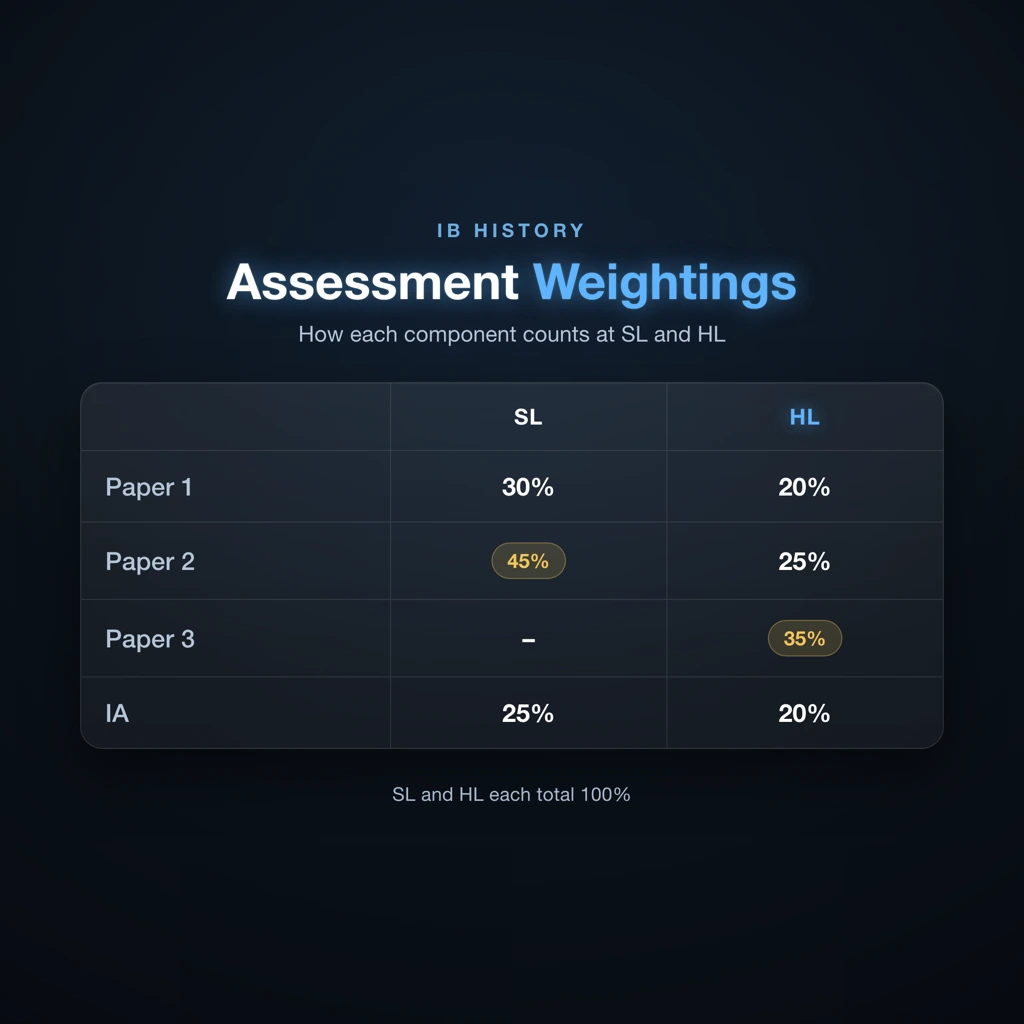
The IB history syllabus is built from four components that combine at different levels: a prescribed subject, world history topics, an HL regional option, and the internal assessment (IA). Understanding how those pieces fit together is the first thing to get right, because the choice of level determines how much of the syllabus you actually study.
SL vs HL in practice:
| Level | Guided hours | Components studied |
|---|---|---|
| Standard Level (SL) | 150 hrs | Prescribed subject + 2 world history topics + IA |
| Higher Level (HL) | 240 hrs | Prescribed subject + 2 world history topics + 1 HL regional option + IA |
The extra 90 hours at HL go almost entirely into the regional option, which demands a depth of chronological knowledge that SL students are not assessed on. This is the counter-intuitive trade-off: SL covers fewer components, but the two world history topics it shares with HL are examined to the same essay standard in Paper 2.
The world history topics run from the medieval period to the twentieth century and include named areas such as Authoritarian States (20th century), Causes and Effects of 20th Century Wars, and The Cold War. Students study two, chosen by their school, so the IB history experience varies more between schools than most students realise.
Which course applies to you: this guide describes the current History course, which applies to everyone sitting exams in May or November 2027. A new History course was first taught in August 2026 and is first examined in May 2028. In it, Paper 1 is built around an inquiry question, Paper 2 adds a section on historical concepts, HL Paper 3 drops from three essays to two, and the IA loses its reflection section and allows at most seven sources, according to the IB's History updates page. Pearson adds that the OPCVL source question disappears from Paper 1. If you sit in May 2028 or later, work from the new subject guide rather than this summary.
3. Paper 1: Source-Based Questions on Prescribed Subjects
Paper 1 is a one-hour exam built around four sources. You answer four questions worth a combined 24 marks, which accounts for 30% of your final grade at SL and 20% at HL. The sources are provided in a separate booklet on the day, so there is no memorisation of documents, but there is absolutely no winging the underlying content.
The four questions
The questions follow a fixed pattern:
- Question 1 tests comprehension. Its two short parts ask what one or two sources say or suggest about a historical situation.
- Question 2 asks you to analyse the value and limitations of one source with reference to its origin, purpose and content.
- Question 3 asks you to compare and contrast two sources, looking at similarities and differences in content, tone, or perspective.
- Question 4 is the most demanding and carries 9 of the 24 marks. You use the sources alongside your own contextual knowledge to evaluate a given claim or statement. This is where weaker responses fall apart: students who treat it as a pure source exercise, ignoring outside knowledge, consistently lose the top mark band.
Prescribed subjects
You study one of five:
- Military Leaders
- Conquest and Its Impact
- The Move to Global War
- Rights and Protest
- Conflict and Intervention
The non-obvious trade-off: Rights and Protest is popular precisely because secondary resources are abundant, but the source paper tends to reward students who can interrogate bias in first-person testimonies, which is a different skill from analysing policy documents. The Move to Global War suits students whose schools already cover interwar diplomacy in Paper 2, since contextual knowledge transfers directly.
OPVL and where it goes wrong
The IBO framework for source analysis is OPVL: Origin, Purpose, Value, Limitation. The common error is treating Value and Limitation as a checklist ("it is valuable because it is a primary source") rather than connecting each point to the specific claim in the question. A source's limitations must be relevant to what you are being asked to evaluate, not generic observations about bias.
Strategic tip: Before choosing a prescribed subject, check what published source collections and textbook chapters your school actually holds. A subject with thin resource support means you enter the exam with weaker contextual knowledge, and Question 4 will expose that gap.
4. Paper 2: Essay Writing Across World History Topics
Paper 2 runs for 1 hour 30 minutes. You answer two essay questions, each drawn from a different world history topic, and the two essays are marked out of 30 in total, which counts for 45% of your final grade at SL and 25% at HL. The hard rule: both questions cannot come from the same topic. Pick one question from Topic A and another from Topic B, for example, not two questions from Authoritarian States.
The most commonly chosen world history topics are:
- Authoritarian States (20th century) - single-party states, consolidation of power, domestic policies
- Causes and Effects of 20th-Century Wars - types of war, causes, practices, and aftermath
- The Cold War: Superpower Tensions and Rivalries - origins, development, and end of the Cold War
Students often pair two of these because school teaching time concentrates on them. That is a reasonable strategy, but it creates a trap: if your two strongest topics both happen to be on wars, you cannot use them together in the exam.
What a strong Paper 2 essay looks like
Each Paper 2 essay is marked out of 15 against one set of markbands rather than separate criteria. The top band asks for a clearly focused answer, accurate and relevant knowledge, critical analysis and evaluation of different perspectives. In practice, that rewards essays with a clear argument in the opening paragraph, specific named evidence throughout, and a genuine counter-argument before the conclusion.
The non-obvious trade-off: a short essay with a tight, defended argument outscores a longer essay that lists facts without analysis. Command terms matter too. "Examine" asks you to consider different aspects; "compare and contrast" demands explicit parallels. Misreading the command term is one of the most costly errors on this paper.
Pace yourself to roughly 40-45 minutes per essay, leaving a few minutes at the start to plan each argument before you write.
5. Paper 3: The HL Regional Option
Paper 3 is the component that separates HL candidates from SL. Sitting at 2 hours 30 minutes, it requires three extended essays drawn from a single regional option, and it carries 45 marks (15 per essay), worth 35% of the HL final grade. That weighting makes it the largest single assessment in the HL course.
The IB offers four regional options:
- History of Europe
- History of the Americas
- History of Asia and Oceania
- History of Africa and the Middle East
Each option is divided into 18 sections running from the medieval period to around 2000, and schools choose which sections to teach. The questions are narrower and more historically specific than those in Paper 2. Where Paper 2 rewards broad comparative thinking across world history themes, Paper 3 demands precise knowledge of a single region, including dates, named leaders, internal political dynamics, and historiographical debate at a regional level. A student who coasts on general argument in Paper 2 will find that approach exposed in Paper 3.
The most consequential decision is which regional option your school actually teaches. The IB does not require schools to offer all four. Most offer one, occasionally two. If your teacher has fifteen years of experience with the History of the Americas and the school stocks five dedicated textbooks on that option, choosing it over a self-taught alternative is almost always the correct call, regardless of personal interest.
The non-obvious trap here: students sometimes assume that personal enthusiasm for, say, African history will compensate for a teacher who specialises elsewhere. At Paper 3 depth, that gap in guided instruction is very difficult to close independently, especially when sourcing specialist reading material on less widely published regional topics.
6. The Internal Assessment: Historical Investigation
The Internal Assessment is a 2,200-word independent historical investigation worth 25% of your final grade at SL and 20% at HL. You choose the question, find the sources, and build the argument yourself. That independence is the point, but it also means the IA is where poorly planned work is most likely to unravel. The three-section structure below applies to May and November 2027 candidates; in the new course, first examined in May 2028, the reflection section is removed.
The three sections
| Section | Focus | Word guidance |
|---|---|---|
| A: Identification and Evaluation of Sources | Analyse two specific sources for their value and limitations | ~500 words |
| B: Investigation | Your historical argument, supported by evidence | The bulk of the word count |
| C: Reflection | Reflect on the methods and challenges historians face | ~400 words |
Section A is not a general background summary. You pick two sources, named explicitly, and examine what makes each one valuable or limited for your specific investigation, considering origin, purpose, and content together.
Section B is where the actual historical argument lives. It needs engagement with historiography, meaning you should show awareness of how different historians have interpreted your question, not just present a sequence of facts.
Section C is the most commonly mishandled section. It is not a conclusion or a summary of your findings. It asks you to reflect on the methods historians use and the challenges those methods present, using your investigation as the lens. A student who writes "I found that primary sources were useful" has missed the point entirely. The reflection should grapple with methodological questions: issues of bias, incomplete records, or how the historian's own position shapes interpretation.
The 10-year rule
Your topic must be at least 10 years in the past at your submission date. In practice, for current cohorts this means events of roughly the last decade are off-limits. Events you consider recent history may fall inside that window. The rule exists because the IB requires sufficient historiographical distance, which means scholarly debate needs time to develop. Check your exact submission year before settling on a topic.
What makes a strong IA topic
- Narrow scope. "The causes of the First World War" is a syllabus overview, not an IA question. "To what extent did the Schlieffen Plan reflect German strategic miscalculation by 1914?" is workable.
- Genuine contestation. If historians broadly agree, there is no argument to sustain across 2,200 words.
- Accessible primary sources. The counter-intuitive trade-off here is that famous events often have too many sources, making Section A harder to focus. A less prominent event with two or three high-quality, contrasting primary sources can produce a tighter, stronger IA than a well-trodden topic drowning in material.
Common mistakes to avoid
- Topic too broad to argue coherently within the word limit
- Section C written as a restatement of Section B's conclusions
- Section B that lists evidence without engaging with how historians disagree
- Choosing a topic that edges inside the 10-year cut-off and needing to restart late in the process
7. Choosing Your Topics Strategically
Topic selection has more long-term consequence than most students realise at the start of Year 1. A poor choice becomes obvious around March of Year 2, when it is too late to switch.
Prescribed subject (Paper 1). Before committing, pull three or four past papers for each candidate topic and count how many distinct angles the questions cover. Some prescribed subjects have been examined from a narrow range of perspectives for years; others rotate widely. Depth of available secondary reading matters too: if your school library holds nothing on the topic, you are writing every essay from scratch.
World history topics (Paper 2). Pick two topics whose case studies genuinely don't overlap. Authoritarian states and causes of wars both draw on 20th-century European examples, so students who combine them often find themselves recycling the same evidence across two essays. Choosing one Europe-heavy topic and one that centres on Asia, Africa, or the Americas forces you to build a broader evidence base, which is actually an advantage when examiners mark for range.
HL regional option (Paper 3). Align with your teacher's specialism if you can. A teacher who studied European history at postgraduate level will set better practice questions, give sharper feedback, and be more likely to have the relevant textbooks on site. Check which books your school already holds before assuming a particular region is viable.
IA topic. Narrow beats broad every time. A question like "Why did Mao launch the Cultural Revolution in 1966?" has a defined scope and a clear line of argument. "Mao's China" does not. The word limit (2,200 words) forces you to narrow regardless; choosing a tight question from the start saves significant revision time.
The new course from May 2028. If you sit your exams in May or November 2027, you are on the current course described here, whenever you started the Diploma. If you sit in May 2028 or later, you are on the new course, so confirm its prescribed subjects and topics with your teacher before relying on the lists in this guide.
8. Common Mistakes and How to Avoid Them
Most IB History marks are lost in predictable ways. Knowing the patterns in advance is more useful than last-minute revision.
Descriptive writing instead of analytical writing
The single most common reason for essays scoring below a 5 is narrating events rather than arguing about them. Describing what happened in the Cuban Missile Crisis is not the same as evaluating why Soviet miscalculation mattered more than American brinkmanship. Every paragraph needs a claim, evidence, and a reason why that evidence supports your argument, not a timeline of facts.
Ignoring command terms
The IB Diploma Programme publishes specific command term definitions, and examiners apply them strictly. "Examine" asks you to consider an argument in detail. "To what extent" requires a clear position and a counter-argument. "Compare and contrast" demands parallel treatment of both subjects throughout, not a section on one followed by a section on the other. Answering the wrong question architecture costs marks even when the content is strong.
Paper 1 OPVL errors
A common trap: when a question asks about a source's value and limitations, students write about its content instead. The IBO is testing your ability to evaluate the source as a historical tool. Origin, purpose, value, and limitation each need to be explicitly linked to what the source can and cannot reliably tell a historian.
IA scope creep
Students who choose a broad 10-year period for their Historical Investigation consistently lose marks in the analysis section for lack of focus. A single event, decision, or turning point gives you room to argue precisely. A decade gives you room to narrate.
Over-relying on one historian
Breadth of historiography is explicitly rewarded in the markbands. Citing only one scholar, or treating one interpretive school as settled consensus, signals thin research. The counter-intuitive version of this mistake: citing three historians who all agree is almost as weak as citing one.
9. Books and Resources Worth Using
There are two distinct categories of text worth owning: IB-specific study guides and general history scholarship. They serve different purposes.
IB-specific textbooks (Pearson, Hodder Education, Oxford Study Guides) are written to the assessed command terms and organised around Prescribed Subjects and World History Topics. For Authoritarian States, look for editions that address the specific Paper 2 demands around rise to power, consolidation, and domestic policies as separate analytical categories. For the Cold War, prioritise texts that distinguish between superpower relations and regional proxy conflicts, since Paper 2 mark schemes reward that precision. For the Americas regional option (HL Paper 3), you want a text that covers the sections your school teaches, not one weighted toward twentieth-century US history.
General history texts by academic historians are useful for the Internal Assessment and for developing genuine argument in essays, but they require more filtering to stay on-syllabus.
Past papers are the single most effective revision tool available. Access them through the IB store or your school's My IB portal. The mark schemes are where the real work happens: print a Level 2 descriptor and a Level 3 descriptor side by side, then annotate your own response to identify exactly which sentences would shift the examiner's judgement. The difference is almost always specificity of analysis, not volume of content.
One practical warning: a new History course is first examined in May 2028, so textbooks written for it will not match the current course. Before buying any textbook second-hand, check the edition date and confirm it matches whichever course your cohort is assessed on.
10. Where to Go From Here
The most useful thing you can do right now is download the current IB History subject guide from the IB's official My IB portal and confirm with your coordinator exactly which prescribed subject and regional option your school has registered. Schools lock in these choices before the course starts, and discovering a mismatch late wastes revision time that could have gone elsewhere.
One non-obvious reason to do this promptly: a new History course was first taught in August 2026 and is first examined in May 2028. May and November 2027 candidates stay on the current course; ask your coordinator which course your exam session falls under if you are unsure.
For the work ahead, our guides on writing the IB History IA and IB exam technique cover the detail this overview leaves out. The mark-scheme logic is learnable, and understanding it early, before you write your first timed essay, is the single biggest structural advantage you can give yourself.
Check your school's registered options with your IB coordinator this week.
More on IB History:
- IB History New Syllabus: What Changes for First Exams 2028
- IB History Historical Investigation: The IA for 2028
FAQ
How long is IB History Paper 1?
Paper 1 is one hour long; you answer four questions on four sources from your chosen prescribed subject.
How long is IB History Paper 2?
Paper 2 is one hour and thirty minutes; you write two extended essays, each drawn from a different world history topic.
How long is IB History Paper 3?
Paper 3 is two hours and thirty minutes; HL students write three essays from their chosen regional option.
How hard is IB History HL?
IB History HL is considered one of the more demanding DP subjects because it requires strong analytical writing across three exam papers plus an independent investigation, with no multiple-choice component.
What is the 10-year rule for the IB History IA?
The IB requires your IA topic to be at least 10 years in the past at the point of submission, so very recent events - roughly the last decade - are not permitted for current cohorts.
How do you write a strong IB History Paper 2 essay?
Lead with a clear argument in your introduction, organise body paragraphs around themes rather than chronology, use specific named evidence for every claim, and address the counter-argument before your conclusion.
References
- DP Subject: Individuals and Societies - 2025-2026 Catalogue - https://catalogue.ibo.org/en/professional-development/dp-subject-individuals-and-societies
- History updates - International Baccalaureate - https://www.ibo.org/university-admission/latest-curriculum-updates/history-updates/
- IB DP History exam changes: a comprehensive guide to Paper 1 and 2 - Pearson - https://www.pearson.com/international-schools/international-schools-blog/2026/04/ib-dp-history-exam-changes--a-comprehensive-guide-to-paper-1--2-.html