IB Math AI: The Complete Guide (SL, HL, IA, AA vs AI)
By Michael Thompson · Education Specialist; 10 years teaching the IB at Bromsgrove School · Published 21 May 2026 · Updated 6 October 2026
IB Math AI - formally, Mathematics: Applications and Interpretation - is one of four IB mathematics courses and the one built around real-world modelling, statistics, and technology. Students often assume it is the easier option; at Higher Level, that assumption evaporates quickly. This guide covers how the course works at SL and HL, how it compares with Math AA, what universities actually require, and how to write an Internal Assessment that scores well.
Key Takeaways
- GDC permitted on every paper: Unlike Math AA, a graphical display calculator is allowed throughout all IB Math AI papers, which shifts the skill emphasis from algebraic manipulation to mathematical modelling and interpretation.
- HL AI is genuinely rigorous: Topics such as differential equations, kinematics, network theory, and multivariate statistics make Math AI HL demanding in its own right - not a soft alternative to AA HL.
- University requirements vary significantly: Engineering and physical sciences typically want Math AA; social sciences and economics are more flexible, with some universities accepting Math AI HL in place of AA HL.
- The IA is 20% of your final grade: A Mathematical Exploration on a real-world application - ideally something you can model with AI syllabus tools such as linear regression or normal distribution - can secure strong marks across all five criteria.
- SL and HL share topics but differ in depth and breadth: HL students cover all SL content plus additional topics including further calculus, graph theory, and complex statistical models, and sit three papers rather than two.
- Check university statements before choosing: Some universities specify 'Math AA or AI HL' while others exclude AI SL entirely for quantitative courses - confirming requirements early is the single most consequential step in choosing between the two courses.
In This Article
- What Is IB Math AI?
- IB Math AA vs AI: How They Actually Differ
- SL and HL Paper Structure and Topic Weightings
- Key Topics Inside the IB Mathematics Applications and Interpretation Syllabus
- Is IB Math AI HL Hard?
- Which University Courses Accept IB Math AI HL - and Which Require AA
- The IB Math AI Internal Assessment: What Makes a Strong Exploration
- IB Math AI or AA: How to Choose the Right Course
- Resources: Formula Booklet, Past Papers, and Study Tools
- Where to Go From Here
1. What Is IB Math AI?
IB Math AI (Mathematics: Applications and Interpretation) is one of four mathematics courses in the International Baccalaureate Diploma Programme. The four are: Analysis and Approaches SL, Analysis and Approaches HL, Applications and Interpretation SL, and Applications and Interpretation HL. AI sits at the applied end of that spectrum.
The course is built around mathematical modelling and real-world problem-solving. Where its counterpart, IB Math AA, emphasises algebraic manipulation and proof, AI is designed for students who want to use mathematics as a tool to make sense of data, systems, and practical contexts. Statistics, probability, and modelling carry significant weight throughout the syllabus.
One distinction worth knowing early: a graphical display calculator (GDC) is permitted in every paper across both SL and HL, including Paper 1. This is not a concession to weaker students; it reflects a deliberate choice to assess mathematical reasoning rather than manual computation. In practice, it changes how you need to study, because memorising algorithms matters less than understanding when and why to apply them.
The "AI" label trips up some students who assume it refers to artificial intelligence. It does not. It stands for Applications and Interpretation, the IB's own naming convention to signal the course's focus on applied, technology-assisted mathematics over abstract theory.
2. IB Math AA vs AI: How They Actually Differ
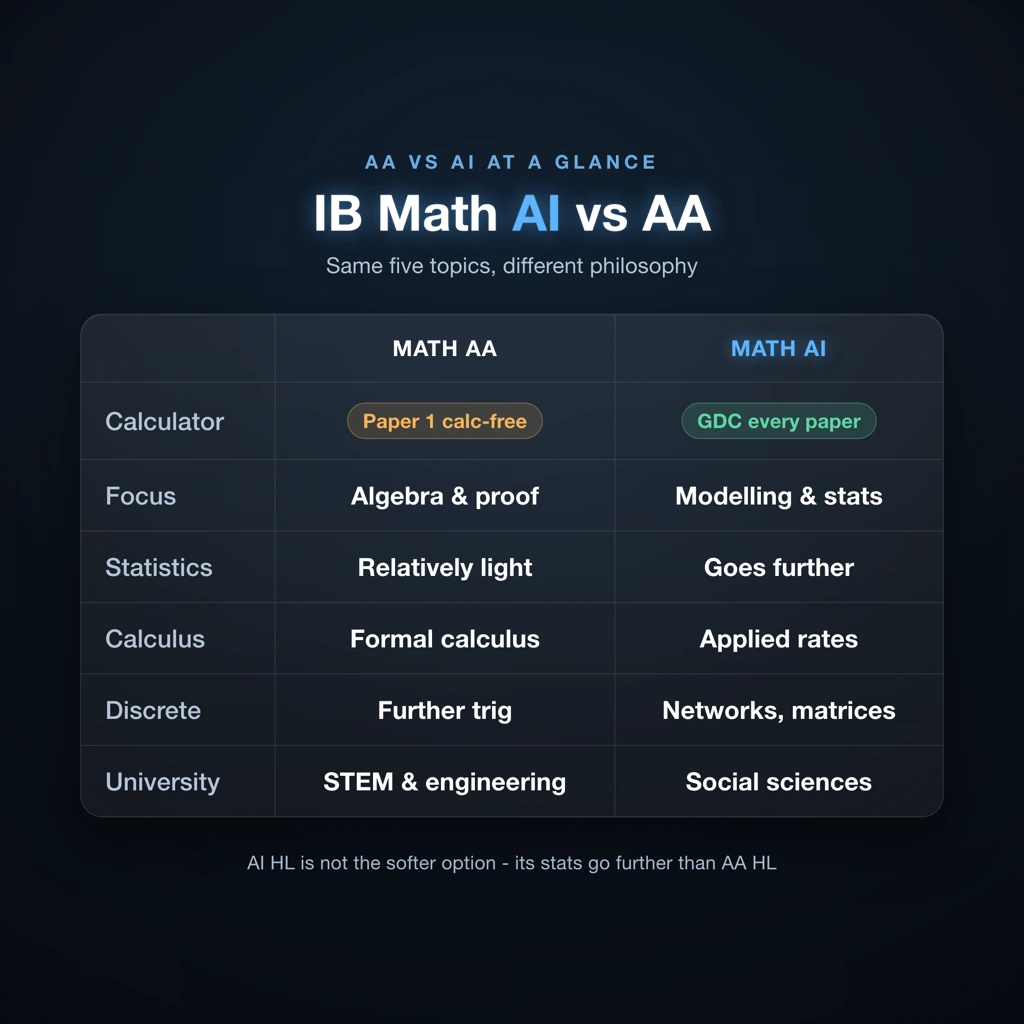
The two courses are built on different philosophies, not just different content lists. Analysis and Approaches (AA) is organised around algebraic rigour and formal proof: students are expected to derive results, work with abstract structures, and demonstrate why something is true. Applications and Interpretation (AI) is organised around mathematical modelling and statistical reasoning: the emphasis is on setting up a model, running it with real data, and interpreting what the output means.
That philosophical split shows up immediately in the GDC rules. In AI, a graphical display calculator is permitted in every paper. In AA, Paper 1 is calculator-free, which forces fluency in algebraic manipulation by hand. If you find yourself reaching for a calculator to evaluate a logarithm mid-exam, AA Paper 1 will punish that habit.
Content differences at a glance
| Area | AA emphasis | AI emphasis |
|---|---|---|
| Algebra and proof | Proof by induction, complex numbers | Mathematical modelling cycles |
| Statistics | Descriptive only at SL | Normal distribution, chi-squared tests, linear regression |
| Calculus | Formal differentiation and integration | Applied rates of change, numerical methods |
| Discrete / other | Further trigonometry | Network theory, transition matrices |
The "AI is easier" misconception
This is the one worth pushing back on. HL AI includes kinematics, coupled differential equations, network theory, and complex statistical inference such as Markov chains. These are not topics that reward vague intuition. The specific gotcha many students miss: AI HL's statistical content goes considerably further than AA HL's, which stays relatively light on probability models. A student who dislikes statistics and assumes AI HL is the softer option often finds the reverse is true.
3. SL and HL Paper Structure and Topic Weightings
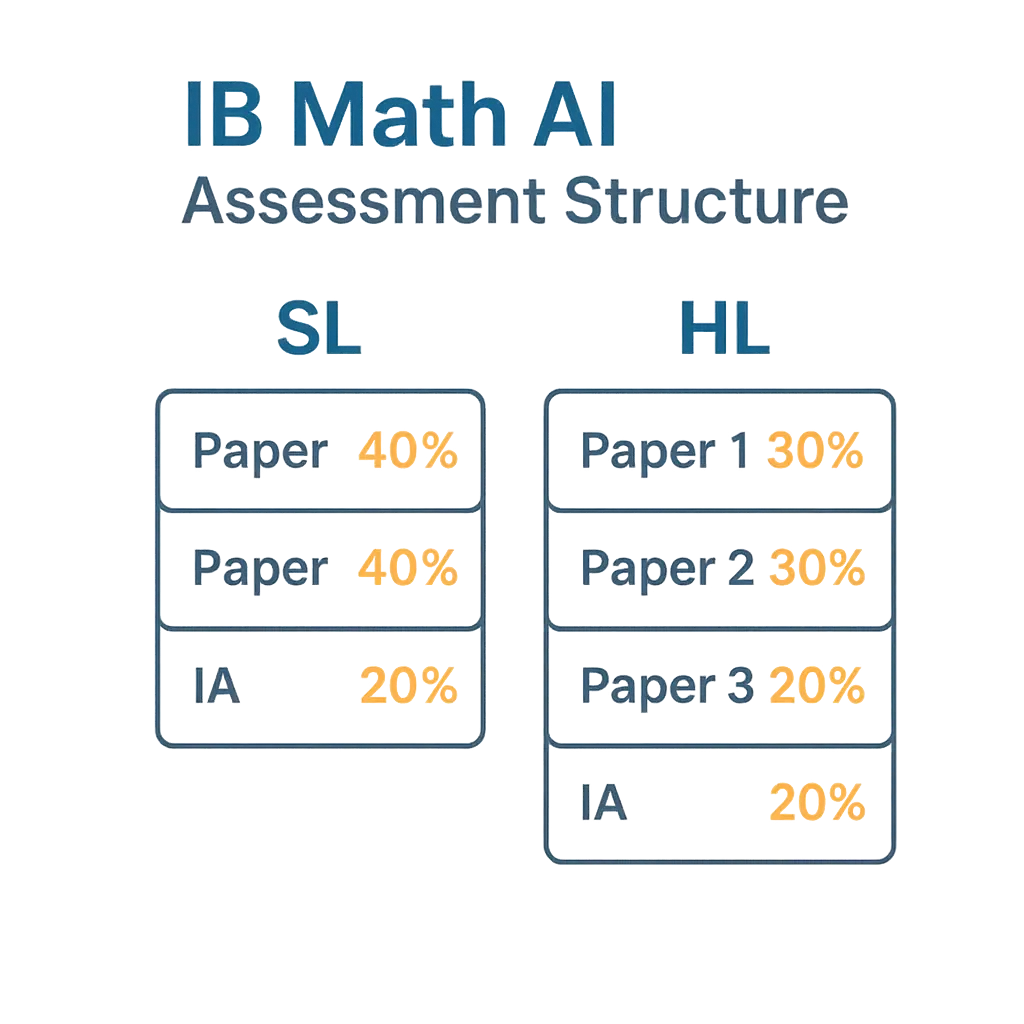
SL and HL share the same five topic areas but sit in quite different exam formats, and that structural gap matters more than most students realise when choosing between them.
SL: two papers, all technology active
SL candidates sit two externally assessed papers, both with a graphical display calculator (GDC) permitted. Total examination time is three hours. The IA (internal assessment) makes up the remaining 20% of the final grade and is completed during the course.
Because no paper is calculator-free at SL, the course rewards setting up models correctly over performing arithmetic by hand. That sounds easier, but examiners can therefore set more complex real-world datasets, which they do.
HL: three papers, all technology active
HL Papers 1 and 2 run for two hours each, and HL adds Paper 3 of 1 hour 15 minutes, bringing total examination time to five hours 15 minutes. Technology is required in all three papers.
| Paper | Technology | Format |
|---|---|---|
| Paper 1 (2 hours) | Required (GDC) | Short-response questions |
| Paper 2 (2 hours) | Required (GDC) | Extended-response questions |
| Paper 3 (1 hour 15 minutes) | Required (GDC) | Two extended-response problem-solving questions |
Unlike AA, no AI paper is calculator-free, at SL or HL. That makes calculator fluency part of exam technique: practise every past-paper question with the GDC you will use in the exam, so choosing the right function is automatic.
Paper 3 is unusual in the IB landscape. Each question unfolds a novel scenario over several parts, asking students to generalise results rather than apply rehearsed methods.
The five topic areas and how weighting shifts
Both levels cover: Number and Algebra, Functions, Geometry and Trigonometry, Statistics and Probability, and Calculus. HL adds content in every topic, with the largest increases in teaching time in Geometry and Trigonometry and in Calculus, and extends into areas not assessed at SL:
- Differential equations and kinematics (Calculus)
- Vectors and graph theory (Geometry and Trigonometry)
- Complex numbers and matrices (Number and Algebra)
- The Poisson distribution, further hypothesis tests and Markov chains (Statistics and Probability)
The IBO-issued formula booklet (also called the data booklet) is provided in every paper at both levels, including Paper 1 HL. Knowing what the booklet contains, and more importantly what it does not contain, is worth mapping early in the course.
4. Key Topics Inside the IB Mathematics Applications and Interpretation Syllabus
The IB Mathematics Applications and Interpretation syllabus is built around five topic areas. What distinguishes it from IB Math AA is not the absence of rigour but a consistent emphasis on context: every technique is introduced through a real-world scenario before the abstraction follows.
Statistics and Probability
This is the heart of the course and where AI students spend the most time.
- Normal distribution - calculating probabilities using the inverse normal and recognising when data fits the model
- Linear regression - finding the least-squares regression line, interpreting the correlation coefficient r, and understanding why r close to 1 does not confirm causation
- Chi-squared tests - testing for independence in two-way tables; a common IA method
- Hypothesis testing - t-tests and z-tests, with decisions based on p-values
One non-obvious gotcha: the formula booklet gives you the regression line formula, but examiners regularly penalise students who use x on y instead of y on x when predicting the dependent variable.
Number and Algebra
- Arithmetic and geometric sequences and series
- Compound interest and amortisation (loan repayment schedules appear at SL as well as HL)
- Logarithms and exponential models - used for population growth, radioactive decay, and cooling curves; ib maths ai logarithms appear in both SL and HL papers
Calculus
- Differentiation for optimisation problems (maximum profit, minimum material)
- Integration for area under a curve (volumes of revolution are HL only)
- HL only: differential equations and kinematics, including displacement, velocity, and acceleration relationships - kinematics ib math ai hl questions often combine calculus with real physical contexts
Geometry and Trigonometry
- Bearings, surface area, and volume in applied settings
- Voronoi diagrams (SL and HL), which test spatial reasoning rather than calculation and catch many students off guard because they require geometric construction logic rarely practised in other topics
- HL only: vectors, including their use in kinematics, and graph theory
5. Is IB Math AI HL Hard?
IB Math AI HL is a demanding course, but its difficulty is different in character from AA HL. Where AA HL tests abstract reasoning and formal proof, AI HL's hardest moments come from sustained applied problem-solving: constructing and critiquing models, interpreting statistical output correctly, and working through unfamiliar real-world scenarios under exam conditions.
The topics themselves are not trivially accessible. Kinematics, differential equations, and advanced probability distributions (including the Poisson and normal distributions used in inferential testing) require the same level of procedural fluency and conceptual understanding you would expect from any rigorous mathematics course. The difference is that you are usually asked what the answer means, not just what it is.
Paper 3 is where many students are caught off-guard. It is an extended problem-solving paper, unique to HL, set entirely within one or two real-world contexts. The question unfolds over several parts, and later parts often depend on earlier answers. Students who are strong at routine exercises but unused to sustained mathematical reasoning over a novel scenario find this format genuinely difficult. There is no equivalent in SL.
One counter-intuitive trade-off: because IB Math AI HL leans on technology throughout, students can underestimate how much mathematical judgement is required. Knowing which tool to use, and being able to tell whether the output makes sense in context, is harder than it looks when a GDC hands you a regression line or a p-value without comment.
6. Which University Courses Accept IB Math AI HL - and Which Require AA
The counterintuitive reality here: IB Math AI HL is not a universal substitute for AA, even at HL. Acceptance depends on the programme, not just the level. Two students with the same grade can face opposite outcomes depending on their target degree.
Engineering is the tightest category. Most UK engineering programmes specify Math AA as a requirement. Durham University's BEng Electronic Engineering lists A-level Mathematics as its benchmark subject - IB candidates should verify directly whether AI HL satisfies this, rather than assuming HL-to-A-level equivalence is automatic.
Economics and social sciences show more flexibility, but with a specific trap. Bristol's BSc Economics and Politics requires Mathematics at either 6 at HL (AA or AI) or 7 at SL, but the SL route accepts AA only. That means IB Math AI HL can satisfy the entry requirement, while IB Math AI SL cannot, regardless of grade. Students aiming for Economics with a high AI SL score are not equivalent to those with a 5 at AI HL.
Business and quantitative programmes carry a similar warning at the other end of the geography. NYU states it does not recommend IB Math AI SL for applicants to the Stern School of Business or the Tandon School of Engineering.
Less quantitative courses offer the clearest path for IB Math AI HL. Notre Dame explicitly states that students not intending STEM majors may complete HL Math AI as an acceptable alternative to AA.
The practical rule: always read the specific university statement on the IBO recognition portal, not the general IB recognition statement. Programme-level requirements override institutional ones.
| Subject area | IB Math AI HL | IB Math AI SL |
|---|---|---|
| UK Engineering (typical) | Check individually | Not accepted |
| Bristol Economics and Politics | Accepted (score 6) | Not accepted |
| NYU Stern / Tandon | Not recommended | Not recommended |
| Notre Dame (non-STEM majors) | Accepted | Not specified |
7. The IB Math AI Internal Assessment: What Makes a Strong Exploration
The Internal Assessment (IA) is a 12-20 page Mathematical Exploration submitted in the final year of the IB Diploma Programme. It counts for 20% of your final IB Math AI grade and is marked against five criteria: Presentation, Mathematical Communication, Personal Engagement, Reflection, and Use of Mathematics.
The "Use of Mathematics" criterion is where most marks are made or lost. Examiners are looking for mathematics that is central to the investigation, not decorative. A common mistake is building an exploration around an interesting dataset and then running a single linear regression with no further analysis. That satisfies the data-handling requirement technically but rarely scores well, because the maths is thin relative to the word count.
What strong AI explorations look like
A strong IB Math AI exploration typically:
- Starts with a genuine real-world dataset (publicly available health data, environmental measurements, sports statistics) rather than data the student generates over a week.
- Applies multiple syllabus tools in combination: for example, fitting a normal distribution model, checking the fit with a chi-squared goodness-of-fit test, and then using the model to make a probabilistic prediction.
- Reflects critically on model limitations, such as explaining why a logistic growth model fits disease-spread data better than a simple exponential beyond a certain point, rather than just noting that the R-squared value is high.
The counter-intuitive trade-off: a narrower topic explored in depth almost always outscores a broad topic covered lightly. Students who ask "can I model the entire global economy?" tend to produce superficial explorations. Students who ask "how well does a normal distribution model the finishing times of amateur 10k runners in a specific race?" tend to produce focused, scoreable work.
HL vs SL expectations
HL students should incorporate HL-specific content, such as kinematics, optimisation using differential calculus, or the Poisson distribution. Using only SL-level mathematics in an HL exploration is penalised under the Use of Mathematics criterion.
Concrete topic directions
- Disease spread modelling: fit exponential and logistic functions to publicly available case data, compare the models, and reflect on which assumptions each requires.
- Sports performance analysis: use linear regression and a hypothesis test (t-test or chi-squared) to examine whether a chosen variable predicts match outcome, and discuss what the p-value does and does not tell you.
- Environmental data: model air quality or temperature data using a normal distribution, test the fit formally, and analyse what sits in the tails.
Whichever direction you choose, the reflection section should engage with why the mathematical model is imperfect, not just acknowledge that it is. That distinction is what separates a level 5 exploration from a level 7.
8. IB Math AI or AA: How to Choose the Right Course
Start with your intended university pathway, not your favourite topic in maths. The course you pick now can narrow or widen your options at admissions, and switching after the first year is rarely straightforward.
If you are aiming for STEM degrees (engineering, physics, pure mathematics) or economics at selective universities, choose AA. The University of Notre Dame makes this explicit: students intending STEM-related majors are encouraged to complete AA, at either HL or SL, while AI HL is positioned as an alternative only for non-STEM pathways.
If you are heading toward social sciences, psychology, geography, business, health sciences, or any discipline where data analysis and modelling are the core mathematical skills, ib math ai is the more relevant choice. The syllabus maps directly onto the quantitative methods used in those fields, including linear regression, normal distribution, and statistical inference.
The non-obvious trade-off: AI SL closes more doors than AI HL does. NYU Abu Dhabi accepts any level of IB Math in general, but specifically recommends against AI SL for applicants to its Stern School of Business or Tandon School of Engineering. This pattern, where SL is the excluded option rather than AI itself, appears at other institutions too. Taking AI at HL preserves significantly more options.
Before finalising your subject choices, do two things:
- Search the IBO university recognition portal for each university on your shortlist and read their exact wording.
- Check the admissions page of each target department directly, since faculty requirements sometimes differ from the university-wide statement.
A university that says "we accept IB Math AI" may still exclude AI SL for specific programmes. Read the small print before assuming the course is accepted.
9. Resources: Formula Booklet, Past Papers, and Study Tools
The IB provides a dedicated Mathematics: Applications and Interpretation formula booklet that covers every formula students are expected to use, from the normal distribution probability density function to regression line equations and financial mathematics notation. It is issued in every exam paper, including Papers 1, 2, and 3. This means the IBO is not testing formula recall; it is testing whether you can select and apply the right formula under time pressure. The practical consequence: students who have barely opened the booklet before exam day consistently misread notation or waste time searching for the wrong entry.
For past papers, the official route is through a school's MyIB account, which gives access to the IBO's past paper repository. Individual students cannot purchase official papers directly in most circumstances, though the IBO's online store offers some authorised resources. Free unofficial copies circulate widely, but paper quality and mark scheme accuracy vary.
A more reliable study habit is using topic-by-paper compilations, which revision platforms organise by syllabus section, such as IB Math AI logarithms or linear regression questions, so you can drill weaknesses without wading through full papers.
One overlooked detail: always use the actual IB formula booklet, not a textbook summary, during every timed practice session. The booklet's phrasing differs subtly from most textbooks, and those differences matter when reading questions quickly under pressure.
10. Where to Go From Here
Subject choices in the IB Diploma are typically locked in during Year 1, which means a decision made before you have fully researched university requirements can be difficult to reverse. The counter-intuitive detail many students miss: some universities distinguish not just between AA and AI, but between AI HL and AI SL for specific programmes. For example, NYU Abu Dhabi accepts any level of IB Math for most applicants, but recommends against AI SL specifically for Business and Engineering applicants.
This week, open the IBO university recognition portal and search each of your target universities. Read their stated IB Math AI policy directly. Do not rely on a friend's interpretation. Check before your school's subject-selection deadline.
More on IB Maths:
- IB Maths AI IA: Criteria, Topics and Structure Guide
- IB Math New Syllabus: What Changes in AA and AI from 2029
FAQ
What does IB Math AI stand for?
IB Math AI stands for Mathematics: Applications and Interpretation, one of four IB Diploma mathematics courses, designed around real-world modelling, statistics, and the use of technology including a graphical display calculator.
Is IB Math AA harder than IB Math AI?
They are hard in different ways: Math AA demands algebraic rigour and proof with a restricted calculator, while Math AI HL demands sophisticated modelling, statistical inference, and extended problem-solving - neither is simply easier than the other.
How long is IB Math AI SL Paper 1 and Paper 2?
IB Math AI SL Paper 1 is 1 hour 30 minutes and Paper 2 is also 1 hour 30 minutes, giving a total examination time of 3 hours across both papers, both with a graphical display calculator permitted.
What is IB Math AI SL equivalent to in UK terms?
IB Math AI SL is broadly equivalent to A-level Mathematics in level, though the content emphasis differs - it focuses more on applied statistics and modelling; universities compare it to A-level Maths rather than Further Maths.
Is IB Math AI good for medicine?
Most UK medical schools require strong scientific subjects rather than a specific maths course, but Math AA is generally preferred if maths is needed; AI SL is unlikely to satisfy any mathematics requirement for medicine, while AI HL may be acceptable at some institutions - check each medical school's entry requirements directly.
What is the IB Math Internal Assessment?
The IB Math Internal Assessment is a Mathematical Exploration - a 12-20 page written investigation of a mathematical topic of the student's choice - worth 20% of the final grade, assessed on presentation, mathematical communication, personal engagement, reflection, and use of mathematics.
References
- Engineering (Electronic) | Durham University | UCAS - https://www.ucas.com/explore/courses/0d42ceed-b5aa-4045-9fda-5e5ede2f20ca/course?studyYear=2027
- Economics and Politics with Study Abroad | University of Bristol | UCAS - https://www.ucas.com/explore/courses/518d2fc2-ce12-448c-a494-bc96743b3a21/course
- University Statement - https://recognition.ibo.org/en-US/university-statements/?id=5a5ce494-f2a1-ed11-aad1-000d3a85c377&university=New+York+University+%28NYU%29+-+Abu+Dhabi&countryID=c1426145-efa1-ed11-aad1-000d3a85c377&country=United+Arab+Emirates
- University Statement - https://recognition.ibo.org/en-US/university-statements/?id=ff816043-f1a1-ed11-aad1-000d3a85c377&university=University%2520of%2520Notre%2520Dame&countryID=3790594b-efa1-ed11-aad1-000d3a85c377&country=Estados%2520Unidos%2520de%2520America&stateID=f7c3307c-efa1-ed11-aad1-000d3a85c377&state=Indiana