AI Tutor vs Human Tutor: Which Is Right for You?
By Michael Thompson · Education Specialist; 10 years teaching the IB at Bromsgrove School · Published 21 May 2026 · Updated 12 June 2026
Choosing between an AI tutor and a human tutor is no longer a futuristic question - it's one UK students and parents are making right now. AI tools can answer questions at midnight, never lose patience, and cost a fraction of private tuition fees; human tutors can read a student's mood, push back on weak essay structure, and hold a student accountable week to week. Neither is universally better. The right answer depends on what you actually need - drilling content, improving technique, staying motivated, or some combination of all three. This article breaks down exactly where each option wins, where it falls short, and when using both together makes the most sense.
Key Takeaways
- AI tutors are cheapest and most available: Most AI tools cost £0-£25 per month versus £40-£100 per hour for a private UK tutor.
- Human tutors still lead on exam technique: Reading marking conventions, giving feedback on written arguments, and adapting to a student's emotional state are things current AI tools do poorly.
- AI hallucinates on niche syllabus content: Narrow specifications - IB HL subjects, specific Edexcel mark schemes - are where AI tutors are most likely to give plausible-but-wrong answers.
- The hybrid model is becoming mainstream: The UK government is investing in AI tools designed to sit alongside teachers, not replace them, with national rollout targeted from 2027.
- Motivation is the hidden variable: Students who struggle to self-direct benefit most from a human tutor's accountability; self-motivated students can get serious mileage from AI alone.
- Data and oversight matter: UK parents and pupils in government research agreed AI in education needs human oversight, clear data rules, and standardised tools before they fully trust it.
In This Article
- What Each Option Actually Is
- Where AI Tutors Genuinely Win
- Where Human Tutors Still Win
- Honest Limitations of AI Tutors Right Now
- Cost Comparison: AI Tools vs Private Tuition in the UK
- The Hybrid Model: AI for Practice, Human for Strategy
- Which Should You Choose?
1. What Each Option Actually Is
The ai tutor vs human tutor question is sharper than it used to be, because the two options now overlap in ways they didn't five years ago. Understanding what each actually is helps you compare them honestly.
An AI tutor is a software system, typically built on a large language model or an adaptive learning platform, that responds to questions, generates practice problems, and explains concepts on demand. The defining feature is availability: it works at 11 pm on a Sunday as readily as a Tuesday afternoon. Some platforms adjust difficulty in real time based on your answers, which is the core idea behind adaptive learning technology in education.
A human tutor is a subject-specialist individual, hired privately, through an agency, or via a school-facilitated programme, who works one-to-one or in small groups. The relationship is the point: a good human tutor reads hesitation, notices when a student is guessing confidently rather than actually understanding, and adjusts accordingly.
The distinction matters more now because the UK government is treating AI tutoring as an infrastructure question, not a fringe experiment. Per GOV.UK, up to 8 companies will each receive £300,000 to build and test AI tutoring tools for Years 9 to 10 in English, maths, science, and modern foreign languages, with national rollout targeted from 2027. The programme aims to reach up to 450,000 disadvantaged pupils per year, precisely because private tutoring can cost hundreds or thousands of pounds annually.
That context shapes the whole debate: AI tutoring is no longer a consumer novelty sitting alongside private tuition. It is being designed, under teacher supervision and aligned to the national curriculum, as a structural alternative.
2. Where AI Tutors Genuinely Win
AI tools have genuine structural advantages over human tutors in specific, predictable situations. Understanding where they outperform is the starting point for any honest ai tutor vs human tutor comparison.
Availability is the clearest win. An AI platform is open at 11pm the night before a mock, during half-term, and at 6am before a commute. There is no booking window, no cancellation fee, and no waiting for a weekly slot to free up. For students cramming AQA GCSE Biology or working through Edexcel A-Level Maths past papers on their own schedule, that flexibility is genuinely useful.
The judgement-free environment matters more than most people admit. A student who does not understand how to balance a chemical equation can ask the same question ten times without any social cost. With a human tutor, the third or fourth attempt at the same concept often triggers visible (if well-intentioned) frustration or a change in approach that can make a student feel they have run out of acceptable attempts. AI removes that ceiling entirely.
Adaptive learning technology is where the best platforms separate themselves from glorified textbooks. Tools that adjust question difficulty in real time based on your answer pattern give a form of personalised learning that a single tutor working with four students back-to-back cannot replicate at pace. If you are consistently dropping marks on surds but not on quadratics, a good platform notices within a session and routes more surds your way. A less obvious trade-off: this works best for well-structured subjects with clear right and wrong answers. Open-ended analysis questions largely defeat it.
Drilling and content recall is where AI comfortably dominates: vocabulary repetition for GCSE French, formula recall for OCR Chemistry, case-study names for A-Level Psychology. The repetition required for long-term memory consolidation is, frankly, boring work that AI handles without complaint and at a cost of roughly £0 to £25 per month for most platforms, making high-frequency practice affordable for almost any budget.
3. Where Human Tutors Still Win
AI tools are strong at drilling content. They are weaker at the things that actually separate a B from an A on exam day.
Exam technique is board-specific in ways that catch students out. An AQA A-Level History examiner rewards a particular essay structure, named "PEEL" paragraphs arranged around a clear argument, and deducts marks for narrative retelling however accurate it is. Edexcel marks differently. OCR differently again. The IB's markbands for Paper 2 History essays penalise students who write long introductions rather than short, claim-led ones. A tutor who has sat with real marked scripts, seen where a student's work fell short of a band descriptor, and adjusted their teaching accordingly brings something most AI tools currently cannot replicate from a chat interface alone.
A skilled tutor reads the room. When a student says "yes, I get it" after an explanation of integration by parts, an experienced teacher notices the slight pause, the answer that is slightly too confident, the follow-up question that reveals the gap. Detecting confusion from text alone is unreliable, and this is one area where human connection in education matters practically, not just sentimentally.
Motivation runs on social pressure as much as intrinsic drive. A fixed weekly appointment with a real person is a forcing function. Cancelling on a chatbot carries no social cost. For students whose tutoring student motivations are fragile, that accountability can be the difference between consistent work and drifting.
Extended writing exposes AI's current limits most clearly. Argument quality, essay structure, and the kind of analytical voice that IB examiners reward in extended essays require judgement that current AI tools apply inconsistently. A tutor can interrogate a student's reasoning in real time, ask "why do you think that?", and reshape an argument through dialogue.
The relationship itself also matters. A tutor who has worked with a student across several months understands their particular anxieties, their tendency to rush conclusions, the topics that knock their confidence. No current AI tool builds that kind of longitudinal model of a specific person.
4. Honest Limitations of AI Tutors Right Now
AI tutors have real weaknesses, and knowing them upfront prevents the specific kind of harm where a student revises confidently from wrong information.
Hallucination on niche content is the biggest practical risk. Mainstream topics are fine. But ask an AI about IB Chemistry after the 2025 syllabus removed the options, a narrow Edexcel IGCSE unit, or any GCSE spec that was updated in the last two years, and you are likely to get a confident, fluent, and partially incorrect answer. The AI has no way of flagging that its training data predates a specification change. A student preparing for OCR A-Level Biology's 2025-onwards spec needs to verify AI-generated content against the actual specification document, not treat the output as authoritative.
Mark schemes are harder than they look. AI can describe the qualities of a strong answer in general terms. What it cannot reliably do is replicate the precise command word logic of an AQA mark scheme, where "state" earns one mark and "explain" requires a linked consequence. Examiners train for weeks on this. AI guesses.
Three further limitations are worth being direct about:
- Age restrictions. Many AI tools, including several marketed for education, carry 18+ terms of service. Younger students using them without adult oversight may be violating those terms.
- Data and privacy. A DSIT and DfE-commissioned study involving 108 parents and pupils found participants were more comfortable with AI in education when data was anonymised and clear rules governed sharing with private companies. Most consumer AI tools do not meet that bar by default.
- No memory across sessions. Most AI tools start each conversation cold. A human tutor who has worked with a student for two months knows which misconceptions keep resurfacing. An AI does not, which limits its ability to adapt strategy over time in the way that genuine personalised learning requires.
The same DSIT/DfE research identified three conditions participants agreed were necessary for AI use in schools: human oversight, parent and pupil permissions, and standardisation of tools. Most off-the-shelf AI tutors currently satisfy none of the three by design.
5. Cost Comparison: AI Tools vs Private Tuition in the UK
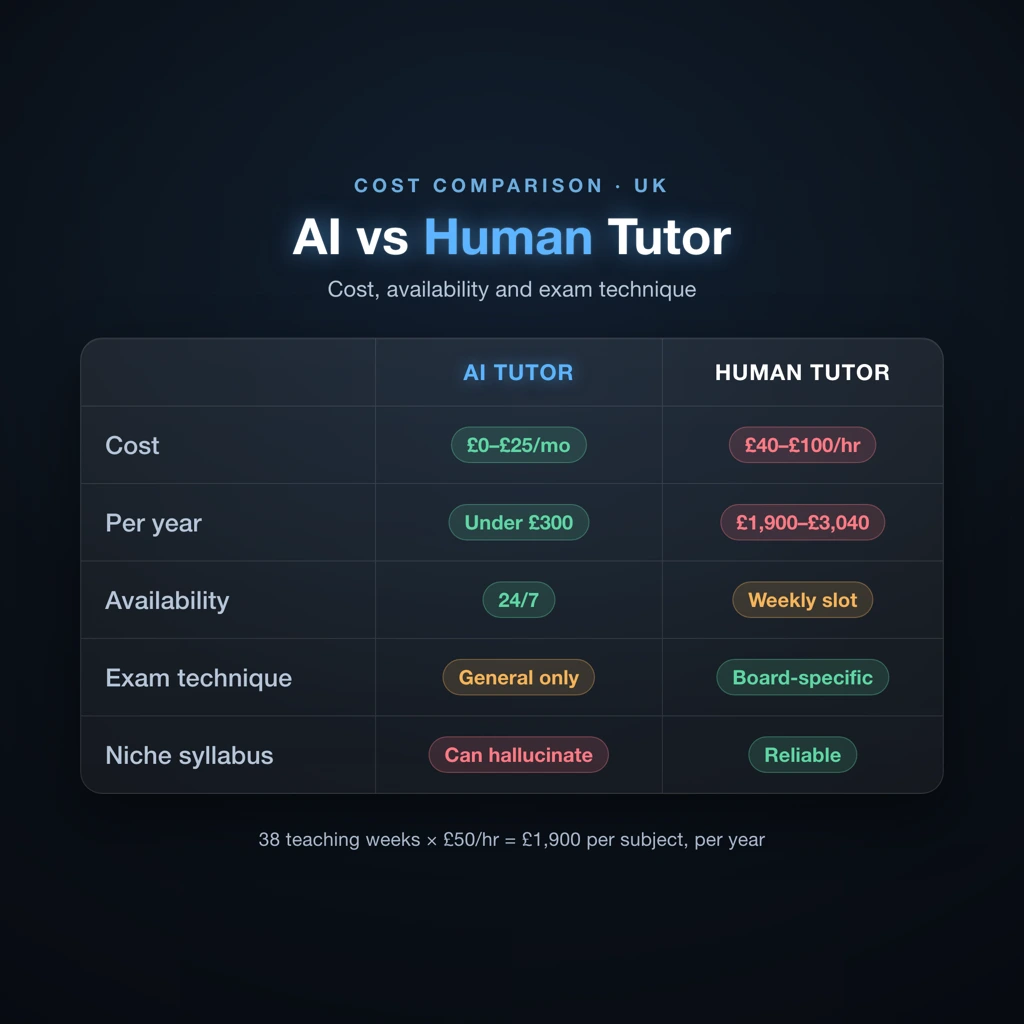
The numbers here are stark. A private tutor in the UK typically charges £40-£100 per hour, with London-based tutors and Russell Group subject specialists sitting at the upper end. Run that across a full academic year and the cost compounds fast.
The annual maths on weekly human tuition:
- 38 teaching weeks x £50/hr = £1,900 per year, per subject
- At £80/hr (a common rate for A-level specialists in London): £3,040 per year
- Premium AI platform (e.g. Khan Academy Khanmigo, Komo): roughly £25/month, under £300 per year
- Free tier options (ChatGPT free, Khan Academy core): £0
The UK government notes that private tutoring can cost "hundreds or thousands of pounds per year" and that evidence suggests it can accelerate learning by up to 5 months. That framing sits at the heart of the equity argument for AI alternatives.
The government's response is a funded initiative targeting up to 450,000 disadvantaged pupils per year, with selected tools aimed for national rollout from 2027. The non-obvious point: that rollout is still years away for most pupils, and access will initially be limited to Years 9 and 10 in English, maths, science, and modern foreign languages. Any student can access free or low-cost AI tools right now, without waiting.
Cost alone should not decide the ai tutor vs human tutor question, but for families spending four figures annually on tuition, it is a variable worth pricing honestly.
6. The Hybrid Model: AI for Practice, Human for Strategy
The most useful framing is not AI or human but AI and human, with each doing the work it is actually suited for.
AI handles the high-frequency, low-stakes tasks. Flashcard drilling, timed practice questions, concept explanations at 11pm the night before a Chemistry paper: these are jobs where volume and instant availability matter more than nuance. An AI tool won't tire of explaining the same mole calculation for the fourth time.
A human tutor handles the low-frequency, high-value tasks. Reading a full practice essay and spotting the structural habit that keeps costing marks. Identifying why a student keeps misapplying the AQA mark scheme for 12-mark history questions despite knowing the content. Building a sequenced revision plan across six subjects with different exam windows. These require judgement built on context, not pattern-matching on text.
The split is reinforced by the direction of UK government policy. The Department for Education's June 2025 AI guidance is explicit: AI use must remain teacher-led, with educators required to verify AI-generated content. The same logic transfers directly to tutoring. AI output is a starting point, not a verdict.
The infrastructure for reliable AI support is being built but is not fully here yet. The Education Hub notes a government-funded £3 million content store designed to supply large language models with curricula and mark schemes, and up to £2 million invested in Oak National Academy's AI-powered lesson assistant Aila. When those tools are calibrated against real mark schemes, AI practice becomes meaningfully more trustworthy. Until then, a human needs to close the loop.
7. Which Should You Choose?
The honest answer depends on what is actually stopping you from hitting your target grade, not on which option sounds more efficient.
AI is probably enough if you are self-motivated, need to drill vocabulary or work through concept explanations repeatedly, are on a tight budget, or want something to fill the gaps between school lessons. Tools like Khanmigo or Quizlet's AI features handle this reliably.
A human tutor is worth the cost if you have a high-stakes assessment coming up that rewards specific technique: an Edexcel A-Level English literature essay, an AQA GCSE speaking assessment, or OCR coursework that needs structured written feedback. AI tools currently cannot mark your tone of voice or tell you that your argument collapses in the third paragraph the way a trained examiner would. Accountability matters here too: if you do not open the app, the app cannot chase you.
Both together works best if you can afford one human session a fortnight for strategy and writing feedback, and use an AI tool daily for practice questions and quick explanations in between.
One counter-intuitive point: students who are already confident often get more from AI than struggling students do, because they know which answers to distrust. If you are not yet confident, human contact closes that gap faster.
Your next action: this week, pick your weakest topic, spend 20 minutes on a free AI tool such as Khan Academy, and write down every answer you are not sure the AI has got right. Book a single human tutor session and bring that list. That one session will be significantly more focused than any general "catch-up" hour.
FAQ
Is an AI tutor better than a human tutor?
Neither is universally better - AI tutors win on cost, availability, and content drilling, while human tutors win on exam technique, motivation, and feedback on extended writing; the right choice depends on the student's specific bottleneck.
How much does a private tutor cost in the UK?
UK private tutors typically charge £40-£100 per hour, meaning weekly sessions over an academic year can cost well over £1,000, compared with AI tools that range from free to around £25 per month.
Can AI tutors handle GCSE and A-Level exam technique?
AI tutors can explain mark schemes in general terms but frequently lack the precision needed for specific AQA, OCR, or Edexcel marking conventions, and are weakest on niche or recently updated specifications.
What are the limitations of AI tutors right now?
Current AI tutors can hallucinate on narrow syllabus content, cannot reliably detect student confusion, often reset each session with no memory of past progress, and many carry age restrictions requiring adult oversight.
Are there free AI tutoring tools available to UK students?
Yes - tools such as Khan Academy and the free tier of ChatGPT are available at no cost, and the UK government is funding AI tutoring tools specifically targeting disadvantaged pupils, with national rollout aimed for 2027.
Should I use both an AI tutor and a human tutor?
A hybrid approach works well for many students: use AI daily for practice questions and concept explanations, and reserve human tutor sessions - typically fortnightly - for exam technique, essay feedback, and revision strategy.
References
- Edtech and AI companies invited to help build safe AI tutoring tools for disadvantaged pupils - GOV.UK - https://www.gov.uk/government/news/edtech-and-ai-companies-invited-to-help-build-safe-ai-tutoring-tools-for-disadvantaged-pupils
- Research on public attitudes towards the use of AI in education - GOV.UK - https://www.gov.uk/government/publications/research-on-parent-and-pupil-attitudes-towards-the-use-of-ai-in-education/research-on-public-attitudes-towards-the-use-of-ai-in-education
- AI revolution to give teachers more time with pupils - GOV.UK - https://www.gov.uk/government/news/ai-revolution-to-give-teachers-more-time-with-pupils
- AI in schools and colleges: what you need to know – The Education Hub - https://educationhub.blog.gov.uk/2025/06/artificial-intelligence-in-schools-everything-you-need-to-know/