IB vs A Levels: Which Should You Choose?
By Michael Thompson · Education Specialist; 10 years teaching the IB at Bromsgrove School · Published 21 May 2026 · Updated 12 June 2026
IB vs A Levels is one of the most consequential decisions a UK student at 16 faces, yet the two qualifications are rarely explained side by side. The IB Diploma Programme spans six subjects plus three compulsory core components; A Levels typically mean three subjects studied in depth. Both are accepted by UK universities, including Oxbridge and Russell Group institutions, but they suit different kinds of learners. This guide lays out the structural differences, scoring equivalences, and what universities actually say - so you can make the call with accurate information rather than playground rumour.
Key Takeaways
- Breadth vs depth: The IB Diploma requires six subjects across five academic groups plus a core; A Levels typically require three subjects, allowing greater specialism.
- Scoring works differently: The IB uses a 45-point scale; A Levels use grades A*-E, and UCAS converts both to a common Tariff for university applications.
- UK universities accept both: Russell Group and Oxbridge universities set equivalent offers for IB and A Levels - Oxford's Assyriology course, for example, asks AAA at A Level or 39 points with 666 at Higher Level for IB.
- The IB core has no A-Level equivalent: Theory of Knowledge, the Extended Essay, and Creativity, Activity, Service are compulsory for IB students and have nothing directly comparable in the A-Level system.
- Neither is objectively harder: The IB's workload is wider; A Levels demand greater depth in fewer subjects - which feels harder depends on the student.
- Medicine and competitive courses care about subjects, not just the qualification: Medical schools such as the University of Manchester specify required science subjects regardless of whether you sit A Levels or IB.
In This Article
- What Are IB and A Levels - and How Do They Differ?
- Subject Breadth: Six IB Subjects and a Core vs Three A Levels
- IB Points vs A Levels: How Scoring and UCAS Tariff Work
- IB or A Levels for UK Universities, Oxbridge, and Medicine
- Which Is Harder - IB or A Levels?
- Pros and Cons of IB vs A Levels: A Direct Comparison
- Should You Do IB or A Levels? Your Next Step
1. What Are IB and A Levels - and How Do They Differ?
The choice between IB vs A Levels shapes not just what you study for two years, but how universities read your application and how prepared you feel for degree-level work. Both qualifications are taken at ages 16 to 19, both are respected by UK universities, and both lead to the same destination. The mechanism, though, is quite different.
The IB Diploma Programme requires you to study six subjects simultaneously, one drawn from each of five subject groups (two languages, individuals and societies, sciences, and mathematics), plus either an arts subject or a second subject from those existing groups. On top of that, you complete three compulsory core components: a 4,000-word Extended Essay, a Theory of Knowledge course, and Creativity, Activity, Service hours. The IB is offered in 143 countries, making it one of the few post-16 qualifications that transfers cleanly across borders.
A Levels, by contrast, are built around depth. You typically pick three subjects and study them intensively, with no compulsory breadth requirement. They are the standard post-16 academic qualification in England, Wales, and Northern Ireland, assessed and regulated by boards including AQA, Edexcel, and OCR.
One detail worth knowing: the IB Career-Related Certificate is a distinct, less common route that pairs two to four IB academic courses with a vocational qualification. It is not the same as the full Diploma and is treated differently by universities, so confirm which programme your school actually offers before you commit.
2. Subject Breadth: Six IB Subjects and a Core vs Three A Levels
The structural difference here is more constraining than most students expect.
The IB Diploma Programme locks in breadth from day one. Per UCAS, students must choose one subject from each of five groups covering two languages, social sciences, experimental sciences, and mathematics, plus either an arts subject or a replacement from those same groups. You cannot drop sciences entirely to focus on humanities, or drop languages to focus on sciences. A student who wants to study English at university still sits a mathematics course. A future engineer still studies a second language.
A Levels work the opposite way. Typically three subjects, chosen freely, with no mandatory spread across disciplines. A science specialist can leave all humanities behind after GCSE. A literature student need never touch chemistry again. That freedom is the defining trade-off.
The non-obvious gotcha with IB group requirements: the arts slot looks flexible, but students who fill it with a sixth academic subject rather than a dedicated arts course sometimes find that subject receives less teaching time than expected. Check with your school before treating group six as a freebie.
The IB core adds three compulsory elements on top of the six subjects:
- Extended Essay (EE) - a 4,000-word independent research paper in a subject of your choice, assessed externally.
- Theory of Knowledge (TOK) - a course examining how we know what we know across disciplines, culminating in an essay and an exhibition.
- Creativity, Activity, Service (CAS) - documented extracurricular engagement, not assessed academically but required for diploma completion.
TOK and the Extended Essay together are worth up to three bonus points on your total IB score, which matters when offers are tight.
The core is genuinely useful for university applications: the Extended Essay in particular gives you something concrete to discuss in personal statements. A Levels have no equivalent built-in requirement, though the EPQ (Extended Project Qualification) is an optional add-on that some students take for the same reason.
Which structure suits which learner:
- IB suits students who are genuinely curious across subjects, or who are unsure which discipline they want to pursue at degree level.
- A Levels suit students with a clear direction who want to build deep subject expertise before university.
If you are already certain you want to study medicine or engineering, three focused A Levels may serve your application more cleanly. If you are still working out what you find interesting, the IB's enforced breadth can be an advantage rather than a burden.
3. IB Points vs A Levels: How Scoring and UCAS Tariff Work
The two systems measure achievement on completely different scales, which makes direct comparison trickier than it looks.
The IB Diploma is scored out of 45. Six subjects each carry a maximum of 7 points (7 × 6 = 42), and up to 3 bonus points come from the core: specifically the combination of Theory of Knowledge and the Extended Essay. CAS (Creativity, Activity, Service) is assessed as pass/fail and contributes nothing to the numerical total - but failing it means no Diploma, regardless of your subject scores. That asymmetry catches students off guard more often than the coursework load does.
A Levels are graded A*-E by boards including AQA, Edexcel, and OCR. UCAS converts both qualifications to a common Tariff points scale for admissions tracking, though most selective universities state their offers in grade terms rather than Tariff totals.
A concrete equivalence example helps here. Oxford's Assyriology course lists its standard offer as AAA at A Level or 39 IB points with 6, 6, 6 at Higher Level. That 39-point IB total leaves little room for error: a candidate scoring 7, 7, 6, 6, 6, 6 at Higher and Standard Level plus 1 bonus point from the core would hit exactly 39.
One non-obvious detail: the Higher Level grade minimums (6, 6, 6 in the Oxford example) are separate conditions from the overall points total. You can hit 39 points and still not meet the offer if your Higher Level grades fall short.
Always check the specific course page on UCAS - equivalences vary by university and by subject.
4. IB or A Levels for UK Universities, Oxbridge, and Medicine
Russell Group universities and Oxford and Cambridge accept both qualifications. The University of Oxford's Assyriology course illustrates the direct equivalence clearly: the A Level offer is AAA, and the IB offer is 39 points overall with 6 6 6 at Higher Level. That pattern holds across most Oxford and Cambridge subjects, which publish both sets of requirements side by side. Neither qualification gives you an admissions edge at Oxbridge; the interview and admissions test carry far more weight.
For medicine, subject match matters more than the qualification type - but IB applicants need to check carefully. The University of Manchester MBChB requires Biology or Human Biology and Chemistry at A Level, plus one further science from a defined list. IB applicants applying to medicine must ensure the equivalent subjects appear at Higher Level, not Standard Level. A student with Chemistry at Standard Level and Biology at Higher Level may not meet the requirements, even with an otherwise strong IB score. The non-obvious gotcha: some medical schools publish A Level requirements only and ask IB applicants to contact the admissions office directly, which means the IB route demands more legwork before you apply.
For law, business, and arts subjects, no equivalent subject conditions typically apply. A competitive IB total and strong relevant Higher Level subjects generally satisfy the same entry criteria as A Level grades. The qualification type rarely determines the outcome for these courses; personal statement, subject choices, and predicted performance do.
US universities tend to view the IB's breadth favourably, but that consideration is outside the UK admissions picture and worth separate research if it applies to you.
5. Which Is Harder - IB or A Levels?
There is no clean answer, and any source that gives you one is conflating two genuinely different kinds of difficulty.
The IB Diploma Programme is hard because of volume and breadth. You are managing six subjects simultaneously, writing a 4,000-word Extended Essay on a topic of your choice, completing the Theory of Knowledge (TOK) course, and logging CAS (Creativity, Activity, Service) hours, all at the same time. The load is relentless and the deadlines stack up across two years. Students who fall behind on the Extended Essay while sitting mock exams in five other subjects will recognise this immediately.
A Levels are hard because of depth. AQA, Edexcel, and OCR examinations in a single subject go further into that subject than IB Higher Level papers typically do. With only three subjects, two years of study converge on a small number of final exams. A bad week in May can undo careful preparation in a way that the IB's distributed assessment partly protects against.
The counter-intuitive point worth knowing: some students find the IB harder for non-academic reasons. If you have no aptitude or enthusiasm for languages, being required to study one at Standard Level for two years is a friction that has nothing to do with intellectual capacity. The same applies to IB Maths, which is compulsory. A-Levels let you drop the subjects you dislike at 16. The IB does not.
Students who struggle with sustained, narrow focus often cope better with the IB's variety. Students who thrive when they can go deep on a small number of things tend to perform better with A Levels.
6. Pros and Cons of IB vs A Levels: A Direct Comparison
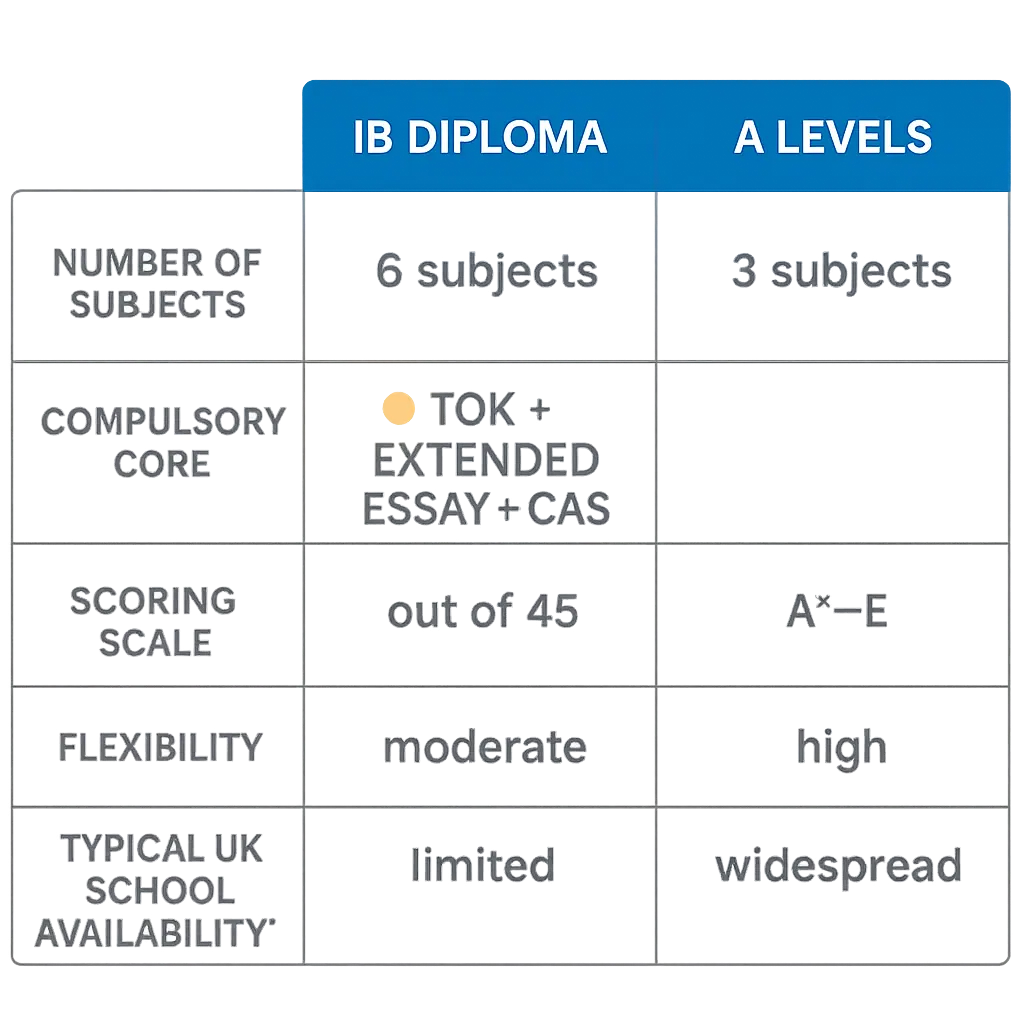
Here is a direct look at where each qualification wins and where it falls short. The counter-intuitive trade-off worth knowing: IB students cannot drop a weak subject mid-course, whereas A-Level students can quietly abandon a fourth AS subject after Year 12. That flexibility matters more than most comparison guides admit.
| Attribute | IB Diploma | A Levels |
|---|---|---|
| Subjects required | Six (one from each group) | Typically three |
| Core components | Extended Essay, Theory of Knowledge, CAS | None |
| Scoring | 45-point scale | A*-E per subject |
| Subject flexibility | Low - group structure is fixed | High - choose any combination |
| Workload style | Concurrent across all subjects | Concentrated in chosen subjects |
| International recognition | 143 countries | Primarily UK, Commonwealth, and Europe |
IB pros
- Breadth: six subjects covering sciences, languages, maths, and humanities simultaneously
- The Extended Essay and Theory of Knowledge build independent research and critical-thinking skills that A Levels do not formally assess
- Strong fit for US university applications, where breadth and a research component are valued in admissions
IB cons
- The fixed group structure means a student passionate about three sciences must still study a second language
- A demanding concurrent workload across six subjects plus the core, all assessed simultaneously
- Fewer UK schools offer the IB Diploma Programme, so access is often determined by geography or private-school fees
A-Level pros
- Deep specialism suits applicants to competitive UK programmes in maths, sciences, or humanities
- Offered by AQA, Edexcel, OCR, and other boards at the majority of UK sixth forms and colleges
- Every UK university admissions team knows exactly how to read and contextualise A-Level grades
A-Level cons
- Narrower preparation can leave gaps: no structured research project, no community service element, no cross-subject integration
- The ib vs a levels comparison here is direct: A Levels reward depth but do not formally develop the research or writing stamina the Extended Essay demands
7. Should You Do IB or A Levels? Your Next Step
Work through these four questions before you commit:
- Does your school actually offer the IB? The IB Diploma Programme is available in 143 countries, but most UK state schools do not run it. If yours doesn't, the choice is made for you.
- Are you applying to US universities as well as UK ones? The IB's breadth is recognised across North American admissions systems in a way that three A Levels often isn't.
- Do you have a tight subject specialism? A student aiming for medicine or a competitive science course can go deeper with three A Levels than with Higher Level subjects shared across six groups.
- Can you manage a concurrent workload? The IB requires the Extended Essay, Theory of Knowledge, and CAS alongside your six subjects, all assessed simultaneously.
One non-obvious check: go to the UCAS course search and look up your specific target course. Oxford's Assyriology, for example, asks AAA at A Level and 39 points with 666 at Higher Level. The gap between those two offers tells you precisely how that admissions team weights each qualification. Many courses publish both figures. Find yours this week, write down both numbers, and check honestly which you are more likely to hit.
FAQ
Is IB or A Levels better for UK universities?
Both are accepted equally by UK universities including Russell Group and Oxbridge, which publish equivalent IB and A-Level offers for the same courses - the subject match to your chosen degree matters more than which qualification you sit.
Is IB or A Levels harder?
The IB is harder in terms of volume and breadth - six subjects plus a compulsory core running simultaneously - while A Levels demand greater depth in fewer subjects; which feels harder depends on whether you thrive on variety or specialism.
Is IB or A Levels better for medicine?
Medical schools specify required science subjects rather than a preferred qualification, so IB students must ensure their Higher Level choices include the sciences the medical school demands - typically Biology and Chemistry - just as A-Level applicants must.
What is the IB equivalent in A-Level grades?
There is no single universal conversion, but as a concrete example, Oxford asks AAA at A Level or 39 IB points with 6 6 6 at Higher Level for the same course - individual offers vary by university and subject.
Does the IB have anything A Levels do not?
Yes - the IB core (Theory of Knowledge, a 4,000-word Extended Essay based on independent research, and Creativity, Activity, Service) is compulsory for all Diploma students and has no direct equivalent in the A-Level system.
Is IB or A Levels better for law?
UK law schools do not favour one qualification over the other; as with most UK degrees, the grade offer is what matters, and students should confirm the specific IB points requirement on their target course page on UCAS.
References
- International Baccalaureate - find out more | UCAS - https://www.ucas.com/further-education/post-16-qualifications/qualifications-you-can-take/international-baccalaureate-ib
- Assyriology | University of Oxford | UCAS - https://www.ucas.com/explore/courses/26adb628-d9e1-b244-ed7d-f8109da61b80/assyriology?studyYear=2027
- Medicine | University of Manchester | UCAS - https://www.ucas.com/explore/courses/bf72694f-d39d-76ef-20ce-2a7cbdafe87c/course?studyYear=2027