Best AI Tools for IB Students: What's Allowed and What Works
By Michael Thompson · Education Specialist; 10 years teaching the IB at Bromsgrove School · Published 21 May 2026 · Updated 4 October 2026
The best AI tools for IB students can sharpen your revision, structure your thinking, and speed up research - but the IB Academic Integrity Policy draws hard lines that most students have not read carefully. Using the wrong tool in the wrong way on your Extended Essay or Internal Assessment is classified as academic misconduct, with consequences ranging from a score penalty to disqualification. This guide reviews the tools worth using, tags each one by risk level, and gives you practical workflows that keep you on the right side of the rules. The IB's own framing is instructive: it wants 'content creators, not content imitators.'
Key Takeaways
- Brainstorming and grammar checks are permitted: The IB Academic Integrity Policy allows AI for idea generation and proofreading, provided you disclose the tool used and do not submit AI-generated text as your own.
- Generating IA or Extended Essay text is banned: Submitting AI-written content as your own work is academic misconduct under IB rules, regardless of how much you edit it afterwards.
- NotebookLM is the lowest-risk tool for research: It works only with sources you upload, so it cannot hallucinate external facts - making it well-suited for Extended Essay background reading.
- Schools typically check AI use through their own processes: Detection tools are imperfect; the greater risk is that an AI-heavy draft lacks the analytical voice IB examiners expect, which costs marks regardless of policy.
- Disclosure is mandatory when AI is legitimately used: The IB requires you to cite any AI tool that contributed to your work, just as you would cite a source.
- Khanmigo is explicitly designed for learning, not answer-giving: It is the closest thing to a policy-safe AI tutor for IB Diploma Programme students working through concepts in maths, science, and TOK.
In This Article
- What the IB Academic Integrity Policy Actually Says About AI
- How AI Disclosure Works in Practice
- Tool-by-Tool Review: ChatGPT, Claude, Gemini, NotebookLM, Khanmigo
- AI for the IB Extended Essay: What Helps Without Crossing the Line
- AI for IB Internal Assessments: Subject-by-Subject Guidance
- AI for TOK Essays and Exhibition: Safe Workflows
- Practical AI Workflows That Stay Within IB Rules
- The Detection Reality: What Schools Actually Check
- Where to Go from Here
1. What the IB Academic Integrity Policy Actually Says About AI
The best AI tools for IB students are not the ones that do the work for you - they are the ones that keep you on the right side of a policy with real consequences. The IB's academic integrity framework centres on a single requirement: every piece of submitted work must be "genuine and authentic," representing your own abilities. That standard applies whether you used AI or not.
The IB frames this around a specific distinction: students should be "content creators," not "content imitators." That language comes directly from a student-facing resource the IB has published, and it is more precise than it sounds. Using an AI tool to understand a concept is creation-adjacent. Asking it to draft a paragraph you then submit is imitation, regardless of how much you edited it afterwards.
What the policy permits, and what it bans:
- Permitted: brainstorming ideas, checking grammar, generating alternative phrasings, asking explanatory questions - all with mandatory disclosure
- Banned: generating IA text, producing Extended Essay sections, drafting TOK essay responses, or using AI output as a structural scaffold for assessed work
The disclosure requirement is where most students get caught out. It is not optional when AI use is permitted - it is the condition that makes permitted use legitimate. If you used an AI tool for any part of the process, that must be acknowledged. Silence is treated the same as falsification.
One counter-intuitive point: the IB's policy does not list specific tools by name. That means your school's interpretation, and your supervisor's instructions, carry significant weight. Check both before you open any AI application.
2. How AI Disclosure Works in Practice
Disclosure means more than a vague acknowledgement. The IB's academic integrity policy requires students to produce genuine work representing their own abilities, and it treats AI outputs as a source in the same way it treats a book or a website. That means your disclosure needs three specific elements:
- The tool - name it exactly (e.g., ChatGPT-4o, Claude 3.5 Sonnet, Gemini 1.5 Pro).
- The prompt type - what you asked it to do (brainstorm, summarise, check grammar, explain a concept).
- The purpose - how it fed into your work (generating search terms, clarifying a source, proofreading a draft).
Where you add this disclosure depends on the component. For the Extended Essay and TOK essay, the most natural place is the references list or a brief note in the body. For Internal Assessments, process journals and reflections are the expected home. A one-line entry in a bibliography is enough: treat it the way you would cite a database or a video.
The counter-intuitive gotcha: disclosing AI use does not automatically protect you. If the submitted work is not your own intellectual output regardless of the disclosure, the IB can still classify it as misconduct. Disclosure confirms honesty; it does not validate the work itself.
Failure to disclose when AI was used is classified as a breach of academic integrity, which can result in a score penalty or, in serious cases, disqualification from the diploma.
3. Tool-by-Tool Review: ChatGPT, Claude, Gemini, NotebookLM, Khanmigo
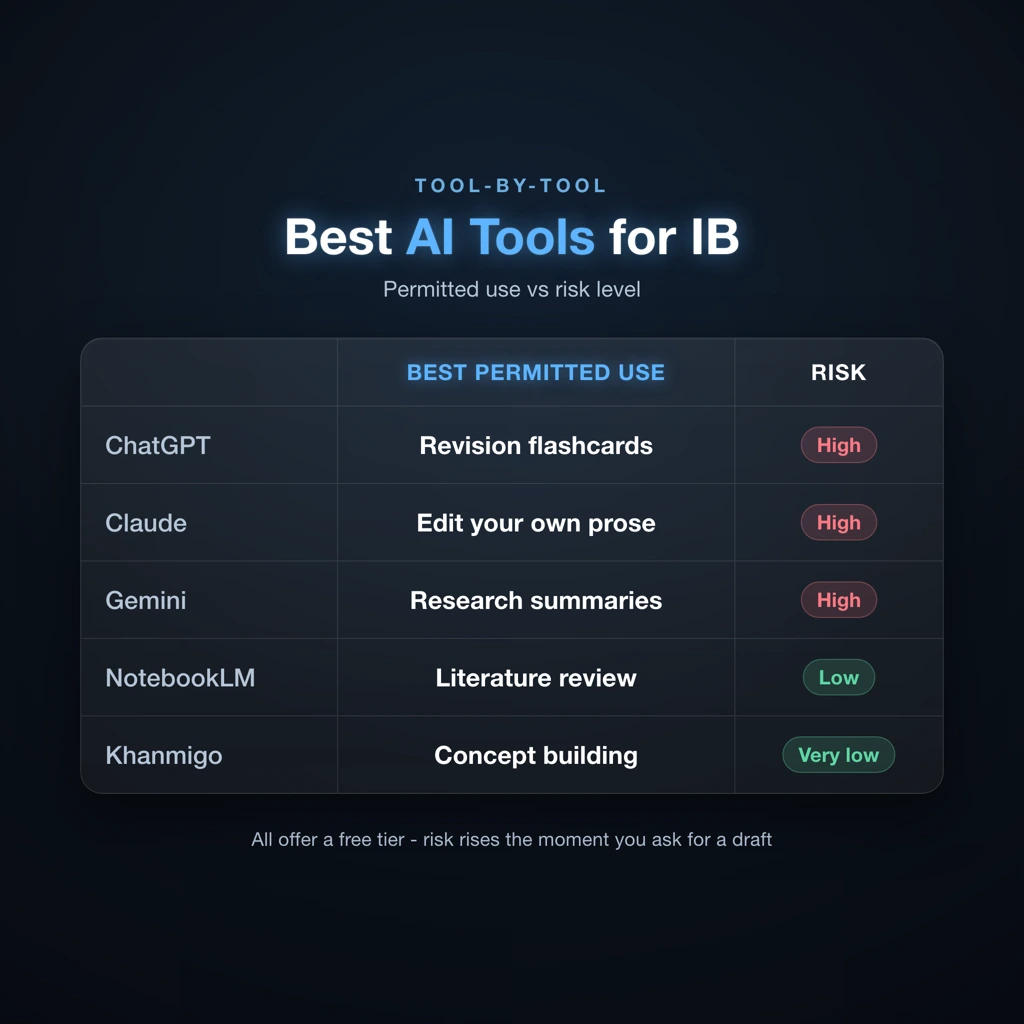
Not all AI tools carry the same risk for IB students. The difference between a permitted use and an academic misconduct referral often comes down to which tool you open and what you ask it to do. Here is how the main options break down.
| Tool | Best Permitted Use | Risk Level | Free Tier? |
|---|---|---|---|
| ChatGPT | Revision flashcards, concept explanations | High for drafting | Yes |
| Claude | Editing your own prose for clarity | High for argument generation | Yes (limited) |
| Gemini | Research summaries with source links | High for drafting | Yes |
| NotebookLM | Literature review on uploaded sources | Low | Yes |
| Khanmigo | Maths and science concept building | Very low | Yes (Khan Academy account) |
ChatGPT
Useful for generating revision flashcards, explaining a concept in simpler terms, or stress-testing your understanding by asking it to quiz you. The risk zone starts the moment you ask it to outline or draft any section of assessed work. The UK Government explicitly names ChatGPT as one of the tools generating concern around inaccuracy and intellectual property in education. Its outputs are also ungrounded: it will confidently cite sources that do not exist, which is a particular hazard for Extended Essay literature reviews.
Claude
Claude's longer context window makes it better than ChatGPT at working with a full draft of your own writing and flagging awkward phrasing or logical gaps. That is a legitimate editing function. The specific gotcha: if you paste in your essay prompt and ask "what arguments could I make here?", Claude will construct a coherent argument structure for you. That structure becomes your assessed work, and the IB's policy treats it as a violation regardless of whether you rephrase the sentences.
Gemini
Named by the UK Government alongside ChatGPT and Microsoft Copilot as a major generative AI tool, Gemini is useful because it can surface real links alongside its summaries, which gives you a starting point for finding genuine sources. The same drafting risks apply as with ChatGPT. Treat its summaries as a signpost to the original paper, not as a substitute for reading it.
NotebookLM
This is the lowest-risk tool on the list for assessed work. You upload your own source documents and it answers only from those, with inline citations pointing back to the exact passage. It cannot hallucinate a reference that is not in your uploaded files. For an Extended Essay literature review, this is the tool most likely to stay within IB guidelines, because the intellectual selection of sources remains yours and the output is traceable.
Khanmigo
Khanmigo is explicitly designed to withhold direct answers. Ask it to solve a maths problem and it will ask you what you have tried so far. That design choice makes it the best option among this list for building genuine understanding in sciences and maths without producing anything you could submit. The counter-intuitive trade-off: students who want a quick answer find it frustrating, but that friction is the feature.
4. AI for the IB Extended Essay: What Helps Without Crossing the Line
The Extended Essay demands original analysis across 4,000 words, and the IB's academic integrity policy is explicit: the work must represent your own abilities. That rules out a large chunk of what AI tools are technically capable of doing. But it still leaves a useful set of preparatory tasks where AI adds genuine value without touching the assessed content.
What you can use AI for:
- Stress-testing your research question. Paste your draft RQ into ChatGPT or Claude and ask whether it is specific, arguable, and answerable within 4,000 words. The model will often expose vagueness you have stopped noticing after weeks of reading.
- Generating a shadow bibliography. Ask an AI to list key texts on your topic, then check that list against your own bibliography. Any gaps are worth investigating. Do not cite sources you found only through AI output without reading them.
- Identifying themes across sources. Upload a batch of PDFs into NotebookLM and ask it to surface recurring arguments or contradictions. This is note-taking assistance, not analysis. The synthesis still has to come from you.
What is banned, with no grey area:
- Drafting any part of the essay body
- Writing your reflective statement on the Reflection and progress form (RPF)
- Producing the abstract
The interdisciplinary EE point worth knowing: from May 2027 you can take an interdisciplinary pathway that integrates knowledge, concepts, theories or methods from two DP subjects. The reasoning about why the two subjects, applied together, answer your question better than either alone has to be your own. AI cannot construct that argument for you, because the IB is assessing your analytical voice, not the plausibility of the framing.
Use AI to prepare and question. Write the essay yourself.
5. AI for IB Internal Assessments: Subject-by-Subject Guidance
The IB's academic integrity policy is consistent across all assessments: work submitted must represent your own abilities, not a tool's. But what that means in practice differs by subject, because the IA task differs by subject.
The table below maps each common IA type to the uses that sit clearly on the right side of that line.
| Subject | Permitted AI use (with disclosure) | Banned |
|---|---|---|
| Computer Science IA | Pasting your own error messages into ChatGPT to understand what went wrong | Submitting AI-generated code as your own |
| Sciences (Biology, Chemistry, Physics) | Asking an AI to explain why a graph shape might look the way it does, as practice before writing your own analysis | Having AI write the data analysis or conclusion sections |
| English / Language A (IO, Written Assignment) | Running your own prose through a grammar checker; asking AI to explain a literary term | AI-generated commentary or argumentative content |
| Maths AA / Maths AI | Using Khanmigo or ChatGPT to understand a method you are stuck on | Submitting AI-produced working, proofs, or calculations |
A non-obvious gotcha for the Computer Science IA: debugging help looks almost identical to code generation in a chat log. If your supervisor asks you to walk through your code verbally and you cannot explain a block you submitted, that is a problem regardless of how the code was originally produced. The safest habit is to reproduce any AI-explained fix yourself, in your own words and your own typing.
For sciences, the counter-intuitive trade-off is that using AI to check your interpretation before you write can actually make the final analysis weaker. If you read an AI explanation first, you are more likely to echo its framing rather than develop your own reading of the data. Use it after you have written a first draft, not before.
The general principle is simple: AI as a thinking partner is usually permissible with disclosure; AI as the author is always banned.
6. AI for TOK Essays and Exhibition: Safe Workflows
TOK is where AI assistance is most tempting and least useful. The assessment criteria reward a personal, exploratory voice, which is exactly what generic AI prose cannot produce.
TOK essays
The prescribed titles are abstract and deliberately open-ended, which makes them hard to interpret on your own. AI handles that interpretive work well, as long as you stay in the driving seat.
Safe uses:
- Unpacking the prescribed title. Ask a tool like Claude to explain what the title is actually asking, then push back on its reading. The friction between your interpretation and the AI's is useful material.
- Generating counter-examples. Ask for real-world cases that complicate your argument. A good counter-example forces you to refine your claim, which is the kind of critical exploration the TOK essay's single holistic mark rewards.
- Self-quizzing on TOK essay criteria. Paste the IB's official assessment rubric and ask the AI to question your draft: "Where does this paragraph fail to engage the knowledge question?" This keeps the thinking yours.
What does not work: asking AI to write any part of the essay. Examiners are experienced readers of IB tok essay examples and the structure of a strong essay produced by a real student. AI-generated prose tends to be declarative where TOK should be tentative, and conclusive where it should be exploratory. It scores poorly precisely because it sounds finished.
TOK exhibition
AI can scan a prompt and suggest real-world objects that connect to it, which is a legitimate starting point when you are stuck. The justification for each object, the link between the object and the core theme, must be your own reasoning. That connection is the entire assessment.
Disclosure
The IB Academic Integrity Policy requires students to produce genuine work representing their own abilities. If you used AI to generate counter-examples or object suggestions, note it in your process notes. The IB frames academic integrity around being a "content creator, not a content imitator," and that distinction applies at the idea-generation stage, not only the writing stage.
7. Practical AI Workflows That Stay Within IB Rules
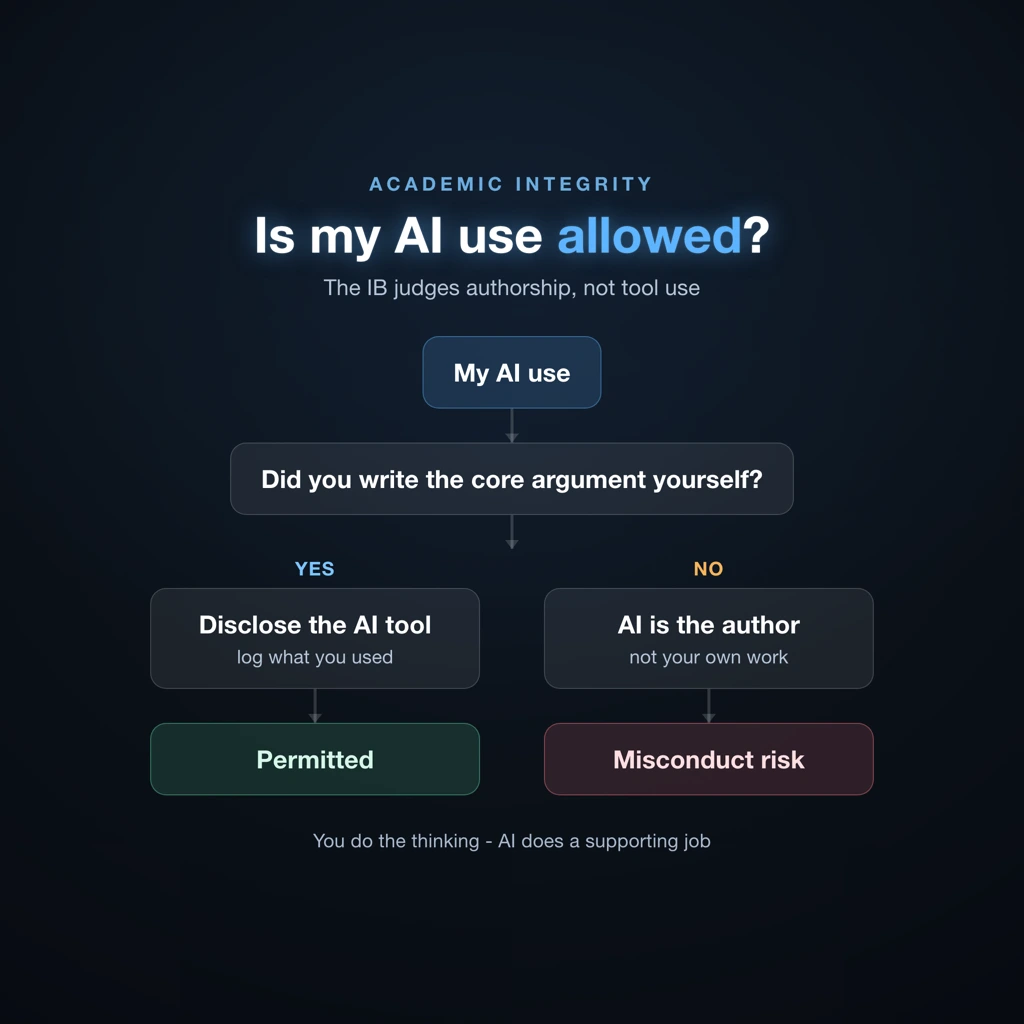
These workflows share a common structure: you do the thinking, the AI does a supporting job you could in principle do yourself (looking something up, checking for gaps, generating practice questions). That distinction matters because the IB's academic integrity framework is built around authorship, not tool use.
Revision flashcard generation. Paste your own notes into ChatGPT or Gemini and ask it to convert them into Q&A pairs. Because the source material is yours, the output is a reformatted version of your own knowledge. The UK Department for Education explicitly lists revision activities as a supported use of generative AI in education.
Concept explanation loops. Ask Khanmigo or Claude to explain a difficult concept, for example wave-particle duality or the Machiavellian realist tradition in TOK. Then close the chat and write the explanation in your own words without looking back. The act of reconstructing it is where the learning happens. If you paste the AI's phrasing into your notes, you have learned nothing and created a disclosure problem.
Essay outline review. Write your own outline first, then paste it and ask: "What arguments am I missing?" The AI acts as a thinking partner, not an author. This is meaningfully different from asking it to write the outline, and the difference is exactly what a TOK marker or EE supervisor will probe.
Spaced repetition via AI. Generate practice questions on your weakest topics, then import them into Anki for spaced repetition drilling. Creating the card deck with AI is permitted; the recall work is entirely yours.
Research gap finder. Upload your EE sources into NotebookLM and describe your research question. Ask: "What does this source set not cover?" This surfaces counterarguments and missing perspectives without generating prose you might accidentally reproduce.
One non-obvious trade-off: AI explanations of concepts are often accurate but shallow. Claude explaining the categorical imperative in two paragraphs will pass a comprehension check but rarely surfaces the nuance a HL Philosophy examiner expects. Use AI to get oriented, then go to the primary text.
8. The Detection Reality: What Schools Actually Check
Schools increasingly use AI detection tools, with Turnitin's AI detection layer being the most widely adopted in UK settings. The UK Department for Education notes that evidence on AI detection accuracy in education settings remains limited, which matters in both directions: false positives flag authentic student work, and false negatives let AI-generated text through unchallenged.
The counter-intuitive gotcha here is that detection tools are not reliable enough to be useful to either party. Students who think a clean Turnitin score confirms they are safe are wrong. Schools that treat a high AI-probability score as proof of misconduct are also on shaky ground.
The more consequential risk is academic, not procedural. IB examiners are trained to reward specific qualities that generic AI output consistently fails to produce:
- Reflection (Criterion E) in the Extended Essay rewards a reflective statement that evaluates your own learning with specific examples, not a plausible-sounding summary.
- Analysis and Evaluation marks in Internal Assessments are awarded for precise, subject-specific reasoning tied to named data or texts.
- TOK essays are marked holistically, out of 10, on how clear, coherent and critical your exploration of the title is, and generic AI text flattens exactly that.
What experienced IB coordinators actually flag in suspect submissions includes sudden style shifts between paragraphs, claims without grounded evidence, and a notable absence of personal voice. The IB frames academic integrity around students being "content creators, not content imitators", and examiners apply that standard through the marking criteria long before any misconduct process begins.
The practical takeaway: build your integrity argument on your actual process, not on whether a detection tool raises a flag.
9. Where to Go from Here
Start this week by downloading the IB Academic Integrity Policy PDF from the IBO website, then check your own school's AI addendum separately. Many IB World Schools have added local rules that are stricter than the IBO minimum, and your school's version is the one that counts when an examiner or coordinator reviews your work.
One non-obvious point: the IB policy page was last updated in February 2026, so any guidance you saved from a previous academic year may already be out of date. Treat your school coordinator as the authoritative source, not a cached PDF.
For the work ahead, see the related guides on IB Extended Essay guidelines, IA requirements by subject, and TOK essay structure and criteria. Email your IB coordinator this week and ask directly whether your school has a written AI addendum.
FAQ
Can IB students use ChatGPT for their Extended Essay?
ChatGPT is permitted for brainstorming and testing research questions, but generating any essay text and submitting it as your own is academic misconduct under the IB Academic Integrity Policy - disclosure is required even for permitted uses.
What AI tools are free for IB students?
ChatGPT, Google Gemini, NotebookLM, and Khanmigo all have free tiers or free access; Claude's free tier has usage limits but is accessible without a subscription.
Does the IB check for AI-generated content?
IB schools commonly use tools like Turnitin's AI detection layer, but detection accuracy is limited; the more immediate risk is that AI-drafted work lacks the personal analytical voice IB examiners are trained to reward, which costs marks directly.
Can I use AI to help with my IB Internal Assessment?
AI can be used as a thinking partner - for example, debugging code in a CS IA or explaining concepts in a Maths IA - but the analysis, argument, and written work must be your own, and any AI use must be disclosed.
What does the IB Academic Integrity Policy say about AI?
The IB requires students to produce genuine, authentic work representing their own abilities, framing the ideal as being a 'content creator, not a content imitator'; AI can support learning but not replace the student's own intellectual contribution.
Is Khanmigo safe to use for IB study?
Khanmigo is designed to guide reasoning rather than provide answers, making it the closest thing to a policy-compliant AI tutor for IB Diploma Programme students working through maths, science, or TOK concepts.
References
- Academic Integrity - International Baccalaureate® - https://ibo.org/about-the-ib/what-it-means-to-be-an-ib-student/responsibilities-of-students-and-ib-world-schools/academic-integrity/
- Generative artificial intelligence (AI) in education - GOV.UK - https://www.gov.uk/government/publications/generative-artificial-intelligence-in-education/generative-artificial-intelligence-ai-in-education
- DP extended essay updates - International Baccalaureate - https://www.ibo.org/university-admission/latest-curriculum-updates/dp-extended-essay-updates/