Is IB Worth It? An Honest Guide for UK Students
By Michael Thompson · Education Specialist; 10 years teaching the IB at Bromsgrove School · Published 21 May 2026 · Updated 12 June 2026
Is IB worth it - or is it two years of unnecessary stress for a qualification most UK universities treat the same as A-Levels? The International Baccalaureate Diploma Programme is a two-year pre-university curriculum taken by students in over 150 countries, requiring six subjects across a broad range plus a core of Theory of Knowledge, an Extended Essay, and Creativity, Activity, Service hours. For the right student, it opens doors at competitive universities worldwide and builds genuine intellectual range. For the wrong student, it is a burnout machine with a demanding workload that offers little advantage over a focused set of A-Levels. This guide gives you the honest trade-offs.
Key Takeaways
- Breadth is the defining feature: IB students study six subjects simultaneously across sciences, humanities, languages, and maths - unlike A-Levels, which typically cover three.
- UCAS points exist but vary by grade: An IB total score converts to UCAS Tariff points, so universities can compare IB applicants directly with A-Level candidates, though entry requirements are set course by course.
- Top universities actively recruit IB students: Russell Group universities and leading institutions worldwide accept the IB Diploma, and many publish specific IB grade requirements alongside A-Level offers.
- The workload is genuinely heavier: The combination of six subjects, TOK, Extended Essay, and CAS commitments means IB students consistently report higher weekly study hours than A-Level peers.
- Specialist students may be disadvantaged: If you know you want to study a single science or creative subject, three A-Levels allow deeper focus and often stronger predicted grades in those subjects.
- International mobility is a real advantage: The IB Diploma is recognised as a university entrance qualification in the US, Canada, Australia, and most of Europe, making it uniquely portable.
In This Article
- What Is the IB Diploma Programme and How Does It Work?
- IB UCAS Points Conversion: What Your Score Is Actually Worth
- International Baccalaureate Diploma University Recognition in the UK and Abroad
- IB vs A-Levels Difficulty: The Honest Workload Reality
- Benefits of the IB Diploma Programme Beyond the Grade
- IB Workload, Stress, and the Burnout Risk Nobody Puts in the Brochure
- Who Benefits Most from the IB Diploma?
- Who Should Consider A-Levels or Other Alternatives Instead?
- Is the IB Certificate Worth Anything Without the Full Diploma?
- What to Do Next
1. What Is the IB Diploma Programme and How Does It Work?
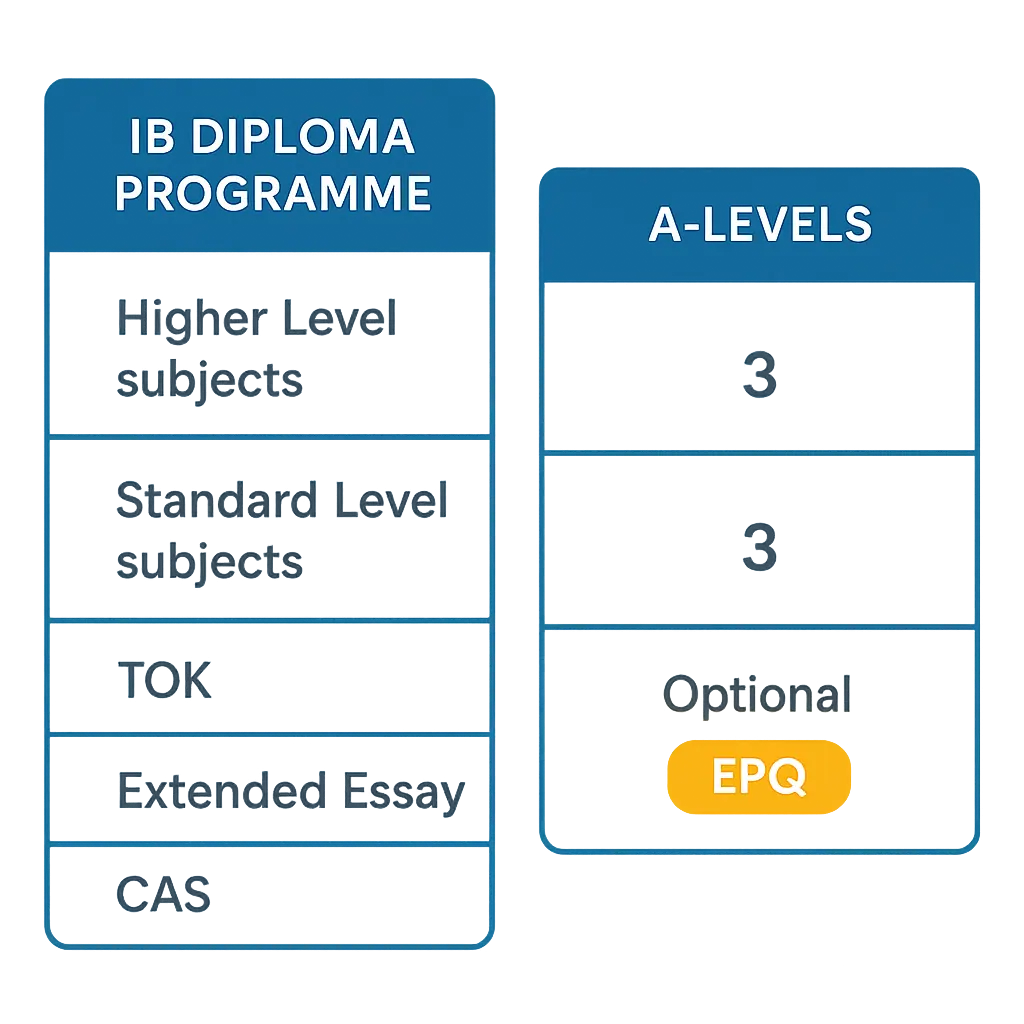
The International Baccalaureate Diploma Programme is a two-year pre-university qualification taken by students aged 16 to 19, and whether is ib worth it is one of the most genuinely contested questions in UK sixth-form education. Unlike A-Levels, which let you specialise in three or four subjects, the IB Diploma requires study across six subject groups simultaneously, making the breadth of the programme its defining feature and its main source of difficulty.
The six subjects split into three Higher Level (HL) and three Standard Level (SL) courses. HL subjects demand roughly 240 teaching hours each; SL subjects around 150. Beyond the six subjects, every Diploma candidate must complete three core components:
- Theory of Knowledge (TOK) - an interdisciplinary course examining how and why we claim to know things
- Extended Essay (EE) - an independent 4,000-word research paper on a subject of the student's choice
- CAS (Creativity, Activity, Service) - a portfolio of extracurricular projects, not graded but compulsory
The scoring system runs to a maximum of 45 points: up to 42 from the six subjects (7 points each) and up to 3 bonus points from the combined TOK and EE assessment. The minimum threshold to be awarded the Diploma is 24 points, with no individual subject score falling below a 2 at HL or 1 at SL.
One non-obvious gotcha: a student can score 28 points overall but still fail the Diploma outright if they receive a grade 1 in any subject or miss the minimum grade conditions at HL. The number alone does not guarantee the qualification.
Students who pass individual IB subjects without completing the full Diploma receive IB certificates rather than the Diploma. Most UK universities treat these certificates as equivalent to a subject-level qualification rather than a full pre-university programme, which significantly limits their value for competitive admissions compared to the full award.
2. IB UCAS Points Conversion: What Your Score Is Actually Worth
Your IB total score (out of 45) maps to UCAS Tariff points, which puts you on the same scale as A-Level applicants when universities compare offers. The full conversion table is published by UCAS in their tariff tables - check that document directly for the current point values, since the figures are updated periodically and quoting a number here risks being out of date.
One thing worth understanding: the tariff is a comparison tool, not an admissions offer. A course that asks for 120 UCAS points might express that as three B grades at A-Level for one applicant and a specific IB total for another. Those two requirements are not always mathematically equivalent once you sit down and work through the conversion.
The more significant gotcha is that most Russell Group and specialist courses publish a separate, named IB requirement alongside their A-Level offer. A medical school might ask for 38 IB points with 6,6,6 at Higher Level, regardless of what the tariff says the equivalent is. The tariff does not override that.
Practical rule: treat the UCAS tariff as a rough orientation, then go directly to each university's course page and look for the line that says "IB requirements." That figure is the one that matters for your application.
3. International Baccalaureate Diploma University Recognition in the UK and Abroad
Every UK university accepts the IB Diploma, including the full Russell Group. Oxford, Cambridge, LSE, and Imperial College London each publish specific IB entry requirements on their admissions pages, often listing both a total points threshold and mandatory Higher Level subject grades. This matters in practice: a 38-point IB score does not automatically open the same doors as a 38-point score with HL Chemistry at 6 for a science degree. The subject-level conditions are where offers get declined.
One counter-intuitive detail many students miss: some competitive UK courses set IB subject requirements that are harder to meet than the equivalent A-Level conditions for the same programme. If you are aiming for a specific department, check the subject-level requirements, not just the headline points total.
Beyond the UK, the Diploma is recognised for undergraduate admissions in the United States, Canada, Australia, and across most of Europe. Students applying to US universities also benefit from the IB's credit and advanced standing policies at many American institutions, which can reduce time-to-degree. For internationally mobile students, that portability is a genuine structural advantage.
For students who are certain they will apply to UK universities only, that international recognition is real but may never be relevant to them personally. The Diploma still carries weight at home. The portability is simply a feature that rewards a particular type of ambition.
4. IB vs A-Levels Difficulty: The Honest Workload Reality
The structural gap is straightforward: A-Level students typically study three subjects in depth, while IB Diploma candidates study six simultaneously, spread across the sciences, humanities, maths, arts, and two languages. On top of that, every IB student must complete a 4,000-word Extended Essay, a Theory of Knowledge essay and exhibition, and around 18 months of CAS (Creativity, Activity, Service) activity. None of those are optional extras. They are pass conditions.
That breadth carries a less-discussed trade-off. Because your week is divided across six subjects plus three core components, the time available to master any single one shrinks. An A-Level student specialising in Chemistry, Maths, and Biology can spend concentrated hours on past papers in those subjects. An IB student studying the equivalent at Higher Level must also keep French B and History ticking over, regardless of how the mocks went.
The IB's mandatory structure is also its biggest trap for students with an uneven subject profile. At A-Level, a student who is weak in one chosen subject can drop it after AS or simply focus elsewhere. The IB does not allow that. A poor grade in a Standard Level subject you considered a filler can pull your total points below the diploma threshold.
Roughly one in five IB candidates worldwide does not earn the full Diploma. That is not a small number for a qualification marketed on its rigour. The failure mode is almost never the Extended Essay or TOK. It is usually a combination of a struggling SL subject and underestimating the points floor required across all six grades simultaneously.
A-Level students face real pressure too, and a badly managed A-Level year is no easier emotionally. But A-Levels let you concentrate. The IB does not.
5. Benefits of the IB Diploma Programme Beyond the Grade
The grade matters, but it is not the whole story. Several structural features of the IB Diploma Programme give students something A-levels simply do not offer, and those features have real downstream effects on university and early career performance.
Academic breadth is the most obvious advantage. IB students study science, humanities, a second language, and mathematics simultaneously across two years. The practical consequence is that a student who wants to study PPE at university has not dropped science at 16, and a prospective medic has not abandoned essay writing. That cross-disciplinary grounding is visible in university coursework from the first term.
Theory of Knowledge (TOK) is genuinely unusual at pre-university level. It teaches students to interrogate how claims are made across different disciplines, not just what those claims are. This is directly useful in essay-heavy courses like philosophy, law, and history, where markers reward epistemic awareness, not just content recall.
The Extended Essay is the closest most students get to independent research before university. Writing a 4,000-word argument on a self-chosen question, under supervisor guidance, mirrors the dissertation process more closely than any A-level coursework unit. Students applying to dissertation-heavy degrees, particularly in the humanities, often cite it as practical preparation rather than exam padding.
One counter-intuitive point: because the Extended Essay demands a narrow, arguable thesis, students who treat it as a long essay rather than a structured argument often score poorly despite producing more words. The IB is explicit that scope control matters.
International recognition adds optionality. Students uncertain whether they will apply to UK, US, or European universities can do so from a single qualification, without strategic compromise.
Some consulting and finance graduate recruiters acknowledge the IB as a rigour signal, though A-level grades at the same institutions carry equivalent weight.
6. IB Workload, Stress, and the Burnout Risk Nobody Puts in the Brochure
The IB Diploma is not a heavy A-level load with a couple of extras bolted on. Six subjects across two years, plus the Theory of Knowledge course, the Extended Essay (a 4,000-word independent research paper), and CAS, means that genuinely light weeks are rare from September of Year 12 through to May of Year 13.
CAS is the part students consistently underestimate. Creativity, Activity, Service requires documented evidence of ongoing extracurricular engagement across all three strands. It is not a box you tick once. You need to record reflections, gather supervisor sign-offs, and demonstrate personal development over time. Students who leave CAS logging to the second half of Year 13 often find themselves scrambling to meet the IB's requirements at exactly the point when exam revision should be their priority.
The less obvious cost is opportunity cost. Hours spent on CAS and TOK preparation are hours not available for deepening knowledge in a subject you want to study at degree level, taking a part-time job, or simply recovering. A student aiming for Medicine who would benefit from hospital shadowing may find CAS absorbs the evenings that shadowing would otherwise fill.
Three warning signs that the IB may not be a good fit:
- You found managing three high-grade GCSEs alongside activities genuinely stretching, rather than stimulating.
- Your strongest interest is narrowly focused on one or two subjects and the breadth requirement feels like a distraction rather than an opportunity.
- Your school has a small IB cohort or limited dedicated IB teaching staff. The quality of TOK and Extended Essay supervision varies sharply between schools, and weaker support infrastructure increases the workload burden on the student.
The IB rewards students who find breadth energising. For those who do not, the workload does not become easier with enthusiasm alone.
7. Who Benefits Most from the IB Diploma?
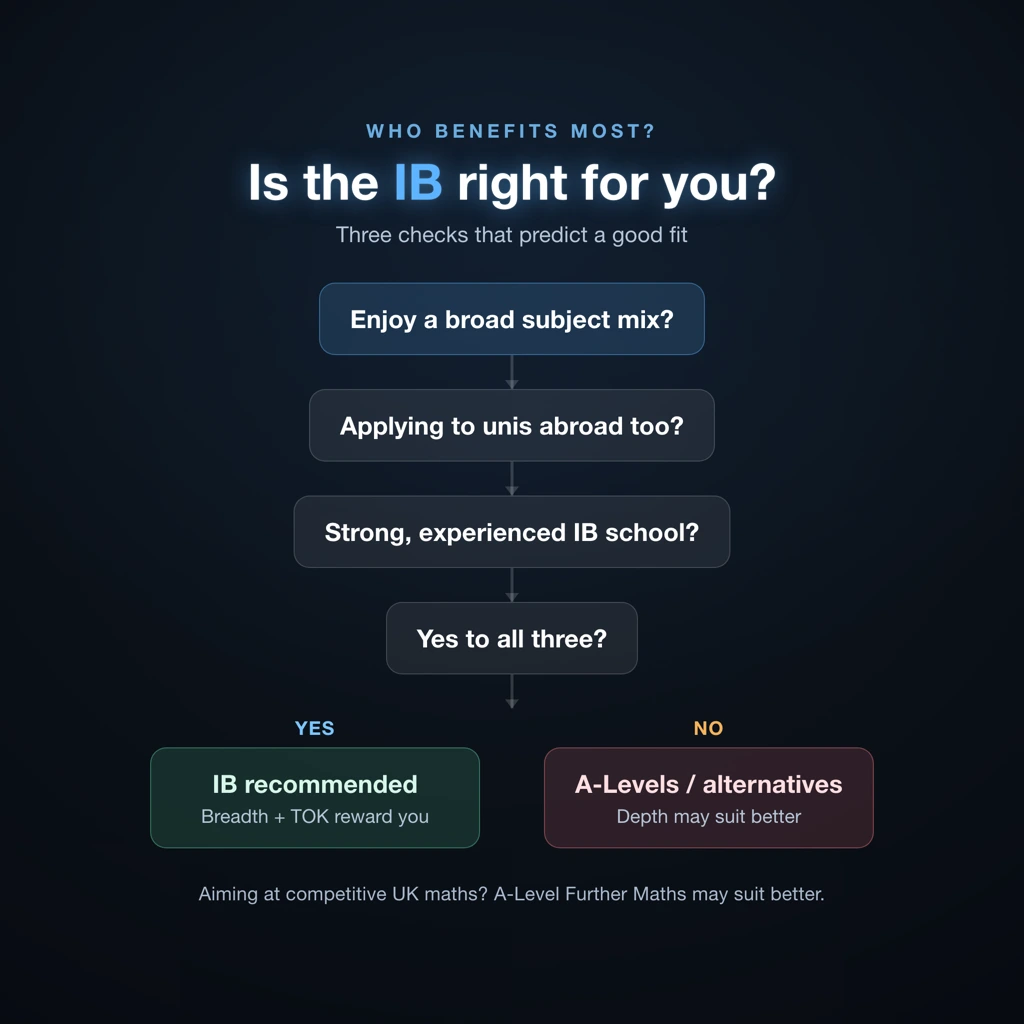
The IB suits a specific type of student. It is not a prestige upgrade on A-Levels for everyone, and fitting the wrong profile is one of the cleaner predictors of a difficult two years.
Academically broad students are the clearest fit. If you genuinely enjoy literature, a science, and a language equally, three A-Levels force you to drop two of them at 16. The IB keeps all three active, which can feel like relief rather than burden.
Students targeting universities across multiple countries get a practical advantage from the IB's international recognition. A single set of results is accepted by admissions systems in the US, Canada, Australia, and across Europe, where A-Level equivalency can require extra documentation or explanation.
Students at well-resourced IB World Schools see significantly better outcomes than those at schools running the programme with stretched or inexperienced staff. The Extended Essay, in particular, depends heavily on a knowledgeable supervisor. A school that has run IB for a decade handles the internal assessment moderation process differently from one in its first cycle, and that gap shows up in results.
Students who find the Theory of Knowledge genuinely interesting rather than an admin obligation tend to thrive. TOK rewards students who notice connections across disciplines. Students who treat it as a box to tick often find it the most draining part of the programme.
One counter-intuitive point: strong mathematicians who would have taken A-Level Further Mathematics sometimes find IB Maths: Analysis and Approaches (Higher Level) narrower in pure content than the A-Level equivalent, which matters for competitive UK mathematics applications.
8. Who Should Consider A-Levels or Other Alternatives Instead?
The IB is not the right call for every able student. In some situations, a different qualification gets you further.
If you have a tight specialism, three A-Levels with an EPQ (Extended Project Qualification) is a stronger package than the IB's mandatory breadth. A student aiming for medicine can take Biology, Chemistry, and Maths at A-Level through AQA or OCR, then use the EPQ to demonstrate independent research, without spending significant time on a second language or Theory of Knowledge. Medical schools read A-Level subject combinations daily; the EPQ is well understood as a differentiator.
If your school has a small or new IB cohort, think carefully. IB teaching quality is highly dependent on trained staff and institutional experience. A school running the Diploma Programme with fewer than one form's worth of students typically has fewer specialist IB teachers and less internal moderation practice, which directly affects predicted grades.
If you are managing mental health difficulties or significant caring responsibilities, the IB's non-negotiable breadth is a structural problem. You cannot drop Theory of Knowledge or CAS when things get hard. A-Levels allow you to reduce to two subjects in a crisis without losing the qualification.
Other routes worth knowing:
- BTECs (Pearson/Edexcel) for vocational or creative fields, including Art and Design
- Scottish Highers and Advanced Highers (SQA) for students in Scotland, which carry their own UCAS tariff
- Cambridge Pre-U for those who want academic rigour and extended essays without the IB's compulsory breadth requirements
9. Is the IB Certificate Worth Anything Without the Full Diploma?
If you complete individual IB subjects but do not finish the full Diploma, you receive IB certificates for those subjects. The honest answer on their value at UK universities: limited.
Most UK universities specify the full IB Diploma as their entry requirement. Individual subject certificates sit in an awkward gap. They are not equivalent to A-Levels, and admissions teams have no standard framework for converting a handful of subject scores into an offer. A small number of universities will consider certificates alongside other qualifications on a case-by-case basis, but this is the exception, not the policy.
One non-obvious quirk: students who narrowly miss the overall Diploma but pass all individual subjects still receive those certificates. The total is not the same as the sum of its parts in admissions terms, because the Diploma requires passing the core (Theory of Knowledge, Extended Essay, and CAS). Failing the core alone can cost you the Diploma even with strong subject scores.
If you start the IB and begin to struggle, contact admissions tutors at your target universities directly, before results day, to ask how they treat incomplete Diplomas. Do not assume the certificates will cover you.
The practical takeaway is straightforward: the certificate is not a meaningful fallback. Committing to the IB means committing to the full programme. If that commitment feels genuinely uncertain, Section 8 of this guide covers the alternatives worth considering instead.
10. What to Do Next
Whether the IB is worth it comes down to two things: whether your subject interests suit the programme's breadth, and whether the school delivering it has the staffing to back that up. Cohort average scores and teacher IB-training vary sharply between schools, and those gaps matter more than any brochure claim.
This week, email the IB coordinator at each school you're considering and ask two specific questions: what was the cohort's average Diploma score last year, and how many subject teachers hold IB category-1 or category-2 training? A school that can't answer both questions clearly is worth treating with caution.
Then check individual university course pages directly. UCAS tariff tables give a rough conversion, but many Russell Group courses publish their own IB subject and level requirements that the tariff alone won't capture.
If you're still weighing your options, read our guides on A-Level subject choices, the UCAS application timeline, and whether an EPQ might suit you as a standalone qualification.
FAQ
Is the IB worth it for UK university applications?
Yes, the IB Diploma is accepted at all UK universities and Russell Group institutions publish specific IB grade requirements, but whether it gives an advantage over A-Levels depends on your subject choices, target courses, and ability to manage a broad workload.
Is IB worth the stress?
For students who thrive on breadth and are well-supported, the IB's workload is manageable; for those with a narrow specialism or limited school support, the mandatory breadth and core requirements create significant pressure with little payoff.
Is IB worth it over AP?
The IB Diploma is a full standalone qualification recognised globally, while AP courses are individual exams that supplement another curriculum; for UK students the choice rarely arises, but internationally mobile students often find the IB's single credential more portable than a collection of AP scores.
Is the IB certificate worth anything without the full Diploma?
IB subject certificates without the full Diploma have limited recognition at UK universities, most of which require the complete Diploma - so if you cannot complete all requirements, discuss your options with admissions tutors early.
Is IB worth the money?
IB schools often charge fees or exist in the independent sector, so the cost question is real - the value depends on the quality of the school's IB programme and whether the international portability of the Diploma is genuinely useful for your plans.
Is IB actually harder than A-Levels?
Structurally yes: IB students study six subjects plus TOK, a 4,000-word Extended Essay, and around 18 months of CAS, compared with typically three A-Level subjects, which means less time to specialise and fewer opportunities to recover from a weak subject.
References
- https://www.ucas.com/sites/default/files/new-tariff-tables.pdf - https://www.ucas.com/sites/default/files/new-tariff-tables.pdf