EPQ UCAS Points: What Each Grade Is Worth and Who Counts It
By Michael Thompson · Education Specialist; 10 years teaching the IB at Bromsgrove School · Published 24 October 2026 · Updated 25 October 2026
The Extended Project Qualification earns UCAS Tariff points on the same scale as every other Level 3 qualification: A* 28, A 24, B 20, C 16, D 12, E 8. Because the EPQ is half the size of an A-level, those points are roughly half what the equivalent A-level grade would earn. What matters most is understanding when those points actually count toward an offer - and when the EPQ is doing something more useful than adding to a points total.
Key Takeaways
- Points are fixed across all boards: AQA, Pearson Edexcel, OCR, and WJEC all award the same UCAS Tariff ladder: A* 28, A 24, B 20, C 16, D 12, E 8.
- The EPQ is worth half an A-level: AQA describes it as 'worth half an A-level', so even an A* earns 28 points rather than the 56 an A-level A* attracts.
- Not every course counts the points: UCAS makes clear that a qualification appearing on the Tariff does not guarantee it will count toward any specific course's entry requirements.
- Alternative offers matter more than raw points: Many universities make lower A-level grade offers to students with a strong EPQ - a grade reduction is often worth more than 28 extra Tariff points.
- Even a D or E earns points: A D is worth 12 Tariff points and an E is worth 8 - both count wherever a course accepts EPQ in its points total.
- The skills argument is stronger than the points argument: The EPQ's value in a personal statement and university interview typically outweighs its Tariff contribution for most applicants.
In This Article
- EPQ UCAS Points by Grade: The Full Tariff Table
- How EPQ UCAS Points Compare with an A-Level
- Does an EPQ Count Towards UCAS Points? When It Does and When It Doesn't
- Alternative Offers and Other Ways Universities Use the EPQ
- How the EPQ Is Assessed: A Brief Board-by-Board Overview
- Common Questions About EPQ UCAS Points Answered
- What to Do Next
1. EPQ UCAS Points by Grade: The Full Tariff Table
The EPQ UCAS points ladder is the same on every board: a maximum of 28 points at A*, down to 8 points at grade E. Every pass grade earns UCAS Tariff points, and below E is unclassified with no points awarded. AQA and WJEC publish the full ladder; OCR and Pearson Edexcel both state that the qualification is worth up to 28 UCAS points.
| Grade | UCAS Tariff points |
|---|---|
| A* | 28 |
| A | 24 |
| B | 20 |
| C | 16 |
| D | 12 |
| E | 8 |
| U | 0 |
The EPQ is classified as half an A-level in size. AQA describes it as "worth half an A-level", OCR confirms it carries "up to 28 UCAS points in the new tariff", and Pearson states plainly that "the grade you receive is worth up to 28 UCAS points." All four boards put the qualification at 120 guided learning hours (OCR also gives a Total Qualification Time of 120 hours), split between a taught element and independent work.
One non-obvious consequence of that half-size status: a grade D in the EPQ (12 points) still adds measurable weight to a UCAS application, which matters when a course specifies a minimum points total. However, many university offers are expressed in letter grades rather than points totals, so whether EPQ UCAS Tariff points are counted at all depends entirely on how a specific course frames its entry requirements. "Adds UCAS points" and "changes your offer" are two different things, and later sections cover each in turn.
2. How EPQ UCAS Points Compare with an A-Level
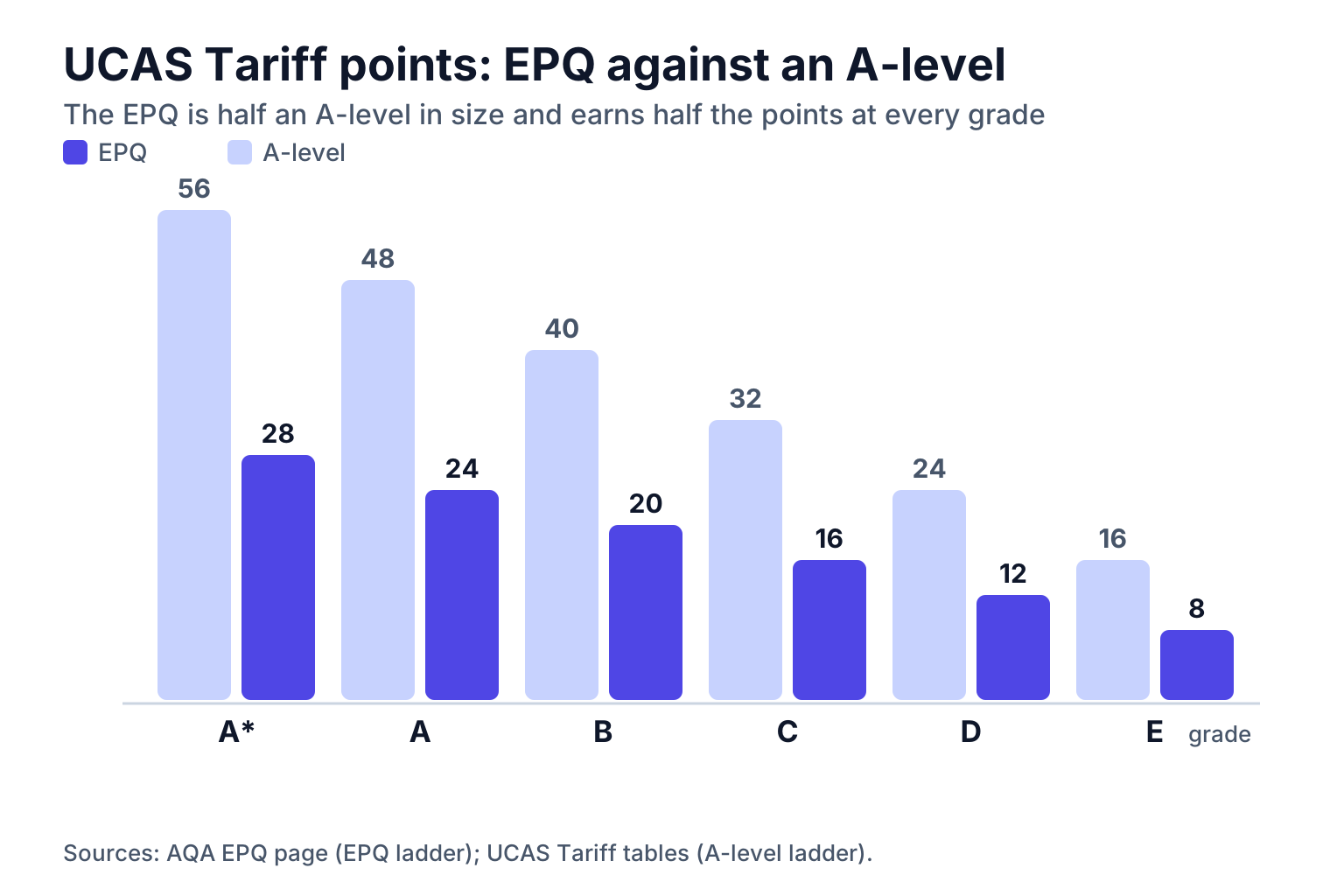
The EPQ earns exactly half the UCAS Tariff points of the equivalent A-level grade. AQA describes the qualification as "worth half an A-level", and the points ladder reflects that precisely.
| Grade | A-level Tariff points | EPQ UCAS points |
|---|---|---|
| A* | 56 | 28 |
| A | 48 | 24 |
| B | 40 | 20 |
| C | 32 | 16 |
| D | 24 | 12 |
| E | 16 | 8 |
*A-level values from the Tariff tables linked from UCAS's Tariff page; EPQ values per AQA's EPQ page.*
The practical implication is worth spelling out. An EPQ A* adds 28 EPQ UCAS points, which is meaningful if a course sets a points threshold and you are sitting 10-20 points below it. It does not, however, turn one A-level grade into another. A student holding AAB (136 points) who adds an EPQ A* reaches 164 points on the Tariff, but a course that asks for AAA in grades still sees AAB, because the EPQ cannot stand in for an A-level grade unless the university says it can.
The counter-intuitive part: UCAS notes that a qualification's Tariff value "will vary dependent on the qualification size, and the grade you achieved", which is exactly why the EPQ sits where it does. Size matters as much as grade. An EPQ E (8 points) still earns Tariff points, but it earns fewer than an A-level E.
Where a course specifies entry in grades rather than points, EPQ UCAS points carry no direct weight at all. The points matter only when a provider actively uses the Tariff in its offer conditions.
3. Does an EPQ Count Towards UCAS Points? When It Does and When It Doesn't
The short answer is: it depends on how the university sets its entry requirements. As UCAS states, "some universities, colleges, and conservatoires refer to UCAS Tariff points in their course entry requirements" - but not all of them do, and that distinction matters.
Two separate questions are worth keeping apart:
- Does the EPQ add to your UCAS Tariff total? Yes, always - an A* adds 28 points, an E adds 8. But this only helps if the course specifies a points-based entry requirement. If the course asks for a points total (say, 128 points from three qualifications), your EPQ grade feeds directly into that calculation.
- Does the EPQ change the specific offer you receive? Only if the university has an explicit EPQ policy - such as offering a lower A-level grade in exchange for a strong EPQ result. That is a separate arrangement from the Tariff, and it is covered in section 4.
The catch is that most offers at selective universities are made in grades, not points - the standard format is something like AAB, not 128 points. For those offers, the EPQ's Tariff value is irrelevant. Holding an A-grade EPQ does not convert into a grade reduction unless the university has confirmed that policy in writing.
UCAS also notes that appearing on the Tariff does not guarantee a qualification will count toward entry requirements for any specific course, even where a provider uses Tariff points.
The practical step: check the specific course page and the UCAS course search. Look for whether the entry requirements list a points total, and whether the EPQ is named separately. If neither appears, assume the Tariff value will not influence your offer.
4. Alternative Offers and Other Ways Universities Use the EPQ
The points on the UCAS Tariff are not the most important thing the EPQ does for a university application. For many students, the bigger gain comes from what universities do before they look at results day grades.
Alternative (lowered) A-level offers
Some universities use the EPQ as grounds to adjust the A-level grades they ask for. AQA's specification notes that "many universities make lower A-level offers to students undertaking an EPQ." The WJEC EPQ student guide cites two specific examples:
- Newcastle University is quoted as saying that if you offer the Extended Project, "Your offer may be varied as a result, in recognition of the level of study skills you will have developed."
- UCL is quoted as saying that, for students presenting A levels, it "will be accepting a pass in the Extended Project as an alternative to the need to offer a pass in a fourth AS level."
Both quotations come from WJEC's 2021 student guide, and neither represents a guaranteed current policy. University entry requirements change year on year, and different courses within the same university often have different rules. Check the specific course page directly before you plan an application around a lower offer.
The EPQ as evidence of independent study
The counter-intuitive point here is that an EPQ can carry more weight in a personal statement or an interview than the 28 points it adds to your Tariff total. It gives you a concrete research question you chose, defended, and evaluated, which is a structured talking point that generic A-level content rarely provides. Admissions tutors can ask about it directly. An A-level grade tells them you passed an exam; an EPQ shows how you work when nobody is guiding every step.
That combination, points on the Tariff and evidence of academic independence, is why many students find the EPQ worth the time even when their target course does not advertise a formal alternative offer.
5. How the EPQ Is Assessed: A Brief Board-by-Board Overview
All four UK boards share the same four assessment objectives (AOs), and the weighting is consistent: AO3 carries the most marks on every board, roughly double the allocation of any other objective.
- AO1 Manage - plan and manage the project
- AO2 Use Resources - select, use, and reference information and sources
- AO3 Develop and Realise - the production of the actual outcome (essay, artefact, performance, or investigation)
- AO4 Review - evaluate the process and outcome
The practical implication: a student who writes a polished dissertation but keeps a scrappy project log is handing back the marks that are easiest to control.
AQA (7993)
The AQA specification sets a total of 50 marks: AO1 10, AO2 10, AO3 20, AO4 10. Grades run A* to E; below E is unclassified. AQA recommends 30 guided learning hours for the taught skills element of the project.
Pearson Edexcel
The Pearson Edexcel student guidance gives the marks for each objective - AO1 9, AO2 12, AO3 24, AO4 9 - and the specification (Issue 4) puts them at 17%, 22%, 44% and 17% of a 54-mark total. Students have 120 hours to complete the qualification. Four routes are available:
- P301 Dissertation
- P302 Investigation/Field Study
- P303 Performance
- P304 Artefact
Pearson's guidance suggests framing the working title as a clear, arguable question for a Dissertation, a testable hypothesis for a Field Study/Investigation, and a commission brief or a design brief for the Performance and Artefact routes respectively.
OCR (H857)
The OCR H857 specification totals 60 marks. AO1, AO2, and AO4 are each worth 12 marks; AO3 is 24 marks. Permitted outcomes are a dissertation (approximately 5,000 words), a report, an artefact, or a performance or event. Non-written outcomes must be accompanied by at least 1,000 words of written work. Total Qualification Time is 120 hours. The Project Progression Record (PPR) is the central tracking document that runs from initial planning through to the final evaluation and must be submitted for moderation.
One notable point: the Verification of Topic and Title (VTT) form must not be sent to OCR at any stage, and project titles must be approved by the centre, not assigned by it.
WJEC
The WJEC Level 3 Extended Project specification (April 2023) uses a 100-mark framework spread across eight learning outcomes, two per AO; the WJEC student guide covers the submission requirements:
| AO | Learning Outcomes | Marks |
|---|---|---|
| AO1 Manage | LO1 + LO2 | 20 |
| AO2 Use Resources | LO3 + LO4 | 20 |
| AO3 Develop and Realise | LO5 + LO6 | 40 |
| AO4 Review and Communicate | LO7 (presentation) + LO8 (evaluation) | 20 |
A dissertation or field study must be at least 5,000 words. An artefact, design, performance, or creative writing outcome requires Project Outcome Notes of at least 1,500 words. The final presentation is to a non-specialist audience and, as a guide, should take around 20 to 30 minutes including questions. Core submission documents are the Candidate Assessment Record and the Candidate Production Record.
WJEC is the only board to give the presentation its own numbered learning outcome (LO7, 10 marks), but the presentation is assessed under AO4 on every board - Pearson's specification says so in terms - so preparation for the Q&A session is mark-bearing whichever board you are on.
6. Common Questions About EPQ UCAS Points Answered
Does a D or E still earn EPQ UCAS points?
Yes. The full tariff runs A* = 28, A = 24, B = 20, C = 16, D = 12, E = 8, according to both AQA and the WJEC student guide. Only a result below E is unclassified and earns nothing. So even a borderline pass contributes something to a points-based offer.
Does the EPQ replace an AS-level in UCAS points terms?
Not quite. The WJEC guide is precise here: the EPQ is worth 50% of an A-level, while an AS-level is worth 40%. Grade for grade, the EPQ therefore carries more Tariff weight than an AS-level (and the EPQ has an A* grade, which the AS does not). Whether a university treats them as interchangeable is a separate question answered by its own admissions policy, not by the Tariff alone. Check each course page directly.
Can you drop the EPQ after applying?
Centre entries are managed by your school or college, and each centre decides how and whether withdrawals are handled. If you are thinking about withdrawing, speak to your centre coordinator before taking any action.
Is the EPQ worth doing only for the EPQ UCAS points?
Probably not, if that is your only reason. The maximum of 28 points matters most where a course sets a points threshold, but many competitive offers are made in grades, not points, so the ceiling is limited in practice. The skills developed across 120 guided learning hours and the concrete topic you bring to an interview tend to be the larger gains for most applicants.
7. What to Do Next
The critical thing to check is not whether your EPQ earns Tariff points (it does), but whether each course you are applying to actually uses those points. A course that states a grades-based offer, such as AAB, will not count your EPQ Tariff points toward entry, even if the qualification appears on the UCAS Tariff. A course that states a points total, or that names the EPQ explicitly in its entry requirements, is a different matter.
One non-obvious gotcha: some courses list both a grades condition and a points condition, and only one of them may include the EPQ. Read the full entry requirements text, not just the headline offer.
This week, look up the published entry requirements for every course on your list. For each entry, look for whether the requirement is stated in grades or in points, and whether the EPQ is named. That single check will tell you exactly how much weight your EPQ Tariff points carry in each application.
FAQ
How many UCAS points is an EPQ worth?
An EPQ is worth between 8 and 28 UCAS Tariff points depending on grade: A* 28, A 24, B 20, C 16, D 12, E 8 - the same on AQA, Pearson Edexcel, OCR, and WJEC.
Does an EPQ count towards UCAS points?
An EPQ does carry UCAS Tariff points, but whether those points count toward a specific course's entry requirements depends on the university and course - UCAS notes that not every provider uses Tariff points in their offers.
How many UCAS points does an EPQ A* give you?
An EPQ graded A* is worth 28 UCAS Tariff points, which is half the 56 points an A-level A* earns, reflecting that the EPQ is half the size of a full A-level.
Does an EPQ D or E still earn UCAS points?
Yes - a grade D earns 12 UCAS Tariff points and a grade E earns 8; only a result below E (unclassified) earns nothing.
Do universities make lower A-level offers for the EPQ?
Some universities make lower A-level grade offers to students with an EPQ - AQA notes this is common practice and the WJEC student guide cites Newcastle University as an example - but you must check each university's current course page for their specific policy.
Is the EPQ UCAS tariff the same on every exam board?
Yes - AQA, Pearson Edexcel, OCR, and WJEC all use the same UCAS Tariff ladder for the EPQ, from 8 points at grade E up to 28 points at grade A*.
References
- Level Three Projects 7993 | Specification | AQA - https://www.aqa.org.uk/subjects/projects/level-three/projects-7993
- WJEC Extended Project Qualification Student Guide 2021 - https://www.eduqas.co.uk/media/1tzjusk5/epq-student-guide-2021.pdf
- Cambridge OCR Level 3 Extended Project Qualification H857 Specification v2.2 (October 2026) - Assessment, PPR, marking criteria bands, overlap with other qualifications - https://www.ocr.org.uk/Images/414382-specification.pdf
- UCAS Tariff Points - what are they and how do they work? - https://www.ucas.com/undergraduate/applying-university/entry-requirements/ucas-tariff-points
- Guidance for students | Pearson qualifications - https://qualifications.pearson.com/en/qualifications/edexcel-project-qualification/level-3/student-support/guidance-for-students.html