EPQ Grade Boundaries 2026: AQA, Edexcel, OCR and WJEC Compared
By Michael Thompson · Education Specialist; 10 years teaching the IB at Bromsgrove School · Published 24 October 2026 · Updated 25 October 2026
EPQ grade boundaries set the minimum raw mark needed for each grade from A* down to E, and knowing where those thresholds sit can help you target the right band across every assessment objective. For June 2026, AQA requires 45 out of 50 for an A*, Pearson Edexcel requires 50 out of 54, and OCR requires 55 out of 60 - different totals, but broadly similar percentage hurdles. The boundaries look distinct on paper because each board uses a different marking grid, not because the standard expected of students differs. This guide sets out the verified 2026 figures for every board, explains how marks convert to grades, and shows which assessment objectives carry the most weight.
Key Takeaways
- AQA EPQ grade boundaries June 2026: A* requires 45/50, A requires 40/50, B 35, C 30, D 25, E 21 - and these figures have been unchanged since June 2024.
- Pearson Edexcel boundaries (P301-P304) June 2026: A* is 50/54, A is 44/54, applying equally to the Dissertation, Investigation/Field Study, Performance and Artefact units.
- OCR H857 boundaries January and June 2026: A* is 55/60, A is 48/60, and the same boundaries apply to both the moderated-upload (01) and moderated-postal (02) components.
- AO3 Develop and realise is the heaviest objective on every board: 40% of the marks on AQA, OCR and WJEC and 44% on Pearson Edexcel, so how well you execute your project outcome has the greatest bearing on your final grade.
- Boundaries can move between series: The document published on results day is the only official authority - always check the board's grade boundaries page for the series in which you sat.
- A grade A* earns 28 UCAS points: Every grade step is worth exactly 4 points, from E (8 points) to A* (28 points), on every board.
In This Article
- EPQ Grade Boundaries 2026 at a Glance
- Converting Raw Marks to Percentages - Why the Numbers Differ
- How the Four Assessment Objectives Are Weighted
- How a Mark Becomes a Grade - the Moderation Process
- Working Out Which Band You Need - Worked Examples by Board
- AQA EPQ Grade Boundaries: Have They Changed?
- EPQ Grades and UCAS Points
- What to Do Next
1. EPQ Grade Boundaries 2026 at a Glance
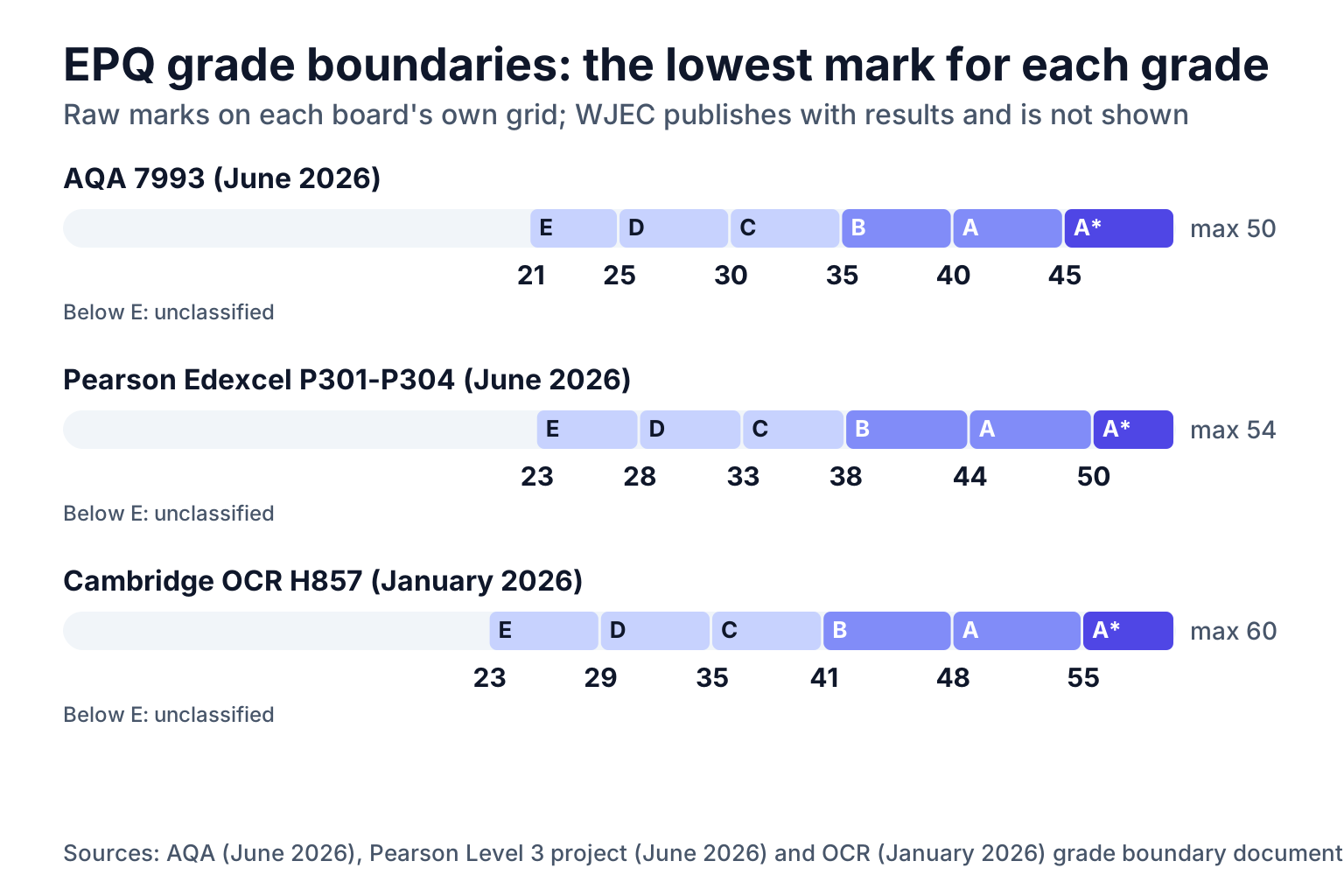
EPQ grade boundaries vary by exam board because each board uses a different maximum raw mark and a different marking grid. The tables below give the confirmed raw-mark boundaries for AQA, Pearson Edexcel and OCR, so you can see exactly where each grade starts. WJEC boundaries are handled separately at the end of this section.
One counter-intuitive detail worth noting upfront: the percentage required for an A* differs across boards (AQA 90%, Pearson Edexcel roughly 93%, OCR roughly 92%), but that does not mean one board is harder to ace than another. The totals and grids differ, so the percentages are not directly comparable. Sections 2 and 3 explain the mechanism.
AQA EPQ (7993) - June 2026
Maximum raw mark: 50. AQA has June and November series. The boundaries below are from the June 2026 grade boundaries document, published 13 August 2026. The same six numbers have been unchanged since June 2024.
| Grade | A* | A | B | C | D | E |
|---|---|---|---|---|---|---|
| Raw mark (out of 50) | 45 | 40 | 35 | 30 | 25 | 21 |
| Percentage | 90% | 80% | 70% | 60% | 50% | 42% |
Pearson Edexcel EPQ (P301-P304) - June 2026
Maximum raw mark: 54, across four unit types: P301 Dissertation, P302 Investigation/Field Study, P303 Performance, P304 Artefact. Pearson has January and June series. All four units share identical raw-mark boundaries, per the June 2026 grade boundaries document. The same raw numbers apply to January 2026, June 2025 and January 2025.
| Grade | A* | A | B | C | D | E |
|---|---|---|---|---|---|---|
| Raw mark (out of 54) | 50 | 44 | 38 | 33 | 28 | 23 |
| Percentage | 93% | 81% | 70% | 61% | 52% | 43% |
Note: Pearson reports the overall qualification (cash-in code ZPJ30) in points rather than raw marks, out of a maximum of 28. The overall boundaries are A* = 24, A = 20, B = 16, C = 12, D = 8, E = 4. Your results slip will show a points score, not a raw mark.
OCR Extended Project (H857) - January 2026
Maximum raw mark: 60, across two components: H857/A/01 (Moderated Upload) and H857/B/02 (Moderated Postal). OCR has January and June series. Both components share identical boundaries, per the January 2026 grade boundaries document, published 19 March 2026. The same boundaries apply to the June 2026 series.
| Grade | A* | A | B | C | D | E |
|---|---|---|---|---|---|---|
| Raw mark (out of 60) | 55 | 48 | 41 | 35 | 29 | 23 |
| Percentage | 92% | 80% | 68% | 58% | 48% | 38% |
WJEC EPQ
WJEC publishes its EPQ grade boundaries alongside its summer results. No recent WJEC boundary document was among the sources checked for this guide, so no figures are reproduced here. For background on the qualification and how grades are structured, the WJEC EPQ student guide is the starting point. Check WJEC's website after summer results are released for the current-year boundaries.
2. Converting Raw Marks to Percentages - Why the Numbers Differ
The three boards use different maximum marks, so a raw boundary number tells you very little on its own. Converting to percentages makes comparison possible.
| Board | A* raw mark | Maximum | A* as % |
|---|---|---|---|
| AQA | 45 | 50 | 90% |
| Pearson Edexcel | 50 | 54 | ~93% |
| OCR | 55 | 60 | ~92% |
Sources: AQA June 2026, Pearson Edexcel June 2026, OCR January 2026.
The gap between AQA's 90% and Edexcel's 93% does not mean Edexcel sets a harder bar. Each board designs its own marking grid with its own mark allocations, so the totals are structurally different. The percentage thresholds reflect those design choices, not a difference in academic standard between boards.
One practical quirk with Pearson Edexcel: the overall qualification (cash-in code ZPJ30) is reported in points rather than raw marks, with a maximum of 28. The raw unit mark boundaries can shift between sessions to account for variation in assessment difficulty, so Pearson converts raw marks to points before reporting a final grade. This means a student's results slip shows a points score, not the raw mark they originally received, which can cause confusion when comparing with AQA or OCR results.
If you are switching boards or comparing your progress with a friend on a different specification, work in percentages rather than raw marks.
3. How the Four Assessment Objectives Are Weighted
All four boards mark against the same four assessment objectives: AO1 Manage, AO2 Use resources, AO3 Develop and realise, and AO4 Review. The wording is shared; the mark allocations are not. AO3 carries the largest slice on every board, which matters more than most students realise: a weak project outcome cannot be rescued by a tidy log and a confident presentation.
| Board | AO1 Manage | AO2 Use resources | AO3 Develop & realise | AO4 Review | Total |
|---|---|---|---|---|---|
| AQA | 10 (20%) | 10 (20%) | 20 (40%) | 10 (20%) | 50 |
| Pearson Edexcel | 9 (17%) | 12 (22%) | 24 (44%) | 9 (17%) | 54 |
| OCR H857 | 12 (20%) | 12 (20%) | 24 (40%) | 12 (20%) | 60 |
| WJEC | 20 (20%) | 20 (20%) | 40 (40%) | 20 (20%) | 100 |
Board-by-board breakdown
AQA splits its 50 marks evenly across AO1, AO2 and AO4 (10 marks each), with AO3 taking the remaining 20. The mark allocation is in the AQA 7993 specification (version 1.4, sections 2.5.2 and 2.5.3); the 50-mark maximum is confirmed in AQA's June 2026 grade boundaries.
Pearson Edexcel runs to 54 marks across four unit routes: P301 Dissertation, P302 Investigation/Field Study, P303 Performance, and P304 Artefact. AO2 gets a slightly larger share (12 marks, 22%) than AO1 or AO4 (9 marks each), which means the quality of sources and research process carries more weight here than on AQA. AO3 still dominates at 24 marks (44%). Boundaries and unit codes are confirmed in Pearson's June 2026 project grade boundaries.
OCR H857 totals 60 marks. AO1, AO2 and AO4 are 12 marks each, each marked across four bands (1-3, 4-6, 7-9, 10-12). AO3 runs to 24 marks across four bands (1-6, 7-12, 13-18, 19-24). Boundaries appear in OCR's January 2026 H857 grade boundaries.
WJEC uses 100 marks distributed across eight learning outcomes grouped under the same four AOs. AO3 is split between LO5 (20 marks) and LO6 (20 marks), giving it 40 marks in total. The proportions mirror AQA's percentages exactly, even though the raw totals look different.
The practical implication: on every board, nearly half your marks rest on the project outcome itself. If you are scoring well on planning and research but the project outcome is underdeveloped, the AO weighting means the gap is difficult to close.
4. How a Mark Becomes a Grade - the Moderation Process
Your centre marks your work against the board's marking grid. The board then moderates a sample of that marking. The moderated mark is mapped against the grade boundaries published on results day, and that mapping is the only authority for which mark earns which grade in a given series.
Grades run A*, A, B, C, D, E. Below E is unclassified.
The published boundary document is final. Boundaries can move between series, so a mark that earned a B one year may sit at a different grade the next. The AQA grade boundaries page and the equivalent pages for Pearson, OCR and WJEC are the only sources that confirm where the line falls in a specific series.
Each board uses named records to support the moderation process:
- AQA - the Production Log and Assessment Record
- Pearson Edexcel - the activity log and project proposal form
- OCR - the Project Progression Record (PPR)
- WJEC - the Candidate Production Record and Candidate Assessment Record
One practical consequence: because moderation works from the paper trail as well as the project itself, gaps in those records can affect the mark before it reaches the boundary table. That is the step most students underestimate.
5. Working Out Which Band You Need - Worked Examples by Board
The principle is straightforward: find the raw mark boundary for your target grade, then work out how your marks across the four assessment objectives (AO1, AO2, AO3, AO4) need to add up to reach it. Because AO3 (Develop and realise) carries 40-44% of the total marks on every board, it is the objective where the most ground is won or lost. Getting AO3 right does not guarantee a grade, but falling short there makes recovery across the other three objectives very hard.
The examples below are arithmetic illustrations written for this guide, not exam-board exemplars. Actual marks depend entirely on how well the work meets each board's official marking criteria. Always check the official marking grid.
AQA
The AQA EPQ grade boundaries for June 2026 set the A boundary at 40 out of 50. The marking grid allocates 20 marks to AO3 and 30 marks across AO1, AO2 and AO4 combined.
Worked example (guide illustration, target grade A):
| Objective | Max marks | Target marks |
|---|---|---|
| AO3 Develop and realise | 20 | 18 |
| AO1 + AO2 + AO4 | 30 | 22 |
| Total | 50 | 40 |
Scoring 18/20 on AO3 and 22/30 across the remaining three objectives reaches the A boundary exactly, five marks short of the A* threshold of 45.
Pearson Edexcel
The Edexcel EPQ grade boundaries for June 2026 set the A boundary at 44 out of 54 across all four unit types (P301-P304). AO3 carries 24 marks; the other three objectives share 30 marks.
Worked example (guide illustration, target grade A):
| Objective | Max marks | Target marks |
|---|---|---|
| AO3 Develop and realise | 24 | 22 |
| AO1 + AO2 + AO4 | 30 | 22 |
| Total | 54 | 44 |
Notice that AO3 alone accounts for 44% of the Edexcel total, slightly higher than AQA's 40%. A student who scores strongly on AO3 but weakly elsewhere can still fall below 44 if the other objectives are not managed.
OCR
The OCR EPQ grade boundaries for January 2026 set the A boundary at 48 out of 60. The marking criteria allocate 24 marks to AO3 and 12 marks each to AO1, AO2 and AO4 (36 marks in total across those three objectives).
Worked example (guide illustration, target grade A):
| Objective | Max marks | Target marks |
|---|---|---|
| AO3 Develop and realise | 24 | 22 |
| AO1 + AO2 + AO4 | 36 | 26 |
| Total | 60 | 48 |
One non-obvious point: because each of AO1, AO2 and AO4 is capped at 12 marks, a student cannot compensate for a weak AO3 by over-performing on a single other objective. The same is true on every board - on AQA each of those three objectives is capped at 10 marks - so the 30-mark and 36-mark groupings in these examples are arithmetic shorthand, not pools that can be redistributed.
6. AQA EPQ Grade Boundaries: Have They Changed?
The short answer: no. The AQA EPQ grade boundaries have not moved since June 2024. The June 2026 boundary document for qualification code 7993 shows the same six figures that AQA published for June 2024, November 2024, June 2025 and November 2025:
| Grade | Raw mark (out of 50) |
|---|---|
| A* | 45 |
| A | 40 |
| B | 35 |
| C | 30 |
| D | 25 |
| E | 21 |
One thing worth noting: stability in epq grade boundaries does not mean the boundaries are fixed by rule. Per AQA, they are set by senior examiners and assessment experts after all marking is complete for each series, then published at 8:00am on results day. The boundary a student sees when results arrive is the definitive one for that series, not a provisional figure. It is possible, in principle, for the numbers to shift if a future cohort performs markedly differently.
The practical implication: do not plan your effort around the assumption that the AQA EPQ boundaries will stay at their current levels indefinitely. The June 2026 document is the most recent authority, and it is the one to consult now.
For the current series the AQA grade boundaries page offers PDF and XLSX downloads, and it links to a grade boundaries archive for previous series.
7. EPQ Grades and UCAS Points
The UCAS points attached to EPQ grades are identical across all four boards. Per AQA's EPQ page and the WJEC student guide, the scale runs:
| Grade | UCAS points |
|---|---|
| A* | 28 |
| A | 24 |
| B | 20 |
| C | 16 |
| D | 12 |
| E | 8 |
Each grade step is exactly 4 points.
The EPQ adds to your total - it does not replace anything. An A* EPQ contributes 28 points on top of whatever your A-levels generate. That 28 is half what a full A-level earns at A*, which reflects AQA's description of the EPQ as "worth half an A-level (28 UCAS points)".
Pearson Edexcel describes the qualification as "worth up to 28 UCAS points", and OCR states "up to 28 UCAS points in the new tariff." The word "up to" matters: universities are not required to count EPQ points, and each course decides independently whether to include them in an offer calculation.
A common arrangement - AQA notes that "many universities make lower A-level offers to students undertaking an EPQ" - is an alternative conditional offer rather than a raw points top-up. A university might offer BBB with an A-grade EPQ instead of ABB, recognising the project's independent-study demands without simply adding numbers to a threshold. Check the specific course page rather than assuming your EPQ points will be accepted at face value.
8. What to Do Next
The most useful thing you can do this week is specific: download the official grade boundaries PDF for your board and open your most recent draft feedback side by side.
The direct links are in section 1 of this guide. For AQA, the EPQ sits under its own category, separate from Level 1 and 2 Project Qualifications, so make sure you open the right file. For Pearson Edexcel and OCR, confirm whether your series is June or January before reading the numbers.
Once you have the document open, note the raw-mark boundary for the grade you are targeting, then look at how your draft measures up against your board's AO3 marking criteria. AO3 carries 40 per cent of the total on AQA, OCR and WJEC and 44 per cent on Pearson Edexcel, so a shortfall there is hard to make up elsewhere. Check whether your draft feedback flags any AO3 weakness, and address that before any other revision.
Do that comparison this week, while your feedback is fresh.
FAQ
Do EPQ grade boundaries change between series?
Yes - boundaries are set after marking is complete each series by senior examiners and are published on results day, so they can move; the AQA 7993 boundaries have in practice been unchanged since June 2024, but the published document for the series you sat is always the definitive source.
When do EPQ grade boundaries come out?
AQA publishes grade boundaries at 8.00am on results day for each series; Pearson Edexcel and OCR publish theirs with their own results for each of their January and June series (OCR's January 2026 document, for example, is dated 19 March 2026). Check your board's grade boundaries page for the series you sat.
How is the EPQ graded?
The centre marks the project against the board's four-objective grid, the board moderates a sample of marking, and the resulting moderated mark is mapped to a grade using the boundary table published on results day; grades run A*, A, B, C, D, E, with below E classed as unclassified.
What are the AQA EPQ grade boundaries for 2026?
For AQA qualification 7993, the June 2026 boundaries out of 50 marks are: A* 45, A 40, B 35, C 30, D 25, E 21.
Does the EPQ count as an A level?
The EPQ is a standalone Level 3 qualification worth half an A level and up to 28 UCAS tariff points; it does not replace an A level, but some universities include it in conditional offer structures.
Can you get an A* in the EPQ?
Yes - all four awarding bodies (AQA, Pearson Edexcel, OCR and WJEC) grade the EPQ on an A*-E scale, so an A* is achievable; for AQA the June 2026 boundary was 45 out of 50 marks.
References
- AQA Level 3 Extended Project Qualification grade boundaries - June 2026 - https://www.aqa.org.uk/files/ZAH5jqWyLbIqZCD1U8KmyT/4c05bb5f8fee66cec34c78c4d6eff337781adcf3.pdf
- Pearson Edexcel grade boundaries June 2026 - Level 3 Extended Project (P301-P304, ZPJ30) - https://qualifications.pearson.com/content/dam/pdf/Support/Grade-boundaries/Project-qualifications/grade-boundaries-june-2026-project-l3.pdf
- OCR Extended Project H857 grade boundaries - January 2026 - https://www.ocr.org.uk/Images/754966-extended-project-grade-boundaries-january-2026.pdf
- WJEC Extended Project Qualification Student Guide 2021 - https://www.eduqas.co.uk/media/1tzjusk5/epq-student-guide-2021.pdf
- AQA Grade boundaries - https://www.aqa.org.uk/exams-administration/results-days/grade-boundaries