IB Students Applying to UK Universities: The Full Guide
By Michael Thompson · Former IB Diploma Programme coordinator; 10 years at Bromsgrove School · Published 5 July 2026
IB students applying to UK universities go through the same UCAS process as A-level applicants, but the way admissions tutors read your grades is different enough that it pays to understand the mechanics before you choose your Higher Level subjects. Your 45-point diploma, the split between HL and SL grades, and the up-to-three bonus points from Theory of Knowledge and the Extended Essay all feed into how offers are worded. The May exam session means your final results arrive after most offer decisions are already made, so predicted grades do far more work here than they do for many other qualification routes. This guide walks through the IB diploma structure, how UK universities phrase their offers, where UCAS tariff points apply and where they do not, and what the timeline looks like from subject selection to results day.
Key Takeaways
- The IB diploma is marked out of 45: Six subjects contribute up to 42 points, with up to 3 additional points awarded for Theory of Knowledge and the Extended Essay combined; CAS is a pass/fail requirement that does not add points.
- UK university offers are phrased in two ways: Some state an overall points total, others name specific HL grade requirements, and many competitive courses combine both - a total and minimum HL grades in named subjects.
- UCAS tariff points convert IB grades to a common scale: But tariff points matter mainly for less selective courses; competitive courses state specific IB grade requirements and ignore the tariff entirely.
- HL subject choices lock in your options two years early: Many competitive courses - medicine, engineering, mathematics - require a science or maths at HL, so choosing the wrong subjects at the start of the Diploma Programme can close doors before you apply.
- Predicted grades drive your application: Because IB final exams sit in May, after most UK offers are made, your school-set predicted grades are what universities assess at application stage.
- Our tools read IB predicted grades directly: You do not need to convert your scores to an A-level equivalent - the site matches you to courses using your IB grade format.
In This Article
- How the IB Diploma is structured - and why it matters for UK admissions
- How UK universities phrase IB entry requirements
- IB diploma UCAS tariff points - and where they actually count
- The HL subject-choice gotcha that can close university doors
- Oxbridge IB requirements - what the top offers actually look like
- The IB application timeline - predicted grades, May exams, and Clearing
- IB or A-levels for UK universities - how admissions tutors compare them
- How our tools work with IB predicted grades
- What to do next
1. How the IB Diploma is structured - and why it matters for UK admissions
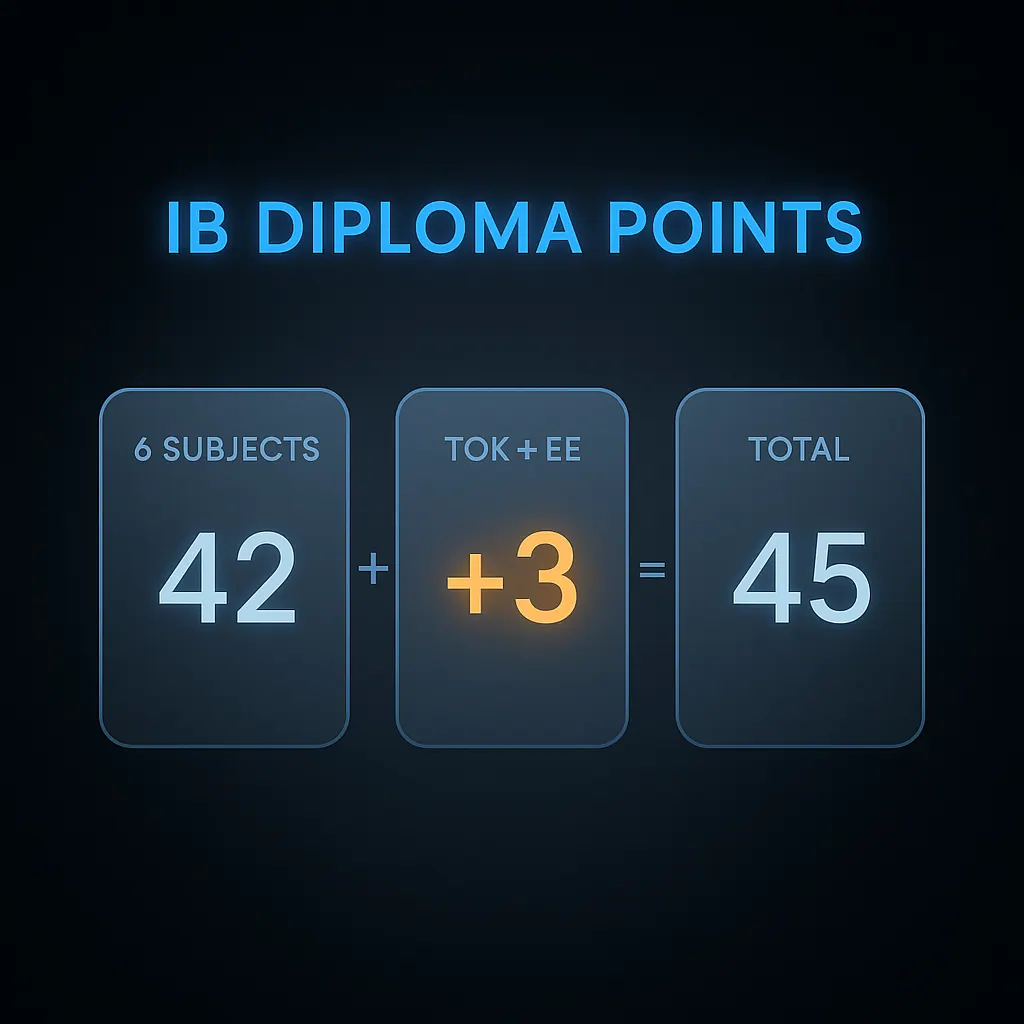
For IB students applying to UK universities, understanding how the diploma is scored is not optional background knowledge. It directly shapes how admissions tutors read your application, and a misread of the structure is one of the most common reasons strong candidates undersell themselves.
The IB Diploma is marked on a **45-point scale**. Six subjects each carry a maximum of 7 points, giving a raw total of 42. The remaining 3 points come from the core: the Theory of Knowledge (TOK) course and the Extended Essay (EE), which are graded together on a matrix. As UCAS notes, the programme also includes a Creativity, Action, Service (CAS) element. CAS is strictly pass/fail. It contributes zero points to your total, but failing to complete it means the full diploma is not awarded, regardless of your exam scores. This catches students who treat CAS as an afterthought.
The six subjects are split between Higher Level (HL) and Standard Level (SL). Students take three subjects at HL (occasionally four), with the rest at SL. The distinction matters enormously for UK admissions: HL subjects are assessed on roughly the same content depth as A-levels, and UK admissions tutors read HL grades on that basis. An HL grade 6 or 7 sits alongside an A or A* in a tutor's mind; an SL grade in the same subject does not carry the same weight, even if the number looks identical.
The non-obvious implication: which subjects you choose for HL is as consequential as your predicted grades, and the wrong HL selection can close doors to certain courses before you even apply.
2. How UK universities phrase IB entry requirements
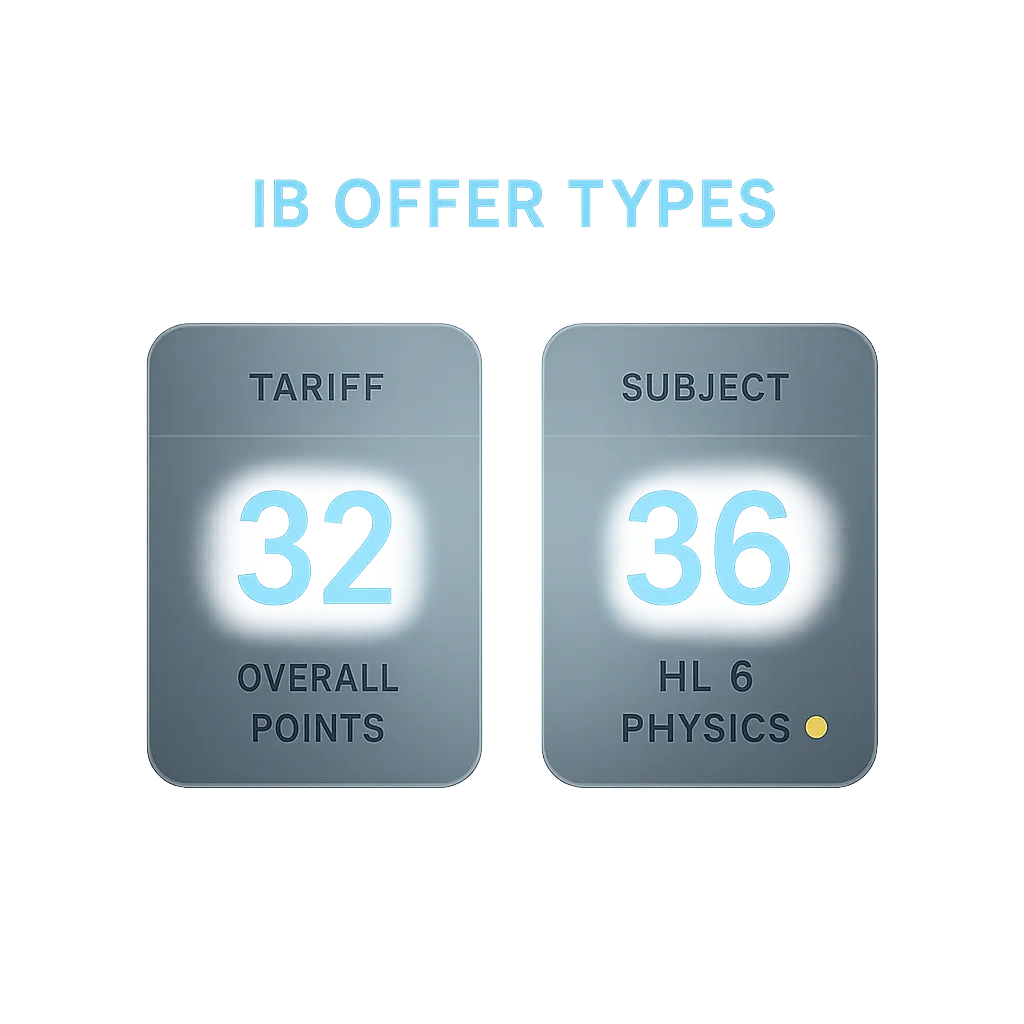
UK universities use two distinct formats when setting IB entry requirements, and most competitive courses combine both.
| Format | What it means | Example |
|---|---|---|
| Overall points total | The minimum IB Diploma score across all six subjects plus core points | University of Bath typically requires 35-36 points overall |
| Named HL grade combination | Minimum grades in specific Higher Level subjects, regardless of total | Cambridge requires 776 or above at Higher Level |
Most universities use both formats together. Bath illustrates this well: the headline total of 35-36 points comes paired with HL grade combinations that range from 7,7,6 down to 5,5,5, depending on the course. A student who hits the points total but misses the HL grade floor on a required subject will not meet the offer.
Cambridge's requirements are more demanding than most. The university's minimum offer level is 41-42 points with 776 in Higher Level subjects, but the non-obvious detail is that admissions decisions are made by individual Colleges, not centrally. Churchill, Corpus Christi, and Selwyn typically set offers above that minimum, and some require 777 or a higher total. Two applicants to different Cambridge colleges on the same course can face different numerical thresholds.
When reading any university's entry requirements, check both numbers: total points and HL grades. Missing either one is grounds for rejection, regardless of how strong the other figure looks.
3. IB diploma UCAS tariff points - and where they actually count
The UCAS Tariff converts IB grades into a numerical points scale so that universities can compare them with A-levels, Scottish Highers, and other Level 3 qualifications on a single table. Both HL and SL subject grades contribute points, though HL grades attract more.
The critical distinction is between two very different types of offer:
- Tariff-threshold offers state a total points figure, such as "120 UCAS points". For these, your IB score feeds directly into the calculation, and the tariff matters.
- Subject-specific IB offers state something like "36 points overall with 6,6,5 at HL". For these, the tariff is essentially irrelevant. The university is looking at your IB grade structure directly, not a converted number.
Competitive courses at most Russell Group universities use the second type. Tariff-based offers are more common at post-92 institutions and for courses with broader entry profiles.
There is also a less-discussed structural quirk worth knowing: UCAS confirms that universities are not obligated to accept a qualification simply because it appears in the tariff, and where a university considers the qualification content only partly relevant to a course, it may count fewer points than the tariff assigns. Some institutions also restrict tariff counting to the highest-scoring subjects only, rather than the full diploma.
The practical upshot: do not use the UCAS Tariff calculator as a substitute for reading the actual IB entry requirements for each course you are applying to. The two can point in opposite directions.
4. The HL subject-choice gotcha that can close university doors
The UCAS application happens in Year 13. The IB subject choices happen at the start of Year 12. That two-year gap is where things go wrong.
Many competitive courses require a specific subject at Higher Level, not just somewhere in the diploma. A student who takes Mathematics: Analysis and Approaches at Standard Level instead of Higher Level may find they have quietly ruled out entire degree programmes before they have started studying for them.
**The subject requirement is about level, not just presence.** Two concrete examples:
- Cambridge states that for any course requiring Mathematics, IB applicants must take Higher Level Analysis and Approaches specifically. Standard Level does not satisfy the requirement, and Analysis and Interpretations at any level is not accepted as a substitute.
- Bath requires Higher Level Mathematics for most science and technology degrees, though some courses will accept Standard Level Analysis and Approaches as an exception. Mathematics degree courses at Bath do not accept Applications and Interpretations at any level.
The counter-intuitive detail is the Analysis and Approaches versus Applications and Interpretations split. Both are IB mathematics courses, both can be taken at HL, and both appear on a diploma. But Cambridge treats them as entirely different qualifications for admissions purposes. A student who picks Applications and Interpretations at HL because it suits their learning style may not realise that choice closes the door to any mathematics-requiring course at Cambridge, regardless of their overall points score.
Check the subject requirements for every course on your list before the end of Year 11. Once you are into the Diploma Programme, switching a Higher Level subject is possible in principle but disruptive in practice, and most schools treat the choice as fixed after the first few weeks of Year 12.
5. Oxbridge IB requirements - what the top offers actually look like
Cambridge's standard minimum for IB applicants is 41-42 points out of 45, with 776 in Higher Level subjects, but that floor is not the same across every College. Churchill, Corpus Christi, and Selwyn typically make offers above the university minimum, and some Colleges require 777 at HL, a higher overall total, or a 7 in a specific subject, according to the University of Cambridge's IB statement. Because admissions decisions are made by individual Colleges, the headline figure is only a starting point.
How Cambridge maps IB grades to UK qualifications matters more than most applicants realise. Standard Level subjects satisfy Cambridge's AS Level requirements; Higher Level subjects satisfy A Level requirements. That equivalence has real consequences: if a course requires an A Level in a subject, Cambridge expects you to have taken it at HL, not SL.
One specific gotcha: for any course requiring Mathematics, Cambridge mandates Higher Level 'Analysis and Approaches'. Analysis and Interpretation at HL, or either Mathematics course at SL, will not satisfy the condition regardless of the grade achieved.
Depending on your chosen course, you may also need to register for or sit an admissions assessment before you apply. Mixed qualification profiles, for example combining IB HL courses with A Levels or AP Tests, are assessed case-by-case and require, in Cambridge's own words, "a very high level of attainment." If you are in that position, contact your shortlisted College's admissions office before submitting your UCAS application.
6. The IB application timeline - predicted grades, May exams, and Clearing
The structural mismatch between the IB exam schedule and the UCAS calendar is one of the most consequential things IB students applying to UK universities need to understand.
UCAS applications open in September of your final IB year. The main equal-consideration deadline for most UK universities falls in late January, and for Oxford, Cambridge, and most medicine courses it is mid-October. IB written exams do not sit until May. That gap means **your school-set predicted grades are the only academic evidence admissions tutors see** when they decide whether to make you an offer.
The predicted grade your IB coordinator submits carries real weight, so a prediction that undersells your likely performance can cost you a place before you have written a single exam paper.
From there, the timeline runs like this:
- January to May: Universities assess applications and issue conditional offers, typically expressed as a total IB Diploma points score plus any Higher Level subject minimums.
- May: IB Diploma written examinations.
- July (IBO results release day): The IBO publishes results on a fixed date each year. Universities receive your results directly. If you meet or exceed your conditions, your place is confirmed automatically.
- July, post-results: Students whose results fall short of their conditional offer conditions enter Clearing, where remaining university places are filled. The same Clearing process applies to IB and A-level students alike.
One non-obvious quirk: because the IBO releases results as a single diploma score, a university cannot see individual component marks unless it specifically requests them. If you narrowly miss an HL minimum, the overall points total may look fine on first read, which can create a short processing delay while the university checks subject-level breakdowns. If you are in this position, contacting the admissions office directly on results day speeds things up.
Per UCAS, the IB Diploma Programme culminates in final examinations that prepare students for university and working life, but the UCAS timeline means the application process is largely over before those exams begin.
7. IB or A-levels for UK universities - how admissions tutors compare them
Every UK university officially accepts both qualifications. The structural difference is the obvious starting point: IB students study six subjects across two years, while A-level students typically sit three. That breadth is real, but it cuts both ways.
For most courses, what matters is depth in the right subjects, not the total number studied. A-level students concentrate more hours in three areas; IB students spread time across six, with three at Higher Level. Admissions tutors at subject-specialist courses are usually comparing your HL grades against A-level grades in the same discipline, not rewarding you for also having Theory of Knowledge.
The counter-intuitive case is competitive STEM at Cambridge. Cambridge accepts both qualifications and assesses applicants individually, but its typical offer is still built around subject-specific depth: strong STEM applicants are expected to study Further Mathematics, which maps more naturally onto the A-level route than the IB's HL structure. Breadth does not substitute for that depth requirement.
On the "is IB harder?" question: the honest answer is that it depends on the institution and the course. At Bath, IB students are the second largest undergraduate group after UK A-level students, which suggests neither qualification is treated as the unusual choice. Any blanket claim that one route is harder or better-regarded is institution-specific at best.
Choose your qualification based on which subjects you need at the right level for your target course, not on a perceived prestige hierarchy.
8. How our tools work with IB predicted grades
Most university search tools are built around A-level grades, which means IB applicants end up doing a mental translation exercise at every step: "My predicted 6 in HL Chemistry - is that an A or an A*?" The site's matching tools skip that step. You enter your predicted grades in IB format - HL and SL subjects, scores on the 1-7 scale, plus your TOK/EE points estimate - and the tool reads them directly.
That matters in a specific, practical way. If a course lists a minimum of 6 in HL Chemistry, you can see whether your predicted grade clears that threshold without reaching for a conversion chart. The same applies to total diploma point requirements: enter your predicted scores and the tool shows the gap between where you are and what the offer demands.
One non-obvious quirk worth flagging: the tool distinguishes between HL and SL scores for the same subject. A predicted 7 in SL Biology does not satisfy an HL Biology minimum of 6 - and that difference has caught out applicants who assumed a high SL score would compensate. The tool flags that mismatch explicitly rather than letting it slide.
This is a time-saver at the research and shortlisting stage. It does not predict admissions decisions or replicate the judgement a university admissions team applies when they read your full application.
9. What to do next
Before you finalise your HL subject choices, pull up the individual course pages for every programme on your shortlist and read the specific IB entry requirements line by line. The overall points total is almost never the whole story. A course may demand HL Chemistry at grade 6 or HL Mathematics: Analysis and Approaches rather than Applications and Interpretation, and discovering that after you have started Year 12 leaves you with very little room to fix it.
One non-obvious gotcha: some universities list their requirements differently on UCAS than on their own course pages, so check both.
For everything that comes next, from writing your personal statement to submitting your UCAS application on time, read our guidance on the full UCAS application process. Start with the HL subject audit this week, while timetabling decisions can still be changed.
FAQ
Is the IB accepted by UK universities?
Yes - the IB Diploma Programme is accepted by UK universities as a recognised qualification for undergraduate entry, and is described by UCAS as academically challenging preparation for university.
How do IB grades convert to UCAS tariff points?
UCAS assigns tariff points to both IB Higher Level and Standard Level subject grades, but competitive courses typically state specific IB grade requirements rather than a tariff threshold, so the conversion matters more for less selective entry routes.
What IB score do you need for Cambridge?
Cambridge's standard minimum is 41-42 points overall with 776 at Higher Level, though individual Colleges can and do require higher totals or 777 in HL subjects.
Can I apply to UK universities with IB predicted grades rather than final results?
Yes - because IB final exams sit in May, after the January UCAS deadline, universities make conditional offers based on school-set predicted grades, with final results confirmed in July.
Do I need specific IB Higher Level subjects to study medicine or engineering in the UK?
Most medicine and engineering courses require relevant sciences or mathematics at Higher Level, not just anywhere in the diploma - and because HL choices are made roughly two years before you apply, it is essential to check course-specific requirements early.
Is the IB Diploma better than A-levels for UK university entry?
UK universities accept both qualifications, and neither automatically produces stronger outcomes - what matters is whether your HL subjects match course requirements and whether your grades meet the stated offer conditions.
References
- International Baccalaureate - find out more | UCAS - https://www.ucas.com/further-education/post-16-qualifications/qualifications-you-can-take/international-baccalaureate-ib
- University Statement - https://recognition.ibo.org/en-US/university-statements?id=8de5118a-f0a1-ed11-aad1-000d3a85c377&university=University+of+Bath&countryID=f4436145-efa1-ed11-aad1-000d3a85c377&country=United+Kingdom&stateID=&state=
- Calculate your UCAS Tariff points | UCAS - https://www.ucas.com/applying/before-you-apply/what-and-where-to-study/entry-requirements/calculate-your-ucas-tariff-points
- University Statement - https://recognition.ibo.org/en-US/university-statements?id=60e5118a-f0a1-ed11-aad1-000d3a85c377&university=University+of+Cambridge&countryID=f4436145-efa1-ed11-aad1-000d3a85c377&country=United+Kingdom&stateID=&state=
- International entry requirements | Undergraduate Study - https://www.undergraduate.study.cam.ac.uk/international-students/international-entry-requirements
- Check which qualifications we accept | Undergraduate Study - https://www.undergraduate.study.cam.ac.uk/apply/before/accepted-qualifications