TOK Exhibition: The Complete Guide (2025-26)
By Michael Thompson · Education Specialist; 10 years teaching the IB at Bromsgrove School · Published 4 September 2026 · Updated 4 October 2026
The TOK exhibition is an internally assessed component of the IB Diploma Programme in which you display three real-world objects and a written commentary explaining how they connect to one of 35 prescribed prompts. It is marked out of 10 by your school, then moderated by the IB, and that mark converts into part of your overall TOK grade (A-E), which can contribute up to three bonus points toward your diploma total alongside your Extended Essay grade. Unlike the TOK essay, the exhibition asks you to anchor abstract knowledge questions in physical, concrete things - a deliberate design that rewards specificity rather than sweeping philosophical claims. Getting the structure right from the start matters, because the 950-word limit leaves no room to waste words on throat-clearing.
Key Takeaways
- Three objects, one prompt, 950 words: The exhibition has a fixed format: three real-world objects, each analysed in roughly 300 words, all tied to a single IA prompt chosen from the IB's list of 35.
- Marked out of 10 in five levels: Your teacher marks against the IB's single holistic assessment instrument; the mark feeds into your A-E TOK grade alongside the essay.
- Objects must be specific and real: A generic stock image of a book fails the criterion; a named, dated, located object - a particular newspaper front page, a specific artefact - does not.
- Each object section must do four things: Identify the object, place it in context, link it explicitly to the prompt, and justify why all three objects together illuminate the prompt.
- The 35 prompts are grouped by theme: Choosing a prompt where you can already picture three distinct, specific objects is more important than choosing the most 'philosophical' one.
- A grade E in TOK is a diploma fail: The exhibition is the only internally assessed TOK component, so a weak mark here directly affects whether you earn the diploma.
In This Article
- What the TOK Exhibition Is and How It Fits the Diploma
- The 35 TOK Exhibition Prompts, Grouped by Theme
- Choosing Objects: What 'Real-World' Actually Means
- TOK Exhibition Object Examples: What Works and What Does Not
- Writing the Commentary: How to Split 950 Words Across Three Objects
- IB TOK Exhibition Marking Criteria: The Five Mark Levels
- TOK Exhibition Grade Boundaries and How the Mark Converts
- Common Mistakes That Cost Marks in the TOK Exhibition
- What to Do Next
1. What the TOK Exhibition Is and How It Fits the Diploma
The TOK exhibition is a practical assessment in which you select one prompt from the IB's fixed list of 35, then identify three real-world objects that connect to it, and write a commentary of up to 950 words explaining how each object illuminates a genuine knowledge question. It is internally assessed by your school and externally moderated by the IB, producing a single mark out of 10.
That mark matters more than most students realise, and here is the non-obvious part: the exhibition is the only TOK component you complete entirely within your school, yet the IB moderator can override your teacher's mark. Schools that consistently over-mark face harsher moderation, so a generous internal score is not necessarily the one that sticks.
The exhibition mark combines with your TOK essay mark to produce a final TOK grade on an A-E scale. That grade then feeds into the TOK/EE matrix alongside your Extended Essay grade. Together, the two grades contribute between 0 and 3 bonus points toward your diploma total, per the IB's DP passing criteria. The maximum possible diploma score is 45 points, and those 3 matrix points are genuinely reachable.
The stakes cut both ways. A grade of E in TOK is a diploma-failing condition regardless of how well you perform across your six subjects, as confirmed by the IB's DP passing criteria. The exhibition, worth 10 of the marks that determine that grade, is not a box-ticking exercise.
2. The 35 TOK Exhibition Prompts, Grouped by Theme
The IB publishes exactly 35 IA prompts, and every student must choose exactly one to anchor their TOK exhibition. All three objects must connect to that single prompt. You cannot blend two prompts or interpret the question loosely enough to cover both.
The 35 prompts fall into recognisable clusters. Understanding those clusters helps you match a prompt to objects you already have, rather than reverse-engineering objects from a prompt that sounded good on paper.
Knowledge and the knower. These prompts ask about personal perspective, bias, and the conditions that make knowledge possible. They suit objects that carry an obvious personal story but require genuine reflection on how that story connects to broader epistemology, not just autobiography.
Methods and tools of knowledge. Prompts here focus on how different disciplines produce or validate knowledge, including the role of models, data, and experiments. They lend themselves to concrete objects: a lab notebook, a data visualisation, a scientific instrument. Students who choose these prompts typically find it easier to avoid vague commentary because the object itself carries methodological specificity.
Language and knowledge. These prompts examine how language shapes, limits, or distorts what we can know. Objects like translated texts, legal documents, or propaganda posters work well. The pitfall is choosing an object where the language angle is superficial, for example, picking a foreign-language song because you like it rather than because its translation raises a genuine knowledge problem.
Certainty and doubt. Some of the exhibition's trickiest prompts live here. Questions about the nature of proof and the limits of certainty sound intellectually impressive but produce abstract commentary unless the object is very specific. A court transcript, a medical diagnosis letter, or a retracted scientific paper grounds the discussion in something real.
Values and knowledge. These prompts ask how ethics, culture, or politics interact with what counts as knowledge. They reward objects with an obvious tension: a government health campaign, a religious text alongside a scientific one, an artwork censored in one country and celebrated in another.
Time and knowledge. Prompts about how knowledge changes over time, or how historical context shapes understanding, suit archival objects: old newspaper front pages, outdated textbooks, first-edition maps showing territories that no longer exist.
The non-obvious trade-off: prompts that feel abstract are often chosen because students think depth sounds better than simplicity. The IB tok exhibition marking criteria reward precise, sustained analysis, not philosophical ambition. The practical test is immediate: can you name three specific, real objects right now? If you need ten minutes to think of even one, choose a different prompt.
3. Choosing Objects: What 'Real-World' Actually Means
The IB requires each object to be a real, specific thing you have genuinely encountered, not something invented for the exercise or assembled from a vague mental image. That distinction matters more than it first appears.
Specificity is the test. A strong object has a name, a date, a location, or an identifiable provenance. A weak one could describe anything.
| Strong choice | Weak choice | Why the weak version fails |
|---|---|---|
| Dorothea Lange's Migrant Mother (1936), Library of Congress collection | "A black-and-white photograph of poverty" | No specific object exists to analyse |
| The UK Coronavirus Act 2020, Section 51 | "A government pandemic law" | Unlocatable, unverifiable |
| The Foucault pendulum at the Pantheon, Paris | "A physics experiment" | Generic, could mean anything |
| A screenshot of a specific retracted tweet by a named public figure | "Something from social media" | Impossible to inspect or verify |
Objects can be physical items, photographs of physical items, or digital artefacts. A screenshot, a scanned letter, a data visualisation published by a named institution: all qualify, provided anyone reading your commentary could find or verify the same object.
The coherence trap is the non-obvious problem most students miss. The three objects need to illuminate the prompt from different angles. If all three make the same epistemological point, examiners see repetition, not depth. Choosing a photograph, a scientific dataset, and a legal document, for example, brings different knowledge-production processes into contact with one another. Choosing three artworks from the same tradition tends to collapse into a single argument restated three times.
Relatedly, the exhibition is built around one theme (the core theme or one of the optional themes), not around areas of knowledge. The assessment rewards commentary that identifies each object's specific real-world context and justifies its link to the prompt.
4. TOK Exhibition Object Examples: What Works and What Does Not
The difference between a strong and a weak tok exhibition object is almost always specificity. A vague object can gesture at a knowledge question; a specific object generates one. The examples below are written for this guide to illustrate that distinction.
Sample prompt: "Are some things unknowable?"
| Weak object | Strong object | |
|---|---|---|
| What it is | "A picture of outer space" | The first image of a black hole, captured by the Event Horizon Telescope collaboration and published in April 2019 |
| Does it have a date? | No | Yes, April 2019 |
| Does it have a named source? | No | Yes, Event Horizon Telescope Collaboration |
| Does it generate a real knowledge question? | Barely - "space is big" is not a TOK claim | Yes: what does it mean to "see" something we cannot observe directly? Is an image reconstructed from radio wave data the same kind of knowledge as a photograph? |
The outer-space picture fails because any examiner can ask: which image, taken by whom, showing what? Without answers, the commentary has nothing to anchor. The Event Horizon Telescope image passes because the specific context forces a genuine epistemological question about indirect observation and the limits of the natural sciences.
The counter-intuitive trade-off here: a less dramatic object with a precise context will outscore a visually striking object with a vague provenance every time. A dated letter, a named court ruling, a specific published dataset, a real product label - all of these create the traction a generic symbol cannot.
One more rule worth repeating: the IB requires the actual image or representation of each object to appear inside the exhibition document itself, not just be described in the commentary. A missing image is a formatting error that puts marks at risk before the examiner reads a single word.
5. Writing the Commentary: How to Split 950 Words Across Three Objects
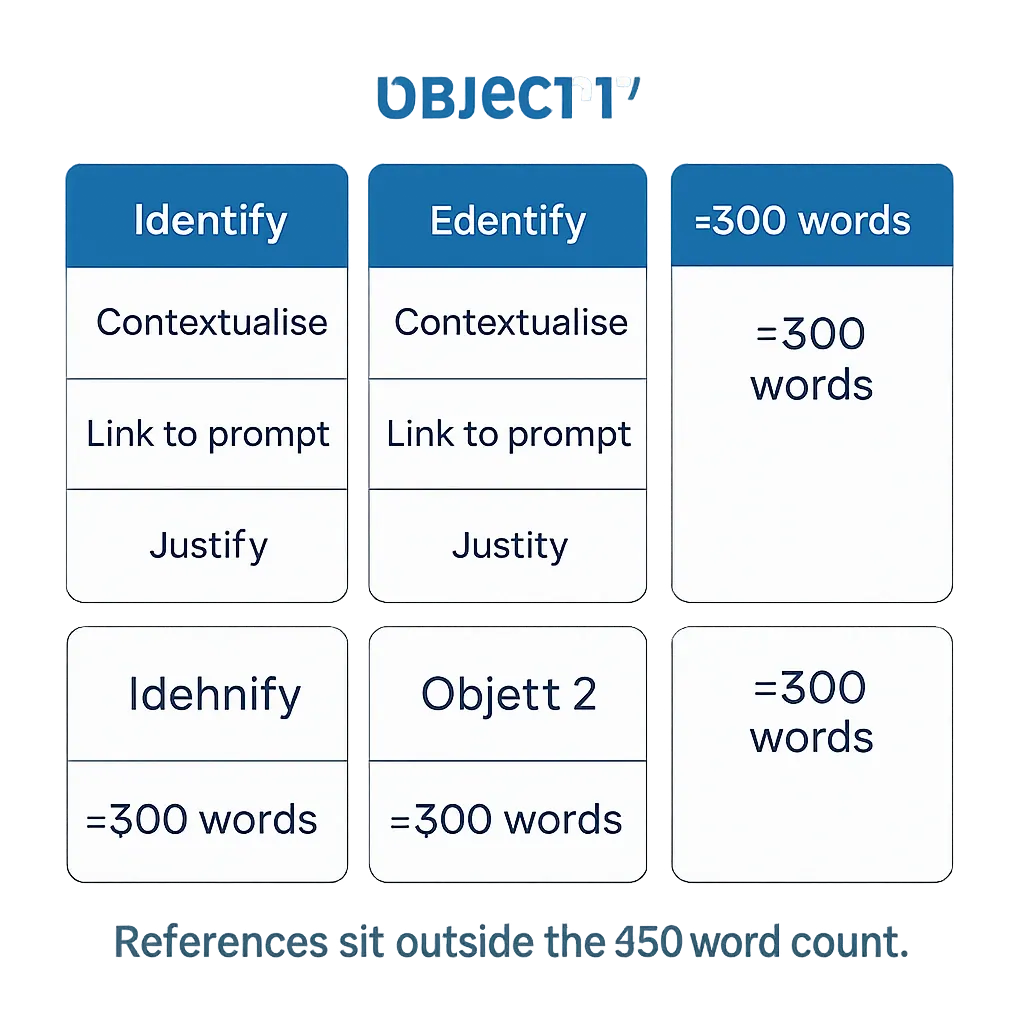
The 950-word limit is a hard ceiling. The IB moderator will not read anything beyond it, so words over the limit do not contribute to your mark. Count carefully before submission.
There is no required introduction or conclusion. The commentary has no prescribed structure beyond covering three objects. Use that freedom deliberately: you do not need to spend words on framing paragraphs that set up what you are about to say. Start with Object 1.
A workable split
A rough guide that experienced teachers recommend:
- Object 1: ~300 words
- Object 2: ~300 words
- Object 3: ~300 words
- Connective sentences (linking objects to each other, or transitioning between sections): ~50 words
The counter-intuitive trap here is spending too long on the first object because it feels like the anchor of the whole exhibition. Resist that. An uneven split of 500 / 250 / 200 typically produces a weaker mark, because the third object ends up under-developed and looks like an afterthought to the moderator.
What each object's section must do
Each of the three blocks should accomplish four things, in roughly this order:
- Identify and describe the object precisely - name it, date it, and locate it. A photograph, a specific treaty text, a particular algorithm: be exact.
- Place it in its real-world context - explain where it exists and why that context matters for knowledge.
- Connect it explicitly to the chosen IA prompt using TOK vocabulary: knowledge claims, perspectives, justification, certainty. Naming the prompt's keywords and showing how they apply is what separates a high-scoring commentary from a descriptive one.
- Justify why this object, and not another - this is the most commonly missed move. Saying why a different, obvious choice would be weaker forces you to think like a knower rather than a curator.
Making the three objects speak to each other
The moderator is looking for more than three separate mini-essays. The objects should build a cumulative answer: Object 2 should complicate or extend what Object 1 establishes, and Object 3 should add something neither of the first two could achieve alone. A brief connective sentence between sections, such as noting a tension or contrast the second object introduces, is enough to signal that you have designed the exhibition rather than assembled it.
Bibliographies and image captions
References and image captions sit outside the word count. Acknowledge every source you draw on, including the origin of each object image. This is not optional: unacknowledged images can raise academic integrity concerns. Keep the bibliography concise, but include it.
6. IB TOK Exhibition Marking Criteria: The Five Mark Levels
The TOK exhibition is marked out of 10 using the IB's assessment instrument, a single holistic judgement with five mark levels (9-10, 7-8, 5-6, 3-4 and 1-2, plus 0). Your teacher applies the mark first, and the IB then moderates a sample of exhibitions, adjusting marks up or down where the teacher's judgement diverges from the descriptor. That adjustment can move you across a grade boundary, so the criteria matter as much as the commentary itself.
What the levels reward and penalise, in plain terms (the lower levels are grouped):
| Band | What it looks like in practice |
|---|---|
| Top (9-10) | All three objects are specific and real; each commentary section makes explicit, convincing links between that object and the chosen prompt; the justification for including each object is clearly reasoned through a TOK lens |
| Mid-high (7-8) | Links to the prompt are present but occasionally implicit or underdeveloped; objects are real but the TOK analysis could be sharper |
| Middle (5-6) | One or more objects are generic or abstract; links to the prompt are vague or restated rather than analysed; objects are described more than interrogated |
| Low (1-4) | Objects are largely irrelevant or hypothetical; the prompt is restated without any analytical engagement; little or no TOK thinking is evident |
The four mark-losing patterns that appear most often in the exhibition:
- Generic objects. A photograph of "a scientist in a lab" could belong to any student's exhibition on any prompt. The IB's assessment instrument rewards specificity: a named photograph, a dated news article, a physical object you can hold.
- Prompt restatement. Writing "This object links to my prompt because my prompt is about..." is description of the prompt, not analysis through it.
- Object description without knowledge questions. Explaining what an object is, rather than what claim about knowledge its existence or use raises, sits in the lower bands.
- Three isolated objects. A non-obvious gotcha: the top band requires the three objects to work together as a coherent set. If each commentary reads as a standalone mini-essay with no sense of cumulative argument, markers will cap the mark below 9 even when individual objects are strong.
Keep the interconnection point in mind when you draft. The TOK exhibition is assessed as one piece, not three separate ones.
7. TOK Exhibition Grade Boundaries and How the Mark Converts
Your tok exhibition is marked out of 10. The TOK essay is also marked out of 10. The IB combines the two, weighting the essay at two-thirds and the exhibition at one-third, then converts the result into a single letter grade from A to E.
Grade boundaries are not fixed. The score needed to achieve each letter grade is set by the IB after each examination session and communicated to schools through their DP coordinators, not published openly. This means the same pair of marks might land an A in one session and a B in another. Ask your coordinator for the most recent boundaries after results day.
How the TOK/EE matrix works
That A-E TOK grade is then combined with your Extended Essay A-E grade using the IB's bonus-point matrix, which adds up to 3 extra points toward the diploma's 45-point maximum, per the IB's DP passing criteria.
| TOK grade | EE grade | Bonus points |
|---|---|---|
| A | A | 3 |
| B | C | 2 |
| C | C | 1 |
| D | D | 0 |
The counter-intuitive gotcha: a weak TOK grade costs bonus points even alongside a strong EE. A D in TOK with an A in the EE earns 2 points rather than 3, and a D in TOK with a C or D in the EE earns none.
More critically, an E in TOK is a diploma-failing condition outright, no matter how many points your six subjects earn. Because the exhibition accounts for a third of the TOK mark, a very low exhibition score can drag the combined total into failing territory even if the essay is solid.
8. Common Mistakes That Cost Marks in the TOK Exhibition
These errors appear consistently across tok exhibition submissions and most are avoidable once you know what the IB moderator is actually looking for.
- Picking a prompt you cannot object-match. Some prompts sound philosophically rich but are nearly impossible to anchor to three distinct, real-world objects. If you cannot identify your three objects before committing to a prompt, change the prompt. The objects come first; the argument follows from them.
- Writing an essay, then hunting for objects to illustrate it. The commentary must be driven by the objects, not the other way around. Moderators recognise pre-written philosophical arguments quickly: the objects appear as decoration rather than evidence. Each paragraph should open with the object, not with the knowledge claim.
- Going over 950 words. The moderator stops reading at the word limit. Any analysis beyond that point receives no credit. This is a hard cut, not a guideline.
- Describing objects without justifying their selection. Stating that an object is a photograph of the Apollo 11 landing is not enough. You must explain why that specific photograph, not any other, is the right object for your chosen prompt.
- Omitting images or object identification. Every object must be clearly identified with an image or precise description in the submitted document. Missing images are a presentation failure that draws attention away from your analysis.
9. What to Do Next
Ask your TOK teacher this week for two documents your school is required to hold: the official IA prompt list and the assessment instrument. Both come directly from the IB, and you are entitled to see them. Cross-check the prompt wording and marking criteria against the IB's published TOK subject guide at ibo.org to confirm you are working from the correct version for your session, not a draft or a previous year's copy.
Then do this before your next TOK lesson: write down three prompts that genuinely interest you, and under each one, sketch out three potential real-world objects. The prompt where three specific, distinct objects appear most naturally is almost always the stronger choice. A prompt that produces only abstract or near-identical objects is a structural warning sign, not a style problem.
Contact your TOK teacher and request those documents today.
FAQ
How many marks is the TOK exhibition worth?
The TOK exhibition is marked out of 10; this mark is combined with the TOK essay mark (also out of 10), with the exhibition worth one-third and the essay two-thirds, to give an A-E TOK grade.
Should a TOK exhibition have a conclusion?
There is no requirement for a formal conclusion section; the 950-word limit is better used giving each object its own focused commentary rather than adding a summary paragraph.
Does the TOK exhibition need a bibliography?
References and image captions do not count toward the 950-word limit and should be included to acknowledge sources, though the IB does not specify a mandatory format.
Does the TOK exhibition have to be personal?
The IB expects objects to come from the student's own experience of the world, which encourages authenticity of choice, but the commentary is an analytical piece not a personal reflection or autobiography.
How many TOK exhibition prompts are there?
The IB publishes exactly 35 IA prompts; students must choose one prompt and use it for all three objects in their exhibition.
How is the TOK exhibition different from the TOK essay?
The exhibition is internally assessed by your school (then moderated), uses real-world objects, and has a 950-word limit; the essay is externally marked by the IB, uses prescribed titles, and has a 1,600-word limit.
References
- DP passing criteria - International Baccalaureate® - https://ibo.org/about-the-ib/what-it-means-to-be-an-ib-student/recognizing-student-achievement/about-assessment/dp-passing-criteria
- https://ibo.org/globalassets/new-structure/programmes/dp/pdfs/tok-sb-english.pdf - https://ibo.org/globalassets/new-structure/programmes/dp/pdfs/tok-sb-english.pdf