TOK May 2027 Prescribed Titles: All 6 Explained
By Michael Thompson · Education Specialist; 10 years teaching the IB at Bromsgrove School · Published 4 September 2026 · Updated 6 October 2026
The TOK May 2027 prescribed titles have been released by the IB, giving candidates their six options for the externally assessed Theory of Knowledge essay. Choosing the right title is less about which one sounds most interesting and more about which one lets you draw on areas of knowledge you can actually evidence well. Each 1,600-word essay is marked out of 10 on a global impression basis, and that mark combines with your TOK exhibition score to determine your overall TOK grade. This guide works through all six titles - what each one genuinely asks, the concepts you need to unpack, the trap reading students fall into, and a claim-and-counterclaim skeleton written for this guide (not a model essay) - so you can make an informed choice before you commit.
Key Takeaways
- Six titles, one choice: The IB has published six prescribed titles for the May 2027 TOK essay session; you select one and write no more than 1,600 words.
- Global impression marking: Essays are marked out of 10 using a global impression approach, meaning the examiner reads the whole essay and awards a holistic mark rather than ticking off criteria one by one.
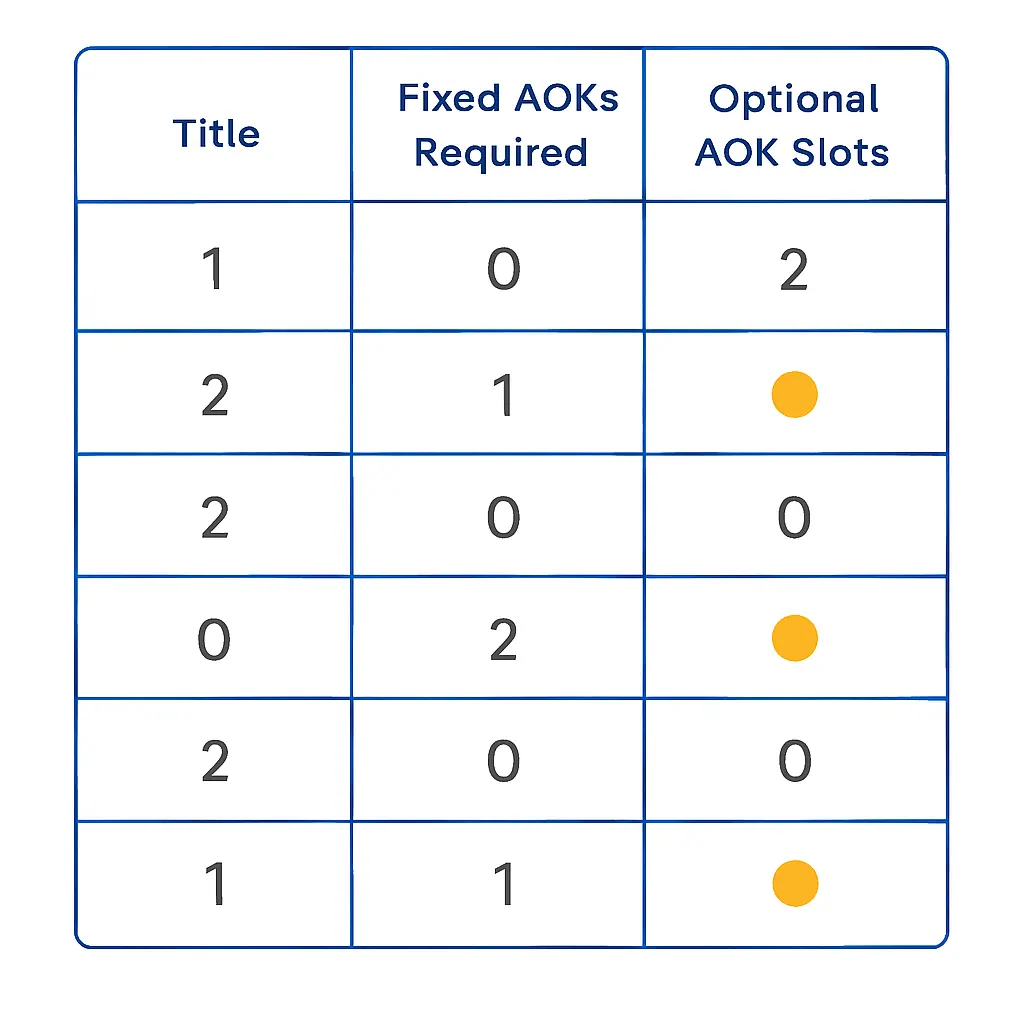
- AOK constraints vary by title: Title 1 specifies the arts and history; Titles 3, 4, and 6 each name one required AOK plus one of your choice; Titles 2 and 5 leave both AOKs open to you.
- Fit your evidence, not the title: Pick the title that matches the areas of knowledge where you have strong, specific real-world examples - not the one whose wording looks easiest at first glance.
- Exhibition is separate: The TOK essay and the TOK exhibition are assessed independently; the essay mark and exhibition mark are combined to produce your final TOK grade on the A-E scale.
- The trap is breadth over depth: Students who try to cover too many knowledge questions without developing any of them deeply tend to score lower; examiners reward sustained, focused argument.
In This Article
- What the TOK essay is - and how it is graded
- The six TOK May 2027 prescribed titles
- Title 1 - arts and history: what it is really asking
- Titles 2 and 5 - open AOK titles explained
- Titles 3 and 6 - constrained AOK titles explained
- Title 4 - the Agatha Christie quotation on coincidence
- How to choose a TOK essay title: matching titles to your evidence
- Theory of knowledge essay structure and common pitfalls
- What to do next
1. What the TOK essay is - and how it is graded
The TOK May 2027 prescribed titles are the six questions the International Baccalaureate issues for each examination session for the externally assessed Theory of Knowledge essay. The essay itself is a maximum of 1,600 words, written in response to one of those six titles and submitted directly to the IB for marking. It is not marked by your own teachers.
The marking method is worth understanding before you pick a title. The examiner uses a global impression scale, awarding a single holistic mark out of 10. There are no separate sub-criteria that add up to a total. The examiner reads the whole essay, forms an overall judgement of how well it addresses the knowledge question, and assigns one mark. That means a structurally tidy essay with shallow analysis can score lower than a messier essay with genuinely sharp thinking, because the mark reflects intellectual quality across the piece, not compliance with a checklist.
The TOK component has two parts: the essay and the exhibition. The exhibition is an internally assessed task, marked by your teacher and then moderated by the IB. It is assessed separately and does not affect your essay mark. The two marks combine to produce a final TOK grade on the A-to-E scale. That grade, alongside your Extended Essay grade, determines the number of bonus points added to your DP total, up to a maximum of three additional points.
One practical consequence: a strong exhibition cannot rescue a weak essay, and vice versa. The two components are weighted, so both matter independently.
2. The six TOK May 2027 prescribed titles
The IB has published the May 2027 prescribed titles, and all six are available now - which means you have more lead time than most students use well. The titles are listed below exactly as published. Do not paraphrase them in your essay; examiners are alert to students who subtly reword a title to make their argument easier.
One structural detail worth noting: four titles name at least one area of knowledge (AOK) for you, while two leave both AOKs entirely open. That choice has real consequences for how much planning each title demands.
| Title | Exact wording | AOK constraints |
|---|---|---|
| 1 | "Do we gain a better appreciation of the human experience from the artist or the historian? Discuss with reference to the arts and history." | Both fixed: arts, history |
| 2 | "If values change over time, how can they, nevertheless, continue to guide the pursuit of knowledge? Discuss with reference to two areas of knowledge." | Both open |
| 3 | "In the production of knowledge, how can knowledge be reliable if it is built on assumptions? Discuss with reference to the human sciences and one other area of knowledge." | One fixed: human sciences |
| 4 | "To what extent do you agree with the claim that 'any coincidence is worth noticing; you can throw it away later if it is only a coincidence' (Agatha Christie). Answer with reference to mathematics and one other area of knowledge." | One fixed: mathematics |
| 5 | "In the production of knowledge, when choosing one explanation over another, to what extent should simplicity be prioritized? Discuss with reference to two areas of knowledge." | Both open |
| 6 | "In the pursuit of knowledge, what value is there in exploring the paradoxical or the counterintuitive? Discuss with reference to the natural sciences and one other area of knowledge." | One fixed: natural sciences |
The IB releases the prescribed titles to schools through its Programme Resource Centre, so your TOK teacher can confirm the exact wording.
The non-obvious trap here is Titles 2 and 5. Open AOK choices feel like freedom, but the examiner is assessing whether your pairing is purposeful. Choosing two AOKs that produce identical examples - say, both pointing to consensus-based revision of knowledge claims - will read as underprepared, regardless of how well the prose is written.
3. Title 1 - arts and history: what it is really asking
Title 1 reads: "Do we gain a better appreciation of the human experience from the artist or the historian? Discuss with reference to the arts and history."
The phrasing sounds like a preference question. It is not. The IB is asking you to compare the epistemic value of two distinct knowledge-producing methods: artistic creation and historical inquiry. "Better appreciation" is doing real philosophical work here, and so is "human experience" - both need unpacking before you write a word of your argument.
Three concepts worth defining precisely:
- "Better appreciation" - does this mean emotional resonance, accuracy, breadth, or depth of understanding? Your answer will shape the entire essay.
- "Human experience" - lived subjectivity, or the documented record of events? Each mode of knowing prioritises a different reading.
- Artist vs historian - not the person, but the method: how each produces, selects, and validates knowledge.
The trap reading is treating the title as "which AOK is superior overall." Examiners expect a conditional argument: art may communicate subjective emotional truth that historical narrative cannot reproduce, but historical method provides contextual and corroborative understanding that individual artistic expression can distort or omit entirely.
A non-obvious gotcha: the AOKs are fixed by the title, so you cannot substitute a third area of knowledge to strengthen a weak example. If your strongest evidence sits in the natural sciences or mathematics, this title will penalise you. Choose accordingly.
4. Titles 2 and 5 - open AOK titles explained
Titles 2 and 5 are the two "open" titles in the May 2027 set: neither specifies which areas of knowledge (AOKs) you must use. That freedom is real, but it is also where most mid-range essays lose marks - students pick AOKs out of habit rather than because the pairing generates productive tension.
Title 2 - values and the continuity of knowledge
Exact wording: "If values change over time, how can they, nevertheless, continue to guide the pursuit of knowledge? Discuss with reference to two areas of knowledge."
The load-bearing word is nevertheless. The title concedes that values shift - that is not the question. It asks how knowledge communities maintain directional coherence despite those shifts. An essay that catalogues how scientific values changed over the centuries without addressing the epistemic tension introduced by "nevertheless" will read as descriptive, not analytical, and will struggle for marks above the 7-8 band.
A productive claim-counterclaim skeleton:
- Claim: Shared procedural values, such as reproducibility in the natural sciences, persist across substantive value shifts and continue to orient inquiry even when what counts as a significant finding changes.
- Counterclaim: In the human sciences, changing values can fundamentally redirect which questions are considered worth asking at all, so the "guidance" itself changes character rather than merely its content.
The non-obvious insight here is that procedural and substantive values behave very differently across AOKs - conflating them is the most common reason an otherwise competent essay fails to resolve the title's tension.
Title 5 - simplicity as an epistemic virtue
Exact wording: "In the production of knowledge, when choosing one explanation over another, to what extent should simplicity be prioritized? Discuss with reference to two areas of knowledge."
This title is asking whether Occam's Razor-style parsimony is a reliable epistemic virtue or a context-dependent heuristic. The phrase "to what extent" signals that a nuanced, conditional position is expected - not a verdict.
The trap is treating simplicity as straightforwardly good or bad. Strong essays identify the conditions under which each judgment holds:
- Claim: In the natural sciences, simpler models are preferred because they are more testable and less prone to overfitting data, making them stronger candidates for generalisation.
- Counterclaim: In the human sciences, oversimplified explanations risk erasing the very complexity that makes human behaviour intelligible, so parsimony can reduce explanatory power rather than increase it.
The open-AOK advantage and its risks
| Feature | Advantage | Risk |
|---|---|---|
| Student chooses both AOKs | You can pair AOKs where you have strong real-world examples | Weak or mismatched AOKs expose the essay's skeleton |
| No prescribed pairing | More room for genuine analysis | Generic pairings (natural sciences + history) often produce generic essays |
The practical takeaway: before committing to either title, write out your two proposed AOKs and one concrete example per AOK. If the examples do not pull in genuinely different directions on the central question, choose different AOKs or a different title.
5. Titles 3 and 6 - constrained AOK titles explained
Both titles come from the TOK May 2027 prescribed titles set and share a structural feature: one area of knowledge is fixed, and you choose the second. That constraint is deliberate. It forces you to argue across disciplines rather than retreating to whichever two examples feel most comfortable.
Title 3
Exact wording: "In the production of knowledge, how can knowledge be reliable if it is built on assumptions? Discuss with reference to the human sciences and one other area of knowledge."
The title is not asking you to argue that assumptions make knowledge impossible. That reading produces a weak, one-sided essay. The real question is epistemic: how do knowledge communities maintain reliability despite foundational assumptions?
The trap: Writing that assumptions are simply unavoidable and leaving it there. The IB wants you to show how communities test, revise, or openly acknowledge their assumptions - not just acknowledge that assumptions exist.
A workable claim-counterclaim structure:
- Claim: In the human sciences, models built on simplifying assumptions, such as rational actor theory in economics, still yield reliable predictive knowledge within clearly defined scope conditions.
- Counterclaim: When real behaviour violates those assumptions, the knowledge produced can be systematically unreliable in ways practitioners may not detect until significant damage is done.
The non-obvious move here is to discuss scope conditions explicitly. A model is not reliable or unreliable in the abstract; it is reliable within the boundaries its assumptions define. Essays that miss this distinction tend to score poorly under global impression marking.
Title 6
Exact wording: "In the pursuit of knowledge, what value is there in exploring the paradoxical or the counterintuitive? Discuss with reference to the natural sciences and one other area of knowledge."
This is a question about epistemic method, specifically what role anomaly, surprise, and contradiction play in advancing knowledge. It is not an invitation to list impressive-sounding discoveries.
The trap: Producing a catalogue of "surprising" findings in physics or biology without connecting them to a clear knowledge question about why counterintuitive exploration is epistemically valuable rather than merely interesting.
A workable claim-counterclaim structure:
- Claim: Counterintuitive findings in the natural sciences, quantum phenomena being the clearest case, have forced revision of foundational assumptions and made paradox a productive driver of knowledge rather than an obstacle to it.
- Counterclaim: In other areas of knowledge, pursuing the paradoxical can become self-indulgent when not constrained by rigorous method, generating complexity without clarity and mistaking difficulty for depth.
The second AOK choice matters more here than on most titles. Mathematics offers a disciplined take on paradox (Russell's paradox, Godel's incompleteness theorems). The arts offer a looser one. Choosing mathematics sharpens the counterclaim; choosing the arts widens the scope. Neither is wrong, but the choice should be deliberate and stated.
6. Title 4 - the Agatha Christie quotation on coincidence
Title 4 reads: "To what extent do you agree with the claim that 'any coincidence is worth noticing; you can throw it away later if it is only a coincidence' (Agatha Christie). Answer with reference to mathematics and one other area of knowledge."
What Christie is actually arguing is an epistemic cost-benefit point: the act of noticing is cheap, and discarding is always available, so the downside risk of attending to a coincidence is low. The title asks you to test that logic across knowledge contexts, not to agree or disagree with Christie as though she made a falsifiable claim.
The trap this title sets
Most students read "to what extent do you agree" and write a position essay - either defending or dismissing Christie. That is the wrong move. The real TOK question is: under what conditions is attending to coincidence epistemically warranted? The answer differs between areas of knowledge, and that difference is where your essay lives.
Concepts you must unpack
- Coincidence vs. correlation vs. causation. These are not the same. Christie's claim applies at the observation stage, before any causal inference is drawn.
- False positives vs. false negatives. In mathematics and natural sciences, missing an anomalous pattern (false negative) has historically carried a high knowledge cost. In the human sciences or economics, where data is noisy, treating every coincidence as worth pursuing (false positive) can entrench cognitive bias and produce unreliable conclusions.
- "Worth noticing" as an epistemic standard. This is not the same as "worth believing." Your essay should hold that distinction clearly.
Claim-counterclaim skeleton
| Mathematics (fixed) | Your chosen second AOK | |
|---|---|---|
| Claim | Unexpected numerical patterns have driven major revisions, from prime number theory to chaos mathematics | Natural sciences: anomalies in data (unexpected spectral lines, orbital deviations) have repeatedly triggered paradigm shifts |
| Counterclaim | Numerology shows that human pattern-recognition finds structure in pure noise | Human sciences: confirmation bias means that noticing a coincidence often ends the inquiry rather than opening it |
Mathematics is fixed by the title. Your second AOK is your choice. Natural sciences, history, and the human sciences all generate productive contrast. The human sciences are particularly strong if you want to push back on Christie's optimism about the low cost of noticing.
The non-obvious insight here: Christie's claim implicitly assumes a rational discarding process. But research in cognitive psychology (outside your AOK box, so use carefully) suggests that once a coincidence is noticed and shared, discarding it is socially and psychologically harder than she implies. That asymmetry is worth a sentence in your counterclaim.
7. How to choose a TOK essay title: matching titles to your evidence
The instinct to pick the title whose wording feels most accessible is almost always wrong. Choose the title that fits your strongest real-world examples, then work outward to the knowledge question - not the other way around.
Step 1 - map your AOK knowledge. Before reading the titles again, list the areas of knowledge where you can name specific cases, methods, or debates: a particular experiment, a disputed historical event, a named mathematical proof. Generic examples ("science uses experiments to find truth") do not produce a focused essay. Specificity is the starting point, not a finishing touch.
Step 2 - stress-test your examples against the title. A usable example must do three things: connect to a clear knowledge question the title raises, carry a claim, and carry a credible counterclaim. If your example only supports one side, it is thin. If it can genuinely be read from two directions, it is worth keeping.
Step 3 - check the AOK constraints early. The six May 2027 titles split into fixed and open AOK requirements. Title 4 requires mathematics; Title 3 requires the human sciences; Title 6 requires the natural sciences. If any of those is an area where your examples are weak, factor that in before you spend time drafting.
Step 4 - avoid the 'sounds deep' trap. Titles 2 and 5 carry open AOK requirements, which feels like freedom. It is, but it also means you must make a deliberate, justified choice of which two areas to use - picking casually produces unfocused essays that spread across too much ground. Similarly, Title 6's phrase "paradoxical or counterintuitive" sounds philosophically rich, but that language does not make the title easier or harder. What matters is whether you can evidence the argument with precision.
The IB's global impression marking standard rewards essays that build a clear, focused argument from specific evidence. Breadth without depth is explicitly penalised - an essay that name-drops four AOKs and three examples superficially will score lower than one that develops two examples thoroughly.
8. Theory of knowledge essay structure and common pitfalls
The IB sets a strict 1,600-word limit for the TOK essay. That is tight. You cannot include every idea you have - you have to choose the two or three examples that do the most work and cut everything else. Examiners read the essay under global impression marking, which rewards a clear, sustained knowledge question running through the whole piece, specific examples that genuinely support the argument, and counterclaims that are engaged with rather than just mentioned and dismissed.
Four pitfalls come up repeatedly:
- Ignoring the title's wording. The prescribed title is the question. Every paragraph should connect back to it explicitly. Writing a strong philosophy essay that drifts away from the specific phrasing is a common way to lose marks that should have been straightforward to earn.
- Vague or over-familiar examples. "Einstein proved Newton wrong" is not an example - it is a placeholder. An examiner wants you to explain the epistemic mechanism: what kind of knowledge claim was involved, how it was justified, and why that matters for the title's argument.
- Listing perspectives instead of arguing. TOK essays are not reports. Presenting three viewpoints and then declining to commit to a position reads as descriptive rather than analytical. The essay needs a sustained argument.
- Misreading the AOK requirements. Missing a mandatory area of knowledge, or treating the optional second AOK as decoration rather than a structural element that develops the argument, is a structural error that limits the essay's ceiling regardless of writing quality.
One non-obvious gotcha: the exhibition and the essay are assessed on entirely separate criteria. Preparing your exhibition objects will not substitute for essay planning, and confusing the two tasks wastes preparation time.
9. What to do next
Pick up a blank piece of paper this week and read each of the six TOK May 2027 prescribed titles in turn. Against each one, write down the two or three specific real-world examples you could actually develop at the depth the 1,600-word limit demands. If you cannot fill that column for a title, that title is probably not yours, no matter how interesting it looks on the page. The students who struggle most are usually those who chose a title because the quotation appealed to them, then discovered their examples were thin.
One counter-intuitive gotcha: your school's internal submission deadline will almost certainly fall weeks before the IB's own deadline. Confirm the exact date with your TOK teacher this week. Missing the internal deadline is the same, in practice, as missing the real one.
Check that date with your TOK teacher before the end of this school week.
Related TOK guides:
FAQ
Have the TOK May 2027 prescribed titles been released?
Yes - the IB released the six TOK May 2027 prescribed titles in September 2026; all six titles are publicly known and cover topics ranging from the arts and history to coincidence in mathematics.
How many words is the TOK essay for May 2027?
The TOK essay has a strict 1,600-word limit; all six May 2027 prescribed titles are subject to this same requirement.
How is the TOK essay marked?
TOK essays are marked out of 10 using a global impression approach, where the examiner reads the whole essay and awards a single holistic mark rather than scoring separate sub-criteria.
Which TOK May 2027 titles let me choose my own areas of knowledge?
Titles 2 and 5 both allow the student to select any two areas of knowledge; Titles 3, 4, and 6 each fix one AOK (human sciences, mathematics, and natural sciences respectively) while leaving the second open; Title 1 fixes both AOKs as the arts and history.
How does the TOK essay affect my IB Diploma points?
The TOK essay mark and the exhibition mark are combined to produce an overall TOK grade on the A-E scale, which then contributes up to three bonus points to your DP total alongside your Extended Essay grade.
What is a knowledge question in TOK, and how does it relate to the prescribed titles?
A knowledge question is a contestable, open question about the nature, scope, or reliability of knowledge itself; the prescribed titles are structured to prompt such questions, and a strong TOK essay identifies and develops one or two focused knowledge questions directly arising from the title's wording.
References
- Diploma Programme core: Theory of knowledge, subject brief (first assessment 2022) | International Baccalaureate - https://www.ibo.org/globalassets/new-structure/programmes/dp/pdfs/tok-sb-english.pdf