TOK Essay: Word Count, Criteria, Titles and Grades
By Michael Thompson · Education Specialist; 10 years teaching the IB at Bromsgrove School · Published 21 May 2026 · Updated 4 October 2026
The TOK essay is a 1,600-word philosophical argument submitted to the IB for external assessment - not a school report, not a personal reflection, but a structured response to one of six prescribed titles released each session. It counts for two-thirds of your Theory of Knowledge grade, with the TOK exhibition making up the remaining third. Together, TOK and the Extended Essay feed into a core points matrix that can add up to three bonus points to your IB Diploma total. Get the essay right and those points are genuinely attainable; get it wrong and you risk losing them entirely.
Key Takeaways
- Strict 1,600-word ceiling: The IB's word limit is 1,600 words - examiners are instructed to stop reading at that point, so going over actively hurts your score.
- Six prescribed titles per session: The IBO releases six titles each session; you choose one and argue it - you cannot modify the wording or invent your own question.
- One holistic rubric out of 10: Examiners mark the essay against a single driving question - "Does the student provide a clear, coherent and critical exploration of the essay title?" - placing it in one of five levels rather than scoring separate criteria.
- Two-thirds of your TOK grade: The essay carries 67% of the TOK component; the TOK exhibition (three objects, one prompt) contributes the remaining 33%.
- A-E grade feeds the core points matrix: Your combined TOK and Extended Essay grades are mapped on a matrix that awards 0-3 bonus points toward your 45-point Diploma total.
- Analysis beats description: The most common reason essays score poorly is narrating examples rather than using them to interrogate the knowledge question - every paragraph must do analytical work.
In This Article
- What Is the TOK Essay
- TOK Essay Word Count and Format Rules
- The Six Prescribed Titles and How the TOK N25 Titles Work
- TOK Essay Assessment Criteria Explained
- How the TOK Essay and Exhibition Combine to Give a Grade
- The TOK and Extended Essay Core Points Matrix
- TOK Essay Structure: How to Build Your Argument
- Common Mistakes That Cost Marks
- Using AI on the TOK Essay
- Where to Go From Here
1. What Is the TOK Essay
The TOK essay is an externally assessed piece of philosophical writing, submitted to the IB for marking by trained examiners rather than your own teachers. It sits at the centre of the Theory of Knowledge component of the IB Diploma Programme, one of three core elements every Diploma candidate must complete alongside Creativity, Activity, Service and the Extended Essay.
The essay is distinct from the TOK exhibition, which is internally assessed by your school and focuses on a single object or set of objects connected to a real-world prompt. The exhibition stays at your school. The essay goes to the IB.
It is also separate from the Extended Essay, a 4,000-word independent research paper in a specific subject discipline. The two are sometimes confused because both are long-form written tasks in the Diploma core, but they assess entirely different things: the Extended Essay rewards subject-specific inquiry; the TOK essay rewards epistemological argument across areas of knowledge.
One non-obvious quirk worth knowing early: your title is not your own. The IB publishes a set of prescribed titles each assessment session, and you must choose one of them. Your argument, your examples, and your line of reasoning are yours, but the question is set externally.
2. TOK Essay Word Count and Format Rules
The TOK essay has a hard ceiling of 1,600 words. The IB sets this limit firmly: examiners are instructed to stop reading at word 1,600, so anything beyond that point is invisible to the marker. A tok essay that runs long does not lose marks for the excess content; it simply loses the opportunity to make those points count.
The word count includes your main argument but excludes:
- The cover page
- The bibliography and reference list
- Diagrams, charts, or image labels
- Footnotes used only for citations (not for additional argument)
That last point is a genuine gotcha. Some students try to smuggle extra argument into footnotes to stay under the word count. The IB's subject guide treats argumentative footnotes as part of the essay, so examiners can include them in the count if they choose.
On formatting, the IB does not mandate a single font or point size, but convention across schools is 12pt Times New Roman or Arial with double line spacing. The tok.essay line spacing convention matters in practice because a single-spaced submission reads as rushed and makes annotation harder for the examiner.
Keep these formatting points in mind:
- Double-space the body text
- Use a legible serif or sans-serif font at 12pt
- Number your pages
- Include a cover page with the prescribed title copied exactly, your candidate number, and the session
Write to roughly 1,500 words. That 100-word buffer lets you make a final editing pass without the risk of the examiner's pen stopping mid-sentence.
3. The Six Prescribed Titles and How the TOK N25 Titles Work
The IBO releases a set of six prescribed titles for each examination session, covering the May and November sitting cycles. Each title is a distinct knowledge question, written in language chosen deliberately by the IBO, and you must address one of them exactly as it appears. No paraphrasing, no substitution, no condensing. Examiners are trained to spot reworded titles, and a modified question is treated as a failure to engage with the prescribed task.
Session codes like N25 or M26 simply identify the cohort: N stands for November, M for May, and the two digits indicate the year. An N25 candidate sits in November 2025 and works to that session's six titles. The practical gotcha worth knowing is that your final essay is due to your IB coordinator well before the IBO's external deadline, often by several weeks, because schools need processing time. Miss the internal deadline and you miss the session entirely.
The titles are not published on any public IB webpage. They are released through the IB's My IB coordinator portal, which means your school's IB coordinator is the only legitimate source. Students sometimes find previous-session titles circulating online and mistake them for the current set. Always confirm you are looking at the correct session code before you commit to a line of argument.
4. TOK Essay Assessment Criteria Explained
The IB marks the TOK essay holistically out of 10 marks, against a single driving question: "Does the student provide a clear, coherent and critical exploration of the essay title?" There are no separate criteria - examiners place the whole essay in one of five levels. Those 10 marks then combine with your exhibition score to produce a final A-E grade (covered in section 5). Understanding what lifts an essay up those levels is the most direct way to improve a tok essay before submission.
| Level | Marks | What the descriptor rewards |
|---|---|---|
| Excellent | 9-10 | A clear, coherent and critical exploration of the title, with well-chosen examples and effective links to areas of knowledge |
| Good | 7-8 | A focused, pertinent exploration with arguments supported by examples |
| Satisfactory | 5-6 | An adequate exploration connected to the title, with some argumentation |
| Basic | 3-4 | Relevant points identified, but description in place of analysis |
| Rudimentary | 1-2 | Only tangential contact with the title; assertions without support |
What separates a weak response from a strong one:
- Engage the knowledge question. A weak essay treats the prescribed title as a factual question and answers it with content knowledge. A strong essay identifies the underlying knowledge question and holds it under scrutiny throughout. The IB calls this "sustained focus," and examiners look for it in every paragraph, not just the introduction.
- Reason in your own voice. Generic philosophical references (quoting Descartes in the first paragraph, for instance) score poorly. Examiners want to see the writer's own reasoning, shaped by their specific background, areas of knowledge, or experience.
- Take the counter-argument seriously. Many students mention an opposing view in a single sentence and dismiss it. A high-scoring essay gives the counter-argument enough space that a reader could genuinely be persuaded by it, then shows why the main claim still holds.
- Use specific, named examples. Real-world examples score better than hypothetical ones. "A 2011 study in psychology" (unnamed) scores lower than a specific, named case the student can discuss precisely.
- Stay on the title to the last paragraph. A non-obvious trap: a well-structured essay that drifts from the prescribed title in its second half caps its level, because the holistic judgment rewards sustained focus from first paragraph to last.
The full assessment instrument, including the descriptors for each mark level, is published in the IB's "Theory of Knowledge Guide" and reproduced in the "TOK Subject Brief." Both are available to students through the IB's online curriculum centre, or your IB coordinator can provide printed copies. Read the descriptor for the top 9-10 level, not just the middle bands, before your first draft.
5. How the TOK Essay and Exhibition Combine to Give a Grade
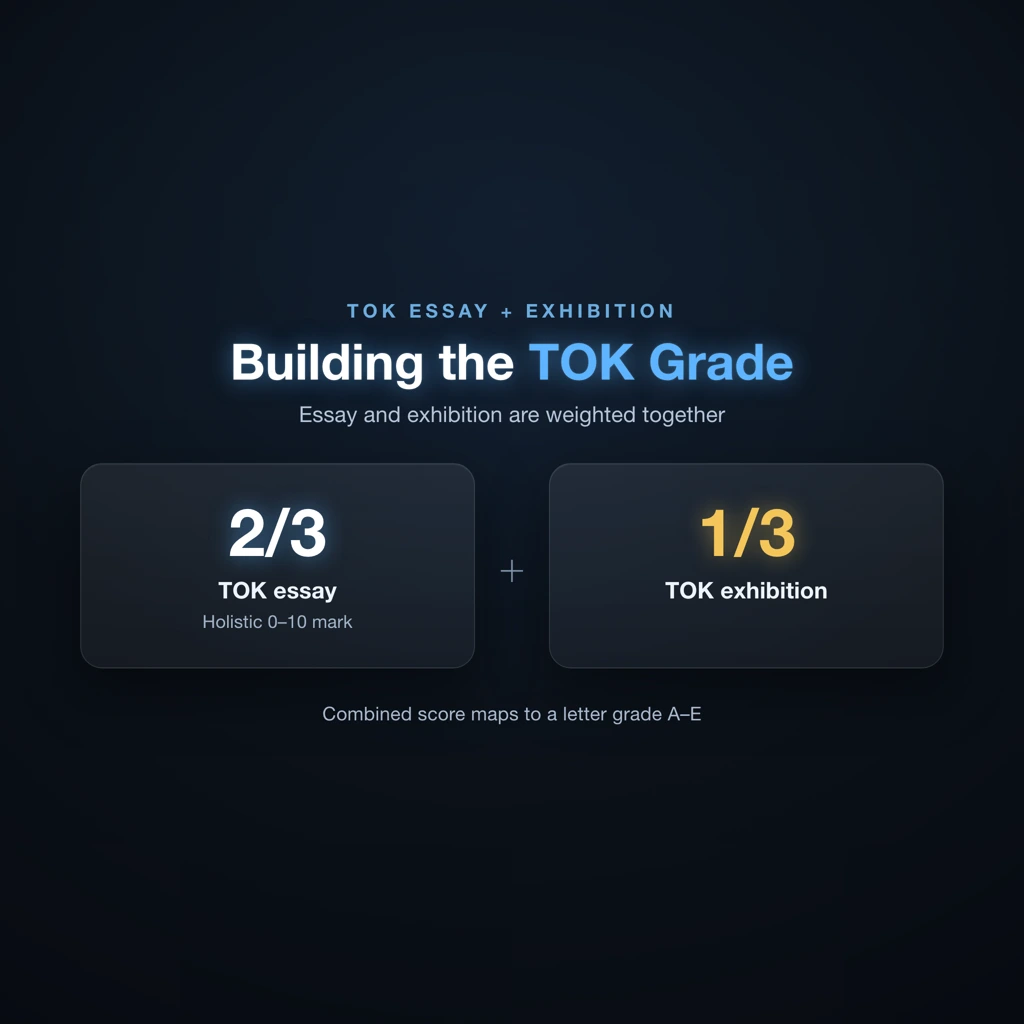
The IB does not grade the TOK essay in isolation. Your TOK essay and your TOK exhibition are weighted together, with the exhibition counting for one-third and the essay for two-thirds of your combined TOK score. A strong tok essay can therefore carry a weaker exhibition, but only so far.
The combined score maps to a letter grade on a five-point scale:
| Grade | Descriptor | Practical meaning |
|---|---|---|
| A | Excellent | Full 3 bonus points available with an EE grade A or B |
| B | Good | Solid contribution to the diploma |
| C | Satisfactory | 1-2 bonus points with an EE grade of C or above; none with a D |
| D | Mediocre | Limits bonus points; grade E in either TOK or EE triggers a failing condition |
| E | Elementary | A failing condition: the diploma is not awarded, whatever the EE grade |
The E-grade risk is the most consequential quirk here. A student can pass every subject at grade 4 or above and still fail the diploma if either TOK or the Extended Essay lands at E. That makes the one-third exhibition weighting more consequential than it appears: a neglected exhibition can drag a competent essay down to a D or E outcome.
One point candidates often miss: per the IB, component marks and grades are not visible to candidates on results day. You will see your overall TOK letter grade on the results page, nothing more. If you want to know how the exhibition and essay scores broke down, your DP coordinator can request a detailed results view, though that access is at the coordinator's discretion.
6. The TOK and Extended Essay Core Points Matrix
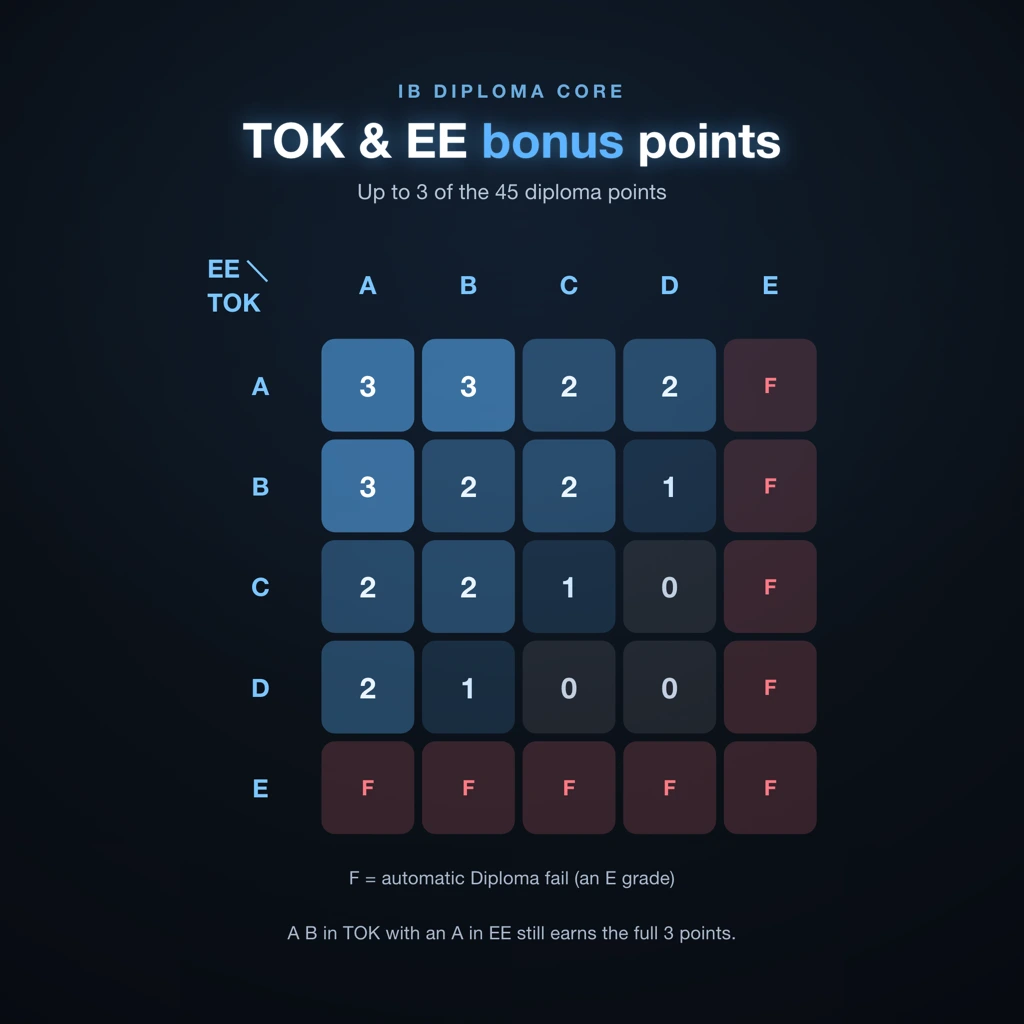
The IB Diploma scores 45 points in total. Your six subject grades contribute up to 42 of those points. The remaining three come from a combined assessment of your TOK essay and Extended Essay performance, using a matrix that cross-references the grade you earn in each component.
The matrix works like this:
| EE: A | EE: B | EE: C | EE: D | EE: E | |
|---|---|---|---|---|---|
| TOK: A | 3 | 3 | 2 | 2 | Fail |
| TOK: B | 3 | 2 | 2 | 1 | Fail |
| TOK: C | 2 | 2 | 1 | 0 | Fail |
| TOK: D | 2 | 1 | 0 | 0 | Fail |
| TOK: E | Fail | Fail | Fail | Fail | Fail |
An E grade in either component triggers an automatic Diploma failure, regardless of how strong your subject scores are. A student sitting on 40 subject points who submits a negligent Extended Essay outline or abandons the tok essay late in the process can lose the Diploma entirely.
The less obvious trade-off: a B in TOK paired with an A in the Extended Essay gives the same three bonus points as two As. That means a student who earns a solid but unspectacular TOK grade can still reach the maximum bonus, provided the Extended Essay compensates. The reverse also holds, which is worth knowing if your Extended Essay length or argument depth is limited by your chosen subject area.
For students who are strong in their six subjects and assume the core components are low-stakes extras, the E-grade failure condition is the detail that changes the calculation.
7. TOK Essay Structure: How to Build Your Argument
A well-structured TOK essay does not simply answer the prescribed title - it unpacks it. The opening move is to reframe the title as a genuine knowledge question: one that exposes the tension the IB Diploma Programme expects you to explore. An introduction that opens with "I will argue that..." tells the examiner where you are going but not why the question is hard. Instead, identify what makes the title genuinely contested. A title about the role of intuition in mathematics, for example, is interesting precisely because mathematicians disagree about whether intuition constitutes knowledge at all.
The introduction should create intellectual tension, not announce a thesis.
Body paragraph sequence
Each body paragraph should follow a claim, counterclaim, evaluation sequence:
- Claim - state a position on the knowledge question, grounded in a specific area of knowledge (AOK) such as natural sciences or history.
- Counterclaim - introduce a real tension, not a token objection. The strongest counterclaims come from a different AOK or a different knower perspective.
- Evaluation - reach a considered judgment. This is where the tok essay earns its marks. The IB assessment criteria reward you for showing why the tension matters, not just that it exists.
Real-life examples: analytical, not decorative
The IB requires a minimum of two areas of knowledge, and the real-life examples (RLEs) you choose to support them must do analytical work. A common pitfall is name-dropping: citing the Milgram experiments to gesture at ethics without connecting the example to your specific knowledge claim. The test is simple: if you removed the example and the paragraph still made the same point, the example is decorative. If removing it collapses the argument, it is doing its job.
A non-obvious trade-off worth knowing: choosing a famous RLE often weakens your argument because examiners have seen the same examples hundreds of times and scrutinise them more closely for vagueness. A specific, less-cited case forces you to explain it precisely, which tends to produce sharper analysis.
The conclusion returns to the prescribed title directly, showing how your exploration has complicated or refined the question rather than simply settled it.
8. Common Mistakes That Cost Marks
The IB's marking descriptors separate "description" from "analysis" at every grade boundary, and most marks lost in the TOK essay come down to five recurring errors.
Descriptive writing instead of analytical writing. Retelling what a scientist discovered, or summarising what a philosopher said, is not TOK argument. The examiner wants to see you interrogate why that example creates or limits knowledge, not just confirm it happened. A useful self-check: if a sentence could appear in a Wikipedia article without modification, it is description, not analysis.
Examples used as decoration rather than evidence. A concrete example should stress-test the claim it accompanies. If you can swap your example for a different one without changing the argument, the example is not doing real work. This is the non-obvious gotcha: strong TOK essays often use a single, well-dissected example more effectively than three examples listed in quick succession.
Ignoring the counterclaim. Presenting one perspective only reads, to an examiner, as a failure to understand that knowledge claims are contestable. The counterclaim is not a box to tick in a single sentence and then dismiss. It needs to be stated charitably, engaged with seriously, and then either qualified or incorporated into your conclusion.
Starting from a conclusion. Essays written backwards, where the student already knows the answer and marshals evidence to confirm it, are structurally visible to experienced markers. Genuine exploration means following an argument where it leads, including to complications.
Word count and bibliography errors. Exceeding 1,600 words draws examiner attention to everything over the limit and can affect assessment. A missing or inconsistently formatted bibliography signals carelessness that undercuts an otherwise solid essay.
9. Using AI on the TOK Essay
The IB's Academic Integrity Policy is unambiguous: submitting AI-generated text as your own work constitutes academic misconduct, in the same category as plagiarism. This applies directly to the TOK essay.
The distinction that matters in practice is between use and submission. Using an AI tool to generate a list of counterarguments you then evaluate yourself, or to check whether a sentence is grammatically clear, sits in different territory from pasting AI-generated paragraphs into your final draft. The problem is that the boundary is genuinely difficult to police from the outside, which is exactly why the IB's approach focuses on the authenticity declaration your school submits alongside your work.
One counter-intuitive point: because the TOK essay is externally assessed by an IB examiner rather than your own teacher, any inconsistency between the analytical voice in your essay and the one your coordinator has observed across your other work is more likely to be noticed, not less. Examiners read thousands of TOK essays and develop a clear sense of what student writing looks like at each performance band.
Your school's coordinator may apply rules stricter than the IBO minimum. Some schools prohibit any AI tool use during drafting; others require you to declare specific tools in your process journal. Check your coordinator's guidance before you start, not after your first draft is written.
10. Where to Go From Here
Ask your DP coordinator this week for access to the current TOK essay assessment instrument on the IB's Programme Resource Centre. Print it, then sit with a draft paragraph and annotate each criterion against what you have actually written. That single exercise reveals gaps in your argument that no amount of re-reading will surface.
One counter-intuitive detail worth knowing: most schools set their internal TOK essay deadline several weeks before the IBO submission window, which means your real deadline is earlier than the official one on the IB calendar. Check with your coordinator today, not after the next holiday.
Early drafting also pays a second dividend: your TOK essay performance feeds directly into the EE/TOK matrix, where the combined grade can add up to three bonus points toward your IB total. Start the essay late and you risk both the TOK grade and those matrix points simultaneously.
Download the rubric. Annotate your draft. Do it before your school's internal deadline, not the IBO's.
FAQ
How many words is the TOK essay?
The TOK essay has a maximum of 1,600 words; the IB does not set a formal minimum, but an essay substantially shorter than that is unlikely to develop a sophisticated argument across the required criteria.
How is the TOK essay graded?
The essay is marked out of 10 using a single holistic assessment instrument, then combined with the TOK exhibition score (which is worth one-third of the overall TOK grade) to produce a final letter grade of A to E.
What are the TOK essay assessment criteria?
There are no separate criteria: the essay is assessed holistically against one driving question - does it provide a clear, coherent and critical exploration of the essay title? - with examiners placing the whole essay in one of five levels, from rudimentary (1-2) to excellent (9-10).
How does the TOK essay affect your IB Diploma points?
Your TOK grade (A-E) combines with your Extended Essay grade on a core points matrix to award 0-3 bonus points on top of your subject scores, which can make the difference between passing and failing the Diploma.
Can you use AI to write your TOK essay?
Submitting AI-generated text as your own work breaches the IB's Academic Integrity Policy and constitutes academic misconduct; students may use AI as a thinking aid, but all submitted writing must be authentically their own.
How should a TOK essay be structured?
A strong TOK essay opens by reframing the prescribed title as a genuine knowledge question, develops two or more body paragraphs each with a claim, counterclaim, and evaluation supported by real-life examples, and closes by returning to the title with a nuanced conclusion.
References
- Assessment FAQ - International Baccalaureate® - https://ibo.org/programmes/diploma-programme/assessment-and-exams/getting-results/assessment-faq/