IB Psychology Syllabus: The 2027 Course Guide (HL & SL)
By Michael Thompson · Education Specialist; 10 years teaching the IB at Bromsgrove School · Published 4 September 2026 · Updated 4 October 2026
The IB psychology syllabus has changed for students sitting exams from May 2027. The new course was first taught in August 2025 and is built from three linked parts: six concepts, the content (the biological, cognitive and sociocultural approaches plus research methodology) and four contexts that every student studies. Higher Level adds extensions on culture, motivation and technology and a new Paper 3 on data analysis, and the internal assessment is now a research proposal that you design but do not carry out. This guide covers each part of the course, how SL and HL differ, the papers, the weightings and the IA, using the IB's subject guide for the new course.
Key Takeaways
- New course, first assessed May 2027: It was first taught in August 2025. The previous course is examined for the last time in November 2026.
- Concepts, content and contexts: Six concepts (bias, causality, change, measurement, perspective and responsibility) are applied to the three approaches and to four contexts.
- No more options: Every student studies all four contexts: health and well-being, human development, human relationships, and learning and cognition.
- HL adds extensions and Paper 3: HL students study the role of culture, motivation and technology, and sit an HL-only Paper 3 on data analysis and interpretation.
- The IA is a research proposal: You design a study using one of the four research methods from your class practicals, and you do not run it. SL and HL complete the same task.
- Less memorising of studies: The IB says students no longer need to memorise the details of research studies, so practise applying concepts and evaluating research instead.
In This Article
- What Is IB Psychology and Who Is It For?
- The 2027 Syllabus Change: What's Different and When It Applies
- Concepts, Content and Contexts: How the Course Fits Together
- HL vs SL: Extensions, Paper 3 and Extra Hours
- The Four Contexts Every Student Studies
- IB Psychology Paper Format: Paper 1, Paper 2, and Paper 3
- The Internal Assessment: A Research Proposal
- Ethics and Research Methods: How They Appear in Exams
- Assessment Model and Grade Weighting at a Glance
- What to Do Next
1. What Is IB Psychology and Who Is It For?
IB Psychology is a Group 3 (Individuals and Societies) subject in the International Baccalaureate Diploma Programme, and the ib psychology syllabus treats psychology as the scientific study of behaviour and mental processes. Rather than teaching one theory of the mind, the course asks you to look at behaviour from biological, cognitive and sociocultural angles, to judge the research behind each claim, and to apply what you know to real situations.
The subject is offered at Standard Level (SL) and Higher Level (HL). SL suits students who want psychology alongside sciences or humanities. HL is the better fit if you are thinking about studying psychology at university, because the HL extensions and the data-analysis paper give you more practice with the research reasoning a psychology degree builds on. Entry requirements vary, so check the course pages of the universities you are considering.
One timing detail matters most right now. The IB's psychology updates page confirms that the new course was first taught in August 2025, with first assessment in May 2027. If you sit your exams in May 2027 or later, you are on the new course, and everything below applies to you.
2. The 2027 Syllabus Change: What's Different and When It Applies
The previous psychology course was first assessed in 2019. Its replacement keeps the three approaches but reorganises the course around them. The IB's own summary of the changes describes three parts: concepts, content and contexts. The table shows what moved where, which is useful if you are working from older notes or textbooks.
| Previous course (last exams November 2026) | New course (first exams May 2027) | |
|---|---|---|
| Organising idea | Core plus options | Concepts, content and contexts |
| Concepts | Not a separate part of the course | Six: bias, causality, change, measurement, perspective, responsibility |
| Main material | The core: three approaches | The content: three approaches plus research methodology |
| Applied topics | Options: SL chose one, HL chose two | Four contexts, studied by every student |
| HL extra content | HL extensions to the approaches | The role of culture, motivation and technology, plus data analysis and interpretation |
| Internal assessment | A simple experiment | A research proposal |
| HL-only paper | Paper 3 | Paper 3 on data analysis and interpretation |
The change in emphasis matters as much as the change in structure. The IB's summary says students no longer need to memorise the details of research studies. Instead, you are expected to use research as evidence, evaluate how it was produced, and connect it to the concepts.
The paper lengths, marks, weightings and IA criteria on this page come from the IB's Psychology guide (first assessment 2027), published in February 2025 and updated in May 2025. Your psychology teacher or DP coordinator has the full guide, including the markbands for each paper.
November 2026 candidates only: you are on the previous course. You study the core approaches plus one option at SL or two at HL, HL students also sit a Paper 3, and your IA is the experimental study: a replication of a published experiment in 1,800-2,200 words, marked out of 22 (Introduction 6, Exploration 4, Analysis 6, Evaluation 6). The rest of this page describes the new course.
3. Concepts, Content and Contexts: How the Course Fits Together
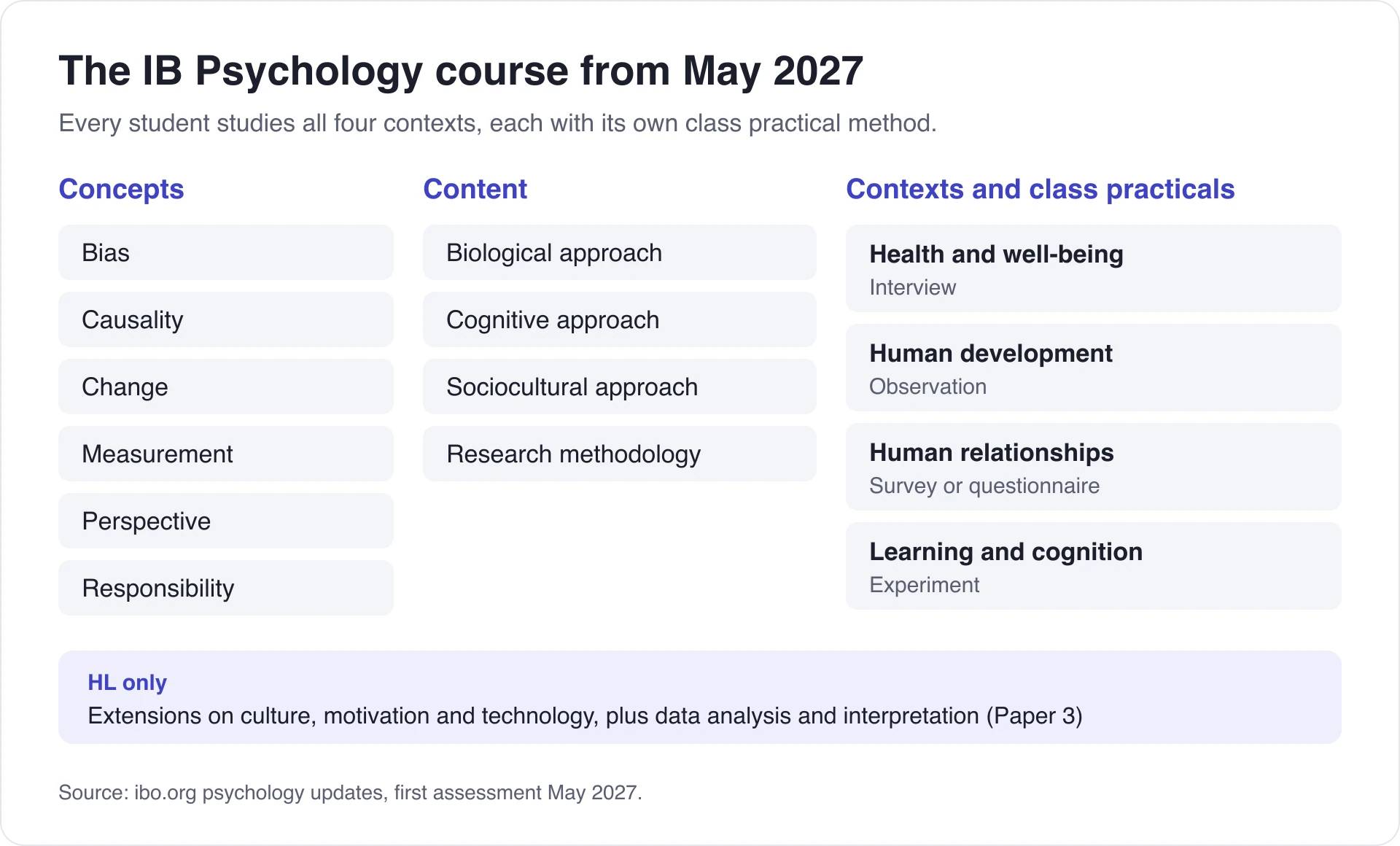
The easiest way to picture the new course is as a grid. The content is what you learn about, the contexts are where you apply it, and the concepts are the questions you keep asking of both.
The six concepts
The six concepts run through the whole course. In plain terms (these glosses are ours; the subject guide has the IB's own wording):
- Bias - how researchers, participants and theories can distort what we think we know.
- Causality - whether evidence shows that one thing causes another, or only that the two are linked.
- Change - how behaviour, people and psychological explanations change over time.
- Measurement - how psychologists turn behaviour and mental processes into data, and how far that data can be trusted.
- Perspective - how the same behaviour looks different from biological, cognitive and sociocultural viewpoints, and across cultures.
- Responsibility - the ethical duties of researchers and the consequences of how psychological knowledge is used.
The content: three approaches plus research methodology
The old core becomes the content. It keeps the three approaches and adds research methodology as a named part:
- Biological approach - behaviour explained in terms of the brain, the nervous system, hormones and genetics.
- Cognitive approach - mental processes such as memory, perception and thinking.
- Sociocultural approach - how other people, groups and culture shape behaviour.
- Research methodology - how psychological knowledge is produced: research methods, sampling, ethics, and what each design can and cannot show.
The exact topics listed under each approach are set out in the subject guide, so check your school's scheme of work for the list you will be examined on.
Why the structure changes how you revise
Under the previous course, a lot of revision time went into memorising named studies and their procedures. That is no longer the main task. You still need research, but as evidence: what a study shows, how far its method supports the claim, and which concept it raises.
A good revision habit is to take one topic and ask the six concept questions of it. Take stress, for example. What biases affect how it is measured? Can a study show that stress causes illness, or only that the two go together? How does the picture change from a biological to a sociocultural perspective? Working through the concepts this way prepares you for the kind of applied questions the new papers ask.
4. HL vs SL: Extensions, Paper 3 and Extra Hours
Both levels study the same concepts, the same content and the same four contexts, and both complete the same internal assessment. The differences are the HL extensions, Paper 3 and teaching time.
| Standard Level | Higher Level | |
|---|---|---|
| Recommended teaching hours | 150 | 240 |
| Concepts, content and contexts | All | All |
| HL extensions (culture, motivation, technology) | No | Yes |
| Exam papers | Paper 1 and Paper 2 | Paper 1, Paper 2 and Paper 3 |
| Internal assessment | Research proposal | The same research proposal |
The HL extensions
The IB describes the HL extensions as the role of culture, motivation and technology in shaping human behaviour, together with data analysis and interpretation. In broad terms, culture asks how far behaviour and research findings hold across cultural groups, motivation asks what drives behaviour, and technology asks how digital and other technologies affect how people think and act. The subject guide sets out exactly what each extension covers.
Paper 3 is the sharpest difference
Paper 3 is an HL-only paper that tests data analysis and interpretation directly. The subject guide describes four source-based questions built on quantitative and qualitative findings you have not seen before, focused on one of the HL extensions. That means HL students need to be comfortable reading data: saying what a result does and does not show, judging how far it generalises, and making sense of qualitative material as well as numbers.
If you are choosing between levels, ask yourself whether you enjoy working with data. Paper 3 rewards students who like interpreting results, and the extensions add breadth on top of the four contexts every student already covers.
5. The Four Contexts Every Student Studies
In the previous course, SL students picked one option and HL students picked two. In the new course there is no choice: every student studies all four contexts.
- Health and well-being - the IB renamed abnormal psychology as health and well-being, and the IB's summary of the changes says the old abnormal and health psychology options both fold into it. Broadly, it covers mental and physical health and what affects them.
- Human development - how people change across the lifespan. It is the nearest equivalent of the old developmental psychology option.
- Human relationships - how people form, keep and lose relationships, and how they behave towards one another and in groups.
- Learning and cognition - new to the course. The IB's summary says it covers cognitive processes beyond memory, such as language and perception.
Class practicals
Alongside the contexts, students carry out at least four class practicals, one in each context. The subject guide pairs each context with a research method: an interview (which can be a focus group) in health and well-being, an observation in human development, a survey or questionnaire in human relationships, and an experiment in learning and cognition. The practicals matter twice. Section A of Paper 2 is four compulsory questions on them, and your IA must use one of the same four methods (see section 7).
What this means for revision
Because you cannot choose your contexts, you cannot leave one out. A practical approach is to keep one page per context listing the research you would use as evidence, the concept each piece of research best illustrates, and one evaluation point for each. Shared research is fine: a study can serve more than one context if you explain why it is relevant to each.
6. IB Psychology Paper Format: Paper 1, Paper 2, and Paper 3
SL students sit Paper 1 and Paper 2; HL students also sit Paper 3. The lengths, marks and sections below come from the assessment outline in the IB's Psychology guide.
| Paper | Who sits it | Focus | Length | Marks |
|---|---|---|---|---|
| Paper 1 | SL and HL | Concepts, content and contexts | 1 hour 30 minutes | 35 |
| Paper 2 | SL and HL | Research methodology, including the class practicals | 1 hour 30 minutes | 35 |
| Paper 3 | HL only | Data analysis and interpretation | 1 hour 45 minutes | 30 |
Paper 1
Paper 1 has three sections. Section A is two short-answer questions on two of the three approaches (8 marks). Section B is two questions that ask you to apply the content to an unseen situation, each set in one of the contexts (12 marks). In Section C you answer one of two concept-based extended-response questions, each from a different context (15 marks). The guide says knowledge of the details of research studies is not assessed in Sections A and C. The extended response is where command terms become decisive.
Key command terms and what they ask for:
- Evaluate - weigh specific strengths against specific limitations and reach a supported judgement. A list of strengths alone scores poorly.
- Discuss - present more than one perspective and balance them. Sitting firmly on one side without acknowledging the other loses marks.
- Explain - identify the mechanism or cause, not just describe the outcome.
- Describe - give a detailed account. No evaluation is needed or rewarded.
A common misstep: students write evaluative answers to "describe" questions and run out of time for the questions where evaluation is actually required.
Paper 2
Paper 2 focuses on research methodology. Section A is four compulsory questions on the class practicals (20 marks), and the guide says they focus on the research method rather than the context the practical was set in. Section B asks you to evaluate an unseen research study in terms of two or more concepts (15 marks). Treat your practicals as revision material: know the aim, method, sample, ethics and limitations of each one, and be ready to say how you would design it differently.
Paper 3 (HL only)
Paper 3 is four questions on a booklet of sources you have not seen before, with quantitative and qualitative findings drawn from one of the HL extensions. In order, the questions cover interpreting a graph (3 marks), analysing data and stating a conclusion (6 marks), a qualitative research consideration such as credibility, bias or transferability (6 marks), and a synthesis question that uses at least three of the sources and your own knowledge to judge a claim (15 marks). Practise describing what a graph or table shows before you interpret it, keep your conclusions within what the data supports, and compare quantitative and qualitative findings where both are given.
Because May 2027 is the first session, there are no past papers for the new course yet. Ask your teacher what specimen or practice material your school has, and be careful with past papers from the previous course: the papers are organised differently and the question styles do not match.
7. The Internal Assessment: A Research Proposal
The IA has changed the most. Instead of running a simple experiment, you now design a research proposal to investigate a population of interest, using one of the four research methods from the class practicals, according to the IB's psychology updates page. You do not carry the study out. Your teacher marks the proposal and the IB moderates a sample. The task is the same at SL and HL.
The IB's Psychology guide marks the IA out of 24, across four criteria worth 6 marks each, and asks you to structure the proposal under the same four headings:
- Introduction - a focused aim, a real-life problem and its impact on your population of interest, and the findings and conclusions of two pieces of relevant research, linked to your investigation.
- Research methodology - why you chose your method, your procedure (including sampling, design and setting), and the ethical considerations that apply to your study.
- Data collection - one data-collection tool that you create (at least five items, with a copy in the appendix), the decisions behind it, and the challenges you expect when collecting data.
- Discussion - your potential findings and their implications for policy or practice, how researcher bias could affect the study, and one additional research method that would add to understanding of the topic.
The proposal must not exceed 2,200 words, and examiners are told to stop reading at the limit. References and appendices do not count towards it.
Because you collect no data, the marks depend on the quality of your design: whether the method suits the question, whether the sample fits the population, whether the ethics hold up, and whether you can foresee what might go wrong. Our IB Psychology IA guide covers the proposal step by step.
8. Ethics and Research Methods: How They Appear in Exams
Research methodology is now a named part of the content, and Paper 2 is built around it, so methods and ethics are no longer something you add at the end of an essay. They are assessed directly, and they also run through Paper 1 answers and, at HL, Paper 3.
Ethical principles you need to know
Professional codes such as those of the APA and the BPS share a common set of principles. These five come up most often:
- Informed consent - participants agree to take part with full knowledge of what is involved
- Confidentiality - personal data and identities are protected
- Debriefing - participants are told the true purpose after the study ends
- Right to withdraw - participants can leave at any time without penalty
- Protection from harm - researchers minimise distress and lasting negative effects
One non-obvious point: debriefing is sometimes treated as a cure-all. A strong answer recognises that debriefing after a deceptive study does not fully undo any distress caused during it.
The four research methods
| Method | What it is good for | A typical weakness to evaluate |
|---|---|---|
| Experiment | Testing cause and effect under controlled conditions | Artificial settings can lower ecological validity |
| Observation | Recording behaviour as it happens | Observer bias, and the ethics of watching people |
| Survey or questionnaire | Collecting attitudes or self-reports from many people quickly | Social desirability and other self-report biases |
| Interview or focus group | Rich, detailed accounts in participants' own words | Hard to generalise; interviewer effects |
For any method, expect to discuss reliability and validity, sampling and ethics, and to connect them to the concepts. Measurement, bias and causality are the most obvious links: how was the behaviour measured, what could have distorted it, and does the design support a causal claim?
Building ethical critique into an answer
A strong answer on any piece of research follows a three-step pattern:
- Identify the ethical issue - name the problem (deception, lack of informed consent, and so on)
- Name the principle - link it explicitly to one of the five principles above
- Explain the consequence - state how the issue affects how the research was carried out or how its findings can be used
Aim for at least one methodological strength, one limitation and one ethical point for each piece of research you use. That structure signals evaluative thinking, which is where marks in the higher bands are awarded.
9. Assessment Model and Grade Weighting at a Glance
The weightings below come from the assessment outline in the IB's Psychology guide. The IA is the same task at both levels, but it counts for more at SL.
Standard Level (SL)
| Component | Weighting |
|---|---|
| Paper 1 | 35% |
| Paper 2 | 35% |
| Internal assessment (research proposal) | 30% |
Higher Level (HL)
| Component | Weighting |
|---|---|
| Paper 1 | 25% |
| Paper 2 | 25% |
| Paper 3 | 30% |
| Internal assessment (research proposal) | 20% |
Moderation. The IA is not simply teacher-marked and filed away. It is externally moderated by the IB: a sample of each school's work is reviewed, and the school's marks can be adjusted up or down as a result. Your teacher's mark is a starting point, not a guarantee.
Grade boundaries. None exist yet for the new course. Boundaries are set after the first exam session, and May 2027 results are released on 6 July 2027. Do not use boundaries from the previous course: the papers and the IA are different, so old boundaries do not carry over.
10. What to Do Next
Three practical steps will put you on firm ground:
- Confirm which course you are on. If your exams are in May 2027 or later, you are on the new course. Check that your notes, textbook and revision resources were written for it.
- Read the assessment section of the subject guide. Your teacher or DP coordinator has the IB's Psychology guide. Its markbands and IA criteria show exactly what each paper and the IA reward.
- Practise the new skills. Apply the six concepts to each context, revise your class practicals for Paper 2, and, at HL, practise interpreting unfamiliar data.
Then read our IB Psychology IA guide before you start planning your proposal, and check the IB's psychology updates page for any official changes.
FAQ
What is IB Psychology?
IB Psychology is a Group 3 Diploma Programme subject that studies human behaviour and mental processes. From May 2027 it is organised around six concepts, the three approaches plus research methodology, and four contexts, at Standard Level and Higher Level.
Is IB Psychology hard?
Difficulty is relative. The new course puts less weight on memorising the details of studies and more on applying concepts, evaluating research and, at HL, interpreting unfamiliar data - skills that need steady practice rather than cramming.
When did the IB Psychology syllabus change?
The new course was first taught in August 2025 and is first assessed in May 2027, according to the IB. The previous course is examined for the last time in November 2026.
What is the difference between IB Psychology HL and SL?
Both levels study the same concepts, approaches and four contexts and complete the same IA. HL adds extensions on the role of culture, motivation and technology, an HL-only Paper 3 on data analysis and interpretation, and 90 more teaching hours (240 against 150).
What is the IB Psychology internal assessment?
From May 2027 the IA is a research proposal: you design a study of a population of interest using one of the four research methods from your class practicals, and you do not carry it out. It is marked out of 24 across four criteria worth 6 marks each, and it must not exceed 2,200 words.
Does the IB Psychology syllabus change again after 2027?
The IB reviews subjects on a rolling cycle. The current course is first assessed in May 2027, and any future changes would be announced on the IB's curriculum updates page, so check ibo.org for official notices.
References
- Psychology updates - International Baccalaureate - https://ibo.org/university-admission/latest-curriculum-updates/psychology-updates/
- Read curriculum updates - International Baccalaureate - https://ibo.org/university-admission/latest-curriculum-updates