Birmingham Medicine Interview 2026-27: Format, Dates, Rates
By Michael Thompson · Education Specialist; 10 years teaching the IB at Bromsgrove School · Published 26 October 2026 · Updated 28 October 2026
The University of Birmingham interviews for Medicine and Surgery MBChB with multiple mini interviews (MMI): six or seven stations for Home applicants, and at least two online stations plus a separate online calculations station for international applicants. Invitations go out in December and January, interviews run in January and February, and decisions arrive by mid-March. On the most recent figures released (2026 entry), 75% of applications led to an interview and 81% of interviewees received an offer. This page sets out the Birmingham medicine interview from the University's own course page and published figures: who is shortlisted, the format and timing, what the interviewers assess, how Birmingham compares with other UK medical schools, and the questions applicants have reported.
Key Takeaways
- Format: multiple mini interviews (MMI): six or seven stations for Home applicants, and at least two online stations plus a separate online calculations station for international applicants; online or in person.
- Dates: invitations go out in December and January, interviews run in January and February, and decisions arrive by mid-March.
- Numbers: 75% of applications led to an interview; 81% of interviewees were offered a place.
In This Article
- The Birmingham medicine interview at a glance
- Who is invited
- The format: stations, timing and interviewers
- What Birmingham assesses
- How Birmingham compares
- Stations and questions at Birmingham medicine interviews
- How this page was built
- What to do next
1. The Birmingham medicine interview at a glance
The University of Birmingham interviews for Medicine and Surgery MBChB with multiple mini interviews (MMI): six or seven stations for Home applicants, and at least two online stations plus a separate online calculations station for international applicants. Invitations go out in December and January, interviews run in January and February, and decisions arrive by mid-March. For 2026 entry, 75% of applications led to an interview (1,219 of 1,633), and 81% of those interviewed received an offer. That puts Birmingham among the schools that interview the largest share of applicants, so the selection happens at the interview: the median school interviews 53% of its applications.
Everything on this page is what the University of Birmingham publishes on its course and admissions pages, read on 18 October 2026. The page on medicine interview dates by school puts Birmingham beside every other school, and medicine interview rates compares the figures.
2. Who is invited
How Birmingham chooses who to interview, as its pages describe it:
- Home standard applicants ranked on an application score (45% GCSE, 40% UCAT total, 15% contextual; scored out of ten), over 1,100 interviewed
- Graduates meeting academic thresholds ranked on UCAT
- International: academic threshold, then ranked on UCAT total, then personal statement assessment
The other steps it describes:
- UCAT required, no cut-off
- SJT band scored at interview stage and weighted equally with each MMI station
- Offers on MMI and SJT only, with a likely minimum standard per station
- Personal statement and reference considered before and after interview
- DBS check (police check for international) and health screening before admission
- No reapplication after rejection at interview
3. The format: stations, timing and interviewers
| What the course page says | |
|---|---|
| Format | multiple mini interviews (MMI): six or seven stations for Home applicants, and at least two online stations plus a separate online calculations station for international applicants |
| Length | eight minutes per station, including two minutes preparation |
| Mode | online or in person |
| Interviewers | Academic staff, clinical staff, professional services staff and trained senior medical students; professional role-players; online: one interviewer or role-player plus a second interviewer, scoring independently |
| At the interview | Role-play with a professional role-player; computer-based calculation station; data interpretation station; scenario reading before each station; International: separate online calculations assessment on another date |
| Dates | invitations December to January; interviews January and February; decisions by mid-March |
The course page does not state whether there is a task before the interview.
An MMI is a circuit: you move from station to station, each with its own interviewer and its own task, and each is scored on its own, so a poor station does not follow you to the next.
4. What Birmingham assesses
The University of Birmingham lists the qualities the interview assesses:
- Commitment and insight into medicine
- Communication
- Ability to evaluate information
- Empathy
- Self-insight and reflection
- Ethical reasoning
- Data analysis and interpretation
- Professionalism
- Rapport with a role-player
These are the criteria the stations score against, and the reason to prepare examples from your own experience that show each one, rather than a speech about wanting to be a doctor.
5. How Birmingham compares
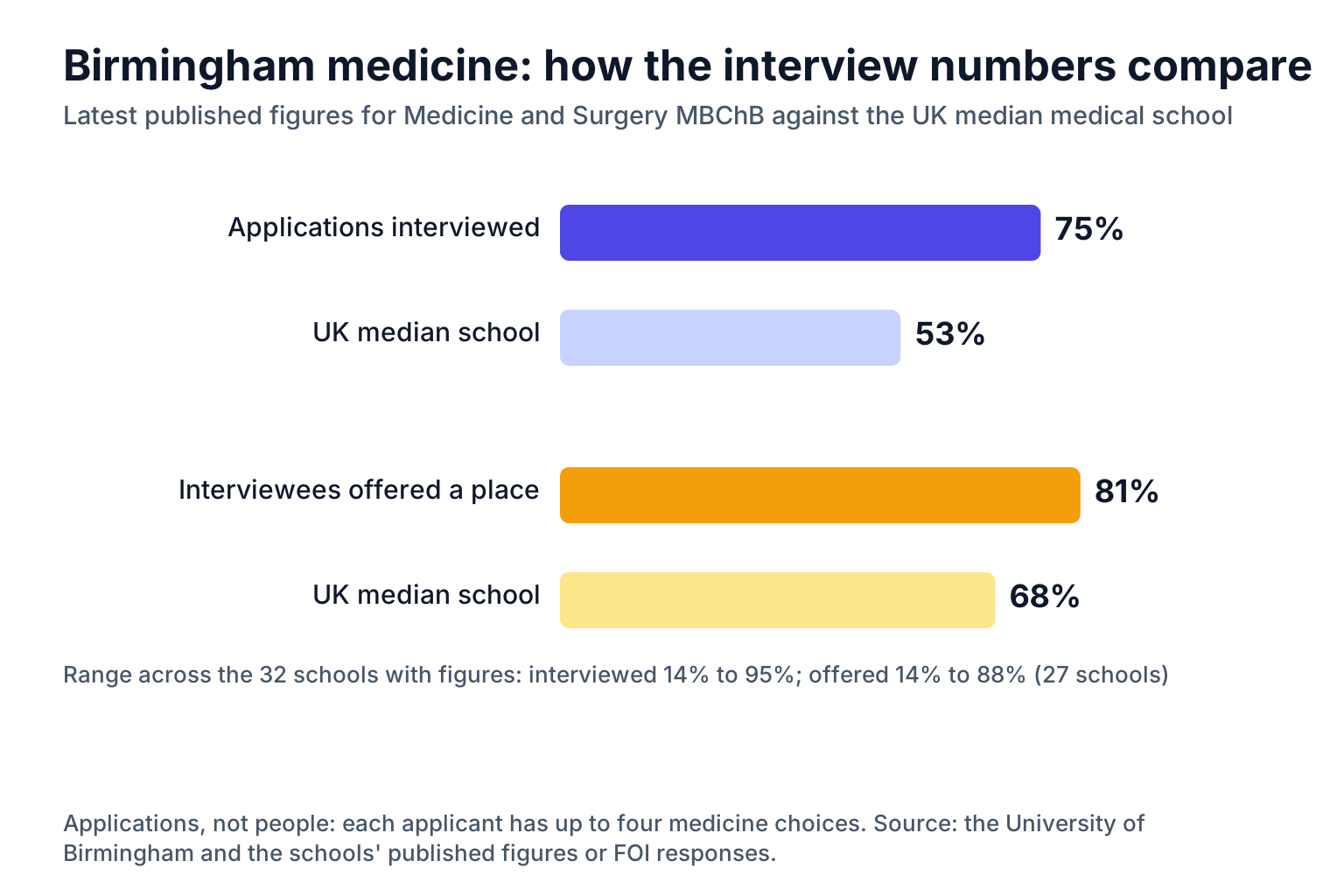
| Birmingham | Lowest UK school | Median UK school | Highest UK school | |
|---|---|---|---|---|
| Share of applications interviewed | 75% | 14% | 53% | 95% |
| Share of interviewees offered a place | 81% | 14% | 68% | 88% |
The comparison is across the 32 UK medical schools that publish or have released interview counts for their standard-entry course (27 of them also give offers); the figures are applications, not people, because every applicant has up to four medicine choices. The nearest schools by interview share are Barts (QMUL) (75%) and Plymouth (73%).
6. Stations and questions at Birmingham medicine interviews
The University of Birmingham describes its stations on its own pages:
- In this station you will be engaging with one of the professional role-players used for training and assessing healthcare students. You are expected to interact with the role player as if the situation is real.
- You will be asked to discuss specific aspects of your work or other relevant experience or your reflections on the online resources provided on the Preparing to Apply webpage.
- You will be asked to undertake simple mathematical calculations involving data that has clinical relevance.
- You will be presented with a topic relevant to healthcare but are not expected to have prior clinical knowledge. You must identify the issues that are of particular relevance to this topic and you should also present rational arguments for possible appropriate courses of action in attempting to resolve any inherent challenges.
- You will be provided with a scenario relating to potential challenges faced by staff working in healthcare.
- You will be provided with clinically relevant information and asked to interpret this and then draw conclusions that are appropriate to the scenario.
- You will be presented with a scenario reflecting potentially poor professional behaviour or attitudes from a member of the healthcare team. You will be asked to think through how you might respond to this as a student and to explore the scope and importance of professionalism in the context of healthcare.
No question reported at Birmingham can be traced to a university page or a first-hand account; our dataset holds 59 attributed to Birmingham by preparation companies, which are not reproduced for that reason. The station types are the same across UK MMIs, so the sourced examples on MMI questions and medicine interview questions are the ones to practise with.
7. How this page was built
The format, timing, dates, shortlisting and assessment criteria come from the University of Birmingham Medicine and Surgery MBChB course page, and the applications, interviews and offers from the school's own admissions figures. Each page was read on 18 October 2026 and the figures exported on 21 October 2026; nothing is estimated, and where the school does not publish a figure the page says so. Interview arrangements change between cycles, so the course page is the final word and this page is the comparison.
8. What to do next
Check the dates and the notice Birmingham gives, then prepare for the format named above and nothing else: eight-minute stations reward a clear first sentence and an example, not a build-up. Work through the assessment list and write one example from your own experience against each criterion. Then practise out loud and timed, with someone who will play the interviewer and, for the role play, the actor. The guide to how to get into medicine covers the UCAT and the four-choice rule, and the hub page on Oxbridge and medicine interviews 2026 links every interview page on this site.
FAQ
What is the Birmingham medicine interview format?
Multiple mini interviews (MMI): six or seven stations for Home applicants, and at least two online stations plus a separate online calculations station for international applicants; online or in person. The course page gives the length: eight minutes per station, including two minutes preparation.
When are Birmingham medicine interviews?
Invitations go out in December and January, interviews run in January and February, and decisions arrive by mid-March.
What percentage of applicants get a medicine interview at Birmingham?
For 2026 entry, 75% of applications led to an interview, and 81% of those interviewed received an offer.
What does Birmingham look for at interview?
The University of Birmingham says the interview assesses commitment and insight into medicine, communication, ability to evaluate information, empathy, and self-insight and reflection, among other qualities.
References
- University of Birmingham: Medicine and Surgery MBChB course page - https://www.birmingham.ac.uk/study/undergraduate/subjects/medicine-courses/medicine-and-surgery-mbchb
- University of Birmingham: medicine admissions figures - https://www.birmingham.ac.uk/documents/college-mds/medical-school/mbchb-admissions-statistics-sept-2026.pdf