Medicine Interview Questions UK: Real Examples With Sources
By Michael Thompson · Education Specialist; 10 years teaching the IB at Bromsgrove School · Published 27 October 2026 · Updated 28 October 2026
UK medicine interview questions test the qualities each medical school publishes in its own selection criteria: motivation, insight into the career, ethical reasoning, teamwork, communication and resilience. They are not a quiz on anatomy, and the same qualities are tested whether you face multiple mini interviews (MMIs) or a panel. Of the 45 UK medical schools that interview for standard-entry medicine, 36 use MMIs and four use a panel interview. Aston University states plainly that no medical knowledge is tested. Below you will find the themes interviewers return to, what a strong answer to each one does, how a panel differs from an MMI, and how to prepare in the weeks before. Every question shown on this page comes from a sourced list rather than guesswork.
Key Takeaways
- Schools publish what they assess: Aberdeen, Anglia Ruskin, Aston, Bangor, Queen Mary and Birmingham all list the qualities they score, and your answers should map directly onto those lists.
- MMIs dominate in the UK: Of 45 UK medical schools interviewing for standard-entry medicine, 36 use MMIs and four use a panel: Queen Mary, Cambridge, Glasgow and Oxford.
- Same qualities, different format: A panel is one continuous conversation and an MMI is a series of separately scored stations, but both look for the same personal qualities.
- Communication is scored throughout: Aberdeen scores communication and interpersonal skills at every station, so how you explain matters as much as what you say.
- Reflection beats a list of placements: Oxford asks for motives that are "well-reasoned" and grounded in observing medical practice, which means saying what you learned rather than where you went.
- One example per assessed quality: Prepare a specific experience of your own for each quality on your school's list, then practise it aloud, timed, with someone who will push back.
In This Article
- What medical school interview questions are really testing
- Medicine interview questions in the UK: MMI or panel
- Motivation, insight and work experience reflection
- Medicine interview questions on ethics and the four principles
- The NHS, its values and professionalism
- Teamwork, resilience and communication
- Questions reported at medicine interviews
- How panel interview medicine questions differ from MMI stations
- How to prepare in the weeks before your interview
- What to do next
1. What medical school interview questions are really testing
UK medicine interview questions test the personal qualities each medical school publishes in its own assessment list, not anatomy or clinical knowledge. The same qualities are assessed whether your school uses multiple mini interviews (MMIs, a circuit of short, separately scored stations) or a panel. The schools' own wording shows this most clearly:
- University of Aberdeen: the MBChB station domains are motivation to study medicine, core qualities, critical thinking & problem solving, teamwork and professionalism. Communication and interpersonal skills are scored at every station.
- Anglia Ruskin University: ARU assesses interpersonal and communication skills (including empathy), teamwork and leadership, preparation and motivation, critical thinking, ethical/moral reasoning and integrity. Answers are scored on quality, demonstration of skills/qualities and communication.
- Aston University: Aston lists understanding of studying and practising medicine, motivation, verbal communication, listening, problem solving, teamwork, professionalism, leadership, compassion, empathy, respect and dignity, emotional intelligence and knowing your limitations. No medical knowledge is tested.
- Bangor University (North Wales Medical School): Bangor assesses the personal qualities and attributes important for doctors.
- Queen Mary University of London: QMUL looks for motivation and an understanding of the reality of a career in medicine. It also assesses initiative, resilience and maturity, teamwork, organisation and problem solving, contribution to university life and communication skills, within values-based recruitment (NHS core values).
- University of Birmingham: Birmingham's published selection information lists commitment and insight into medicine, communication, ability to evaluate information, empathy, self-insight and reflection, ethical reasoning, data analysis and interpretation, professionalism and rapport with a role-player.
The same five themes appear on almost every list: motivation, communication, teamwork, professionalism and ethics. Sections three to six cover each one. Two details matter in practice. Because Aberdeen scores communication at every station, a clumsy delivery can cost marks even on a problem-solving task. And because Aston rules out medical knowledge, time spent revising clinical facts will not earn you marks there.
Takeaway: find each of your schools' assessment lists before you prepare anything else, and build your preparation around their exact wording.
2. Medicine interview questions in the UK: MMI or panel
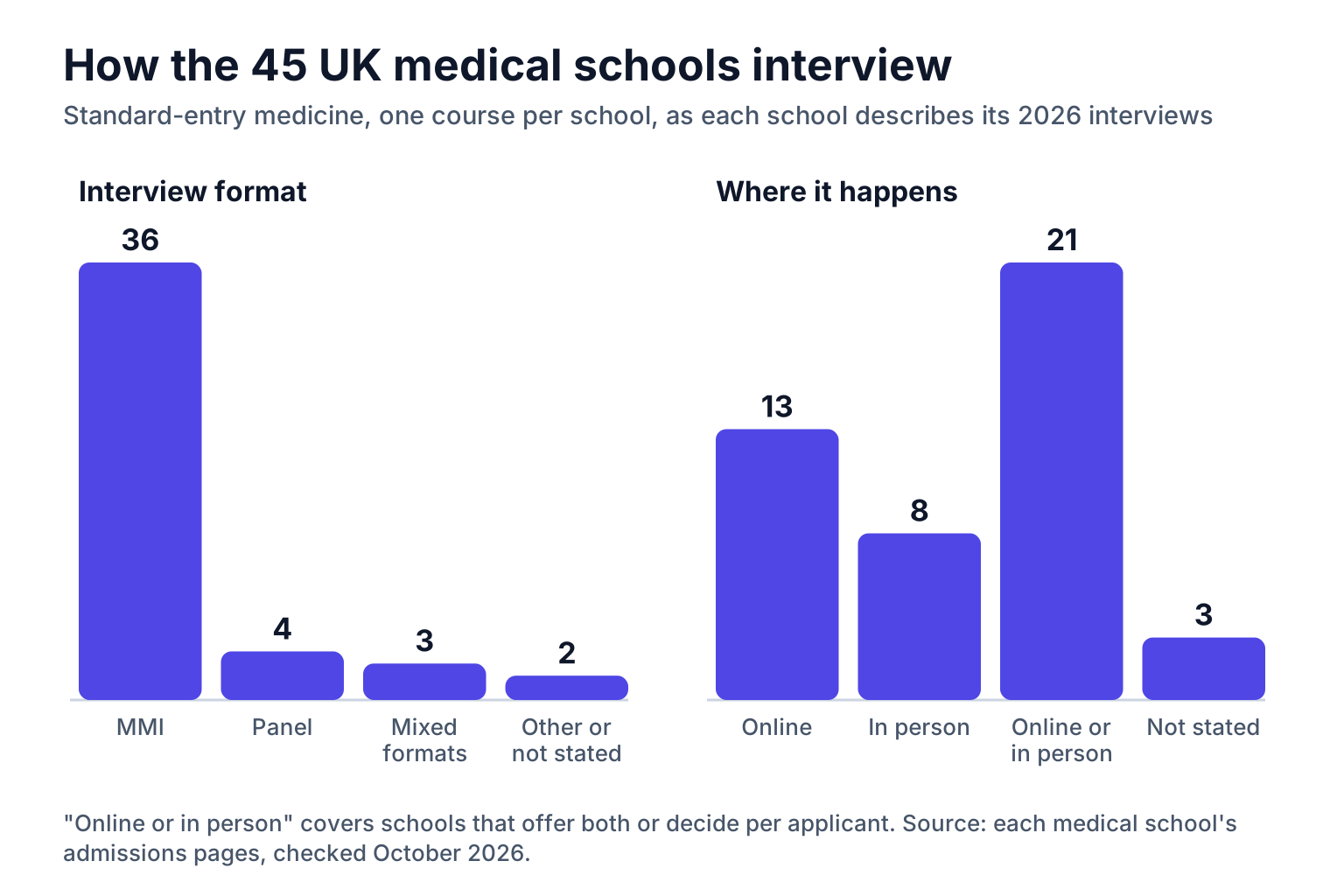
Most UK medical schools now interview by MMI, not by panel. Of the 45 UK medical schools that interview for their standard-entry medicine course, 36 use multiple mini interviews and four use a panel interview (Queen Mary University of London, the University of Cambridge, the University of Glasgow and the University of Oxford). The rest combine formats, use a group exercise or do not name a format. Those figures come from the schools' own course pages, read October 2026.
- Multiple mini interview (MMI): a series of short, separately scored stations. One weak answer stays contained to one station.
- Panel interview: one conversation with two or more interviewers. Each answer can shape the next follow-up.
At Oxford, reaching interview is itself a filter: 29% of A100 applicants are interviewed and 11% are successful, per Oxford's Medicine course page. Those are Oxford's figures alone, so do not read them across to other schools.
The medicine interview questions UK schools ask draw on the same qualities in both formats. Check which format each of your schools uses, because it changes how you practise, not what you practise.
3. Motivation, insight and work experience reflection
Motivation appears in the published selection criteria of several UK medical schools, and their wording shows they want more than enthusiasm. Queen Mary University of London assesses "motivation and reality of a career in medicine", and the University of Birmingham lists "commitment and insight into medicine". Both pair why you want the job with how accurately you understand it.
Oxford says your motives for choosing Medicine should be "well-reasoned". It advises gaining insight by observing medical practice and talking to healthcare providers (University of Oxford). The second route is easy to overlook: a conversation with a nurse, GP or paramedic about their working week counts as insight, alongside time spent shadowing.
Whatever the format, medicine interview questions on this theme reward answers that:
- Link the reason to evidence: something you saw, did or were told, rather than a general wish to help people.
- Name the hard parts: long hours, uncertainty, difficult conversations. That is the "reality" half of Queen Mary's wording, and leaving it out makes an answer sound unexamined.
- Stay specific: claims any applicant could make tell the interviewer nothing about you.
Work experience is judged the same way. Birmingham also assesses self-insight and reflection, which favours what you took from a placement over what you watched. Structure your reflection in three steps:
- What you observed.
- What it showed you about the role.
- What you would do differently, or still want to understand.
Takeaway: for each placement, write one sentence on what changed in your understanding of medicine, not a list of what you did.
4. Medicine interview questions on ethics and the four principles
Schools do not leave ethics to chance. Anglia Ruskin University lists "ethical/moral reasoning" and "integrity" among the qualities it assesses, and the University of Birmingham names "ethical reasoning" in its own list. Expect some medicine interview questions to test how you think through a problem where two good aims pull in different directions.
Most candidates structure that thinking with the four principles of medical ethics:
- Autonomy: respecting a person's right to make their own decisions.
- Beneficence: acting in the person's best interests.
- Non-maleficence: avoiding harm.
- Justice: treating people fairly and sharing resources fairly.
Naming the principles is the easy part. A strong ethics answer does four things:
- It identifies everyone affected, not just the patient.
- It weighs competing principles openly.
- It reaches a reasoned position.
- It recognises where a student's role ends.
That last point maps directly onto Aston University's stated quality of "knowing your limitations". Saying you would check with, or escalate to, someone more senior is part of a good answer, not a dodge.
Candidates looking for medicine interview questions ethics answers often want a model verdict. No single verdict earns the marks. Anglia Ruskin scores the quality of the answer and the demonstration of skills and qualities, so a clear, balanced line of reasoning matters more than landing on one "right" view.
Practise talking through any dilemma out loud in this order: the facts, the people affected, the principles in tension, your position, and what you would check or escalate.
5. The NHS, its values and professionalism
Several schools assess values and professionalism directly. Queen Mary University of London uses values-based recruitment built on the NHS core values, so the NHS shapes how answers are judged as well as being something you might discuss. Professionalism is on the published assessment lists for the University of Aberdeen, Aston University and the University of Birmingham. Aston also lists respect and dignity as separate qualities.
A strong answer treats the NHS as the system you would train and work in. Interviewers are not looking for a recited list of values. They want to see that you understand what those values mean for how a doctor behaves. The most convincing answers link a value to something you have done or seen, such as:
- how a staff member protected a patient's dignity during your work experience
- a time you owned a mistake, kept a confidence or asked for help when something was beyond you
Read two documents before your interview. Start with your school's own values page. Then read Good Medical Practice, the GMC's guidance for doctors. This matters for MMI and panel formats alike, because these medicine interview questions reward evidence rather than definitions.
Choose two values from your school's page and match each one to a specific moment from your own experience.
6. Teamwork, resilience and communication
Teamwork appears on almost every school's assessment list. The University of Aberdeen, Anglia Ruskin University, Aston University and Queen Mary University of London all name it. Queen Mary pairs it with initiative, resilience and maturity, while Anglia Ruskin and Aston add leadership. Aston's course page describes the end point as working with patients "as partners within a multi-disciplinary team" (Aston University), so teamwork extends to patients as well as colleagues.
Communication is weighted even more heavily. Aberdeen scores communication and interpersonal skills at every station, not in one dedicated slot. Aston lists verbal communication and listening as separate qualities. The University of Birmingham assesses rapport with a role-player (an actor playing a patient or member of the public in a station).
A strong teamwork answer does three things:
- Names your specific contribution, not what "the team" achieved
- Describes a setback and how you responded at the time
- Explains what you learned and what you now do differently
Communication is assessed in how you answer, as well as what you say. Because Aberdeen scores it throughout, a polished account of empathy loses force if you talk over a follow-up or miss the point of it. Pause, listen to the whole prompt, and respond to what was actually said.
Prepare one teamwork example where something went wrong. It shows resilience and reflection together in a single story.
7. Questions reported at medicine interviews
Every question below can be traced to its source: one is published by Newcastle University on the linked page, and 18 come from the Medical Schools Council and the Royal College of Surgeons of England, whose guidance covers every medical school. Schools write new stations and questions each year, so read these for the kind of thinking they call for, not as a list to learn.
| Question | Reported at | Source |
|---|---|---|
| Why do you want to be a doctor? | Newcastle | Newcastle University, published sample question |
| What aspects of medicine do you find interesting? | Medical schools generally | Medical Schools Council, published sample question |
| Why do you want to study medicine at this university? | Medical schools generally | Medical Schools Council, published sample question |
| Which is more important, being a good leader or a good team player? | Medical schools generally | Medical Schools Council, published sample question |
| What elements of being a doctor appeal to you? | Medical schools generally | Medical Schools Council, published sample question |
| What parts of the course do you think you will most enjoy? | Medical schools generally | Medical Schools Council, published sample question |
| Why is it important to reflect on failures and mistakes? | Medical schools generally | Medical Schools Council, published sample question |
| Are failures and mistakes an important part of medicine as a degree and as a career? | Medical schools generally | Medical Schools Council, published sample question |
| How do you see the UK's healthcare system in 20 years' time? | Medical schools generally | Royal College of Surgeons of England, published sample question |
| What single healthcare intervention could change the health of the UK population the most? | Medical schools generally | Royal College of Surgeons of England, published sample question |
| Do you read any medical publications? | Medical schools generally | Royal College of Surgeons of England, published sample question |
| Would you prescribe the oral contraceptive pill to a 14-year-old girl who is having sex with her boyfriend? | Medical schools generally | Royal College of Surgeons of England, published sample question |
| What is the difference between primary care and secondary care? | Medical schools generally | Royal College of Surgeons of England, published sample question |
| Is there a story or experience that inspired you to become a doctor? | Medical schools generally | Royal College of Surgeons of England, published sample question |
| Which quality do you think is the most important in a doctor? | Medical schools generally | Royal College of Surgeons of England, published sample question |
| What do you think will be your greatest challenge in completing medical school or learning how to be a doctor? | Medical schools generally | Royal College of Surgeons of England, published sample question |
| What is the 'postcode lottery'? | Medical schools generally | Royal College of Surgeons of England, published sample question |
| What qualities do you have that mean you will be a good doctor? | Medical schools generally | Royal College of Surgeons of England, published sample question |
| If you had £1 billion to spend on one element of healthcare, what would it be and why? | Medical schools generally | Royal College of Surgeons of England, published sample question |
Our dataset holds 3,650 further questions reported for these courses, mostly from preparation companies' lists and forum threads that cannot be traced to a university page or a first-hand account, so they are not reproduced here.
8. How panel interview medicine questions differ from MMI stations
The core difference is memory. A panel interview is one conversation. The interviewers can follow up, return to something you said earlier and build on it. An MMI is a set of separately scored stations, and each one starts fresh with an assessor who has not heard your previous answers.
The panel schools organise their interviews in different ways:
- Queen Mary University of London (Medicine MBBS, A100): typically two members of senior academic or clinical staff, sometimes joined by a lay selector (a non-medical member of the public).
- University of Cambridge (Medicine, A100): most applicants have one or two interviews totalling 35 minutes to an hour, though some Colleges hold three or four, with two or three interviewers in subject interviews. General academic interviews may be with academics outside the subject.
- University of Glasgow (Medicine MBChB, A100): one interview in two sections, Panel A and Panel B, lasting 30 minutes in total. The same two interviewers cover both panels.
- University of Oxford (Medicine, A100): interviews at two colleges with Oxford academic tutors. These may include Fellows, Junior Research Fellows and graduate academics, and there are typically two per interview.
These formats have practical consequences. At Glasgow, the people who hear your Panel B answers have already heard Panel A. A claim you make early can be tested later. Oxford works the other way. Two colleges means two separate conversations, so you get something closer to a reset between them. At Cambridge, a general interviewer may come from outside medicine. If that happens, explain your reasoning without relying on clinical shorthand. At Queen Mary, a lay selector hears your answers as a patient or member of the public might.
Preparation should match the format. For panel interview medicine questions, practise holding a sustained exchange. Ask a partner to probe one point three or four times so you get used to defending it, refining it or conceding it honestly. For MMIs, practise resetting between stations, adapting quickly to role-players and finishing a coherent answer within a short time window.
The same qualities sit underneath all medicine interview questions. Only the rhythm changes. Check which format your school uses, then rehearse in that format, not the other one.
9. How to prepare in the weeks before your interview
The best preparation starts from what your school says it assesses, not from guessing what you will be asked. These four steps cover most of the ground.
- Build an evidence sheet from your school's assessment list. Copy the qualities your school publishes on its course page down the left side of a page. Beside each one, write a single specific example from your own experience: school, volunteering, work experience, a part-time job or caring responsibilities all count. A Saturday shift where you calmed an upset customer is evidence of communication. Calling yourself "a people person" is not. Read the list closely, because some items are easy to miss. Aston's list includes "knowing your limitations" alongside teamwork, empathy and leadership, and that quality needs an example of its own.
- Read Good Medical Practice and your school's values page. Read the GMC's Good Medical Practice and the values page on your school's own website. Then note where each example on your evidence sheet connects to them. This matters most at schools that select on values. Queen Mary University of London, for instance, uses values-based recruitment built around NHS core values.
- Practise out loud, timed, with someone who pushes back. Silent rehearsal only shows whether you know your material. It does not show whether you can explain it clearly to another person while being interrupted. Communication is not a side skill. Aberdeen scores communication and interpersonal skills at every station. Ask a teacher, parent or friend to set a timer, ask follow-ups and challenge anything vague.
- Talk about work experience reflectively. For each placement, cover what you observed, what it taught you about the role, and how it shaped your motivation. Oxford advises applicants to gain insight by observing medical practice in action and talking to healthcare providers, and expects motives for choosing Medicine to be "well-reasoned". Observation without reflection reads as a list.
Treat medicine interview questions and answers as structured reflections, not scripts. Know each example and the quality it proves, then put the wording together fresh each time you speak.
Pitfalls to avoid
- Memorised scripts. They sound polished until the first follow-up, then collapse because there is no thinking behind them.
- Listing activities without reflection. Ten placements with no insight carry less weight than one placement you understand well.
- Showing off medical knowledge. Aston tests none. Its course page asks instead for "critical thinking, an empathetic attitude, and... ambition and drive to excel".
- Claiming certainty in ethical grey areas. Weigh both sides and say where the uncertainty lies. False confidence is a weaker answer than careful reasoning.
Finish your evidence sheet first. Every other step depends on having one real example for each quality your school names.
10. What to do next
Start with each school's own list of qualities rather than a bank of medicine interview questions. The lists are not identical: Queen Mary University of London names contribution to university life, while the University of Birmingham includes data analysis and rapport with a role-player. An example built for one school can leave a gap at another.
- Find the selection criteria page for every school that has invited you.
- Confirm the format, MMI or panel.
- Copy out each listed quality in the school's own wording.
- Write one example from your own experience against each quality, including what you learned.
Where two schools list the same quality, check that one example really fits both before you reuse it. This week, open each of your schools' selection criteria pages and write one example from your own experience against every quality listed.
Related guides
- Medicine interview dates by school
- Medicine interview rates by school
- MMI questions by station type
- Oxford and Cambridge medicine interviews
- Every Oxbridge and medicine interview guide
Medicine interviews by school
Format, dates and interview numbers for Imperial, UCL, King's, Barts (QMUL), Manchester, Nottingham, Leicester, Glasgow, Leeds, Sheffield, Edinburgh, Liverpool, Exeter, Birmingham and Cardiff.
FAQ
How do I prepare for a medicine interview?
Prepare one example from your own experience for each quality your school says it assesses, read the GMC's Good Medical Practice and the school's values page, and practise out loud, timed, with someone who pushes back.
How should I answer medicine interview questions?
Show the quality the school assesses through a specific example and what you learned from it; Anglia Ruskin, for instance, scores on quality of answer, demonstration of skills and qualities, and communication.
What are common medical interview questions about?
They cluster around the qualities schools publish: motivation and insight into medicine, ethical reasoning, NHS values and professionalism, work experience reflection, teamwork, resilience and communication.
How do I explain my motivation for medicine at interview?
Oxford says motives for choosing medicine should be "well-reasoned" and advises gaining insight by observing medical practice and talking to healthcare providers, so ground your motivation in what you have seen.
Do medicine interviews test medical knowledge?
Generally not; Aston University states that no medical knowledge is tested, and published assessment lists focus on personal qualities such as communication, empathy, teamwork and professionalism.
Are Oxford and Cambridge medicine interviews different?
Both use panels with academics: Oxford interviews applicants at two colleges, typically with two tutors per interview, while most Cambridge applicants have one or two interviews totalling 35 minutes to an hour.
References
- Medicine | Undergraduate Degrees | The University of Aberdeen - https://www.abdn.ac.uk/study/undergraduate/degree-programmes/796/A100/medicine-5-years/
- Medicine degree - MBChB - ARU - https://www.aru.ac.uk/study/undergraduate/medicine
- Medicine | Aston University - https://www.aston.ac.uk/study/courses/medicine-mbchb/september-2027
- Medicine BMBS | Bangor University - https://www.bangor.ac.uk/courses/undergraduate/a100-medicine-bmbs
- Medicine MBBS 5 Years (A100) - Faculty of Medicine and Dentistry - https://www.qmul.ac.uk/fmd/study/undergraduate/courses/a100/
- Medicine | Oxford University - https://www.ox.ac.uk/admissions/undergraduate/courses/course-listing/medicine
- Newcastle University, published sample question - https://belong.ncl.ac.uk/hubfs/Interview%20information%20for%20Medicine%20applicants%202026.pdf
- Medical Schools Council, published sample question - https://www.medschools.ac.uk/wp-content/uploads/2025/05/how-to-run-a-mock-mmi.pdf
- Royal College of Surgeons of England, published sample question - https://www.rcseng.ac.uk/careers-in-surgery/careers-support/applying-to-medical-school/interview-questions/
- Medicine, MB and BChir | Undergraduate Study - https://www.undergraduate.study.cam.ac.uk/courses/medicine-mb-bchir
- University of Glasgow - Undergraduate study - 2027 Degree programmes A‑Z - Medicine - https://www.gla.ac.uk/undergraduate/degrees/medicine/