How to Get Into Medicine in the UK: Complete Guide
By Michael Thompson · Former IB Diploma Programme coordinator; 10 years at Bromsgrove School · Published 5 July 2026
Getting into medicine in the UK is one of the most competitive paths in higher education, and the requirements go well beyond strong grades. You need the right A-levels or IB subjects, a strong UCAT score, relevant work experience, a compelling personal statement, and - for most schools - a successful MMI interview. The UCAS rules also limit you to four medicine choices out of five, so your application has to be strategically built from the start. This guide covers every stage in the order you will encounter it, from subject choices in Year 12 through to interview preparation.
Key Takeaways
- Chemistry is non-negotiable: Almost every UK medical school requires A-level Chemistry, usually paired with Biology, and most ask for A*AA or AAA.
- IB applicants need Chemistry and Biology at Higher Level: Most medical schools state their IB offer as a total points score with specific HL grade minimums - read each school's page carefully.
- UCAT is now the dominant admissions test: The majority of UK medical schools use UCAT, and you should book your test well before the October UCAS deadline.
- Only four of your five UCAS choices may be medicine: Use your fifth choice for a strong related backup such as Biomedical Science.
- Work experience quality beats quantity: Admissions teams look for genuine reflection on what you observed, not an impressive-sounding list of placements.
- The new UCAS personal statement has three questions: Each answer should prioritise evidenced motivation and suitability over achievement-listing, within a 4,000-character total.
In This Article
- A-Levels for Medicine: What Grade Profile Do You Actually Need?
- The IB Route: How to Read a Medicine Offer
- Scotland, BTEC, and Other Qualifications
- The UCAT: Sections, Scores, and the 2026 Testing Window
- UCAS Medicine Rules: The Four-Choice Limit Explained
- Work Experience for Medicine: What Schools Are Really Assessing
- The Medical School Personal Statement: Three Questions, 4,000 Characters
- MMI Interviews: Format, Scenarios, and How to Prepare
- Graduate Entry and Alternative Routes Into Medicine
- What to Do Next
1. A-Levels for Medicine: What Grade Profile Do You Actually Need?
Knowing how to get into medicine starts with understanding that A-level requirements are not uniform across all UK medical schools. Chemistry is the near-universal constant: almost every school requires it, and you need it at A-level, not just AS. Biology is the standard second science, but most schools will accept Physics or Maths in its place.
*Oxford's published offer is A\AA**, with at least grade A in Chemistry and at least one of Biology, Physics, Mathematics, or Further Mathematics, across three A-levels sat in the same academic year. The University of Oxford is explicit that Critical Thinking, General Studies, and the international A-level in Thinking Skills are excluded from that count entirely.
One non-obvious point: the "same academic year" rule catches students who spread A-levels across two sittings. Oxford will not count a grade achieved in a different year toward the standard three-subject offer, which matters if you are considering resitting a paper.
Requirements vary meaningfully between schools, so treating any single figure as the sector-wide benchmark is a mistake. Check each medical school's official admissions page directly.
A few subjects are commonly refused as substitutes for the required sciences:
- Critical Thinking and General Studies are rejected at Oxford and widely elsewhere
- BTEC qualifications in Health and Social Care or Sport and Exercise Science are not accepted at Oxford as replacements for Chemistry, Biology, Physics, or Mathematics at any level
If your second science is Physics or Maths rather than Biology, confirm acceptance with each school individually before finalising your choices.
2. The IB Route: How to Read a Medicine Offer
IB medicine offers look different from A-level ones, and misreading them is easy. Most medical schools state a total points score plus separate minimum grades at Higher Level (HL), and both conditions must be met simultaneously.
Oxford's IB offer is 39 points overall (including core points), with 7, 6, 6 at HL. Chemistry is compulsory at HL, plus at least one of Biology, Physics, or Mathematics.
What "including core points" means in practice: the IB Diploma's maximum is 45 points, of which 3 come from the core components: Theory of Knowledge, the Extended Essay, and CAS. A student scoring 36 points from six subjects but only 2 from the core totals 38, which falls short of Oxford's threshold. Those three core points are not a bonus; they count toward the number medical schools publish.
The less obvious risk is treating Standard Level subjects as irrelevant. They are not. A weak SL grade can pull your overall total below the threshold even if every HL grade is strong. If your HL scores are 7, 6, 6 (19 points) and your three SL subjects average 5 each (15 points), you reach 34 before core, meaning you need full marks from TOK and the Extended Essay just to hit 37. The arithmetic matters.
Different schools set different thresholds and HL requirements, so check each medical school's admissions page directly before shortlisting.
3. Scotland, BTEC, and Other Qualifications
Not every applicant sits three A-levels, and medical schools have worked out offers for the main alternatives. The catch is that requirements vary by institution, so Oxford's thresholds (the most detailed publicly available) are a useful reference point rather than a universal standard.
Scottish Highers applicants should note that Oxford requires AA in Advanced Highers and AAAAA in Highers, taken in the same academic year, with Chemistry compulsory at Advanced Higher level. Other Scottish medical schools, including Edinburgh, Glasgow, Aberdeen, Dundee, and St Andrews, each publish their own Scottish thresholds. Because medicine entry requirements differ across Scottish institutions, check each school's admissions page directly rather than assuming Oxford's profile applies elsewhere.
BTEC applicants face a specific hurdle. Oxford accepts a Level 3 Extended Diploma in Applied Science at D\*DD, but only if it includes Unit 13 (Applications of Inorganic Chemistry) and Unit 14 (Applications of Organic Chemistry). BTECs in Health & Social Care or Sport & Exercise Science are not accepted at any level. Check your BTEC specification carefully before submitting your UCAS application.
**Irish Leaving Certificate** applicants need at least H1H1H2H2H2H2 at Higher level, with Chemistry compulsory.
4. The UCAT: Sections, Scores, and the 2026 Testing Window
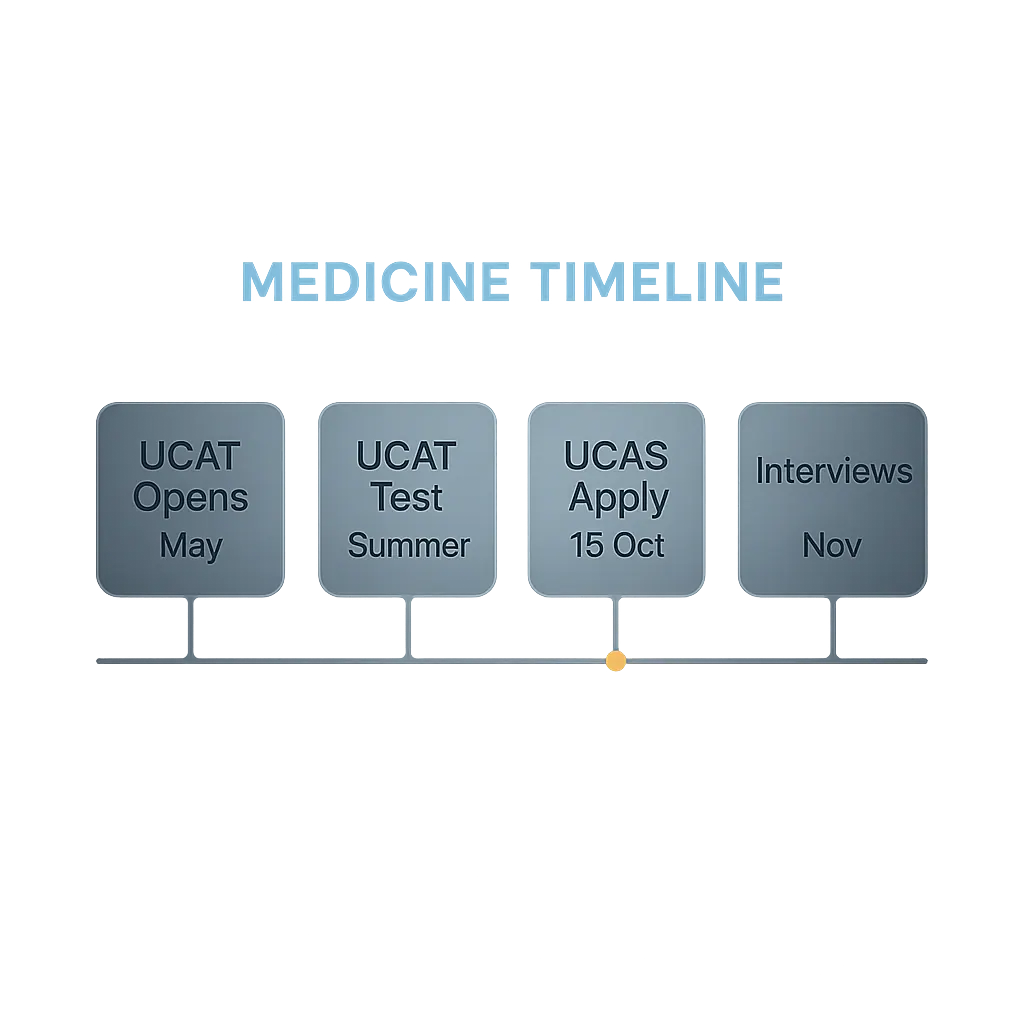
The UCAT (University Clinical Aptitude Test) is now the single admissions test used by most UK medical schools, including Oxford. It has five sections:
- Verbal Reasoning - reading comprehension under time pressure
- Decision Making - logical reasoning with syllogisms, probability, and Venn diagrams
- Quantitative Reasoning - numerical problem-solving, not advanced maths
- Abstract Reasoning - pattern recognition in shape sequences
- Situational Judgement - ethical and professional scenarios, scored on a separate Band 1-4 scale
The Situational Judgement section is where schools diverge significantly. Oxford does not use SJ scores at the shortlisting stage at all - its shortlist is built entirely from the four cognitive subtests combined with GCSE results, per the Oxford admissions process page. Many other medical schools do weight SJ, so a Band 1 or 2 result matters more depending on where you apply.
Oxford's shortlisting trade-off is worth understanding before you sit the test. The university gives UCAT and GCSEs equal weight for most applicants - but if you sat five or fewer GCSEs, UCAT is given double weight. There is no fixed cut-off score: a stronger UCAT can compensate for weaker GCSE performance, and vice versa, with grades assessed relative to your school's cohort rather than on raw numbers alone, as Oxford's requirements page explains.
For the 2026 cycle, note the sequencing carefully. The UCAT booking deadline for Oxford applicants is 15:00 BST on 16 September 2026, well ahead of the UCAS deadline of 15 October 2026. Miss the booking window and your Oxford application cannot be considered. Check the official UCAT consortium site for current score thresholds, as cut-offs shift each year with the cohort.
5. UCAS Medicine Rules: The Four-Choice Limit Explained
UCAS sets a hard limit of four medicine choices per application. You have five UCAS choices in total, but no more than four can be for medicine (A100 or equivalent). This is a UCAS rule, not a convention that individual schools can waive.
That leaves your fifth choice free. **Biomedical Science is the most common backup**, and it tends to be credible to admissions tutors because the subject overlap is genuine. An offer in Biomedical Science gives you a realistic pivot route if your medicine applications don't progress, and some medical schools offer a transfer pathway after the first year for students who perform well.
One non-obvious implication: if you also want to apply to Oxford Medicine, that counts as one of your four medicine slots, not a separate category. Oxford does not get special treatment within the four-choice rule.
The UCAS deadline for medicine, dentistry, veterinary science, Oxford, and Cambridge is 15 October, per UCAS. Miss it and your application is not considered for that cycle.
If you already hold a relevant science degree, the four-choice rule still applies, but you gain access to graduate-entry medicine. Oxford's A101 Accelerated course, for example, is a four-year route open to science graduates and runs alongside the standard five-year A100.
6. Work Experience for Medicine: What Schools Are Really Assessing
Medical schools are not counting hours or ticking off settings. They want evidence that you understand what the job involves and that you can reflect on what you observed. A single GP placement where you noticed a doctor managing a patient's anxiety about a diagnosis is more useful than a long CV of disconnected activities.
The mix of settings matters less than the reflection. Clinical exposure (ward rounds, GP surgeries, outpatient clinics), care-home or hospice volunteering, and community work all demonstrate relevant qualities. What selectors are looking for are specifics: compassion under pressure, resilience, and some grasp of the constraints the NHS operates under.
Securing clinical work experience is genuinely hard. One student described in a UCAS blog emailed approximately 20 GP practices before a single one agreed to a placement. That number is worth sitting with: persistence is part of what you are demonstrating, not just a prerequisite for getting the placement.
Starting in Year 12 is the practical choice. It gives you time to accumulate more than one setting and, critically, to process what you saw before you write your personal statement. Students who leave it to the summer before application often find they are reflecting on very fresh experiences under deadline pressure.
Non-clinical activities count too, if you make the connection explicit. The same student trained as a badminton coach and volunteered as a Patient Research Ambassador, speaking to patients about research trials. Neither is clinical, but both involve communication, reliability, and working with people in specific circumstances. The reflection is the point.
7. The Medical School Personal Statement: Three Questions, 4,000 Characters
From the 2026 cycle, UCAS replaced the old single free-text box with three structured questions. For medicine, this matters because each question has a distinct job: one asks why you want to study the subject, one asks about what you have done to prepare, and one asks about your broader skills and contribution. You cannot bury weak motivation under a list of achievements anymore - the format forces each element to stand on its own.
The non-obvious trap here is that the three-question structure tempts applicants to treat each answer as a separate mini-essay, disconnected from the others. Medical schools read all three together, so a clinical placement mentioned in question two should connect back to the motivation you stated in question one. Repetition is waste; unlinked evidence is worse.
Reflective insight outweighs volume. One paragraph showing you understood why a ward round worked the way it did is worth more than three paragraphs listing placements by date. When one applicant described in the UCAS blog put their statement through multiple drafts, with feedback from both teachers and doctors they had met during work experience, the goal was precisely this: checking whether the reflection was genuine, not whether the word count was filled.
Medical school personal statement examples are a useful calibration tool, but copying structure uncritically is a common mistake. If an example opens with an ethical dilemma, that works because it ties to that writer's specific experience. Transplant the structure without the evidence and the answer reads as hollow.
Write the answer to each question for your experiences, then benchmark against examples, not the other way around.
8. MMI Interviews: Format, Scenarios, and How to Prepare
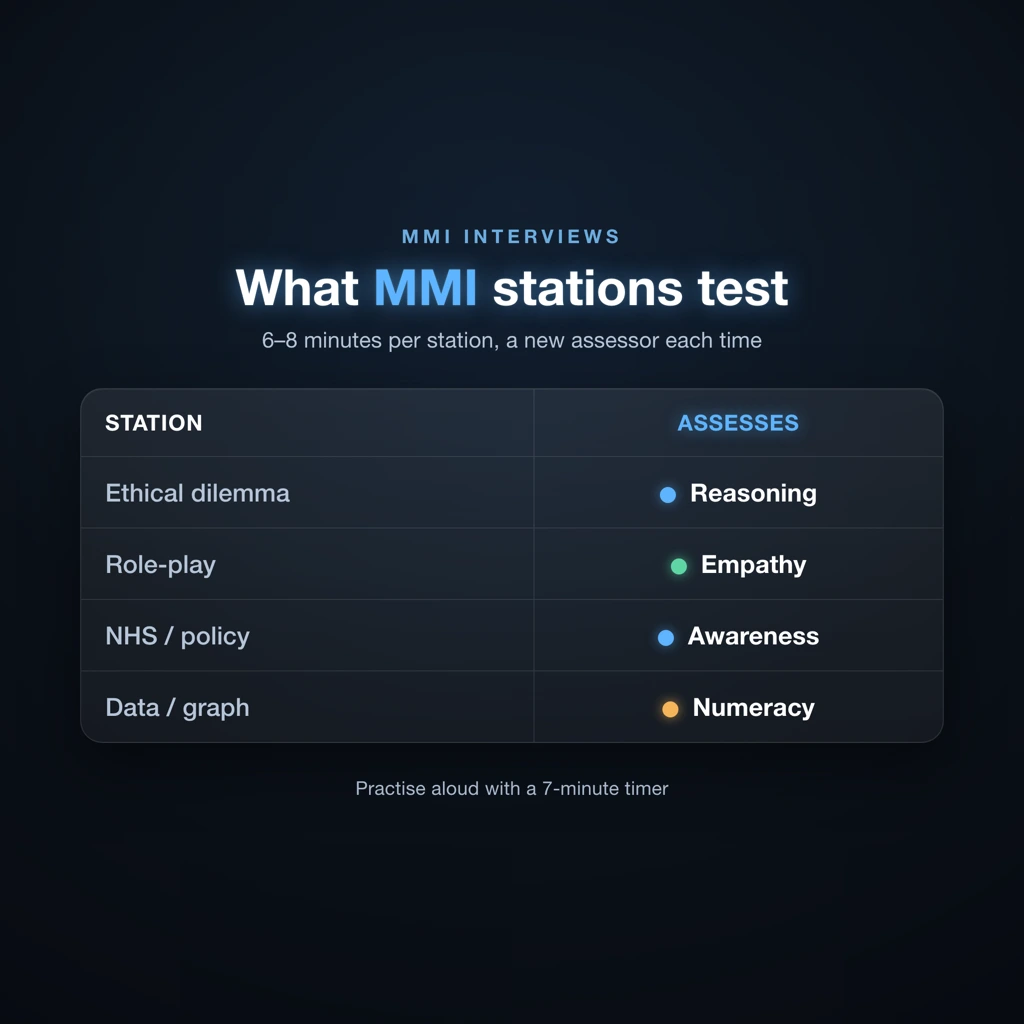
Most UK medical schools now use Multiple Mini Interviews (MMI): a circuit of timed stations, typically 6-8 minutes each, where you rotate between different assessors rather than facing a single panel. One UCAS applicant described receiving three MMI-style interview invitations alongside one traditional panel interview, with the panel itself running 7-9 stations at that same 6-8 minute duration per station - so even panel formats borrow the MMI structure (UCAS).
Common station types include:
- Ethical dilemma (for example, a resource allocation or consent scenario)
- Role-play empathy exercise, often with an actor playing a patient or distressed colleague
- Current NHS or health policy question
- Data or graph interpretation, testing whether you can read evidence under pressure
Oxford interviews roughly 25% of its applicant pool, which has been around 425 candidates in recent years. Notably, interviewers at Oxford are not told UCAT scores or the applicant's college preference at the time of interview, so your score cannot prop up a weak performance at the stations - and it cannot harm you if it was borderline (University of Oxford). Oxford also uses two separate college interviews rather than a single MMI circuit, which is a structural quirk worth knowing before you prepare.
How to prepare without sounding scripted:
- Practise answering out loud with a timer set to 7 minutes. Reading ethics frameworks silently is not the same as reasoning through them aloud under pressure.
- Vary your practice scenarios. Interviewers recognise rehearsed answers - a candidate who gives a fluent but identical response to every dilemma signals exactly that.
- Read NHS news (The BMJ and NHS England briefings are free) so policy questions feel familiar rather than abstract.
The one consistent piece of preparation advice from applicants who receive offers: start mock stations with peers or teachers months before interview season, not weeks.
9. Graduate Entry and Alternative Routes Into Medicine
Graduate Entry Medicine (GEM) is a 4-year accelerated programme for applicants who already hold an undergraduate degree at 2:1 or above. It suits career-changers and graduates who came to medicine late, but the entry bar is high and the programmes are fewer than many applicants expect.
Cambridge's graduate Medicine course (MB, BChir) is one of the most selective examples. It is open only to home fee-status students and offered through four colleges: Hughes Hall, Lucy Cavendish, St Edmund's, and Wolfson. A non-obvious quirk: clinical teaching is based primarily at West Suffolk Hospital in Bury St Edmunds, not at Addenbrooke's. Students do spend half their third year on specialist rotations at Cambridge University Hospital, but anyone expecting a Cambridge-city clinical experience throughout should read the course structure carefully before applying.
Oxford's alternative is the 4-year A101 Accelerated course, available to science graduates as a distinct option from the standard A100.
The BSc-then-GEM path is longer but viable. The UCAS subject guide profiles one student who completed a BSc in Biomedical Science at Hull, then an MSc in Women and Children's Health at King's College London, before joining King's GEM programme at the Portsmouth campus. That route takes several years beyond school, so it is worth mapping the full timeline before committing.
10. What to Do Next
The UCAS deadline for medicine is 15 October, and most schools set an internal submission date at least four weeks before that, putting your real deadline closer to early September. If you miss the internal date, your referee has almost no time to write a considered reference, which matters more than most applicants realise.
Pick the biggest gap in your application right now and close it first. If your personal statement is the current bottleneck, get a structured review early rather than relying on a single read from a teacher pressed for time. A medical school personal statement review can identify structural problems before they reach your referee.
Set your internal draft deadline today. Work backwards from 15 October, subtract four weeks, and put that date in your calendar now.
FAQ
How hard is it to get into medicine in the UK?
Medicine is among the most competitive UK undergraduate courses - the UCAS 15 October deadline applies, places are limited, and most schools require strong GCSEs, a high UCAT score, relevant work experience, and a successful MMI interview in addition to top A-level grades.
Can you get into medicine without science A-levels?
Chemistry at A-level is a near-universal requirement; without it, direct entry to most UK medical schools is not possible, though some graduate-entry programmes accept a strong relevant degree instead of specific A-levels.
What A-levels do you need for medicine?
Chemistry is required by almost all UK medical schools; a second science - typically Biology, but sometimes Physics or Maths - is also expected, and most schools ask for A*AA or AAA depending on the institution.
How do you get into medicine as a graduate?
Graduate Entry Medicine programmes (typically four years) accept applicants with a relevant undergraduate degree at 2:1 or above; Cambridge's graduate course and Oxford's A101 Accelerated course are two examples, both requiring UCAT and a competitive interview.
How much work experience do you need for medicine?
There is no fixed minimum; what matters is that you can reflect meaningfully on what you observed - a mix of clinical, care, and community experience is useful, and starting in Year 12 gives you time to write about it authentically.
What is the UCAT and when should I take it?
The University Clinical Aptitude Test (UCAT) is a computer-based admissions test covering five sections including Situational Judgement; the testing window typically runs July to September, and you must sit it before the 15 October UCAS deadline.
References
- Medicine: Academic Entry & Age Requirements - University of Oxford, Medical Sciences Division - https://www.medsci.ox.ac.uk/study/medicine/pre-clinical/requirements/academic
- Medicine: Application Process - University of Oxford, Medical Sciences Division - https://www.medsci.ox.ac.uk/study/medicine/pre-clinical/applying/application-process
- Medicine: Requirements - University of Oxford, Medical Sciences Division - https://www.medsci.ox.ac.uk/study/medicine/pre-clinical/requirements
- More people than ever want to be a doctor | UCAS - https://www.ucas.com/corporate/news-and-key-documents/news/more-people-ever-want-be-doctor
- My journey into medicine | UCAS - https://www.ucas.com/connect/blogs/my-journey-medicine
- Medicine (Graduate course), MB and BChir | Undergraduate Study - https://www.undergraduate.study.cam.ac.uk/courses/medicine-graduate-course-mb-bchir
- Medicine & Allied Subjects Guide | Why Study Medicine? | UCAS - https://www.ucas.com/explore/subjects/medicine