Oxbridge Medicine Interview: The Complete Guide
By Michael Thompson · Education Specialist; 10 years teaching the IB at Bromsgrove School · Published 21 May 2026 · Updated 4 October 2026
The oxbridge medicine interview is the final filter between a strong application and an offer - and it works differently from almost every other medical school interview in the UK. Oxford and Cambridge each take fewer than 200 students per year for medicine, and both use interviews to test how you think under pressure, not how polished your answers are. This guide covers the structural differences between the two universities' interview formats, the question categories you should prepare for, how to discuss work experience without sounding rehearsed, and the mistakes that cost strong candidates their offers.
Key Takeaways
- Oxford and Cambridge use different interview styles: Oxford interviews tend to focus on theoretical science and graph/mechanism problems; Cambridge leans toward clinical problem-solving and ethical reasoning in scenario form.
- Both universities now require UCAT: Per UCAS, Oxford and Cambridge both use UCAT alongside GCSE scores to shortlist applicants before interview, replacing the old BMAT.
- Oxford shortlists roughly 41% of eligible applicants: In 2025, 41.4% of eligible Oxford medicine applicants were shortlisted for interview, with a mean shortlisted UCAT score of 2,377.5 out of 2,700.
- Ethics questions follow a four-pillar framework: Autonomy, beneficence, non-maleficence, and justice give you a structured way into any scenario - but interviewers penalise candidates who claim false certainty on genuinely contested issues.
- Work experience questions are about reflection, not volume: Interviewers want to hear what you noticed and what it changed in your thinking - not a list of placements.
- Weak 'why medicine' answers are among the most common failure points: A vague answer citing caring for people or scientific interest without a specific grounding moment signals that you haven't thought hard enough about the career.
In This Article
- What the Oxbridge Medicine Interview Actually Tests
- Oxford vs Cambridge Medicine Interview: Key Differences
- Oxbridge Medicine Entry Requirements and Admissions Tests
- The Oxford Interview Offer Rate: What the Numbers Say
- Science Problem-Solving Questions: Graphs, Mechanisms, and Data
- Biomedical Ethics Interview Topics and the Four-Pillar Framework
- Medicine Interview Personal Statement Questions: How to Discuss Work Experience
- Common Mistakes in the Oxbridge Medicine Interview
- How to Prepare: Mock Interviews, Resources, and a Weekly Practice Plan
- What to Do Next
1. What the Oxbridge Medicine Interview Actually Tests
The oxbridge medicine interview is not a job interview, and it is not a personality test. Both Oxford and Cambridge structure their medical interviews to resemble what happens in their teaching: the Oxford tutorial and the Cambridge supervision. The interviewer's goal is to sit with you inside a problem, not to watch you perform.
That distinction matters more than most preparation guides admit. Interviewers are not checking whether you recall the Krebs cycle correctly. They are checking what you do when you reach the edge of what you know. Can you reason aloud? Can you update your position when the interviewer offers a new piece of information? Will you say "I'm not sure, but..." and press on, or will you freeze?
One counter-intuitive point: Oxbridge interviewers are trained. Mary Beard, writing for BBC News, directly contradicts the common assumption that academics simply wing it. That training shapes the style of questioning: interviewers probe deliberately, not randomly. A question that sounds strange ("What did the Romans wear under their togas?" is Beard's own example) is designed to expose your reasoning process, not to catch you out with an unknowable answer.
The three things interviewers are watching for:
- Intellectual curiosity - genuine engagement with a problem you haven't seen before
- Flexibility - willingness to revise your answer under gentle challenge
- Reasoning aloud - talking through mechanism, not just announcing a conclusion
2. Oxford vs Cambridge Medicine Interview: Key Differences
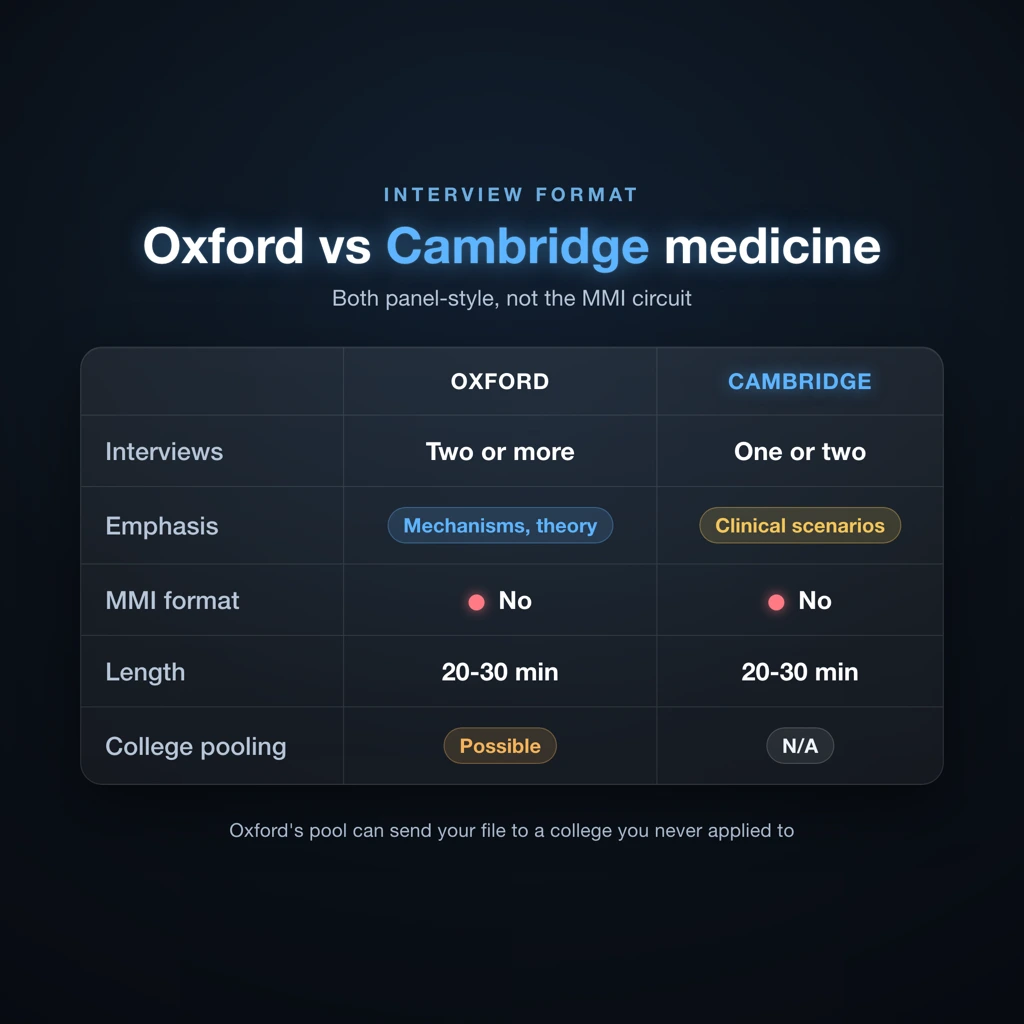
Both universities use panel-style interviews rather than the MMI circuit (a timed rotation of short stations) common at other UK medical schools. That similarity aside, the two formats diverge in meaningful ways.
Oxford typically involves two or more separate interviews, often held at different colleges on the same day or across consecutive days. The content is weighted towards theoretical science: expect to reason through biological mechanisms, interpret graphs you have not seen before, and work from first principles under questioning. Candidates who are pooled can be called to interview at a second college beyond their original application college, so it is possible to face two full interview panels at two different institutions in a single admissions cycle.
Cambridge interviews tend to centre more on clinical reasoning and applied problem-solving. A tutor may walk you through a patient vignette or a data set and ask you to think aloud as you interpret it. The emphasis is less on abstract mechanism and more on how scientific principles connect to real clinical situations.
| Feature | Oxford | Cambridge |
|---|---|---|
| Number of interviews | Typically two or more | Usually one or two |
| Content emphasis | Biological mechanisms, graphs, theory | Clinical scenarios, data interpretation |
| MMI format used? | No | No |
| Interview length (approx.) | 20-30 minutes each | 20-30 minutes each |
| Pooling to another college | Yes, possible | Not applicable |
One non-obvious point: because Oxford's pool system can send your file to a college you never contacted, candidates sometimes prepare only for their chosen college's style and are caught off-guard by a different tutor's approach. Preparing for variation in tone and topic is worth the effort regardless of which university you applied to.
3. Oxbridge Medicine Entry Requirements and Admissions Tests
Both Oxford and Cambridge replaced the BMAT with the UCAT for medicine applicants from 2025 entry onward (the UCAT sat in 2024), per UCAS and confirmed by Cambridge's January 2024 announcement. One thing worth knowing upfront: Cambridge also introduced the ESAT for Natural Sciences and Engineering at the same time, but ESAT is not required for Medicine at Cambridge. If you are applying to medicine specifically, UCAT is the relevant test at both universities.
A-level requirements
The standard conditional offer at both Oxford and Cambridge is A*AA, with Chemistry required at both. A second science, typically Biology, Maths, or Physics, is expected at most colleges. Check individual college pages for variation, since a small number have slightly different preferences.
How Oxford uses UCAT for shortlisting
Oxford combines UCAT scores with GCSE results to decide who gets an interview. The 2025 cycle used a revised UCAT scoring scale of 2,700 (Abstract Reasoning was removed from the test, reducing the previous maximum of 3,600). According to the University of Oxford Medical Sciences Division:
- Oxford received 1,156 UCAS applications in 2025; 1,026 were deemed eligible after withdrawals and disqualifications.
- 41.4% of eligible applicants were shortlisted for interview.
- The mean UCAT score among shortlisted applicants was 2,377.5 out of 2,700.
That mean is a useful calibration point. Scoring around 2,377 puts you in the shortlisted cohort on average, but GCSEs can shift the threshold up or down for any individual applicant.
A less obvious quirk: Oxford double-weighted UCAT scores for applicants who sat GCSEs in summer 2020 or 2021, because teacher-assessed grades from those years were not considered robustly comparable across schools.
Deadlines
UCAT registration opens each summer, and the test window typically closes in late September, before the UCAS 15 October deadline. UCAS notes explicitly that some admissions test registration deadlines fall before the UCAS submission deadline. Book your UCAT slot as soon as registration opens; leaving it to October is not an option.
4. The Oxford Interview Offer Rate: What the Numbers Say
Getting to interview is harder than most applicants realise, and getting an offer from interview is harder still.
According to the University of Oxford Medical Sciences Division, Oxford received 1,156 UCAS applications in 2025. Around 60 were disqualified for failing to meet entry requirements, leaving 1,026 eligible applicants. Of those, 41.4% were shortlisted for interview (down slightly from 42.2% in 2024). That means roughly 6 in 10 eligible applicants never reach the interview stage at all.
One non-obvious detail worth knowing: shortlisting is not purely algorithmic. The combined UCAT and GCSE score produces a cut-off, but Oxford's data confirms that 80 additional applicants below that cut-off were added to the shortlist through tutor and Shortlisting Committee review. If your scores sit just below the line, your application is not automatically dead.
The deferred-entry picture is notably harsher. Of 24 eligible applicants seeking 2027 entry, 10 were interviewed and only 1 received an offer, compared with 2 in 2024. If you are considering deferring, that is a number worth sitting with.
The headline takeaway: being shortlisted is a genuine achievement, but it signals the start of the most competitive stage, not the approach of an offer. The oxbridge medicine interview filters hard.
What the 2025 Oxford shortlisting numbers show at a glance:
- 1,156 total UCAS applications received
- ~60 disqualified for not meeting entry requirements
- 1,026 eligible applicants (88.8% of all applicants)
- 41.4% of eligible applicants shortlisted for interview
- 80 applicants added below the algorithmic cut-off by committee review
- Mean UCAT score for shortlisted applicants: 2,377.5 out of 2,700
- Deferred entry (2027): 10 interviewed, 1 offer made
5. Science Problem-Solving Questions: Graphs, Mechanisms, and Data
Both Oxford and Cambridge will put unfamiliar material in front of you: a graph with a counterintuitive trend, a diagram of a receptor you've never studied, or a short passage describing an experiment. The point is not to test recall. It is to watch how you think when you don't already know the answer.
The non-obvious quirk here is that silence is the worst possible response, even if your reasoning is hesitant. Interviewers at both universities are trained to distinguish a student who is genuinely working through a problem from one who is waiting for a cue. Narrating a half-formed thought is more valuable than a confident answer that arrives from nowhere.
Common formats you should practise:
- Graph interpretation. A curve with an unexpected plateau, a double axis, or a data point that contradicts the trend. Name your axes, state what you'd expect, then explain the anomaly.
- Mechanism from first principles. You're given a protein or a physiological process. Walk through it using what you know: substrate, receptor, downstream effect, and where the system could fail.
- Step-by-step calculation. A clinical value, a drug dose, or a unit conversion. State your assumptions before you calculate, not after.
Oxford tends to press harder on the pure science mechanism: explain why the enzyme behaves that way, not just that it does. Cambridge more often wraps the same reasoning in a patient scenario, so the biological question arrives inside a clinical frame. The underlying skill is identical; the framing shifts.
When you're genuinely unsure, say so explicitly and explain what additional information would help you. That is itself a mark of scientific thinking.
6. Biomedical Ethics Interview Topics and the Four-Pillar Framework
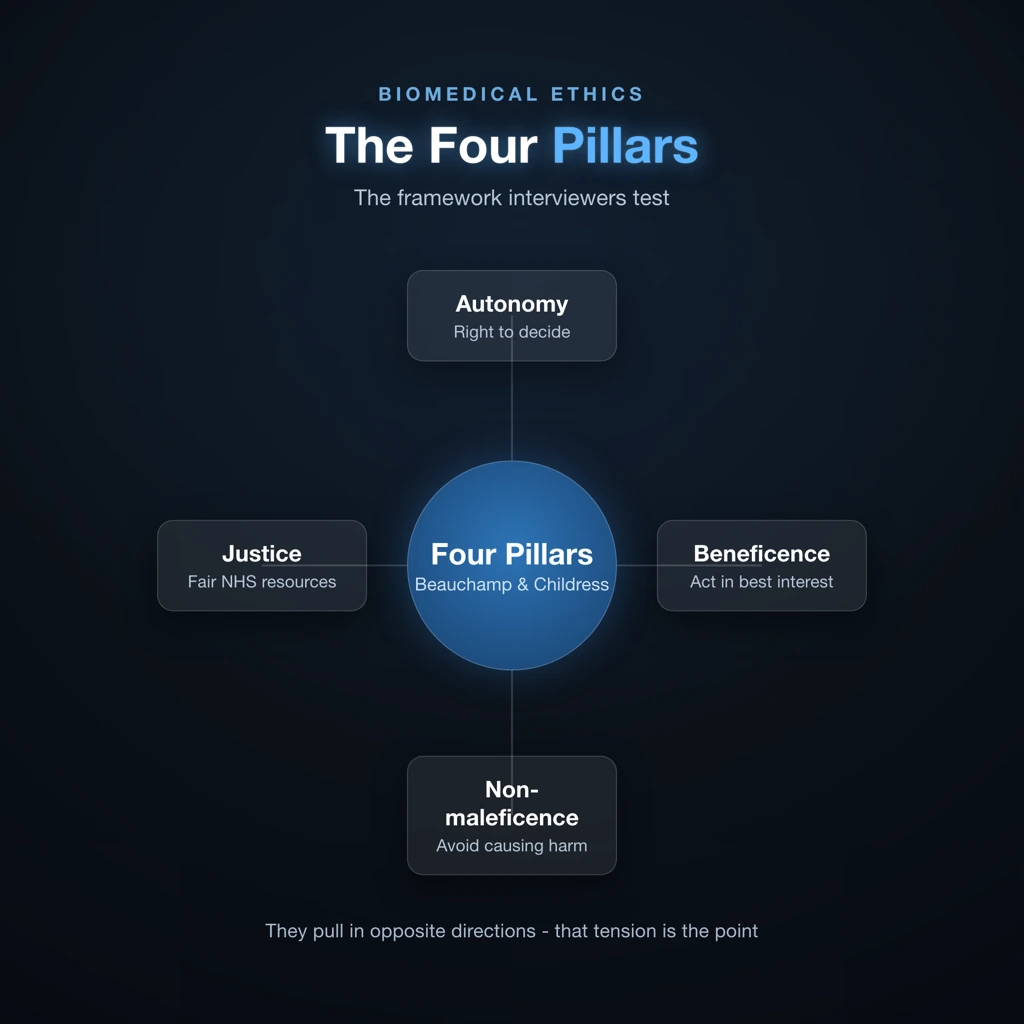
Biomedical ethics questions appear at both Oxford and Cambridge medicine interviews, and the framework you need is the same at both: the four pillars developed by Beauchamp and Childress.
The four pillars at a glance:
- Autonomy - a patient's right to make decisions about their own body, even decisions a clinician disagrees with
- Beneficence - the duty to act in the patient's best interest
- Non-maleficence - the obligation to avoid causing harm, including through over-treatment
- Justice - fair distribution of finite NHS resources across the population
Interviewers present a scenario and watch how you reason, not what conclusion you reach. A patient with capacity who refuses a blood transfusion on religious grounds, a NICE committee deciding whether to fund a drug costing hundreds of thousands per patient, a GP weighing a teenager's confidentiality against a parent's concern: none of these has a clean answer. The pillars almost always pull in opposite directions, and that tension is the point.
Common biomedical ethics interview topics to cover:
- End-of-life care and assisted dying legislation
- Consent in patients who lack mental capacity (the Mental Capacity Act 2005 framework)
- Rationing of expensive treatments on cost-effectiveness grounds
- Confidentiality versus public safety, for example infectious disease disclosure
The most common mistake is forcing a verdict. On genuinely contested questions, interviewers find a confident "it's clearly right to..." less impressive than a structured "autonomy supports X, but non-maleficence and justice both push back because...". State the tension explicitly, work through it, and land on a qualified position.
A non-obvious gotcha: students often treat the pillars as a checklist to recite rather than a thinking tool. Apply them to the specific NHS context in the scenario. Mention NICE, the Mental Capacity Act, or GP referral thresholds where relevant. That specificity signals you understand medicine as it actually functions, not just ethics as it appears in a textbook.
7. Medicine Interview Personal Statement Questions: How to Discuss Work Experience
Your personal statement is open on the interviewer's desk. Anything you wrote there is fair game, and Oxford and Cambridge interviewers are trained to follow up on specifics, not generalities. If you named a GP shadowing placement or a hospice volunteering role, expect a question about it within the first few minutes.
The question is almost never "describe what you did." It is far more likely to be "what did you notice that surprised you?" or "how did that change how you think about being a doctor?" The distinction matters. A description tells the interviewer you were present. A reflection tells them you were thinking.
Strong answers share a particular shape:
- A specific moment: a single scene, a conversation overheard, a procedure observed
- An observation: what you actually noticed, not what you expected to see
- A question it raised: the unresolved thing that stayed with you afterward
- A connection to medicine as a discipline, not just medicine as a career
Weak answers fall into two traps. The first is listing placements ("I shadowed in A&E, then a GP, then a care home...") as if volume is the point. The second is the phrase "it confirmed my passion for medicine," which closes down thinking rather than opening it up.
The counter-intuitive truth about oxbridge medicine interview preparation here: one well-reflected week in a single GP surgery consistently impresses more than six months of unreflected hospital observation. Interviewers are testing analytical habit, not CV breadth.
Practical preparation: for every placement you mention in your personal statement, write down one specific scene you witnessed and one question it left unresolved. That pair is your raw material for any follow-up question the interviewer asks.
8. Common Mistakes in the Oxbridge Medicine Interview
Most errors in the Oxbridge medicine interview are not knowledge gaps. They are reasoning failures that trained interviewers recognise within seconds. As Mary Beard notes in a BBC piece on the subject, Oxford and Cambridge interviewers do receive interview training, so they can reliably distinguish genuine thinking from a polished performance. The following mistakes are the ones that cost candidates most.
Claiming false certainty on ethical questions. Biomedical ethics questions rarely have a single correct answer. Stating a firm conclusion without acknowledging the tension between competing principles signals you haven't understood what the question is testing. The interviewer is looking for structured reasoning, not a verdict.
A generic "why medicine" answer. If your answer could have been given by any applicant, it will land as one. The question is an invitation to connect a specific experience or observation to a specific piece of thinking. Vague references to "caring for people" without any grounding in your work experience or reading carry no weight.
Going silent when pushed beyond your knowledge. Interviewers at both Oxford and Cambridge deliberately probe past what you know. Saying "I'm not certain, but working from first principles..." is the correct move. Silence, or a confident-sounding guess, are both worse.
Over-rehearsed answers that don't flex. When an interviewer redirects mid-answer, a scripted response becomes a liability. Adapting in real time is itself part of what is being assessed.
Skimming the material in front of you. If a graph or passage is placed before you, that document is the primary data source for the question. Answering from background knowledge while ignoring what is on the page is a common and easily avoidable error.
Failing to ask for clarification on an ambiguous question. Requesting a moment to think, or confirming what form the answer should take, reads as intellectual maturity. Bluffing through a misunderstood question does not.
9. How to Prepare: Mock Interviews, Resources, and a Weekly Practice Plan
The most common preparation mistake is practicing answers rather than practicing thinking. Interviewers redirect the moment they sense a rehearsed response, so fluency with unfamiliar problems matters far more than a polished script.
Structure your mock sessions to match the real format. An oxbridge medicine mock interview should have one or two people in the room, an unseen problem introduced mid-session, and sustained pushback on your reasoning. A 20-minute session where a teacher or tutor challenges every answer, including your correct ones, is more useful than an hour of solo reading. The goal is learning to be wrong gracefully, to say "that assumption doesn't hold because..." rather than stalling or doubling down.
Build a weekly science reading habit at depth-plus level. Pick one topic per week, enzyme kinetics, action potentials, the complement system, and work through it from first principles rather than memorising facts. The counter-intuitive thing here is that breadth is less valuable than depth: an interviewer who probes a topic you half-know will expose the gap faster than one who asks something you've never seen.
For ethics, read one short news item about an NHS controversy each day and apply the four-pillar framework (autonomy, beneficence, non-maleficence, justice) to it before you check any commentary.
Useful resource types:
- TSA past papers and old BMAT Section 2 questions for structured scientific reasoning
- Bioethics case study banks from medical school preparation resources
- Your A-level textbooks, read beyond the specification into the mechanisms behind the facts
Avoid purchased model-answer banks entirely. A memorised answer collapses the moment an interviewer asks "why does that follow?"
10. What to Do Next
One detail catches applicants off guard every year: UCAT registration deadlines fall before the UCAS October deadline, which means you can close the door on Oxford or Cambridge medicine before your personal statement is even drafted. Missing UCAT registration does not give you a late-entry route, it ends your application for that cycle entirely.
Check the current UCAT registration window on the official UCAT consortium site this week, and note the date in your calendar alongside your UCAS deadline, not after it.
Once that is secured, turn to your personal statement and build the work experience narrative covered in section 7. Both strands, the admissions test score and the interview, are decided months apart but weighted together.
Register for UCAT now. Book a mock interview before October.
FAQ
How hard is the Oxbridge medicine interview?
The interview is designed to push you past the edge of your preparation - interviewers deliberately ask questions you cannot have rehearsed, so the difficulty is less about knowledge and more about reasoning under pressure.
How does the Oxford medicine interview offer rate compare to shortlisting?
In 2025, Oxford shortlisted 41.4% of eligible medicine applicants for interview, but total offers are far fewer - around 150-170 places across all colleges - so most interviewed candidates do not receive an offer.
When are Oxbridge medicine interviews held?
Both Oxford and Cambridge hold medicine interviews in December, typically across two to three weeks; Oxford usually runs interviews between late November and mid-December, and candidates are notified of their slot in advance.
What is the difference between Oxford and Cambridge medicine interview formats?
Oxford interviews lean toward theoretical science and mechanism-based problems; Cambridge interviews tend to involve more clinical problem-solving and scenario-based ethical reasoning, though both use a panel format rather than an MMI circuit.
Do you need UCAT for Oxford and Cambridge medicine?
Yes - per UCAS, both Oxford and Cambridge switched to UCAT for medicine from 2025 entry, replacing the BMAT; Oxford shortlists using a combined UCAT and GCSE score, with the mean shortlisted score in 2025 being 2,377.5 out of 2,700.
How should I prepare for an oxbridge medicine mock interview?
Simulate the tutorial format with one or two people asking you unfamiliar science problems and ethical scenarios, then probing every answer - the goal is to practise reasoning aloud and adapting when pushed, not to rehearse fixed responses.
References
- A Point of View: The Oxbridge interview - BBC News - https://www.bbc.co.uk/news/magazine-15888124
- University Admissions Tests | UCAS | UKCAT, BMAT, LNAT And More - https://www.ucas.com/applying/before-you-apply/what-and-where-to-study/entry-requirements/admissions-tests
- New admissions tests for 2024 | University of Cambridge - https://www.cam.ac.uk/news/new-admissions-tests-for-2024
- Medicine: Shortlisting Process and Admissions Statistics - University of Oxford, Medical Sciences Division - https://www.medsci.ox.ac.uk/study/medicine/pre-clinical/statistics