Cambridge HSPS Interview Questions: Format and Real Examples
By Michael Thompson · Education Specialist; 10 years teaching the IB at Bromsgrove School · Published 27 October 2026 · Updated 28 October 2026
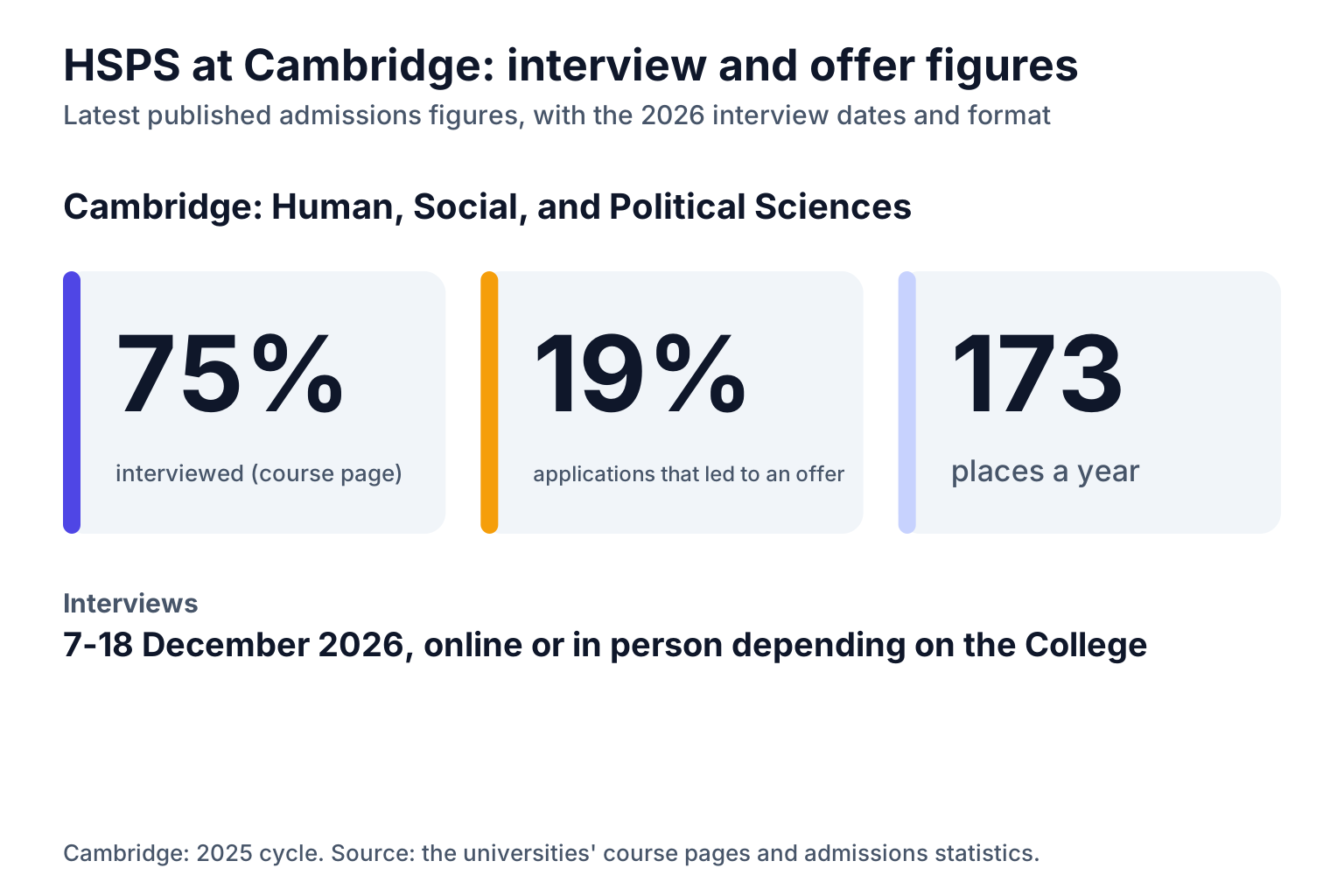
Cambridge HSPS interview questions ask you to reason aloud about a question or short text from politics, sociology, social anthropology or international relations, usually with two or three interviewers, for 35 minutes to an hour in total. Tutors say they are looking for enthusiasm and curiosity, suitability for the course, wider reading and critical analysis. The main interview period for 2026 runs from 7 to 18 December, and the course page says around 75% of applicants are invited. Most applicants have one or two interviews, online or in person depending on the College. This guide sets out how the HSPS interview runs, what happens before it, what each assessment criterion means in the room, and how to prepare in the weeks beforehand.
Key Takeaways
- Interviews run 7-18 December 2026: The winter pool follows in mid to late January 2027, according to the University of Cambridge HSPS course page.
- Most applicants have one or two interviews: Some Colleges hold three or four, and total time is usually 35 minutes to one hour, though this varies by College.
- Two pieces of written work come first: You submit written work before the interview, and your College may set pre-interview reading or tasks in the invitation.
- There is no pre-registered admission test: Hughes Hall, King's and Newnham run their own College assessment, with details sent by the College.
- Four things are assessed: Tutors look for enthusiasm and curiosity, suitability for the course, wider reading and critical analysis.
- Rehearsed answers do not help: A Lucy Cavendish College interview pack states that questions change each year and interviewers are not looking for pre-prepared answers.
In This Article
- What a Cambridge HSPS interview actually is
- Cambridge HSPS interview format: dates, length and interviewers
- Before the HSPS interview: written work, pre-reading and College assessments
- Who gets a human social and political sciences interview
- What tutors assess in a Cambridge HSPS interview
- Oxbridge practice questions for Cambridge HSPS interviews
- How politics, sociology and anthropology shape HSPS interview questions
- How to prepare for HSPS interview questions in the weeks before
- The common mistake: rehearsing answers to Cambridge HSPS interview questions
- What to do next before your HSPS interview
1. What a Cambridge HSPS interview actually is
A Cambridge HSPS interview is a conversation in which you reason aloud with academics about a question or a short text on politics, sociology, social anthropology or international relations. Cambridge HSPS interview questions test how you think through unseen material, not what you have memorised, so the way you work towards an answer matters more than reaching a neat one.
HSPS (Human, Social, and Political Sciences) is built on three core disciplines: Politics and International Relations, Social Anthropology and Sociology. In Part II (years two and three) you can specialise in one of them or combine two, choosing from three single-subject or five two-subject tracks, according to the University of Cambridge HSPS course page.
Here is what a human social and political sciences interview asks of you:
- What you do: think aloud about material you have not seen before.
- Who asks: two or three interviewers, drawn from more than one HSPS subject.
- How long: 35 minutes to one hour in total for most applicants.
That mix of interviewers has a practical consequence. If your personal statement is all politics, a sociologist or anthropologist may still be in the room, testing whether you can look at the same material through a different discipline.
Tutors assess four things:
- "enthusiasm and curiosity"
- "suitability of the course"
- "wider reading"
- "critical analysis"
Treat it as a short supervision, not an oral exam. First-year HSPS students usually have one or two small-group supervisions a week, per the course page, and the interview works the same way. Expect a discussion you help to steer, not a quiz with right answers.
2. Cambridge HSPS interview format: dates, length and interviewers
There is no single format for a Cambridge HSPS interview. The Cambridge interview format guide covers what the Colleges share. The University publishes ranges, and each College decides where its own applicants fall within them. Some details are fixed and others vary:
| Feature | What applies |
|---|---|
| Main interview period | 7-18 December 2026 |
| Winter pool interviews | Mid to late January 2027 |
| Number of interviews | Varies by College: most applicants have 1-2, some have 3-4 |
| Total interview time | 35 minutes to 1 hour for most applicants, varying by College |
| Mode | Online or in person, depending on the College |
The length figure is a total, not a per-interview figure. One 45-minute conversation and two shorter ones can both fall inside the same range. The format is also set by the College. Do not assume your interview will be on a screen because a friend applying elsewhere had an online interview.
Who interviews you
Subject interviews usually have two or three interviewers, drawn from more than one HSPS subject. HSPS combines Politics and International Relations, Social Anthropology and Sociology (University of Cambridge). That means a point you frame as politics may be followed up by a sociologist or an anthropologist from a different angle. This mix is why Cambridge politics interview questions and Cambridge sociology interview questions often blur together in the room.
Some Colleges also hold a general academic interview, which may be with academics from other subjects. This changes how you should pitch your explanations. A historian or an engineer will not share your reading list. You need to:
- define any subject-specific term the first time you use it
- walk through your reasoning step by step rather than jumping to a conclusion
- make your argument stand on its own, without relying on a named theorist to carry it
Takeaway: when your invitation arrives, write down your College's exact number of interviews, their length and the mode. The University only gives ranges, so the invitation is the one place that tells you your actual format.
3. Before the HSPS interview: written work, pre-reading and College assessments
Some of the preparation for a Cambridge HSPS interview happens before you are in the room. You submit two pieces of written work in advance. Your interviewers may have read them and can refer to them, so treat each essay as part of the conversation. You wrote them months earlier, and a useful check is to reread both and note where your argument is thinnest or where you would now argue differently. Being able to say that clearly is better than defending a weak point you no longer believe.
Some Colleges also set pre-interview reading or a short task. If yours does, the College says so in your invitation, so read it fully rather than skimming for the date.
There is no pre-registered admission test for HSPS, so there is nothing to sign up for in the autumn. That makes one detail easy to miss: Hughes Hall, King's and Newnham set a College admission assessment at interview, and the relevant College provides the details.
Whether the material comes as pre-reading or at interview, it is usually something you can reason about without specialist knowledge:
- a short passage of text
- a set of figures or a simple table
- a scenario that describes a social or political situation
The Cambridge HSPS interview questions that follow tend to grow out of this material.
Takeaway: check today whether your College is Hughes Hall, King's or Newnham, and whether your invitation mentions reading or a task.
4. Who gets a human social and political sciences interview
Cambridge interviews everyone with a realistic chance of an offer for HSPS, which the course page puts at around 75% of applicants. Most people who apply should therefore expect an invitation.
The figures for the 2025 admissions cycle (applications from September 2024 for entry in October 2025, or deferred entry in October 2026) were:
| HSPS, 2025 cycle | Figure |
|---|---|
| Applications | 1,230 |
| Applicants interviewed | about 75% (the course page's figure, not a 2025 count) |
| Offers | 236 |
| Places | 173 |
An invitation is a step in the process, not a signal of the outcome. Because interviewing is the norm rather than the exception, being asked tells you only that your application is still being considered. It does not tell you how the tutors rate it, and it does not mean an offer is close.
Treat the invitation as the start of your preparation, not a verdict. Use the time between the email and the interview to work through the format and the kinds of Cambridge HSPS interview questions covered in the sections below.
5. What tutors assess in a Cambridge HSPS interview
Cambridge names four things tutors look for at an HSPS interview: enthusiasm and curiosity, suitability for the course, wider reading and critical analysis. None of them tests how many facts you can recall. Each one shows in how you handle the conversation.
| Criterion | What it looks like in the room |
|---|---|
| Enthusiasm and curiosity | You ask what a term means, follow an idea past the obvious answer, and sound interested rather than rehearsed |
| Suitability for the course | You work through unfamiliar material with two or three academics and build on their prompts |
| Wider reading | You bring in something you have read only when it is relevant, and say what it changed in your thinking |
| Critical analysis | You think aloud so the interviewer can follow each step, test your own claim, and change your mind when pushed, saying why |
Suitability is about format as much as interest. In Part I you take four papers, three of them from the core subjects, and first-years usually have one or two small-group supervisions a week alongside lectures, according to the Cambridge HSPS course page. The interview works like a short supervision. You reason out loud, an academic challenges you, and you respond.
Applying what you have been taught beats reciting. A concept from A-Level Sociology, Politics or History, applied to new material, shows more than a memorised quotation. Interviewers can come from more than one HSPS subject, so explain your terms plainly. Shorthand from one discipline may not land with someone from another.
These skills overlap with the aims of an interview pack from Lucy Cavendish College. The pack says its practice material is for building "critical thinking, oracy, and problem-solving skills." That is the College's description of its own workshop pack, not a University list of criteria.
Aim to show how you reason, not how much you know. A clear line of thought that you can revise under pressure counts for more than a polished answer.
6. Oxbridge practice questions for Cambridge HSPS interviews
Every question below can be traced to its source: six come from a practice pack Lucy Cavendish College, Cambridge, compiled to show the kind of question asked at Oxbridge interviews. Tutors write new material each year, so read these for the kind of thinking they call for, not as a list to learn.
| Question | Reported at | Source |
|---|---|---|
| Does the recent migration crisis in Europe challenge or reinforce racism? | Oxbridge practice pack | Lucy Cavendish College, Cambridge, Oxbridge practice pack |
| Are there conditions under which the outcomes of democratic elections should be ignored? | Oxbridge practice pack | Lucy Cavendish College, Cambridge, Oxbridge practice pack |
| What are the major causes and consequences of global inequality? | Oxbridge practice pack | Lucy Cavendish College, Cambridge, Oxbridge practice pack |
| Should women have their own representatives? | Oxbridge practice pack | Lucy Cavendish College, Cambridge, Oxbridge practice pack |
| Must all revolutions necessarily fail? | Oxbridge practice pack | Lucy Cavendish College, Cambridge, Oxbridge practice pack |
| If you could interview a relative who had lived through World War II, what would you expect to learn about the main ways society has changed since the war, and what might make their perspective distinctive? | Oxbridge practice pack | Lucy Cavendish College, Cambridge, Oxbridge practice pack |
Our dataset holds 94 further questions reported for these courses, mostly from preparation companies' lists and forum threads that cannot be traced to a university page or a first-hand account, so they are not reproduced here.
7. How politics, sociology and anthropology shape HSPS interview questions
Your interviewers come from more than one HSPS subject, so a single conversation can move from politics and international relations to sociology or social anthropology with little warning. The course page frames each discipline in its own terms: Social Anthropology investigates "what it is to be human" through social and cultural diversity, while Sociology examines power and inequality (University of Cambridge).
That framing tells you the angle each tutor is likely to bring. Cambridge politics interview questions may start from a short passage or a political scenario. Cambridge sociology interview questions may put a set of figures in front of you and expect you to reason about what they suggest about inequality. An anthropologist may come at the same material through culture and difference instead.
Breadth is built into the degree itself. In Part I you take four papers. Three must come from the core subjects, and the fourth can be another core paper or an option in archaeology, biological anthropology or psychology (University of Cambridge). Curiosity beyond one subject is therefore part of suitability for the course, which is one of the things tutors assess.
There is also a less obvious point. From the second year you choose one of three single-subject tracks or one of five two-subject tracks. Tracks cannot be changed, except by moving from a two-subject track to one of its component subjects (University of Cambridge).
Be ready to say why you want the combination of subjects HSPS offers, not just one of them. Write one honest sentence on what sociology or anthropology adds to the politics you already read, or the other way round.
8. How to prepare for HSPS interview questions in the weeks before
The most useful preparation is practising how you reason, not what you will say. Lucy Cavendish College's interview pack states that its questions are "NOT intended for you to prepare specific answers ahead of your interview", and adds that interviewers are not looking for pre-prepared answers. Plan your weeks around that.
Start with what you have already sent. Re-read your personal statement and both pieces of submitted written work as if someone else wrote them. Your essays may be months old, and your thinking has probably moved on since then. Mark the weakest step in each argument and the strongest counter-argument. Being able to extend or question your own essay is more useful in the room than defending every line of it.
Practise unseen material aloud with someone who keeps asking "why". A parent, friend or teacher is fine. They do not need to know the subject. Rotate the format:
- a short passage from a newspaper, report or academic article
- a table of figures you have not seen before
- a social or political scenario with no obvious right answer
Talk through your reasoning as you go. Stop worrying about reaching a neat conclusion. If the questioner pushes and you change your mind, say why. That habit is the skill you are training.
Read across all three core disciplines. The Cambridge HSPS course page lists them as Politics and International Relations, Social Anthropology and Sociology. Interviewers come from more than one HSPS subject, so a candidate who has only read politics can be caught out by an anthropologist. Wide reading across neighbouring subjects is normal for this course and not a distraction from it.
HSPS has no pre-registered admission test, so there is no test date to plan around. If you applied to Hughes Hall, King's or Newnham, expect a College assessment at interview, and read the details your College sends.
Set up early if your interview is online. Mode is online or in person depending on the College, so confirm it from your invitation. For an online interview:
- a quiet room where you will not be interrupted
- a stable internet connection
- a charged device, with the charger nearby
- paper and a pen for working
- a test run of the platform your College names, a few days before
Spend most of your time on unseen practice. Cambridge HSPS interview questions change each year, so the reasoning habit is the part that carries over.
9. The common mistake: rehearsing answers to Cambridge HSPS interview questions
The most tempting way to use a list of Cambridge HSPS interview questions is also the least useful: writing model answers and memorising them. Lucy Cavendish College, which publishes an Interview Question Pack for arts, humanities and social sciences, says its questions are "NOT intended for you to prepare specific answers ahead of your interview." The same pack explains that "Interview questions change each year and interviewers are not looking for pre-prepared answers."
A script also breaks down in practice. It covers the opening prompt and nothing after it. With two or three interviewers, the conversation moves on through follow-ups, and a memorised answer has nothing to offer once a tutor pushes back or shifts the angle. Cambridge lists critical analysis among the things it assesses. That shows in how you reason when your first answer is tested, not in how polished it sounds.
Use question packs to practise reasoning aloud on unfamiliar material, not to build a bank of responses.
10. What to do next before your HSPS interview
This week, re-read your invitation and note four things: how many interviews your College has set, how long they last, whether they are online or in person, and whether any pre-reading or College assessment comes first. Hughes Hall, King's and Newnham run a College admission assessment, with details sent by the College.
In the fortnight before, set up two or three sessions reasoning aloud on unseen material with someone who keeps asking why. Re-read your two pieces of written work and your personal statement, so you can explain and defend any point in them.
The day before, if your interview is online, test your room, connection and device in the spot you will use.
Open your invitation tonight and write those four details on one page. Check that page again before your first interview.
Related guides
- Cambridge interview dates 2026
- Cambridge offer rates by course
- Oxbridge geography interview questions
- Oxford PPE interview questions
- Every Oxbridge and medicine interview guide
Course pages
Entry requirements and the latest admissions figures: Cambridge Human, Social, and Political Sciences.
FAQ
What is HSPS at Cambridge?
HSPS (Human, Social, and Political Sciences) is a Cambridge degree covering Politics and International Relations, Social Anthropology and Sociology, where students can specialise in one or two subjects from the second year.
Are Cambridge HSPS interview questions hard?
They are designed around unfamiliar material, and tutors assess enthusiasm and curiosity, suitability for the course, wider reading and critical analysis rather than recall, so not knowing an answer straight away is expected.
Where are Cambridge HSPS interviews held?
HSPS interviews are held online or in person depending on the College, so the invitation from your College confirms the mode.
When are Cambridge HSPS interviews in 2026?
The main interview period runs from 7 to 18 December 2026, with the winter pool in mid to late January 2027.
Are there Cambridge HSPS interview questions and answers to learn?
No set answers exist to learn; a Lucy Cavendish College interview pack states that questions change each year and interviewers are not looking for pre-prepared answers.
References
- Human, Social, and Political Sciences, BA (Hons) | Undergraduate Study - https://www.undergraduate.study.cam.ac.uk/courses/human-social-political-sciences-ba-hons
- Interview question pack (arts, humanities and social sciences), Lucy Cavendish College - https://www.lucy.cam.ac.uk/sites/default/files/inline-files/Interview%20Question%20Pack%20%28AHSS%29.pdf