Oxford PPE Interview Questions: Real Examples and Format
By Michael Thompson · Education Specialist; 10 years teaching the IB at Bromsgrove School · Published 27 October 2026 · Updated 28 October 2026
Oxford PPE interview questions put a philosophical puzzle, a political question or a piece of economic reasoning in front of you, and tutors do not expect a single right answer. Every shortlisted applicant has at least one online interview, typically with two Oxford academic tutors, on 7-9 December 2026, with additional dates on 11-16 December 2026 (Oxford PPE course page). Because PPE is a joint course, the tutors come from each of its subjects. Oxford says they are looking for independent thinking, the ability to follow and construct arguments, and the ability to think about topics you have not met before. This guide covers how the interview runs, what those three criteria mean in a live conversation, and how to use the weeks before December.
Key Takeaways
- No right answer is expected: A PPE interview gives you a philosophical, political or economic problem and watches how you reason through it, not whether you reach a set conclusion.
- Interviews are online in December 2026: The main dates are 7-9 December, with additional dates on 11-16 December, and every shortlisted applicant has at least one interview.
- Two tutors, from across the course: Interviews are typically run by two Oxford academic tutors, and because PPE is a joint degree, the tutors are drawn from each subject.
- Three things are assessed: Oxford names independent thinking, following and constructing arguments, and thinking on novel topics as what tutors look for.
- The interview stage is selective: Across 2023-25, 38% of applicants were interviewed and 32% of those interviewed received an offer, for an average of 227 places.
- Practise unseen material aloud: Working through unfamiliar passages and arguments with someone who keeps asking why is closer to the real interview than memorising answers.
In This Article
- What an Oxford PPE interview actually involves
- Oxford PPE interview dates, format and who interviews you
- How competitive the Oxford PPE interview stage is
- What Oxford PPE interview questions are designed to test
- How PPE interview questions draw on philosophy, politics and economics
- Questions reported at Oxford PPE interviews
- How to prepare for your Oxford PPE interview in the weeks before December
- Setting up a quiet space for an online Oxford PPE interview
- What studying PPE at Oxford looks like after the interview
- What to do next before your PPE interview
1. What an Oxford PPE interview actually involves
An Oxford PPE interview is a conversation in which tutors put a philosophical puzzle, a political question or a piece of economic reasoning to you, and no single right answer is expected. Oxford PPE interview questions are built around unfamiliar material, so your job is to reason aloud. You work through what you are given, test your own claims and respond when a tutor pushes back.
The basics:
- Who interviews you: Oxford academic tutors, typically two per interview. Because PPE is a joint course, the tutors are drawn from each subject.
- How it happens: online. Every shortlisted applicant has at least one interview.
- What came before it: the TARA admissions test, sat before shortlisting.
The mixed panel is worth noticing. First-year PPE covers General philosophy, The theory of politics and Microeconomics, among other papers, according to the Oxford PPE course page. That means a philosopher and an economist may probe the same answer from different angles. The format also resembles how the course is taught: Oxford PPE tutorials involve two to four students and a tutor, working through ideas in conversation.
Oxford states that the interview assesses "independent thinking", "following and constructing arguments" and "thinking on novel topics". Section 4 unpacks what each of these looks like in the room.
Takeaway: the interview tests how you think in real time, so preparation means practising reasoning aloud, not learning answers.
2. Oxford PPE interview dates, format and who interviews you
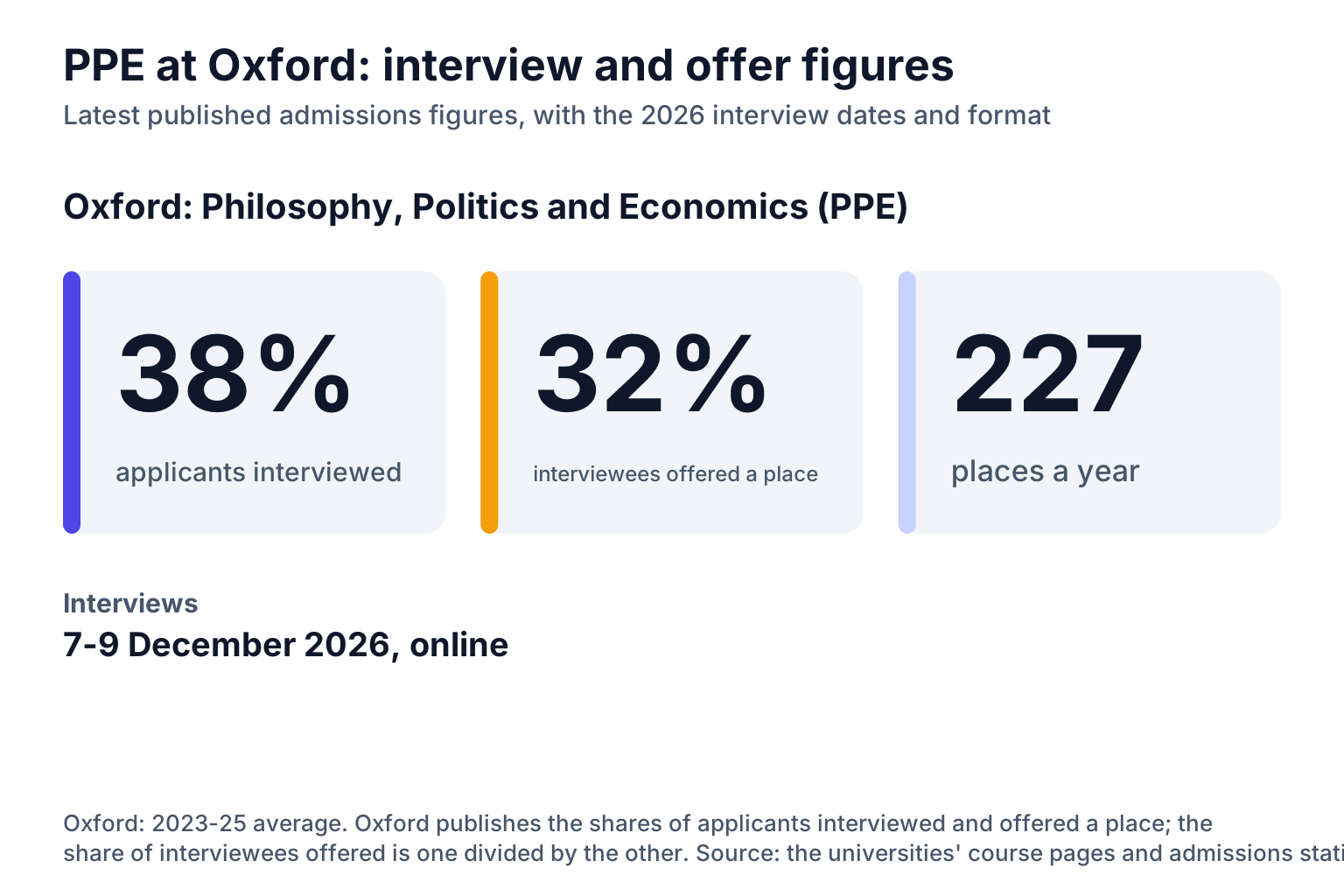
The 2026 Oxford PPE interviews run on 7-9 December, with additional dates on 11-16 December. Every shortlisted applicant is interviewed, and you will have at least one interview. All of them take place online; the Oxford interview format guide covers the pattern every course shares.
Two earlier steps decide whether you get that far:
- UCAS application. PPE has the UCAS code L0V0, and the application deadline is 15 October 2026.
- TARA admissions test. You sit TARA before shortlisting, so by the interview it is behind you.
| Detail | 2026 round |
|---|---|
| Main interview dates | 7-9 December |
| Additional interview dates | 11-16 December |
| Number of interviews | At least one |
| Mode | Online |
| Interviewers | Oxford academic tutors, typically two per interview |
| Who is interviewed | All shortlisted applicants |
Your interviewers are Oxford academic tutors. There are typically two in each interview, and because PPE is a joint course, tutors come from each subject. This means you could move from a philosophy discussion to economic reasoning with different people asking. If you are sent any material in advance, read it carefully. Do not assume a fixed set of pre-reading.
The additional dates are the easy thing to miss. It is natural to block out 7-9 December and treat the rest of the month as free. But the second window runs to 16 December, so a school concert, mock exam or family trip booked for that week could clash with an interview slot you cannot easily move.
Block out both date ranges in your calendar now, 7-9 December and 11-16 December. Tell your school today which days you need kept clear.
3. How competitive the Oxford PPE interview stage is
About one in eight PPE applicants receives an offer, but nearly one in three interviewees does. Oxford's PPE course page gives an average intake of 227 places and says 38% of applicants are interviewed, both as three-year averages for 2023-25 (the Oxford interview rates guide has every course). Over the same period, 32% of those interviewed were offered a place. Oxford publishes the shares of all applicants interviewed and offered a place; the share of interviewees offered is one divided by the other.
| Stage (3-year average, 2023-25) | Figure |
|---|---|
| Average intake | 227 places |
| Applicants interviewed | 38% |
| Interviewees offered a place | 32% |
| Applicants successful overall | 12% |
The course page puts overall success at 12% of applicants. This is the same result measured against a bigger group. Of every 100 applicants, about 38 are interviewed, and 32% of those 38 is roughly twelve offers.
The two percentages describe different pools. Shortlisting is the first filter. Your TARA result and written application have to clear it before any tutor speaks to you. Once you are through, the interview is where most of the remaining decisions are made. For context, the typical offer is AAA, according to Oxford's PPE page.
Takeaway: if you are shortlisted, treat it as a real achievement. Your odds in the interview room are close to one in three, not the one in eight that the headline figure suggests.
4. What Oxford PPE interview questions are designed to test
Oxford PPE interview questions are not a test of how much you have read. Oxford names three things the tutors are assessing: independent thinking, following and constructing arguments, and thinking on novel topics. Each one looks different in the conversation.
- Independent thinking. You offer a view of your own and defend it. Repeating a commentator's position, however accurately, tells the tutors about the commentator rather than about you.
- Following and constructing arguments. You track the line of reasoning a tutor sets out, spot the assumption it rests on, and build your own case one step at a time.
- Thinking on novel topics. You apply what you have been taught at A-level or in the IB Diploma Programme to material you have never seen. A memorised answer has nowhere to go when the material is unfamiliar.
These criteria show up as habits. You think aloud so the tutors can follow your reasoning as it forms. When a tutor pushes back with a good point, you revise your position rather than defending it out of pride. When you change your mind, you say so plainly and explain which point moved you. That explanation is itself evidence of following an argument.
Oxford's sample questions page says its published questions "come direct from the tutors who conduct the interviews" (University of Oxford). The PPE questions from it are listed in section 6. When a tutor prompts you during one of them, the prompt is something to pick up and reason from, not a sign you have failed.
Tutors can only assess reasoning they can hear. A long silence followed by a polished conclusion gives them less to work with than a visible, honest line of thought, including the parts you later correct.
5. How PPE interview questions draw on philosophy, politics and economics
PPE is a joint course, and tutors from each subject take part in interviews. That means you should expect to engage with more than one discipline. There is no published split of time or questions between the three, so don't assume one.
The material you work on could take several forms. Possible kinds of task include:
- a short passage to read and analyse
- a hypothetical scenario to reason through
- a simple graph or small set of data to interpret
- a chain of reasoning to test for weak links
None of these formats is guaranteed. What they share is that you think through something unfamiliar out loud.
It also helps to know what the degree itself teaches. This is course content, not interview content. According to Oxford's PPE course page, first-year students take:
| Subject | Year 1 courses |
|---|---|
| Philosophy | General philosophy, Moral philosophy, Elementary logic |
| Politics | The theory of politics, The practice of politics, Political analysis |
| Economics | Microeconomics, Macroeconomics, Mathematical and statistical techniques |
One detail is easy to miss. The same page describes Political analysis as introductory empirical and quantitative methods. Numbers are not confined to the Economics side of the degree.
You do not need to have studied Economics or Politics at school to reason clearly about them. You should still be comfortable with basic numerical reasoning, such as reading a chart or working out what a percentage change does and does not show, because the course includes quantitative methods.
Oxford PPE interview questions can move between subjects without warning. Practise switching between conceptual reasoning (what a term means), institutional reasoning (how a system works in practice) and quantitative reasoning (what the numbers show) within a single conversation.
6. Questions reported at Oxford PPE interviews
Every question below can be traced to its source: six are published by the University of Oxford on the linked page. Tutors write new material each year, so read these for the kind of thinking they call for, not as a list to learn.
| Question | Reported at | Source |
|---|---|---|
| When I was at school in the 1970s, there was talk of a pensions crisis that would one day hit. ... Is there a fault with the British political system that means we can't sensibly address serious medium and long-term problems when they are identified? | Oxford | University of Oxford, published sample question |
| Are our deaths bad for us? | Oxford | University of Oxford, published sample question |
| What exactly do you think is involved in blaming someone? | Oxford | University of Oxford, published sample question |
| Why is income per head between 50 and 100 times larger in the United States than in countries such as Burundi and Malawi? | Oxford | University of Oxford, published sample question |
| 'I agree that air transport contributes to harmful climate change. But whether or not I make a given plane journey, the plane will fly anyway. So there is no moral reason for me not to travel by plane.' Is this a convincing argument? | Oxford | University of Oxford, published sample question |
| Suppose that you could plug yourself into a machine for the rest of your life, which would give you all the experiences you find enjoyable and valuable. Once in the machine, you would not know that you are plugged in, and that these experiences are not real. Would you go into the machine? If so, why? If not, why not? | Oxford | University of Oxford, published sample question |
Our dataset holds 118 further questions reported for these courses, mostly from preparation companies' lists and forum threads that cannot be traced to a university page or a first-hand account, so they are not reproduced here.
7. How to prepare for your Oxford PPE interview in the weeks before December
The most useful preparation now is spoken, not read. By the interview stage the TARA admissions test is already behind you, so the weeks before December are best spent moving away from timed test practice and towards explaining your reasoning out loud.
Start with your own personal statement. Re-read it line by line. Any book, idea or argument you mention could come up, so be ready to explain it in plain terms and then take it one step further: what follows from it, where it breaks down, and what someone who disagrees would say. If you submitted any written work, re-read that too and mark the places where you would now disagree with yourself. It is much easier to change your mind calmly in the room if you have already found the weak spot at your desk.
Practise unseen material aloud. Find someone who will keep asking "why?" and give them material you have not seen before:
- a short opinion piece from a newspaper
- a paragraph of philosophy
- a simple chart from a news article
Talk through your reasoning step by step. When they push back, pause, restate the objection in your own words, then answer it. The skill you are building is handling a counter-argument without freezing, not producing a polished speech.
Build fluency with the basic tools. Treat these as practice habits, not a forecast of what you will be asked: spotting the hidden assumption in an argument, testing a claim against a counter-example, and saying what a simple graph does and does not show. These habits connect directly to the first-year course, which includes Elementary logic, Political analysis (introductory empirical and quantitative methods) and Mathematical and statistical techniques, according to Oxford's PPE course page.
Plan the last fortnight.
- Reduce new reading. A new book started in the final days rarely sticks well enough to discuss under pressure.
- Increase spoken practice. Short daily sessions work better than one long rehearsal.
- Keep both interview windows free. Oxford's 2026 interview dates are 7-9 December, with additional dates of 11-16 December, so avoid booking anything in either range.
8. Setting up a quiet space for an online Oxford PPE interview
The Oxford PPE interview is held online, so the room you sit in becomes part of the interview. You will typically be talking to two tutors, and you want them following your reasoning, not the washing machine next door.
Before the day, sort out:
- A quiet room with a door you can close. Tell everyone at home your interview times.
- A stable connection, tested at the same time of day as your interview. A test at midnight tells you little about a busy household mid-afternoon.
- A charged device that is also plugged in.
- Headphones with a microphone, which cut echo and background noise.
- Good lighting in front of you. A bright window behind you turns you into a silhouette.
Keep plain paper and a pen on the desk for sketching a diagram or setting out the steps of an argument. Have your personal statement within reach for a last read before the call, then put it away once the call starts.
Run a full rehearsal call with someone at home or school. Check your sound, how you sit in the camera frame, and what you will do if the connection drops. Read any instructions Oxford or your college sends about technical problems, and keep them to hand.
Fix these technical risks a week early, so that on the day the only thing you are thinking about is the problem in front of you.
9. What studying PPE at Oxford looks like after the interview
PPE at Oxford is a three-year BA, but it does not stay three subjects wide for everyone. According to the University of Oxford PPE course page, at the end of Year 1 you either continue with all three branches (tripartite) or concentrate on two (bipartite). You can also specialise in Sociology or International Relations through your Politics option choices.
Year 1 is less essay-only than many applicants expect. The course page lists Elementary logic in Philosophy, Political analysis (introductory empirical and quantitative methods) in Politics, and Mathematical and statistical techniques in Economics. These sit alongside General philosophy and Moral philosophy.
Teaching runs on a small-group rhythm. The course page describes a typical week as:
- Up to eight lectures
- Two tutorials and/or classes, plus private study for essays or problem sets
- Tutorials of two to four students and a tutor
- Classes of typically six to ten students
This structure explains why discussion-based reasoning matters on this degree. Much of your learning happens by defending and revising an argument in a small group. On the philosophy side, the course page frames the subject around themes such as "what can we (really) know?" and "why be moral?". These describe what the degree covers. They are not a preview of your interview.
If the course comes up, you can explain which branches interest you, whether tripartite or bipartite appeals, and why.
10. What to do next before your PPE interview
Start with the calendar. The second interview window is the one applicants tend to forget. Oxford's 2026 PPE interviews run on 7-9 December, with additional interviews on 11-16 December, so a shortlisted applicant could be called on any of those days.
This week:
- Re-read your personal statement and mark three claims you could defend aloud for several minutes each, including when someone pushes back.
In the fortnight before the interview:
- Hold at least a few spoken practice sessions on unseen material with someone who keeps asking why.
- Run a full online rehearsal in the room you will use, with the same device, chair and lighting you plan to have on the day.
Block out 7-9 and 11-16 December 2026 in your diary today. Then tell your school which of those days you may be unavailable.
Related guides
- Oxford interview dates 2026, every course
- Oxbridge economics interview questions
- Oxbridge philosophy interview questions
- Every Oxbridge and medicine interview guide
Course pages
Entry requirements and the latest admissions figures: Oxford Philosophy, Politics and Economics (PPE).
FAQ
How competitive is PPE at Oxford?
Across 2023-25, 38% of Oxford PPE applicants were interviewed and 12% were successful overall, according to Oxford's PPE course page; dividing one by the other, about 32% of those interviewed received an offer.
How many PPE students are there at Oxford?
Oxford's average PPE intake is 227 students a year, based on a three-year average for 2023-25 published on the course page.
How do you get into PPE at Oxford?
You apply through UCAS (course code L0V0) by 15 October 2026 with typical entry of AAA, take the TARA admissions test, and, if shortlisted, attend at least one online interview in December 2026.
Is the Oxford PPE interview online?
Yes, Oxford lists the PPE interview mode as online, with interviews on 7-9 December 2026 and additional dates on 11-16 December 2026.
Who interviews you for Oxford PPE and what are they looking for?
Interviews are typically run by two Oxford academic tutors drawn from the subjects on the joint course, and they assess independent thinking, following and constructing arguments, and thinking on novel topics.
References
- Philosophy, Politics and Economics | Oxford University - https://www.ox.ac.uk/admissions/undergraduate/courses/course-listing/philosophy-politics-and-economics
- Sample interview questions | Oxford University - https://www.ox.ac.uk/admissions/undergraduate/applying/guide-for-applicants/interviews/sample_questions