Cambridge Interview Preparation: The Complete Guide
By Michael Thompson · Education Specialist; 10 years teaching the IB at Bromsgrove School · Published 21 May 2026 · Updated 12 June 2026
Cambridge interview preparation is more specific than most applicants expect - and the gap between prepared and unprepared candidates tends to show within the first five minutes. Most undergraduate interviews last between 20 and 50 minutes and are built around problem-solving or close reading, not a rehearsed presentation of your personal statement. Understanding the format, the subject-specific conventions, and the pool system before you walk into the room (or log on) gives you a structural advantage. This guide covers everything from how Cambridge interviews differ from Oxford, to what happens if you're pooled, to the common mistakes that trip up even well-prepared candidates.
Key Takeaways
- Two interviews per subject is standard: Most colleges run two 20-50 minute subject interviews, often near-consecutive, and the format is now predominantly online.
- Pre-sent material is common: Many subjects send a problem, text, or data extract ahead of your interview - read it carefully but don't over-prepare a fixed answer.
- Cambridge leans heavier on problem-solving than Oxford: Expect to be pushed with extension questions mid-solution; the point is to see how you think when you don't know the answer yet.
- The pool is not a rejection: Being pooled means other colleges can still interview and offer you a place; pooled candidates are actively considered, not filtered out.
- Admissions assessments feed directly into interview shortlisting: Tests like the ESAT and TMUA are used alongside your UCAS form to decide who gets interviewed, so they matter before you sit down.
- Going silent is the biggest mistake: Interviewers want to hear your reasoning aloud - a quiet pause while you think privately is far less useful than a tentative spoken attempt.
In This Article
- What the Cambridge Interview Actually Looks Like
- How Cambridge Interviews Differ from Oxford
- Admissions Assessments and How They Shape the Interview Decision
- The Pool System: What It Means and What Happens Next
- Subject-Specific Cambridge Interview Questions and Approaches
- How to Prepare for a Cambridge Interview: Practical Steps
- Cambridge Interview Tips: What Interviewers Are Actually Looking For
- Common Mistakes That Cost Candidates in Cambridge Interviews
- Foundation Year and Non-Standard Interview Formats
- Where to Go from Here
1. What the Cambridge Interview Actually Looks Like
Solid cambridge interview preparation starts with knowing exactly what you are walking into, because the format is more structured than most applicants expect. Cambridge interviews are not a conversation about why you love the subject. They are a supervised thinking exercise, run to a tight schedule, with academics who are watching how your mind works under pressure.
Most applicants receive two interviews per subject. At St John's College, each interview panel contains two or three academics, typically including the Director of Studies and College Fellows, and each session runs 35-50 minutes. At St Catharine's College, the two interviews run near-consecutively and are shorter, around 20-25 minutes each. The difference matters: a longer session gives the interviewer more room to push you into genuinely unfamiliar territory.
All St Catharine's interviews are conducted remotely, continuing a format in place since 2020, and St John's takes the same approach. One detail candidates often miss: subjects including Economics, Engineering, and Physical Natural Sciences require a digital whiteboard and stylus, meaning you will be doing live written work on screen, not just talking.
Material in the room can include pre-sent problems, an unseen text, or written work you submitted earlier in your application. Interviewers will have read that work before you arrive.
Interview times run 8am to 6:30pm UK time. For international candidates, that translates to a possible 6am-midnight local window, so your slot may land at an awkward hour regardless of timezone.
2. How Cambridge Interviews Differ from Oxford
The most practical difference is what you are expected to do with your hands. For maths and science subjects, Cambridge commonly requires candidates to show working in real time on a digital whiteboard or, for in-person formats, on paper held up to a webcam. St Catharine's College explicitly states that science and maths applicants must have a pad of paper or whiteboard visible to the camera throughout. Oxford interviews involve live problem-solving too, but the format more often centres on discussion: unpicking an argument, responding to a hypothetical, or being pushed on something in your personal statement.
The extension-question model is common to both universities. An interviewer poses a problem, you attempt it, then they adjust the difficulty based on your response. Cambridge interviewers, though, have a documented tendency to push further into unseen territory mid-problem rather than circling back to familiar material. The Cambridge undergraduate admissions guidance specifically advises maths and science applicants to practise explaining their working-out process, not just reaching an answer. That emphasis on narrated reasoning is more pronounced at Cambridge than at most Oxford colleges.
One counter-intuitive point: arriving with a polished answer can actually work against you. If you solve the opening problem too cleanly, the interviewer moves the question further into territory you cannot have prepared for. The stretch zone is the point. Neither Cambridge nor Oxford is testing whether you know the answer; both are testing what you do when you do not.
3. Admissions Assessments and How They Shape the Interview Decision
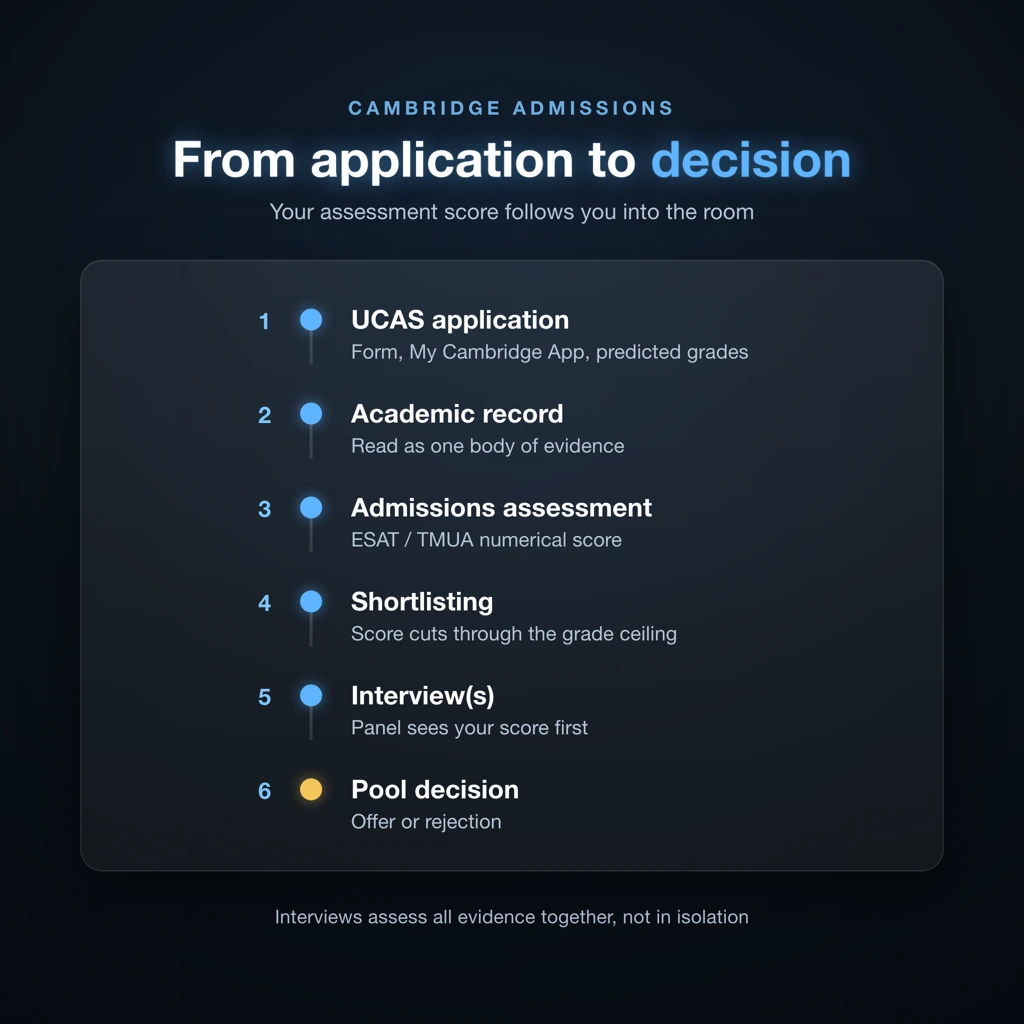
Before Cambridge decides who to interview, it has already read your UCAS form, your My Cambridge Application, your predicted grades, and your admissions assessment score. St Catharine's College confirms that interviews assess academic potential across all of this evidence together, not the interview in isolation.
The problem that assessments solve is straightforward: most Cambridge applicants are on course for A and A* grades, which means predicted grades alone cannot separate candidates. Tests like the ESAT (Engineering and Science Admissions Test) and the TMUA (Test of Mathematics for University Admission) produce a numerical score that cuts through the grade ceiling and creates genuine differentiation at the shortlisting stage.
The non-obvious consequence: interviewers see your assessment score before you walk in. A weaker score does not automatically disqualify you, but it does signal to the panel where to probe. If your TMUA score suggests shaky algebraic fluency, expect the interviewer to push harder on exactly that. A strong score, equally, will not earn you an easy ride, but it shifts the session toward more ambitious problem territory.
Going into cambridge interview preparation knowing your own score band is therefore practical, not just reassuring. Review the questions you found hardest in your sitting and treat them as a forecast of where the interview may apply pressure.
4. The Pool System: What It Means and What Happens Next
If your first-choice college interviews you but cannot offer you a place, it can refer you to the pool rather than simply rejecting you. The pool is a shared database of strong candidates that other colleges draw from when they have unfilled spaces. Being pooled is not a soft rejection: it is an active route to an offer, just at a college you did not originally apply to.
A few things worth knowing about how it works:
- You have no control over which college picks you. Colleges browse pooled candidates and invite those who fit their subject needs. The process is driven entirely by colleges, not by applicants.
- A pooled college may interview you again or make a direct offer without a further interview, depending on how much evidence they already have from your original interview record and admissions assessment scores.
- The timeline extends further than most applicants expect. Pool decisions can arrive in late December or into January, well after your original college has finished its process.
The practical consequence for cambridge interview preparation is straightforward: do not wind down after your first interview. Keep your personal statement and any submitted written work to hand, because a pooling college will have read both before they contact you, per University of Cambridge guidance. If you are called for a second interview, the interviewers will likely have seen your first college's notes, which means arriving having already thought carefully about your original interview is worthwhile, not redundant.
5. Subject-Specific Cambridge Interview Questions and Approaches
The format and focus of Cambridge interviews shift significantly by subject. Understanding what each discipline actually tests helps you prepare for the right things rather than generic "think out loud" advice.
Natural Sciences and Engineering interviews almost always involve unseen maths and physics problems worked through in real time. At St John's College, Engineering and Physical Natural Sciences applicants are required to use a digital whiteboard and stylus during the interview. The counter-intuitive point here: interviewers are often less interested in whether you reach the correct answer than in watching you identify what kind of problem you are facing. Stalling silently is the worst outcome; narrating a wrong turn is not.
Mathematics questions extend well beyond A-level syllabus content. The interviewers want to see logical progression, not a memorised method. Expect to be pushed onto unfamiliar ground deliberately.
Medicine combines two distinct assessments within the same interview: scientific problem-solving and clinical potential. Per St Catharine's College, clinical potential is one of the few criteria that supplements the standard academic potential measure for Medicine applicants. Ethical scenarios and data interpretation questions are common formats.
English, History, and HSPS interviews centre on close reading of unseen texts or pre-sent articles. HSPS interviewers explicitly do not expect prior knowledge of all subjects within the course; they assess five qualities, including the ability to assimilate and use new, complex information in real time. Approximately 75% of HSPS applicants are invited to interview, so being called is not itself a strong signal either way.
Economics interviews probe quantitative reasoning and economic intuition, not just A-level content. Law interviews use hypothetical legal scenarios to test argument construction and the ability to hold a position under pressure, then revise it when the interviewer introduces a complicating fact.
6. How to Prepare for a Cambridge Interview: Practical Steps
Start with the basics: re-read your personal statement and any written work you submitted to your college before the interview. Interviewers will have read both, and a question that feels lateral often traces back to something you wrote in October.
Practice interviews matter more than most applicants expect. The University recommends doing one with a teacher or someone who does not know your application, or, failing that, questioning yourself aloud for 30 minutes. The point is to get used to thinking through an unfamiliar problem with someone watching, which is a different skill from knowing the material.
Preparation looks different depending on your subject:
- Arts, humanities, and social sciences. Read beyond texts your school set and be ready to analyse something you have never seen before, on the spot. Familiarity with one unseen text you genuinely enjoyed is more useful than a vague awareness of ten.
- Maths and sciences. Practise explaining your working process step by step, not just arriving at the answer. At St Catharine's College, interviewers may ask permission to screenshot your working during the interview, so clarity on paper counts.
Sort your tech early. All St John's College interviews are conducted online and require reliable wi-fi, a camera, and a microphone. Subjects including Economics, Engineering, and Physical Natural Sciences require a digital whiteboard and stylus. Attend any college tech-check session offered: it is not optional preparation, it is a rehearsal for the actual conditions.
One detail candidates frequently miss: if you fall ill on the day, contact the college admissions office before the interview. Circumstances reported after will not usually be considered.
7. Cambridge Interview Tips: What Interviewers Are Actually Looking For
Per St Catharine's College, the sole selection criterion at most Cambridge colleges is academic potential. Personality, confidence, and polish are not assessed. Arriving well-spoken but intellectually passive will not help you; arriving nervous but genuinely engaged will.
HSPS sets out five qualities its interviewers look for, and they translate well across most subjects:
- Genuine enthusiasm and curiosity for the subject, not performed interest
- Course fit - evidence that you understand what you are actually applying to study
- Reading beyond school-set texts - one specific book or paper you have engaged with critically carries more weight than a long list of titles you have skimmed
- Critical analysis - the ability to interrogate an argument, not just describe it
- Assimilating new information quickly - interviewers will introduce an unfamiliar idea mid-interview and watch what you do with it
That last point is the one most candidates underestimate. Extension questions are deliberate. Interviewers are not trying to catch you out; they are trying to find the edge of your thinking. Changing your answer after new information is a sign of good reasoning, not weakness.
The counter-intuitive corollary: being right first time is less valuable than showing how you respond when you are wrong.
For Medicine and Veterinary Medicine, St Catharine's notes that clinical potential is assessed alongside academic ability, making those interviews structurally different from the rest.
8. Common Mistakes That Cost Candidates in Cambridge Interviews
Most errors in Cambridge interviews come from the same root cause: candidates prepare for the wrong thing. They rehearse answers when they should be rehearsing thinking.
Going silent is the single most damaging habit. When a problem gets hard, the instinct is to think privately and then deliver a polished response. That is exactly backwards. The interviewer cannot assess reasoning they cannot see. Undergraduate Study at Cambridge specifically recommends practising problem-solving and being able to explain your working-out process, because the process is the point.
Treating extension questions as a sign of failure will knock your confidence at precisely the wrong moment. When an interviewer pushes further, it almost always means they found your answer interesting enough to pursue, not wrong enough to correct.
Over-rehearsing from scripted "cambridge interview questions and answers" resources produces a different problem: fluency without thought. Interviewers notice when a candidate has memorised a route to an answer rather than finding one. It reads as performance, and Cambridge is not looking for performance.
Ignoring or skimming pre-sent material wastes the clearest preparation signal the college gives you. That material is sent precisely because the interview will engage with it in depth.
Failing to respond to new information introduced mid-interview is a related trap. Cambridge interviews frequently introduce a concept or data point the candidate has never seen, to observe how they reason in real time. Candidates who try to connect everything back to prior knowledge rather than working with what is in front of them miss the exercise entirely.
Not knowing your own personal statement is the most avoidable mistake. Cambridge advises all applicants to re-read their personal statement and any submitted written work before the interview. An interviewer who asks about something you wrote and receives a vague answer will reasonably question how genuine the interest was.
9. Foundation Year and Non-Standard Interview Formats
The Cambridge Foundation Year interview process is structured differently enough from standard undergraduate interviews that treating it as the same exercise will leave you underprepared.
Every shortlisted candidate has two interviews, each capped at 30 minutes, conducted fully online. Shortlisting decisions are communicated by email at the end of February; add foundation.year@admin.cam.ac.uk to your safe senders list or you risk missing the notification entirely. For 2026 entry, interviews run 23-27 March 2026, with slot assignments sent roughly two weeks beforehand. Rescheduling is not permitted.
The two-interview structure works like this:
- Interview A is built around a textual source emailed to you 30 minutes before the session. You will know the general theme in advance but not the specific extract. No prior research is required or expected; the point is responsive analysis of what's in front of you, not what you've read around it. You may print the document, use a coloured overlay, or adjust the font.
- Interview B gives you three format options chosen by you: Working with Material Sources (an object), Working with Languages (a short English-language text), or Working with Data (charts or tables). No material is sent in advance; everything is shown during the interview itself.
The counter-intuitive gotcha for Interview A: additional preparation on the topic can actively work against you. Candidates who arrive with a prepared argument sometimes resist the text rather than engaging with it.
10. Where to Go from Here
Book a mock interview this week. Ask a teacher, or better, an adult who doesn't know your subject well, to put a past Cambridge question to you and push back on every answer you give. The unfamiliar-adult format is specifically recommended by St John's College and the central undergraduate admissions team for good reason: someone who knows your subject will unconsciously fill gaps in your reasoning. Someone who doesn't, won't.
For video resources, Downing College's Arts/Humanities and Sciences/Maths webinars are free and hosted by working admissions tutors. St John's runs its own guidance webinars separately. Check both, because format details vary by college.
Then open My Cambridge Application, confirm your interview date, and verify your tech requirements now, before the December window arrives.
FAQ
How should I prepare for a Cambridge interview?
Re-read your personal statement and submitted written work, practise problem-solving aloud for your subject, do at least one mock interview with someone unfamiliar with your application, and check your tech setup if your interview is online.
Are Cambridge interview questions related to your course?
Yes - Cambridge interviews are almost entirely subject-specific; questions are designed to probe your academic thinking in the discipline you applied for, not your general knowledge or personality.
How do I pass a Cambridge interview?
There is no single pass/fail trick, but the key is reasoning aloud - interviewers are assessing your thinking process, so a tentative spoken attempt is more useful to them than a silent pause followed by a correct answer.
What happens if I am pooled after my Cambridge interview?
Being pooled means your first-choice college cannot offer you a place but has flagged you as a strong candidate; other colleges with available places can then review your application and invite you for a further interview or make you a direct offer.
Are there free resources for Cambridge interview preparation?
Yes - several Cambridge colleges publish free preparation materials including Downing College's Arts and Sciences webinars, St John's guidance webinars, and subject-specific advice pages from HSPS and other departments.
How long is a Cambridge interview?
Interviews typically last between 20 and 50 minutes depending on college and subject; most applicants have two interviews, often near-consecutive, giving a total of roughly 40 minutes to an hour of interview time.
References
- Undergraduate Interviews - St John's College, Cambridge - https://www.joh.cam.ac.uk/apply/undergraduate/undergraduate-interviews
- Preparing for interviews | St Catharine's College, Cambridge - https://www.caths.cam.ac.uk/study-us/undergraduate-study/how-apply/preparing-interviews
- Preparing for your Cambridge interview | Undergraduate Study - https://www.undergraduate.study.cam.ac.uk/apply/after/interview-preparation
- Preparing for interview | Human, Social and Political Sciences (HSPS) - https://www.hsps.cam.ac.uk/interview
- Interviews | Foundation Year - https://www.foundationyear.cam.ac.uk/interviews
- Resources for preparing for interview | Downing College Cambridge - https://www.dow.cam.ac.uk/undergraduate-admissions/apply-downing/interviews/resources-preparing-interview