Cambridge Natural Sciences Interview Questions: 2026 Guide
By Michael Thompson · Education Specialist; 10 years teaching the IB at Bromsgrove School · Published 26 October 2026 · Updated 28 October 2026
Cambridge Natural Sciences interview questions are problems, data and unfamiliar material in the sciences you applied for, which you work through aloud with two or three interviewers. For most applicants that means one or two interviews totalling 35 minutes to an hour, online or in person depending on the College, in the main period of 7-18 December 2026. The University says interviewers look at your understanding of the subject, readiness for high-level study, critical and independent thinking, curiosity and enthusiasm. Your application stream, Biological or Physical, and the subjects you are studying now shape the kind of material you will see. The sections below set out how Colleges run the interview differently, what each assessment criterion means when you are working on a problem, and how to use the weeks before December.
Key Takeaways
- Main interviews run 7-18 December 2026: The winter pool follows in mid to late January 2027, according to the University's Natural Sciences course page.
- Most applicants have one or two interviews: These total 35 minutes to an hour, though some Colleges hold three or four and the format varies by College.
- Your stream shapes the questions: Cambridge says your choice of Biological or Physical Sciences and your current courses affect the types of questions asked.
- Tutors assess thinking, not recall: Peterhouse says interviewers evaluate how you approach new information and ideas rather than testing what you already know.
- Pre-interview material is possible: Written work is not usually required, but a College may set reading, a task or a preparation paper and will say so in your invitation.
- Online and in-person interviews carry the same weight: Trinity and Peterhouse both state that the type of question and level of assessment are the same in either format.
In This Article
- What a Cambridge Natural Sciences interview involves
- Interview dates, length and format for 2026
- How Colleges run the Cambridge NatSci interview differently
- How biological and physical streams shape Cambridge Natural Sciences interview questions
- What tutors are assessing and how it shows in the conversation
- Questions reported at Cambridge Natural Sciences interviews, and practice questions
- The kinds of material you may be handed
- How to prepare for natural sciences interview questions in the weeks before December
- Assumptions the College pages correct
- What to do next before your Natural Sciences interview
1. What a Cambridge Natural Sciences interview involves
A Natural Sciences interview at Cambridge is a conversation in which you work aloud through problems, data and unfamiliar material in the sciences you applied for, while the interviewers discuss your reasoning with you as it develops. Most Cambridge Natural Sciences interview questions are built to be worked through, not recited. The tutors care about how you get somewhere as much as where you end up.
Only shortlisted applicants are interviewed. In subject interviews you will usually meet two or three interviewers, matched to the Biological or Physical stream you chose. Most applicants spend between 35 minutes and one hour in interview in total, though this varies by College. The University of Cambridge says interviews assess your:
- understanding of the subject
- readiness for high-level study
- fit with the Cambridge learning environment
- critical and independent thinking
- curiosity
- enthusiasm
The stream matters more than it first appears. The Cambridge Natural Sciences course page states that "Your choice of application stream, and the courses that you are currently studying, will affect the types of questions that are asked at interview." Yet the course is taught by 14 departments across the physical and biological sciences, and you do not choose your subjects until you arrive. A Cambridge Natural Sciences interview therefore tests the sciences you study now, for a degree that lets you pick up new areas such as Earth Sciences or Materials Science later.
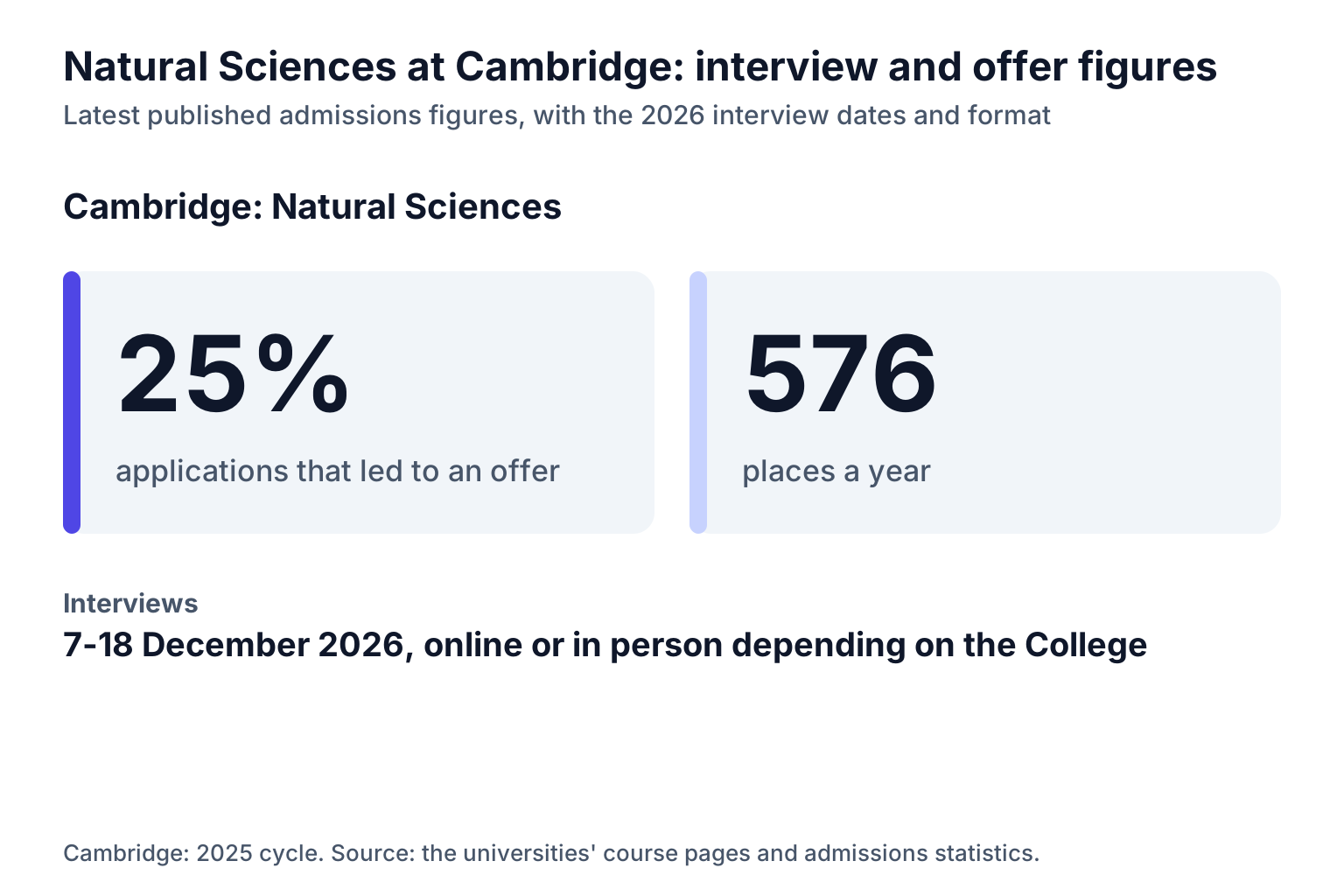
In the 2025 admissions cycle, Cambridge received 2,644 applications for Natural Sciences, made 672 offers and filled 576 places.
Check which stream you named on your application before you prepare. That choice affects the types of questions you are asked at interview.
2. Interview dates, length and format for 2026
The main interview period for 2026 runs from 7-18 December 2026, with interviews for applicants placed in the winter pool held in mid to late January 2027, according to the Natural Sciences course page. Most other details of the Cambridge Natural Sciences interview depend on your College, so treat the table below as a range rather than a fixed timetable.
| Feature | What to expect |
|---|---|
| Number of interviews | Varies by College: most applicants have 1-2, some have 3-4 |
| Total length | 35 minutes to 1 hour for most applicants |
| Mode | Online or in person, depending on the College |
| Subject interviewers | Two or three |
| Written work | Not usually required |
| Pre-interview reading or tasks | Possible, and the College says so in your invitation |
Who interviews you changes how you should talk. Subject interviews are run by biological or physical sciences interviewers matched to your application stream. A general academic interview may be with academics from other subjects, so the person asking about your interest in science may not be a scientist at all. Stream jargon that works with a chemist will lose a non-specialist. Practise explaining your strongest topic in plain terms, and define each technical word the first time you use it. If a non-scientist can follow your reasoning, a specialist certainly can.
Your invitation is the document to read closely. It confirms whether your interviews are online or in person, how many you have, and whether any reading or task comes first.
The admissions test comes earlier in the process. Natural Sciences applicants take the ESAT, a pre-registered admission test. Trinity College gives the 2026 booking deadline as 6pm BST on 28 September 2026 and the test window as 12-16 October 2026. By the time interview invitations arrive, you will already have sat it. Your preparation from here should focus entirely on the interview.
3. How Colleges run the Cambridge NatSci interview differently
This is the one place in this guide where College differences are set out. Each College decides how many interviews you have, what you see beforehand and whether you attend in person or online. Three College pages show how much practice can vary.
Trinity describes its NatSci interviews as "strongly academic in character". Every interviewee sits an "interview preparation paper", and its questions are then discussed in the interview. Trinity says the paper is meant to "make the interview experience less daunting". A sample paper is in its NST Admissions Guide (Trinity College Cambridge, Natural Sciences).
At least one interviewer will be an expert in the main interest you specify after applying. But you "must be prepared to talk about any of your A-level subjects at interview", so a declared interest in physics does not excuse rusty chemistry. On mode, Trinity offers UK applicants an in-person interview in Cambridge. Applicants outside the UK choose in-person or online (Trinity College Cambridge, Interviews).
Sidney Sussex typically holds "two short or one longer interview". These focus on your chosen route, Biological or Physical, and "involve working through some science and maths problems". Sidney expects candidates ordinarily resident in the UK to attend in person and offers candidates outside the UK an online interview. It does not ask for any written work (Sidney Sussex College).
Peterhouse usually gives applicants two interviews, each with a pair of interviewers and lasting about 30 minutes, though the number and length vary by course. Your interviewers are usually the Admissions Tutor, the Director or Directors of Studies and other subject specialists (Peterhouse).
Each of these is that College's own practice, not a University rule. Read your own College's Natural Sciences page and its interview page together, because format, pre-reading and mode are set by the College. Then check the details against your interview invitation.
4. How biological and physical streams shape Cambridge Natural Sciences interview questions
When you apply, you state whether you are interested in Biological or Physical Sciences, and Cambridge uses this information in the admissions process. The course page is direct about what follows: "Your choice of application stream, and the courses that you are currently studying, will affect the types of questions that are asked at interview." Cambridge Natural Sciences interview questions are therefore shaped by two things: your stream and your current subjects.
Your current syllabus is the starting point. Cambridge advises applying for Physical Sciences if you have studied Physics and Maths A levels, "because your interview will be on subjects that you have already studied". In practice, the interview builds on what you have been taught, then extends it. It does not test you on topics you have never met.
Interviewers are allocated by application stream. Trinity adds that at least one interviewer will be an expert in your main interest, but you "must be prepared to talk about any of your A-level subjects at interview."
- Biological natural sciences interview questions may centre on data and biological mechanisms.
- Physical natural sciences interview questions are more likely to involve problems that need maths.
The stream does not lock you in. Students choose their subjects after arriving and can take both physical and biological options.
Takeaway: choose the stream that matches the A levels you are taking now. Then revise every one of those subjects, not only your favourite.
5. What tutors are assessing and how it shows in the conversation
Cambridge lists six things its Natural Sciences interviewers look for: understanding of the subject, readiness for high-level study, fit with the Cambridge learning environment, critical and independent thinking, curiosity and enthusiasm. The table below shows how each one might come through while you work on a science problem. These are readings of the wording, not a marking scheme.
| Criterion | What it can look like mid-problem |
|---|---|
| Understanding of the subject | Explaining why a method applies, not just naming it |
| Readiness for high-level study | Taking an unfamiliar step once it is explained and building on it |
| Fit with the Cambridge learning environment | Treating the exchange as a discussion rather than a test |
| Critical and independent thinking | Checking assumptions, units and whether a result is sensible |
| Curiosity | Wondering aloud what changes if a condition changes |
| Enthusiasm | Staying engaged when the problem gets harder |
Thinking aloud is the point. Peterhouse says interviews assess thinking, learning and reflection in a way similar to Cambridge's supervision teaching. It also says questions aim "to generate discussion". A correct answer reached in silence leaves your interviewers very little to discuss.
Changing your mind is evidence, not failure. Peterhouse also says interviewers evaluate how you approach new information and ideas, rather than testing knowledge. When an interviewer offers a hint, the useful response is to use it and revise your approach. That moment of revision is the "new information" the College describes.
Reason from what you have been taught. Trinity gives every Natural Sciences interviewee a preparation paper. Trinity says it lets you "see what you can do without any help and what needs to be discussed with your interviewers to help you to reach an answer". In other words, Trinity expects some questions to stay unfinished until the interview. Arriving with a partial answer and a clear account of where you got stuck fits that design.
Takeaway: when you practise, say each step out loud, including the uncertain ones. Name the assumption you are making, say where you are unsure, and explain what you would check next.
6. Questions reported at Cambridge Natural Sciences interviews, and practice questions
Every question below can be traced to its source: 21 come from a practice pack Lucy Cavendish College, Cambridge, compiled to show the kind of question asked at Oxbridge interviews, and nine were reported by applicants describing their own Natural Sciences interview. Tutors write new material each year, so read these for the kind of thinking they call for, not as a list to learn.
| Question | Reported at | Source |
|---|---|---|
| In your maths exploration, how did you show that the gamma function worked as a factorial? | Cambridge | Applicant report, reasonabledeviations.com |
| What is the square root of (-2)^2? | Cambridge | Applicant report, reasonabledeviations.com |
| Could Felix Baumgartner have broken the sound barrier? | Cambridge | Applicant report, reasonabledeviations.com |
| If I mix some lithium ions in water, what happens? | Cambridge | Applicant report, reasonabledeviations.com |
| What is the factorial of a half? | Cambridge | Applicant report, reasonabledeviations.com |
| How would you find a specific gene? | Cambridge | Applicant report, ilyacarey.com |
| How does air pressure vary as a function of height? | Cambridge | Applicant report, reasonabledeviations.com |
| Have you heard of the Boltzmann distribution? | Cambridge | Applicant report, reasonabledeviations.com |
| Is the Gamma function the only function that can model a factorial? | Cambridge | Applicant report, reasonabledeviations.com |
| Why do aeroplanes tilt to turn corners? | Oxbridge practice pack | Lucy Cavendish College, Cambridge, Oxbridge practice pack |
| Why are explosions a risk in flour mills? What stops bags of flour exploding in the kitchen? | Oxbridge practice pack | Lucy Cavendish College, Cambridge, Oxbridge practice pack |
| Why do we need ATP, why not just release energy from glucose directly? | Oxbridge practice pack | Lucy Cavendish College, Cambridge, Oxbridge practice pack |
| How and why are the structures of Carbon Dioxide and Silicon Dioxide different? | Oxbridge practice pack | Lucy Cavendish College, Cambridge, Oxbridge practice pack |
| Here is a blank graph. Sketch the curve of this equation: V(r) = A/r^12 - B/r^6 and then interpret the graph, differentiate the equation and label the minimum points. | Oxbridge practice pack | Lucy Cavendish College, Cambridge, Oxbridge practice pack |
| A ball, initially at rest, is pushed upwards by a constant force for a certain amount of time. Sketch the velocity of the ball as a function of time, from start to when it hits the ground. | Oxbridge practice pack | Lucy Cavendish College, Cambridge, Oxbridge practice pack |
| How does a glow-stick work? | Oxbridge practice pack | Lucy Cavendish College, Cambridge, Oxbridge practice pack |
| If I've got an alkane and I'd like to know more about it, what should I do? | Oxbridge practice pack | Lucy Cavendish College, Cambridge, Oxbridge practice pack |
| What height does a geostationary satellite need to be at? | Oxbridge practice pack | Lucy Cavendish College, Cambridge, Oxbridge practice pack |
| What volume of wine can be drunk to reach the legal concentration of alcohol in the blood for driving? | Oxbridge practice pack | Lucy Cavendish College, Cambridge, Oxbridge practice pack |
| What is the concentration of water? | Oxbridge practice pack | Lucy Cavendish College, Cambridge, Oxbridge practice pack |
| How do amino acids bond to form a peptide? | Oxbridge practice pack | Lucy Cavendish College, Cambridge, Oxbridge practice pack |
| How does blood maintain its pH? | Oxbridge practice pack | Lucy Cavendish College, Cambridge, Oxbridge practice pack |
| Draw ethanol and propane. What are their states at room temperature? Why do they differ? | Oxbridge practice pack | Lucy Cavendish College, Cambridge, Oxbridge practice pack |
| Why is it that in a sample of molecules, the energy given out in form of the electromagnetic spectra is less than that absorbed (Bearing in mind that in a sample of atoms it is the same)? How would the spectra be affected if an atom was bonded, as opposed to alone? | Oxbridge practice pack | Lucy Cavendish College, Cambridge, Oxbridge practice pack |
| If you had a cylinder, sealed at both ends, with the pressure rising inside, would it blow at the end or split along the side first? | Oxbridge practice pack | Lucy Cavendish College, Cambridge, Oxbridge practice pack |
| What is an amino acid and why are there only twenty? | Oxbridge practice pack | Lucy Cavendish College, Cambridge, Oxbridge practice pack |
| How many moles of H2O are in a single cup of water? | Oxbridge practice pack | Lucy Cavendish College, Cambridge, Oxbridge practice pack |
| How would you adjust ethanol to make it a stronger acid? How would you adjust carboxylic acid to make it stronger? | Oxbridge practice pack | Lucy Cavendish College, Cambridge, Oxbridge practice pack |
| How hot does the air have to be in a hot air balloon if I wanted to use it to lift an elephant? | Oxbridge practice pack | Lucy Cavendish College, Cambridge, Oxbridge practice pack |
| Why is the pole-vaulting world record about 6.5m, and why can't it be broken? | Oxbridge practice pack | Lucy Cavendish College, Cambridge, Oxbridge practice pack |
Our dataset holds 111 further questions reported for these courses, mostly from preparation companies' lists and forum threads that cannot be traced to a university page or a first-hand account, so they are not reproduced here.
7. The kinds of material you may be handed
At several Colleges, the interview starts from something put in front of you, not from conversation alone. What you receive depends on the College, and three published examples show the range:
- Problems worked in the room. Sidney Sussex says its interviews "involve working through some science and maths problems" in your chosen stream (Sidney Sussex). It asks for no written work, so the material arrives on the day.
- A paper sat first, then discussed. Every Trinity NatSci interviewee sits an "interview preparation paper", and the interviewers discuss its questions with you in the interview (Trinity College). Trinity's general interview page also says that for some subjects, applicants are given material to review before the interview begins (Trinity interviews).
- Preparatory study. Peterhouse may hand you "preparatory study" (text, data or questions) to analyse beforehand. It may also use a Cambridge College registered written assessment as a springboard for discussion, and its questions may cover your personal statement and any submitted work (Peterhouse).
The University's course page says pre-interview reading or tasks are possible, and your College will say so in the invitation. Read yours line by line.
Trinity describes its paper as a way to show what you can do without help and what needs discussing to reach an answer (Trinity College). On that description, a half-finished attempt is the expected starting point, not a failure.
Takeaway: practise starting on unseen material out loud in three moves. Say what you notice, then what you know that applies, then what you would try first.
8. How to prepare for natural sciences interview questions in the weeks before December
By late autumn, the admissions test is over and the interview is the only thing left to prepare. Trinity lists the ESAT window as 12-16 October 2026, so the weeks before the main interview period (7-18 December 2026) are for interview preparation alone.
Start with what you have already sent. Peterhouse says questions may cover your personal statement and any submitted work. Go back through every topic you mentioned and check you can explain the science underneath it. If you named a reaction, a mechanism or an experiment, you should be able to explain how it works. If your College asked for marked school work, which Peterhouse says may be requested in November, re-read that too. Peterhouse says this work is not used to choose who is interviewed, but it may shape the questions. That makes your teacher's corrections worth revisiting: an error you have since understood gives you something to talk about.
Revise every science and maths subject you take, not just the one you want to specialise in. Trinity says applicants must be prepared to talk about any of their A-level subjects. The Cambridge course page says your stream and the courses you are currently studying affect the types of questions asked. This applies to both biological and physical natural sciences interview questions. Work through your current specification, whether AQA, OCR, Edexcel or IB, including the topics you have only just been taught.
Practise out loud, not in silence. Tutors assess critical and independent thinking and curiosity (see section 5). Peterhouse says interviewers look at how you approach new information rather than what you already know. Working through past problems silently trains the wrong habit. Instead, talk through unseen problems and unfamiliar graphs with someone who keeps asking "why?". Let them interrupt you. Practise saying what you would try next when you get stuck.
If your interview is online, Trinity uses Zoom and asks for a reliable internet connection, a computer with a video camera and a location where you will not be disturbed. In practice, a few checks help:
- Test the camera and microphone a day early, in the room you will use.
- Keep paper and a pen within reach for sketching and working.
- Tell everyone at home when the interview is, so the room stays quiet.
9. Assumptions the College pages correct
Before you prepare for Cambridge Natural Sciences interview questions, it helps to set aside a few assumptions that the official pages address directly.
- Online is neither easier nor harder. Trinity says "the type of questions you will be asked and the level of assessment will be the same" whether you are interviewed in person or online. It also states it gives no admissions preference based on format (Trinity College). Peterhouse says question type and level of assessment are the same in both of its formats (Peterhouse).
- You do not need a portfolio. Written work is not usually required for Natural Sciences (University of Cambridge), and Sidney Sussex asks for none (Sidney Sussex). Only gather work if your College asks for it.
- Your stated interest does not fence off your other subjects. At Trinity, at least one interviewer is an expert in your main interest, but you must be ready to talk about any of your A-level subjects (Trinity College). A Physics specialist can still be asked about Chemistry.
- Illness need not cost you the interview at Trinity. UK applicants who cannot travel, for example through illness in winter, may be considered for a remote interview if they notify the College and explain why (Trinity College). This is Trinity's practice, so check your own College's page.
10. What to do next before your Natural Sciences interview
This week, open your interview invitation and note three things: whether the interview is online or in person, how many interviews you have, and any pre-interview reading or task the College has set. Any reading or task is named in the invitation itself, so it is easy to miss if you only checked the date. The main interview period runs 7-18 December 2026.
In the fortnight before your interview:
- Re-read your personal statement as if a scientist will question every line.
- Practise unseen material aloud with someone who keeps asking why, rather than someone who only checks answers.
- If the interview is online, test your camera, connection and quiet room at the same time of day as your slot.
Start any set reading or task first. Then fit your practice sessions around it.
Related guides
- Cambridge interview dates 2026
- Oxbridge physics interview questions
- Oxford biology interview questions
- Every Oxbridge and medicine interview guide
Course pages
Entry requirements and the latest admissions figures: Cambridge Natural Sciences.
FAQ
Are Cambridge Natural Sciences interview questions hard?
They are designed to stretch you on unfamiliar material: Peterhouse says questions aim to generate discussion and test how you approach new information and ideas rather than what you already know.
When are Cambridge Natural Sciences interviews held in 2026?
The main interview period is 7-18 December 2026, with the winter pool in mid to late January 2027, according to the University's Natural Sciences course page.
How long is a Cambridge Natural Sciences interview?
Most applicants have one or two interviews totalling 35 minutes to an hour, though some Colleges hold three or four and the length varies by College.
Is the Cambridge Natural Sciences interview online or in person?
It depends on the College: the course page says interviews are online or in person by College, and Trinity and Peterhouse say the questions and level of assessment are the same in either format.
Will I be asked about my personal statement at a Cambridge NatSci interview?
You may be: Peterhouse says interview questions are subject-based and may cover your personal statement and any submitted work.
How many people apply for Natural Sciences at Cambridge?
In the 2025 cycle Cambridge received 2,644 applications for Natural Sciences, made 672 offers and filled 576 places, according to its admissions statistics.
References
- Natural Sciences, BA (Hons) and MSci | Undergraduate Study - https://www.undergraduate.study.cam.ac.uk/courses/natural-sciences-ba-hons-msci
- Undergraduate Admissions Statistics, 2025 cycle, University of Cambridge - https://www.undergraduate.study.cam.ac.uk/sites/default/files/2026-05/ug_admissions_statistics_2025_cycle.pdf
- Natural Sciences (Physical and Biological) - Trinity College Cambridge - https://www.trin.cam.ac.uk/subjects/natural-sciences
- Interviews - Trinity College Cambridge - https://www.trin.cam.ac.uk/undergraduate/applying/interviews
- Study Natural Sciences | Sidney Sussex College Cambridge - https://www.sid.cam.ac.uk/apply/subjects/natural-sciences
- Interviews | Peterhouse - https://www.pet.cam.ac.uk/interviews
- Applicant report: reasonabledeviations.com - https://reasonabledeviations.com/2017/05/01/cambridge-natsci-interview/
- Applicant report: ilyacarey.com - https://ilyacarey.com/2021/01/19/my-cambridge-interview-for-biological-natural-sciences/
- Interview question pack (sciences and maths), Lucy Cavendish College - https://www.lucy.cam.ac.uk/sites/default/files/inline-files/Interview%20Question%20Pack%20%28Sciences%20&%20Maths%29.pdf