What Is the Extended Project Qualification? EPQ Explained
By Michael Thompson · Education Specialist; 10 years teaching the IB at Bromsgrove School · Published 24 October 2026 · Updated 25 October 2026
The extended project qualification (EPQ) is a Level 3 standalone qualification in which you plan, research, produce and present an independent project on a topic of your own choosing - assessed on four objectives and worth half an A-level, carrying up to 28 UCAS points. Four exam boards offer it: AQA (7993), Pearson Edexcel (ZPJ30), Cambridge OCR (H857), and WJEC. Your school or college picks the board, so the version you encounter depends on where you study, not on any choice you make yourself. What stays the same across all four is the structure: 120 guided learning hours, the same four assessment objectives, the same grade ladder from E to A*, and the same UCAS Tariff points at every grade.
Key Takeaways
- Half an A-level in size: The EPQ is a Level 3 qualification worth up to 28 UCAS Tariff points - the same points ladder (A* 28, A 24, B 20, C 16, D 12, E 8) applies on every board.
- Four assessment objectives: All boards assess AO1 Manage, AO2 Use resources, AO3 Develop and realise, and AO4 Review; AO3 carries the most weight on every board.
- Four project routes: You can produce a dissertation, an investigation or field study, an artefact, or a performance - but every non-written outcome must be accompanied by a written report.
- 120 guided learning hours: Roughly a quarter of that time is a taught skills element on AQA and OCR (about 30 hours), and around 45 hours on WJEC; the rest is independent research, production, and presentation.
- Internally assessed and externally moderated: Your supervisor marks the work using the board's criteria; the board then moderates a sample to ensure consistency.
- Your school chooses the board: AQA, Pearson Edexcel, OCR, and WJEC each have slightly different mark totals and log names, but the core structure is identical across all four.
In This Article
- What Is the Extended Project Qualification?
- EPQ UCAS Points and Grading
- The Four Assessment Objectives Explained
- The Four Project Routes: Dissertation, Investigation, Artefact, Performance
- What You Actually Produce: Log, Product, and Presentation
- How the Four Exam Boards Compare
- A Typical EPQ Timeline
- Is the EPQ Worth It?
- What to Do Next
1. What Is the Extended Project Qualification?
The extended project qualification (EPQ) is a standalone Level 3 qualification in which a student independently plans, researches, produces and presents a project on a topic of their own choosing. It is graded A*, A, B, C, D, E (below E is unclassified) and carries UCAS Tariff points on the same scale as a half A-level: A* = 28, A = 24, B = 20, C = 16, D = 12, E = 8. There is no exam. The entire qualification is assessed through coursework and then moderated by the awarding body.
One detail that catches students out: your school or college chooses the board, not you. Four boards offer the EPQ in England and Wales:
- AQA, specification number 7993
- Pearson Edexcel, specification ZPJ30
- Cambridge OCR, specification H857
- WJEC
The four boards share the same four assessment objectives (manage, use resources, develop and realise, review) and the same UCAS points ladder, but they differ in total marks, log names and some word-count guidance. Those differences are set out in the comparison section below.
EPQ meaning in one sentence: a research and production qualification, at A-level standard, built entirely around independent work.
2. EPQ UCAS Points and Grading
The extended project qualification is graded A*, A, B, C, D, or E. Below E is unclassified. The UCAS Tariff points attached to each grade are the same whichever board your school uses, per AQA's specification:
| Grade | UCAS Tariff points |
|---|---|
| A* | 28 |
| A | 24 |
| B | 20 |
| C | 16 |
| D | 12 |
| E | 8 |
For context, AQA describes the EPQ as "worth half an A-level (28 UCAS points)", and the Tariff ladder reflects that size: each EPQ grade earns half the points of the same grade at A-level. Even an A* in the EPQ therefore adds fewer points to a Tariff total than a middling A-level grade, which matters if you are comparing the two qualifications purely on points.
How UCAS Tariff points work in practice: per UCAS, the Tariff "translate[s] your qualifications and grades into a numerical value" that some universities refer to in their entry requirements. Not every course or provider uses the Tariff at all, and a qualification appearing on it does not guarantee it will count towards a specific offer. Check directly with any university you are applying to, rather than assuming EPQ points will be counted.
The practical upside sits elsewhere. Some universities make alternative offers that include an EPQ grade alongside A-level conditions, which can effectively lower the A-level grades required. That arrangement is separate from Tariff arithmetic and worth asking admissions teams about explicitly.
3. The Four Assessment Objectives Explained
Every exam board uses the same four assessment objectives (AOs), with the same labels and the same broad meaning. What differs is the mark allocation and the total marks available.
| Assessment Objective | What it covers | AQA (50 marks) | Pearson Edexcel (54 marks) | OCR (60 marks) |
|---|---|---|---|---|
| AO1 Manage | Planning, proposal, organising the project | 10 marks (20%) | 9 marks (17%) | 12 marks (20%) |
| AO2 Use resources | Finding, selecting and referencing sources | 10 marks (20%) | 12 marks (22%) | 12 marks (20%) |
| AO3 Develop and realise | Producing the actual project | 20 marks (40%) | 24 marks (44%) | 24 marks (40%) |
| AO4 Review | Evaluating the project and presenting it | 10 marks (20%) | 9 marks (17%) | 12 marks (20%) |
Sources: AQA 7993 specification | Pearson Edexcel student guidance | OCR H857 specification
AO3 carries the most marks on every single board. On AQA it is 40% of the total; on Pearson Edexcel it is 44%; on OCR it is 40%. The practical consequence is that a polished planning log does not rescue a weak project. The product itself is where the largest single share of the marks lives.
WJEC takes the same four AOs and maps them across eight numbered learning outcomes totalling 100 marks: AO1 covers learning outcomes 1 and 2 (10 marks each), AO2 covers outcomes 3 and 4 (10 marks each), AO3 covers outcomes 5 and 6 (20 marks each), and AO4 covers outcomes 7 and 8 (10 marks each). The structure is more granular, but the underlying weighting is consistent with the other boards. The learning-outcome breakdown is in the WJEC Level 3 Extended Project specification (April 2023); the WJEC EPQ student guide covers what the student submits.
One practical point worth noting: because your school or college chooses the exam board, you have no say in which mark scheme applies to you. Check which board runs your centre's extended project qualification before you plan your time, since the difference between 50 and 60 total marks affects how finely the grades are differentiated at each level.
4. The Four Project Routes: Dissertation, Investigation, Artefact, Performance
Every board offers at least three project routes, and your choice shapes what you produce, how much you write, and how the work is assessed. The routes look distinct, but they share one rule: every project includes a written component, no matter what form the main output takes.
Dissertation
A research-based written argument, typically running to around 5,000 words. You pose a question, build a case from sources, and reach a reasoned conclusion. This is the route most people picture when they hear "EPQ". A title written for this guide might look like: "To what extent did the First World War change British attitudes towards class?" (Note: this is an illustrative example written for this guide, not an official exam-board exemplar.)
According to the AQA specification and the OCR specification, a dissertation-style project should be approximately 5,000 words. The WJEC student guide requires at least 5,000 words for this route.
Investigation or Field Study
Built around a testable hypothesis rather than an open question. Where a dissertation argues, an investigation tests. The WJEC student guide specifies at least 5,000 words for a field study outcome. Pearson Edexcel's student guidance notes that investigation titles should be framed as a testable hypothesis.
Artefact
A made object: a physical construction, a piece of artwork, a piece of software, a garment. The artefact is the primary product, supported by a written report. Word-count requirements by board:
- AQA: written report of at least 1,000 words; photographs or other media may be submitted in place of large physical objects, so you are not required to send a scale model to the moderator (AQA specification).
- OCR: the extended piece of written work accompanying a non-written outcome must be at least 1,000 words (OCR specification).
- WJEC: artefact, design, performance, or creative writing outcomes require Project Outcome Notes of at least 1,500 words (WJEC student guide).
Performance
A live or recorded event: a concert, a theatrical piece, a film. Pearson Edexcel (Unit 3 Performance), OCR ("a performance or event") and WJEC treat this as a distinct route. AQA does not have a separate performance route. On AQA, a performance, film, or musical composition is classified as an artefact product and carries the same 1,000-word written report requirement (AQA specification).
The written-report rule matters more than students expect
The non-obvious catch: choosing an artefact or performance route does not reduce your writing burden as much as it looks. You still write a substantial report alongside the product. The difference between a 1,000-word minimum and a 5,000-word dissertation is real, but the report must still explain your research process, decisions, and evaluation, so a thin report will cost you marks across multiple assessment objectives. If writing is a significant weakness, a non-written route is not a straightforward escape.
Check which board your school uses before settling on a route, since the board determines the available routes and the precise word-count requirements.
5. What You Actually Produce: Log, Product, and Presentation
Every EPQ student submits three things: a running log, the project product itself, and a live presentation. Each one is assessed, so none can be treated as an afterthought.
The project log
The log is the paper trail that proves you did the intellectual work yourself. What it is called depends on your board:
- AQA calls it the Production Log and Assessment Record. It must document the formal proposal and approval, initial plan, research records, advice received and action taken, plan changes and reasons, a review of the completed product, and a presentation record. Crucially, AQA's specification states that all substantive advice given to you must be recorded by you and confirmed by your supervisor, so every conversation with your teacher that shapes the project needs to go in writing.
- Pearson Edexcel uses an activity log to document progress throughout, alongside a separate project proposal form completed at the start.
- OCR uses the Project Progression Record (PPR), which runs from initial planning to the final evaluation and must be submitted for moderation.
- WJEC submits a Candidate Assessment Record, which contains the Candidate Production Record along with the Presentation Reviewer Statement and the presentation evidence.
The non-obvious point: the log is not just admin. Because it records changes to your plan and the reasons for them, a well-kept log directly evidences AO1 (Manage) and AO4 (Review), which together account for 40% of marks on AQA and OCR.
The product
The product is whatever you set out to make, whether a dissertation, artefact, investigation report, or performance. Section 4 covers the four routes in detail. One requirement cuts across all of them: every project product must include a written component, and boards specify minimum lengths for non-written outcomes.
The presentation
At the end of the project, you give a presentation and take questions. AQA's specification says the audience must be non-specialist and allows formats including PowerPoint, Prezi, flipcharts, posters and short video excerpts; WJEC also specifies a non-specialist audience, while Pearson's specification says the audience "may, but does not need to, contain a subject specialist". WJEC's student guide gives a guide duration of around 20 to 30 minutes including questions (adding that "this will depend upon you and the topic"), and the presentation must be witnessed and signed off by the supervisor.
Assessment and moderation
The whole qualification is internally assessed by your supervisor and externally moderated by the exam board. OCR's specification describes this explicitly as "internally assessed and externally moderated." Pearson notes that students have 120 hours within which to complete the EPQ, which covers both the taught element and independent work.
6. How the Four Exam Boards Compare
All four boards share the same UCAS Tariff ladder, the same four AO labels, and the same 120 guided learning hours. What differs is how those hours are structured and how marks are allocated.
| Feature | AQA (7993) | Pearson Edexcel | OCR (H857) | WJEC |
|---|---|---|---|---|
| Total marks | 50 | 54 | 60 | 100 |
| AO3 marks | 20 | 24 | 24 | 40 |
| Guided learning hours | 120 | 120 | 120 | 120 |
| Log name | Production Log and Assessment Record | Activity Log | Project Progression Record (PPR) | Candidate Production Record |
| Dissertation word guidance | ~5,000 words | Not given in the sources used here | ~5,000 words | At least 5,000 words |
| Artefact written element | Min. 1,000 words | Records of the outcome and supporting evidence (no word count in the sources used here) | Min. 1,000 words | Min. 1,500 words (Project Outcome Notes) |
| Project types | Written report alone, or artefact plus report (performance counts as artefact) | 4 units (dissertation, investigation/field study, performance, artefact) | 4 outcomes (report, dissertation, artefact, performance or event) | Dissertation or field study; artefact, design, performance or creative writing |
Sources: AQA specification, OCR specification, WJEC student guide, Pearson student guidance.
One practical difference worth noting: WJEC requires at least 1,500 words of Project Outcome Notes for artefact, design, performance, or creative writing projects, compared with AQA's 1,000-word minimum for a written report accompanying an artefact. If your project is non-written, the board your school uses affects how much written explanation you must provide.
You cannot choose your board. Your school or college registers with one board and all students follow that board's rules, log formats, and mark scheme. Before you start, confirm which board your centre uses, then read that board's specification directly.
7. A Typical EPQ Timeline
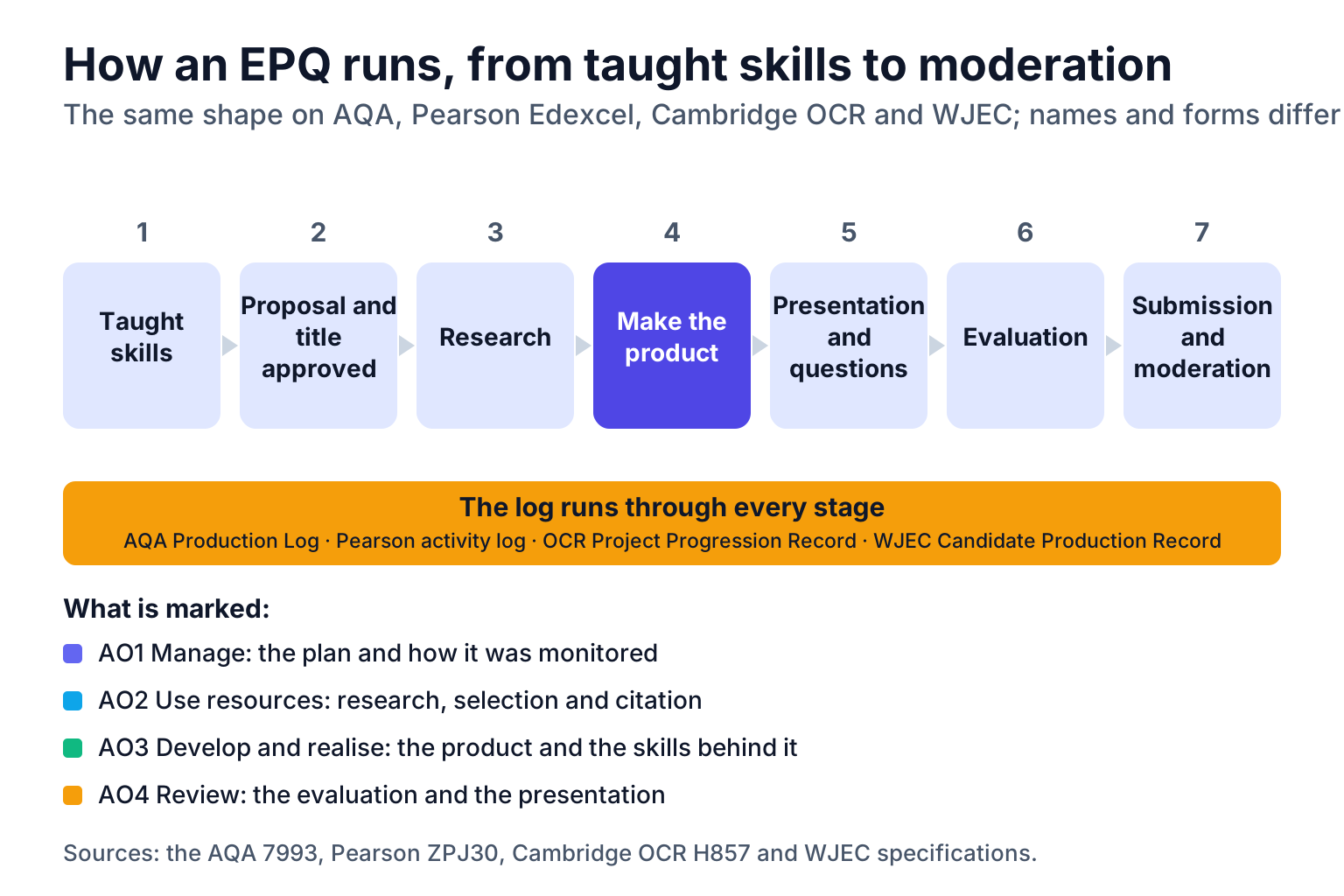
The deadlines you work to are set by your centre, which schedules the project around the board's submission dates for the series it enters you for. What every board does share is a common sequence of phases, and understanding that sequence helps you spot where time actually gets spent.
Phase 1: Taught skills. Before any research begins, you complete a skills element covering topics such as research methods, referencing, and presentation technique. AQA's specification plans for approximately 30 guided learning hours here; WJEC recommends around 45. That gap matters: if you are on a WJEC centre, expect a noticeably longer taught phase before you are let loose on your own topic.
Phase 2: Choosing a topic and drafting a title. You identify an area of interest and work up a specific title. Under OCR's rules, centres must not suggest titles or themes to you; the idea has to come from you. Under Pearson's process, you do some initial reading first and then complete a Project Proposal form setting out your objectives, the reasons for the project, its planned stages, timescales, and the resources you will need.
Phase 3: Formal title approval. Your centre signs off the title (on OCR, the Verification of Topic and Title form stays with the centre and is never sent to OCR). On AQA, the proposal and approval are recorded in the Production Log and Assessment Record, and all substantive advice your supervisor gives must be recorded there by you and confirmed by the supervisor.
Phase 4: Research and production. The largest phase. You gather sources, develop your argument or make your artefact or rehearse your performance, and keep your log current throughout. AQA requires the Production Log and Assessment Record to document initial plans, research records, advice received, and any changes to the plan with reasons. Regular supervisor meetings punctuate this phase; recording what was said at each one is not optional.
Phase 5: Completing the product. You finish the dissertation, investigation report, artefact, or performance and write any accompanying written report required for a non-written outcome.
Phase 6: Presentation. You deliver a presentation, including a question-and-answer session; AQA and WJEC specify a non-specialist audience. WJEC's student guide suggests around 20 to 30 minutes including questions; AQA permits flipcharts, posters, Prezi, PowerPoint, or short video excerpts.
Phase 7: Submission. Your log and product go forward for internal assessment, then to the board for moderation. Your centre sets the exact date.
The practical gotcha: most of the marks for planning and management are earned in phases 2 to 4, not at the end. A log that looks thin at submission cannot be retrospectively filled in without it being obvious.
8. Is the EPQ Worth It?
The honest answer depends on what your sixth form demands of your time and what you want from an application. The extended project qualification is optional, entry to it is decided by your school or college rather than the exam board, and it is typically taken alongside three A-levels. Whether it earns its place in your schedule comes down to three things: skills, university recognition, and the cost in hours.
What the boards say it develops
Every board frames the EPQ around the same four aims: independent research, planning, evaluation, and presenting evidenced conclusions to an audience. These are not skills that exam scripts demonstrate easily. A student who has planned a project from blank page to presentation has concrete material to write about in a UCAS personal statement, rather than restating grades that are already visible in the application.
How universities treat it
AQA states that "many universities make lower A-level offers to students undertaking an EPQ." The WJEC student guide names two specific examples: Newcastle University notes that an EPQ offer "may be varied as a result, in recognition of the level of study skills you will have developed," and UCL accepts a pass in the EPQ as an alternative to a pass in a fourth AS level for students presenting A-levels.
That said, UCAS is clear that a qualification appearing on the Tariff does not guarantee it will count towards entry requirements for a specific course, even at providers that use the Tariff system. Always confirm with the individual university and course before treating an EPQ grade as a fallback.
The real cost
The qualification requires 120 guided learning hours in total. The taught element alone runs to approximately 30 hours on AQA or around 45 hours on WJEC, on top of independent research, production, and a presentation with questions (WJEC's student guide suggests around 20 to 30 minutes; Pearson's student guidance says no more than 10; AQA sets no length). Running that alongside A-level coursework and exam revision is manageable, but not trivial.
One counter-intuitive point: the taught phase is fixed overhead regardless of how ambitious your project is. A straightforward dissertation and a complex artefact both consume those early hours on planning and research skills before the actual project work begins.
The bottom line: if your school offers it, you have a genuine area of interest to explore, and the 120 hours are realistic alongside your other commitments, the EPQ gives your application something examinable results cannot.
9. What to Do Next
The most important variable in starting an extended project qualification is one most students overlook: your school's exam board. AQA, Pearson Edexcel, Cambridge OCR, and WJEC each use a different log name, mark scheme, and total mark tally. None of that is interchangeable. Until you know which board your centre is registered with, you cannot open the right log, follow the right mark scheme, or meet the right internal deadlines.
This week, ask your sixth-form subject leader or head of year two things: which exam board your school uses for the EPQ, and when the next cohort enrols. Enrolment determines your log, your title-approval window, and every internal deadline that follows. Contact that person before the end of this week.
FAQ
What is the Extended Project Qualification (EPQ)?
The EPQ is a Level 3 standalone qualification in which a student independently plans, researches, produces and presents a project on a topic of their own choosing; it is worth half an A-level and carries up to 28 UCAS Tariff points, graded A* to E.
Is the EPQ equivalent to an A-level?
No - AQA describes the EPQ as 'worth half an A-level (28 UCAS points)': it is half the size of an A-level, and its UCAS Tariff points are scaled to match, with a maximum of 28 at A*.
How many UCAS points is the EPQ worth?
The EPQ carries A* 28, A 24, B 20, C 16, D 12, E 8 UCAS Tariff points - the same ladder applies on AQA, Pearson Edexcel, OCR, and WJEC, though not every university course counts these points in its entry requirements.
Is the EPQ mandatory?
No - the EPQ is an optional qualification typically taken alongside three A-levels; schools or colleges decide whether to offer it and who may enrol.
How long does the EPQ take to complete?
The EPQ requires 120 guided learning hours in total across all four boards, of which roughly 30-45 hours is a taught skills element; the remainder is independent research, production, and presentation.
Do universities accept the EPQ?
Some universities make alternative offers that include an EPQ grade in recognition of the independent study skills it develops - for example, WJEC's student guide cites Newcastle University as adjusting offers and UCL as accepting an EPQ pass in place of a fourth AS level - but students should confirm directly with each university whether an EPQ offer is available for their specific course.
References
- Level Three Projects 7993 | Specification | AQA - https://www.aqa.org.uk/subjects/projects/level-three/projects-7993
- Cambridge OCR Level 3 Extended Project Qualification H857 Specification v2.2 (October 2026) - Assessment, PPR, marking criteria bands, overlap with other qualifications - https://www.ocr.org.uk/Images/414382-specification.pdf
- WJEC Extended Project Qualification Student Guide 2021 - https://www.eduqas.co.uk/media/1tzjusk5/epq-student-guide-2021.pdf
- UCAS Tariff Points - what are they and how do they work? - https://www.ucas.com/undergraduate/applying-university/entry-requirements/ucas-tariff-points
- AQA Level 3 Extended Project Qualification (7993) Specification v1.4 - 2.5.1 Assessment evidence and project product - https://filestore.aqa.org.uk/subjects/AQA-W-7993-SP-19.PDF
- Guidance for students | Pearson qualifications - https://qualifications.pearson.com/en/qualifications/edexcel-project-qualification/level-3/student-support/guidance-for-students.html