How to Get a 7 in IB Business Management
By Michael Thompson · Education Specialist; 10 years teaching the IB at Bromsgrove School · Published 4 September 2026 · Updated 4 October 2026
Getting a 7 in IB Business Management is achievable, but it requires more than content knowledge - it demands precision in how you apply that knowledge under exam conditions. The subject sits in Group 3 (Individuals and Societies) and is offered at both Standard Level and Higher Level, with different paper structures and mark thresholds at each tier. The gap between a 6 and a 7 almost always comes down to command-term accuracy, structured argumentation, and an Internal Assessment that is properly scoped. This guide breaks down the assessment model, the habits that cost marks, and a revision structure you can start using this week.
Key Takeaways
- Grade boundaries shift every session, so your target should be consistent performance across all components, not chasing a fixed raw mark.
- Command terms are the examiner's instructions: using 'examine' or 'evaluate' correctly - rather than just describing - is what separates a 6-level answer from a 7.
- The Internal Assessment contributes 30% (SL) or 20% (HL) of your final grade, making it one of the most valuable places to recover marks before the exam season.
- Paper 2 rewards structured tool application: knowing when to deploy SWOT, Ansoff, or force-field analysis - and when not to - is a core exam skill.
- Past-paper practice by topic beats full-paper marathon sessions: targeted question drilling in the last twelve weeks builds the fluency that broad reading alone cannot.
- The five most common mark-losing habits are all fixable: identifying which ones apply to you, and correcting them early, is the most efficient use of revision time.
In This Article
- What a 7 in IB Business Management Actually Requires
- Command Terms and Question Types: the 6-to-7 Gap
- IB Business Management Paper 2: Structure and Tips
- IB Business Management Internal Assessment: Criteria, Word Count, and Where Marks Are Lost
- A Realistic Two-Year Revision Structure
- The Five Most Common Mark-Losing Habits - and How to Fix Them
- What to Do Next
1. What a 7 in IB Business Management Actually Requires
Knowing how to get a 7 in IB Business Management means understanding exactly what the IB is measuring and how each component feeds into your final grade. The subject is assessed across two or three papers plus an Internal Assessment, and the split varies depending on your level.
At Standard Level, the assessment breaks down as: Paper 1 (35%), Paper 2 (35%), and the Internal Assessment (30%). At Higher Level, a third paper is added and the weighting shifts: Paper 1 (25%), Paper 2 (30%), Paper 3 (25%), and the Internal Assessment (20%).
The one thing most students misread is the grade boundary system. The IB does not publish fixed raw-mark thresholds in advance. Boundaries are set after each examination session through a standardisation process, meaning the mark needed for a 7 changes from May to November. Historical data and published examiners' reports give a rough sense of the range, but no source can guarantee a specific cut-off ahead of results day.
On the IB's 1-7 scale, a grade 7 in Business Management is defined by descriptors that require a student to demonstrate thorough understanding of the subject and to consistently apply relevant business management tools to unfamiliar contexts. The key word is "consistently" - a handful of strong paragraphs scattered across an exam script is not enough.
HL candidates face an additional demand that SL students do not: Paper 3 is based on an unseen case study about a social enterprise, requiring both strategic analysis and extended written argument. HL grade boundaries are set independently from SL boundaries, so the two cohorts are not competing against each other.
2. Command Terms and Question Types: the 6-to-7 Gap
The IB uses command terms to signal exactly how much cognitive work a question demands. In Business Management, lower-order terms - define, state, identify, outline - appear in short-answer questions worth one to four marks. Higher-order terms - examine, evaluate, discuss, justify, to what extent - dominate the extended-response questions that carry eight, ten, or more marks. Those extended questions are where the gap between a 6 and a 7 is decided.
The command term is the marking instruction. Misread it and even a technically accurate response lands in the wrong mark band.
What the gap looks like in practice
Consider this question: "Examine one reason why a business might adopt a price-skimming strategy."
6-level response (illustrative example): "Price skimming involves setting a high initial price to maximise revenue from early adopters before lowering the price over time. A business might use this to recover research and development costs quickly."
That answer is correct. It is also thin. It describes the strategy without examining the reasoning in context.
7-level response (illustrative example): "Price skimming allows a business launching a genuinely novel product, where no close substitutes exist, to extract maximum willingness to pay from early adopters before competitors enter the market. This works only where the product has sufficient perceived differentiation; a business in a commoditised segment would see customers switch immediately, making the strategy self-defeating. The strategy is therefore most defensible in high-barrier, innovation-led industries."
The 7-level response applies the concept to a condition, tests a limiting case, and links the reasoning back to the question.
The judgement problem on 'evaluate' and 'to what extent' questions
A specific and common cap on the 6 band: students write two balanced sides and then stop. The IB mark scheme for these higher-order questions awards the top descriptors only when the response includes a substantiated final judgement. "Both strategies have advantages and disadvantages" is not a judgement. "Strategy A is preferable for a cash-constrained SME, because its payback period is shorter and the risk of long-term commitment is lower, though Strategy B becomes superior if the firm can secure external financing" is.
Practical approach
- Before writing anything, annotate the command term on your past-paper question and write a one-sentence conclusion or judgement at the top of your rough notes.
- Build your argument toward that conclusion rather than discovering it at the end.
- For "examine" questions, ask: what is the condition under which this point holds, and what would break it?
The non-obvious gotcha: "discuss" questions in Business Management are not invitations to be neutral. The highest mark-band descriptors still reward a reasoned position. Students who interpret "discuss" as "describe both sides equally" consistently miss the top descriptor.
3. IB Business Management Paper 2: Structure and Tips
Paper 2 presents unseen stimulus material, typically a short case study about a real or fictional business, and asks you to apply business management tools and concepts directly to it. At HL, Paper 3 works differently: it is built around unseen material about a social enterprise, and its questions require deeper strategic analysis of that specific organisation. The pre-released case study belongs to Paper 1, which both SL and HL sit.
The most common Paper 2 mistake is tool-dumping. A SWOT analysis that lists four generic strengths with no reference to the figures, quotes, or context in the stimulus earns little credit. Examiners are not checking whether you know what a SWOT is. They are checking whether the tool actually answers the question in front of you. If the question asks you to evaluate a proposed expansion, a PESTLE analysis anchored to two or three specific details from the stimulus will outperform a comprehensive but floating SWOT every time.
Before you write anything
- Read the entire stimulus and annotate it: circle data, underline tensions, note which of the five units each detail belongs to.
- For each question, identify the command term and mark allocation before committing to a structure. A "describe" (2 marks) needs two clear points; an "evaluate" (10 marks) needs a mini-thesis, balanced evidence from the stimulus, and a justified conclusion.
- Map your time: roughly one minute per mark is a workable rule, leaving ten minutes to annotate at the start.
Unit coverage is a direct exam risk
The IB Business Management specification spans five units: Introduction to Business Management, Human Resource Management, Finance and Accounts, Marketing, and Operations Management. Paper 2 can draw questions from any of them. A gap in Finance and Accounts is not a calculated risk; it is a guaranteed problem if ratio analysis or break-even appears on the paper.
Open every extended response with a single mini-thesis sentence that signals your line of argument, then alternate between evidence pulled from the stimulus and the conceptual explanation that makes sense of it. That rhythm is what distinguishes a 6 from a 7.
4. IB Business Management Internal Assessment: Criteria, Word Count, and Where Marks Are Lost
The Internal Assessment is a business research project with a hard word count of 1,800 words for both SL and HL; SL and HL students do the same task. The limit is absolute: examiners stop reading at the cap, so any analysis you write beyond it earns no marks.
The assessment criteria
The IA is marked out of 25 against these seven criteria (marks in brackets):
- Integration of a key concept (5) - one of change, creativity, ethics or sustainability, used as the lens for the whole project
- Supporting documents (4) - three to five, from which most of your information is drawn
- Selection and application of tools and theories (4) - appropriate choices, applied to your organisation's own data
- Analysis and evaluation (5) - depth of reasoning, not breadth of content
- Conclusions (3) - directly answering the research question with supported judgement
- Structure (2) - a logical flow from introduction to conclusion
- Presentation (2) - title page, accurate contents page, headings and numbered pages
Where marks most commonly go missing
- Too broad a research question. A question like "How successful is Company X?" invites description. Frame it around a specific decision instead: "Should [business name] expand into the premium segment by [date]?" This structure forces you to weigh options and reach a judgement.
- Tool application that describes rather than analyses. Drawing a SWOT matrix and listing points earns limited marks. Linking each point to the decision and to supporting primary data is what lifts the score.
- A conclusion that doesn't close the loop. If your research question asks whether to expand, your conclusion must answer yes or no, with conditions. Restating findings without a verdict loses evaluation marks.
- Exceeding the word count. Any content past the limit is invisible to the examiner.
- Weak primary data. Poorly designed surveys or a single interview with no clear methodology undermine the findings section regardless of how well you write around them.
The counter-intuitive gotcha: students often assume longer interviews or more questionnaire respondents automatically strengthen the IA. Examiner feedback consistently points to quality of analysis, not volume of data, as the differentiator.
The IB runs a dedicated Category 3 professional development workshop titled "A focus on internal assessment", aimed at educators with substantial IB experience, specifically to help teachers develop and adapt IA tasks. The fact that this workshop exists for experienced practitioners signals how technically demanding the component is, even for teachers who have marked it many times.
5. A Realistic Two-Year Revision Structure
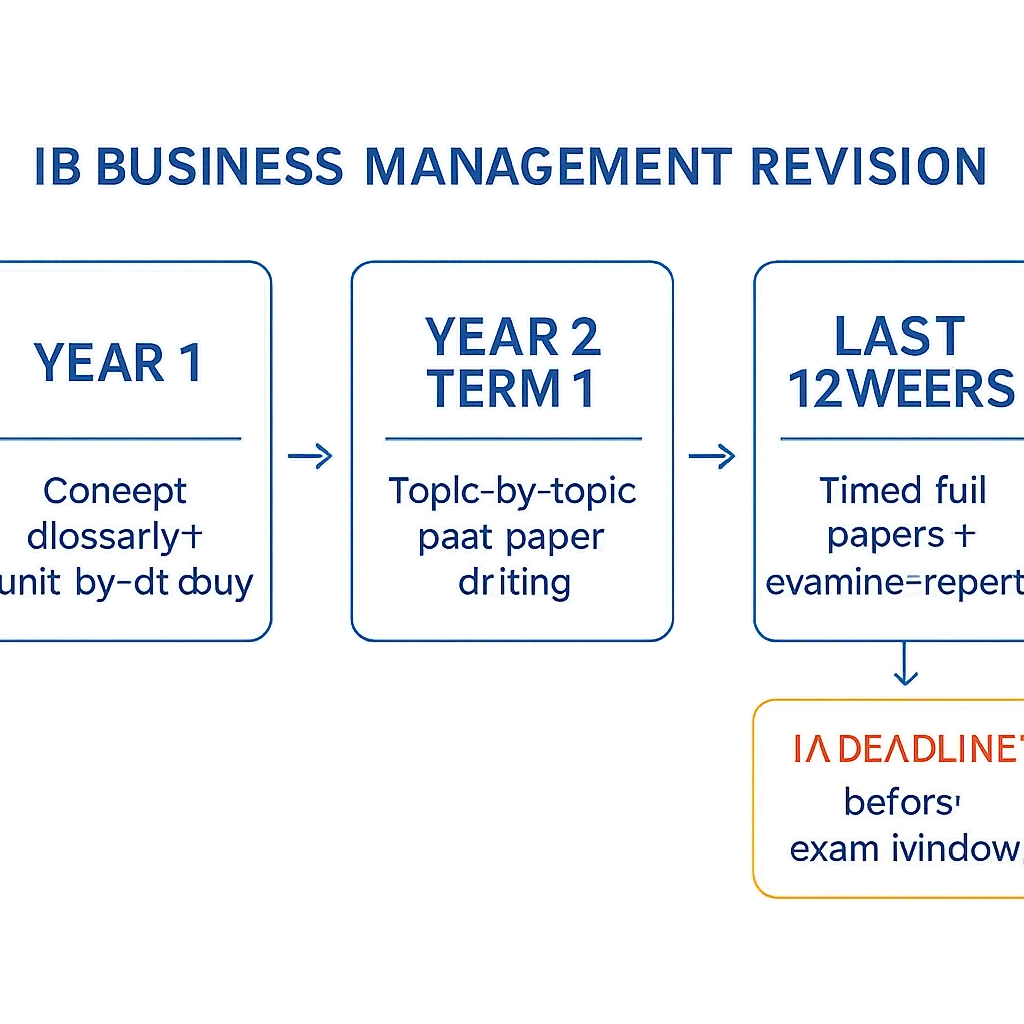
Most students treat Business Management revision as a Year 2 problem. By the time they start, half the Year 1 content is faint memory and the IA is eating into exam prep time. The fix is to treat the two years as distinct phases with different goals.
Year 1: build and record
As each unit is taught, build a running concept glossary. This is not a full set of notes - it is a tightly formatted record of definitions, formulas, and worked numerical examples for quantitative content (break-even output, contribution per unit, current ratio, gross profit margin). The counter-intuitive point: writing the glossary entry the week a topic is taught takes ten minutes; reconstructing it from memory in Year 2 takes much longer and is less accurate.
Year 2, first term: topic-focused past-paper practice
Shift away from reading notes. Instead, take one question type per week - for example, every "evaluate" question on motivation theory from the last five exam sessions - write a timed response, then mark it against the mark-band descriptors before looking at any model answer. This forces you to identify which criterion you are not hitting, rather than passively comparing your answer to someone else's.
Last twelve weeks: full-paper conditions
Run two full timed sittings per month. After each sitting, review it against examiners' reports (available through MyIB and the IB store). These reports name the specific errors markers see most often and are far more diagnostic than a generic mark scheme.
IA timeline: front-load it
Finalise your research question by the end of Year 1. Primary data collection then happens early in Year 2, and writing is complete before the exam revision window opens. Students who leave primary research until Term 2 of Year 2 consistently find that IA drafting and Paper 1 preparation collide.
6. The Five Most Common Mark-Losing Habits - and How to Fix Them
Most mark losses at the 5-to-6 boundary are not caused by gaps in content knowledge. They come from a small set of repeating habits that examiners flag consistently.
Habit 1: Describing instead of analysing. Students state what a concept means and then move on. After every factual claim, ask "so what does this mean for the specific business in the question?" That one prompt forces the analytical step that moves a response into the upper mark bands.
Habit 2: Ignoring the stimulus. A generic answer built on theory alone sits in the lower mark bands almost by definition in Paper 2. Before writing, underline three to five specific details in the case and commit to using at least two in each extended response. The case data is not background reading - it is the answer material.
Habit 3: Missing the judgement in evaluate and discuss questions. Students present a balanced argument and then stop. The counter-intuitive fix: write the final judgement sentence before you write the body. It acts as a compass and prevents the response from drifting into an unsupported list of pros and cons.
Habit 4: Poor time allocation. Dividing total exam time by total available marks gives a per-mark minute rate. Apply this calculation before the exam, not during it. Low-mark questions are the budget killers.
Habit 5: Generic tool application in the IA. A SWOT or PEST built from general industry knowledge rather than evidence specific to the business will not satisfy the IB Business Management internal assessment criteria. Every bullet point in a business tool should trace back to a source, a data set, or a finding from the student's own primary or secondary research.
7. What to Do Next
The most direct thing you can do this week costs no money and takes under two hours. Locate the most recent IB Business Management examiners' report for your exam session through your school's MyIB access or the IB store at store.ibo.org. Read the examiner commentary specifically for the question types you find hardest, whether that is extended response or data-response.
A non-obvious detail worth knowing: examiners frequently flag the same two or three errors across consecutive sessions, which means the commentary from last year's report almost always predicts what will cost you marks this year.
Note the two most frequent criticisms. Then write one timed practice response built around each criticism before your next class. That is the difference between knowing what a 7 requires and actually producing work at that level. Download the report this week and start with the question type that worries you most.
FAQ
How hard is it to get a 7 in IB Business Management?
A 7 is achievable but requires consistent performance across all components - papers and IA - particularly on higher-order command-term questions where analytical judgement, not just content knowledge, is assessed.
What is a 7 in IB grading?
The IB uses a 1-7 scale; a 7 is the highest grade and corresponds to the IB's descriptor of 'thorough understanding' and consistent, accurate application of subject-specific tools and concepts.
What are the IB Business Management HL grade boundaries?
Grade boundaries are set after each exam session by IB examiners and are not published in advance; they shift depending on overall cohort performance, so no fixed raw-mark threshold can be guaranteed.
How does the IB Business Management Internal Assessment affect my final grade?
The IA contributes 30% of the final grade at SL and 20% at HL, making it one of the highest-value components - especially because it is completed before the exam window and can be refined with teacher feedback.
What is the word count for the IB Business Management Internal Assessment?
The IA is a business research project with a hard limit of 1,800 words at both SL and HL, and examiners stop reading at the word limit.
How should I prepare for IB Business Management Paper 2?
Practise applying business management tools directly to unseen stimulus material, annotate each question's command term before writing, and ensure every extended response opens with a clear analytical claim rather than a description of theory.
References
- DP Subject: Individuals and Societies - 2025-2026 Catalogue - https://catalogue.ibo.org/en/professional-development/dp-subject-individuals-and-societies